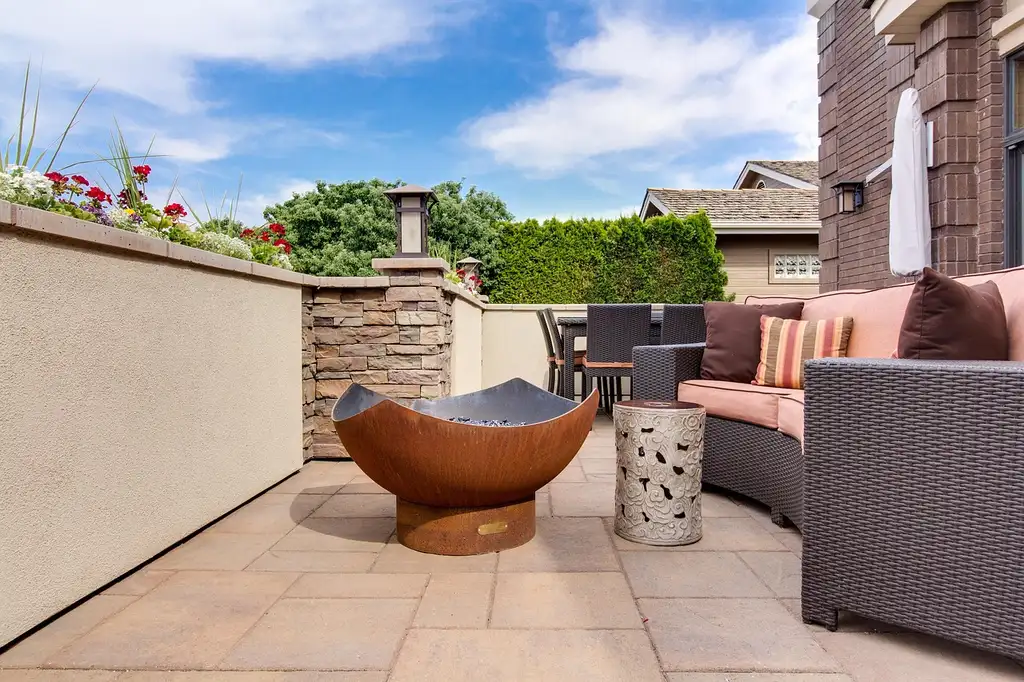
Outdoor heater vs indoor heater: Key differences explained
Indoor heaters belong in enclosed rooms with the right ventilation. Outdoor heaters belong in open or drafty spots, where air moves and weather hits the unit. Use the wrong one, and you can end up with carbon monoxide risk, clearance failures, or heat that burns fuel without warming you. This guide compares room type, airflow, weather exposure, and fuel, so you can pick the safe heater for the space.
| Decision factor | Outdoor heater | Indoor heater: What’s the difference? | Winner |
|---|---|---|---|
| Best space type | Open-air, patio, screened, or wind-exposed areas | Bedrooms, living rooms, workshops, and other enclosed rooms | Tie |
| Ventilation burden | Lower concern outdoors, but still needs safe placement and airflow | Must match vented or ventless design to the room and exhaust needs | Indoor heater: What’s the difference? |
| Weather exposure | Built for moisture, wind, and open edges | Not built for rain, gusts, or wide temperature swings | Outdoor heater |
| Heat delivery indoors | Often radiant or infrared, aimed at people and objects | Can use radiant, convection, or forced-air delivery | Indoor heater: What’s the difference? |
| Fuel flexibility | Commonly propane, electricity, or natural gas | Gas, oil, wood, electricity, and pellet-based systems | Indoor heater: What’s the difference? |
| Installation complexity | Placement, tip-over resistance, and overhead clearance matter most | Clearance rating, exhaust path, ceiling height, and combustion air matter most | Tie |
What actually separates indoor heaters and outdoor heaters?
The main split is usually whether heat and exhaust can be managed safely in the space. Indoor heaters are made for enclosed spaces with controlled airflow, while outdoor heaters are made for open or partly open areas where wind and weather change how they run.
That gap matters more than the fuel name on the box. I have seen propane units used both ways, and the safe answer depended on venting, oxygen needs, and the rating. Same fuel. Different job.
How rating labels map to real use
The rating label tells you more than the cabinet shape does. A vented heater needs an exhaust path, which lowers indoor combustion risk, and it is often used in fixed indoor installs. A ventless heater has no flue or chimney, so it can place more demand on indoor air quality, moisture control, and oxygen-depletion safety.
For outdoor use, the label should also cover weather exposure, tip-over risk, and overhead use. A heater that works on a patio can be a bad fit under a roof if its clearance rating does not match the space.
Why the same fuel can be safe in one setting and wrong in another
Fuel type matters, but room type matters more. Propane, natural gas, electricity, oil, wood, and pellet systems all show up in heater categories, yet safe use depends on whether the heat stays in a room or escapes into open air.
That is why “indoor” and “outdoor” labels are not decoration. They tell you how the heater handles exhaust, oxygen, wind, and nearby combustibles.
📊 Water heaters typically never heat above 140°F. Source: Boiler vs. Water Heater: What’s the Difference?.
How heat delivery changes by space type
Radiant heat works well when air moves or the space leaks. It warms people and objects directly, which is why it appears in outdoor heaters and some indoor setups. Forced-air systems fit best when the goal is to warm a closed room evenly through moving air.
Radiant heat for people and objects in drafty spaces
Radiant heaters do not need to warm every bit of air before you feel heat. That makes them useful on patios, in garages, and in other spaces where leaks or wind would strip warm air away fast.
The tradeoff is the smaller working zone. Distance and angle matter more than they do with a whole-room forced-air unit.
Forced-air systems for enclosed interiors
Forced-air systems move heated air with fans or ducts, which suits enclosed rooms. They work best when the room holds air well and the heater can circulate heat without fighting outside wind.
That is why many homeowners pick forced-air furnaces, unit heaters, or similar indoor systems in living rooms and workshops. The room itself helps carry the load.
Vented and ventless heaters in practice
A vented heater sends exhaust outdoors through a flue or chimney. That setup matters in fixed indoor installs, especially where combustion products should not stay in the room.
Ventless heaters skip the flue, which makes installation simpler, but they demand more attention to moisture, indoor air quality, and oxygen depletion. Use them only where the rating and room conditions match the maker’s rules.
Fuel type and heat output: what changes indoors vs outdoors
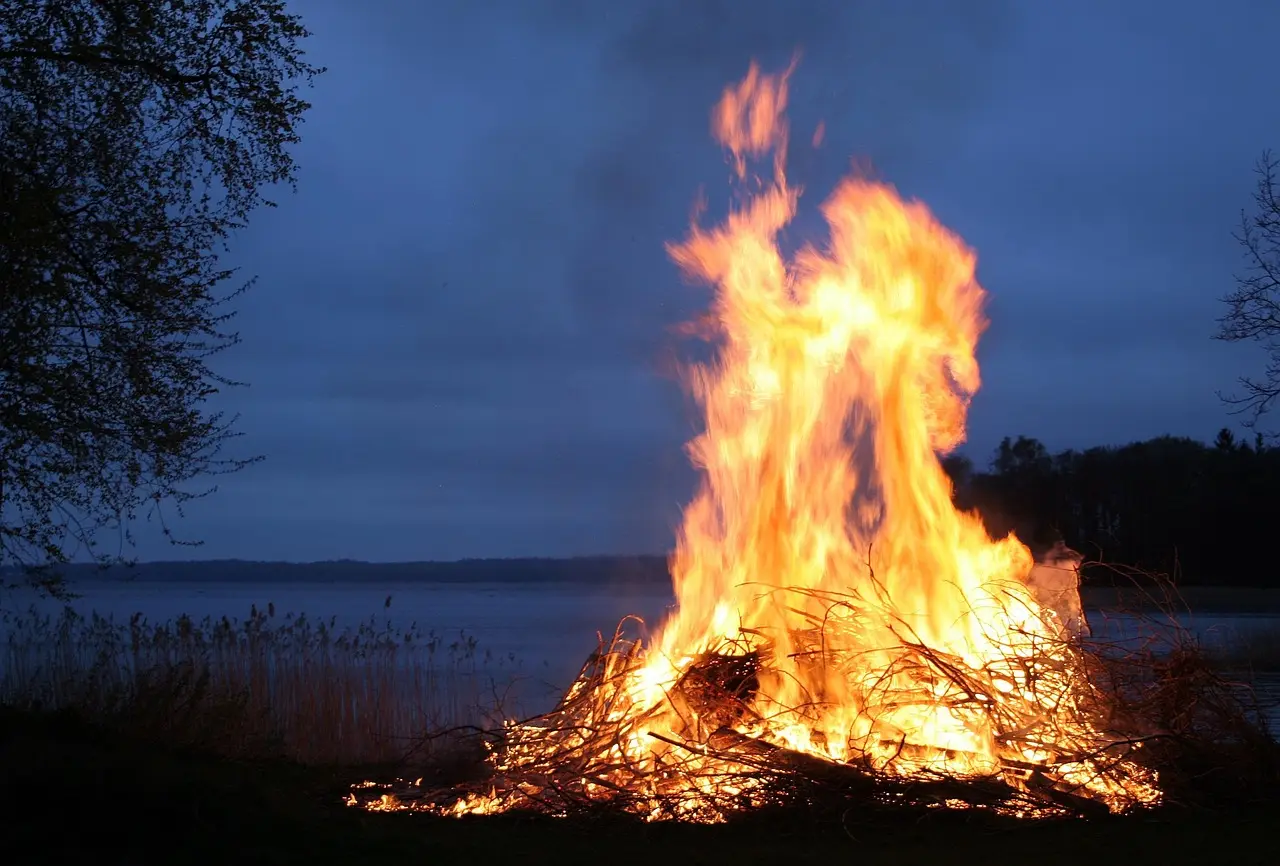
Indoor heaters commonly use gas, oil, wood, electricity, or pellet fuel in some systems. Outdoor heaters more often use propane, electricity, natural gas, or infrared formats built to handle exposure and direct heat where people sit.
Heat output has to fit the space, and outdoor spaces need more because wind steals heat quickly. A heater that works in a closed room may feel weak on a patio or screened porch, even if fuel use looks similar on paper.
What fuels show up indoors
Boilers use fuel to heat water and make steam or hot water, and boilers move heat through pipes and radiators to warm a home. Combination boilers can heat home water and faucet water in one unit.
Water heaters are different. They are made for showers, dishes, and laundry hot water; tank water heaters store hot water in an insulated tank, and tankless water heaters heat water on demand. Water heaters are usually powered by natural gas or electricity, and they are not the same thing as a room heater.
What fuels show up outdoors
Outdoor heaters often use propane, electric, infrared, or natural gas formats. They are usually built for open air, where heat moves away fast and placement matters more than trying to warm the whole space.
That is also why outdoor heaters are often judged by direction and coverage, not just by raw output. A focused radiant head can feel stronger than a larger unit throwing heat into the wind.
Why wind changes output needs
Wind is the outdoor heater’s biggest problem. It strips away the warm layer near your body and makes the heater work harder just to keep you comfortable.
That means output has to rise as exposure rises. A covered porch may need less than a fully open patio, but both need more than an interior room of the same size.
Safety and installation rules that change the answer
Clearance rating is not optional. It is the minimum distance from combustibles, and it is set by the maker. Indoor and outdoor heaters both need that number followed, along with rules for wall distance, overhead use, and ceiling height.
Clearance rating and combustible surfaces
Combustibles include curtains, furniture, stored boxes, rafters, and anything else that can dry out or ignite near heat. A heater that fits the room shape can still be wrong if the clearance zone is too tight.
That is why the install page matters as much as the product page. A heater that looks safe on paper can be the wrong one when it sits too close to wood, fabric, or a low ceiling.
Ventilation, exhaust path, and combustion air
Indoor combustion heaters need a plan for exhaust and combustion air. Without that plan, combustion products can build up and oxygen can drop, especially in small or tightly sealed rooms.
Outdoors, the concern changes. You still need air movement and safe spacing, but you are not managing the same closed-room exhaust load.
Ceiling height, wall distance, overhead use, and tip-over risk
Ceiling height matters because many heaters throw heat upward as well as outward. Wall distance matters because radiant surfaces and hot shells can overheat nearby finishes.
For outdoor heaters, tip-over risk becomes a bigger issue. That is especially true for patio and portable units set on uneven ground or in foot traffic paths.
Side-by-side selection matrix for six real-world spaces
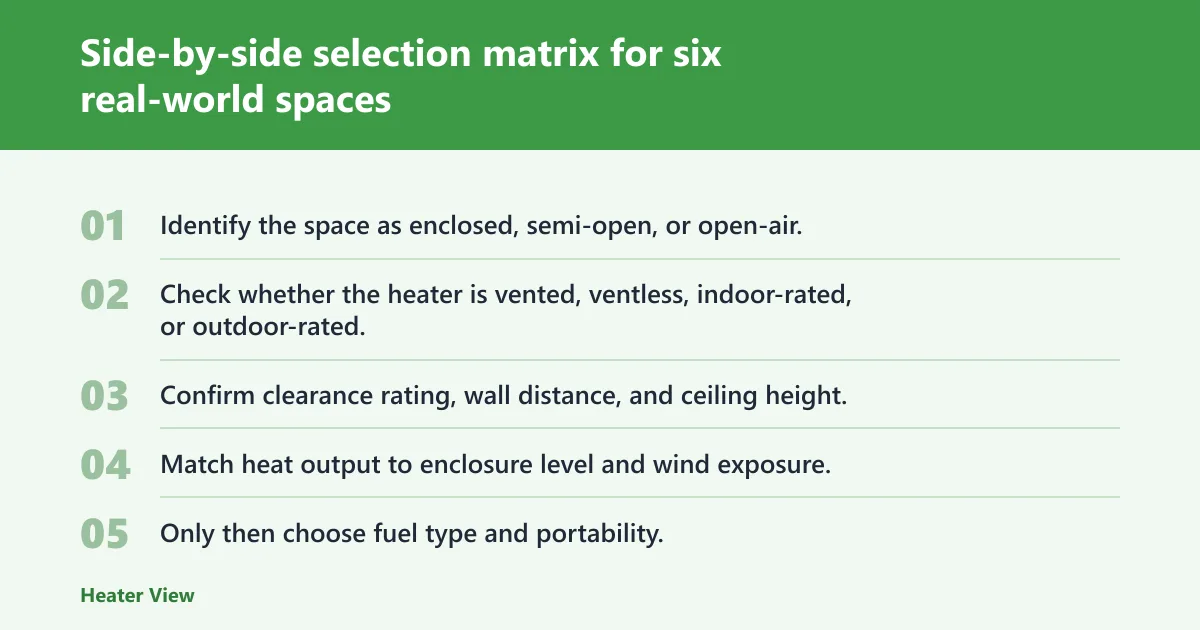
This matrix starts with the space, not the product label. That is the cleaner way to choose. The right answer changes when the room is sealed, partly open, windy, or full of stored combustibles.
| Space | Recommended heater type | Required ventilation | Top safety check |
|---|---|---|---|
| Bedroom | Indoor electric or vented indoor system | Follow room rating and exhaust rules if combustion is involved | Keep clearance from bedding, curtains, and clothing |
| Living room | Indoor convection or forced-air heater | Normal room ventilation; vented model if fuel combustion is present | Confirm clearance from furniture and wall surfaces |
| Garage | Indoor-rated unit heater or vented heater | Needs combustion-air and exhaust planning if not electric | Watch stored gasoline, solvents, and low ceiling height |
| Screened porch | Outdoor or semi-outdoor radiant heater | Open-air flow; do not treat it like a sealed room | Check overhead clearance and wind exposure |
| Patio | Outdoor patio heater or infrared outdoor heater | Not a closed-room setup; keep sides open | Check tip-over stability and wind performance |
| Workshop | Indoor forced-air or vented heater | Use the heater type that matches dust, fumes, and exhaust needs | Keep away from sawdust, solvents, and stacked materials |
For bedrooms and living rooms, the big issue is indoor air and clearance. For garages and workshops, the challenge is heat plus combustible storage, dust, and the urge to use a portable unit that was never meant for a closed work area.
Screened porches and patios sit in the middle. They are not fully indoors, but they are not fully exposed either, which is why outdoor-rated radiant heaters usually fit better than indoor heaters with open combustion assumptions.
- Identify the space as enclosed, semi-open, or open-air.
- Check whether the heater is vented, ventless, indoor-rated, or outdoor-rated.
- Confirm clearance rating, wall distance, and ceiling height.
- Match heat output to enclosure level and wind exposure.
- Only then choose fuel type and portability.
Can an outdoor heater be used inside the house?
No, not unless the heater is specifically rated for indoor use and installed to that standard. An outdoor heater can create carbon monoxide, excess moisture, or heat-clearance violations in a closed room, and those risks rise fast when ventilation is poor.
The rating label matters more than the fuel in this case. A propane heater built for a patio is not a safe indoor substitute just because it makes heat.
What can go wrong in a closed room
A closed room can trap combustion products and heat. That can lead to air-quality problems, oxygen-depletion risk, and overheating of nearby materials.
Even if the heater seems to run normally, the room can still be unsafe. A heater is not safe indoors just because it lights and stays on.
Safer alternatives for indoor spaces
For enclosed rooms, choose an indoor-rated electric heater or a properly vented heating system. If the room needs a fixed solution, a vented model is the safer long-term choice because it gives exhaust a path out of the building.
For temporary heat in a bedroom, living room, or office, an electric unit with the right clearance and tip-over protection is usually the cleaner fit.
Choose indoor heater if… / choose outdoor heater if…
Choose the heater that fits the space first. If the room is enclosed, the ceiling is low, or combustibles sit close to the heat source, an indoor-rated unit is the safer starting point. If the space is open, windy, or only partly covered, an outdoor-rated heater is the better match.
Choose indoor heater if…
Choose indoor heater if the space is fully enclosed, such as a bedroom, living room, or workshop with controlled airflow. Choose indoor heater if you need vented exhaust, forced-air circulation, or a system tied to the home’s heating layout.
Choose indoor heater if you can meet clearance ratings and you do not want weather exposure to change performance. If combustion is involved, the room also needs the right ventilation and combustion air.
Choose outdoor heater if…
Choose outdoor heater if you are heating open air, a patio, a screened porch, or another space where wind and leakage are part of the job. Choose outdoor heater if you want radiant heat that targets people directly instead of trying to warm all the air around them.
Choose outdoor heater if the unit can handle tip-over risk, overhead limits, and moisture exposure. If the space is only semi-open, use the outdoor rating as the deciding factor, not the room label.
Choose neither until the rating matches the room
If the heater’s rating does not match the room, stop there. A label mismatch can turn a good product into a bad install fast.
That is the simplest rule in this whole comparison: space type, ventilation, clearance, and exposure decide the heater, not the other way around.
What type of heater is safest for indoor use?
A safer indoor choice is often an indoor-rated electric heater, or a properly vented system when combustion heat is needed. Electric units avoid indoor combustion products, while vented systems send exhaust out of the living space.
Ventless heaters can work in some settings, but they need close attention to moisture, oxygen, and room size. The safest pick still depends on the room and the heater’s rating label.
What fuels do indoor heaters use?
Indoor heaters can use gas, oil, wood, electricity, and pellet fuel in some systems. Boilers use fuel to heat water and make steam or hot water, and boilers move heat through pipes and radiators to warm a home. Combination boilers can heat home water and faucet water in one unit.
Water heaters are separate equipment. Water heaters are made for showers, dishes, and laundry hot water, and they are usually powered by natural gas or electricity.
What fuels do outdoor heaters use?
Outdoor heaters commonly use propane, electricity, natural gas, and infrared formats. They may also be built around radiant heat that focuses warmth on people and objects rather than trying to heat all the air around them.
The best fuel is the one that fits the setting, the install path, and the exposure. A patio near a gas line points to one answer. A portable setup on a windy deck points to another.
Do indoor heaters and outdoor heaters need different installation requirements?
Yes. Indoor heaters need attention to exhaust paths, combustion air, clearance ratings, ceiling height, and wall distance. Outdoor heaters need weather-aware placement, tip-over stability, overhead clearance, and enough open space to keep heat away from combustibles.
The install rules differ because the failures differ. Indoors, the hazard is trapped exhaust and not enough air. Outdoors, the hazard is exposure, blow-off, and unsafe closeness to people or materials.
Which heater is better for cold-weather patios?
Outdoor radiant heaters are usually the better fit for cold-weather patios, especially when wind is present. Radiant heat warms people and objects directly, which holds up better than trying to heat all the open air around a patio.
If the patio is partly enclosed, the right answer still depends on whether it is truly outdoor-rated and whether the clearance, overhead use, and wind conditions fit the model. A screened porch often sits near the border, so the rating label should decide.
How do I know if a heater is rated for indoor use?
Check the manufacturer label and the installation instructions, not just the marketing copy. An indoor-rated heater will state its allowed use, venting requirements if any, and the clearances it needs from walls, ceilings, and combustibles.
If the label only mentions patios, decks, or outdoor placement, do not move it inside. When in doubt, treat the heater as outdoor-only until the documentation says otherwise.
What are the main types of indoor heating?
The main types of indoor heating include forced-air systems, radiant heat, convection heaters, boilers, and vented or ventless combustion heaters. Forced-air systems move heated air through fans or ducts, while radiant systems heat objects directly. Convection warms room air, and boilers move heat through water and radiators.
Some homes also use combination boilers for both space heat and home water. Water heaters are separate from space heaters; tank models store hot water in an insulated tank, and tankless models heat water on demand.
Frequently asked questions
What is the difference between an outdoor heater and an indoor heater?
Outdoor heaters are built for open or semi-open spaces where wind, moisture, and exposure are part of the job. Indoor heaters are built for enclosed rooms with ventilation and clearance rules that manage combustion products, oxygen, and nearby combustibles.
Can an outdoor heater be used inside the house?
Usually no. A heater rated only for outdoor use can create carbon monoxide, moisture, or fire-clearance problems in a closed room. Only use a heater indoors if the label and instructions say it is indoor-rated and the install rules can be met.
What fuels do indoor heaters use?
Indoor heaters commonly use gas, oil, wood, electricity, and pellet fuel in some systems. The correct fuel is only part of the decision; venting, combustion air, and clearance ratings matter just as much.
What fuels do outdoor heaters use?
Outdoor heaters often use propane, natural gas, electricity, or infrared formats. These heaters are built to tolerate open-air conditions, but they still need safe spacing, stable placement, and the right overhead clearance.
Do indoor heaters and outdoor heaters need different installation requirements?
Yes. Indoor installations focus on ventilation, exhaust paths, combustion air, and clearance from combustibles. Outdoor installations focus on wind, moisture, tip-over risk, and whether the heater can safely sit under a roof, awning, or ceiling.
Are outdoor heaters more energy efficient than indoor heaters?
Not in a simple, across-the-board way. Outdoor heaters can lose more heat to wind, while indoor heaters can lose less if the room is enclosed and well matched to the output. Efficiency depends on enclosure, exposure, fuel, and how well the heater fits the space.