Old furnace vs new furnace: when should you replace it?
Replace an old furnace when repairs, repeat failures, comfort trouble, or safety flags cost more than keeping it running. Age matters, but it is only one input; the real call is whether the furnace still heats safely and at a sane cost.
Gas furnaces can last many years with proper maintenance, and regular service matters. Lifespan also depends on installation quality and sizing; a poorly installed or incorrectly sized unit can age faster. The serial number or nameplate often reveals the manufacturing date, which helps anchor the decision.
Old furnace vs new furnace: the decision in one sentence
The trade-off in plain terms
An old furnace usually wins on low upfront spending. A new furnace usually wins on lower fuel waste, fewer emergency repairs, and better comfort when the existing unit is struggling.
| Decision factor | Old furnace | new furnace: When should you replace it | Winner |
|---|---|---|---|
| Upfront cost | Usually cheaper if the fix is small | Higher initial spend, with installed costs varying by type | Old furnace |
| Operating cost | Older units often waste more fuel | Modern units can use fuel more efficiently | new furnace: When should you replace it |
| Risk of repeat failure | Rises when parts keep failing | Lower after a proper replacement | new furnace: When should you replace it |
| Safety margin | Can become a concern if warning signs appear | Newer equipment reduces age-related risk when installed correctly | new furnace: When should you replace it |
Upfront cost
Repairing an old furnace is usually the cheaper move when the problem is isolated. Replacement takes a larger check on day one, so a new unit only makes sense when the old one is nearing the end of useful life or is stacking up expensive failures.
Operating cost
Older furnaces often run at a lower AFUE, while modern condensing models run at a higher AFUE. Higher AFUE usually means less fuel waste, which is why a furnace that looks “cheap to keep” can still cost more every month.
Reliability and safety
A furnace that breaks repeatedly is already telling you something. Once repairs start affecting multiple parts, or a cracked heat exchanger enters the picture, replacement becomes a better financial and safety decision than another round of patchwork fixes.
According to What to Know When Replacing a Furnace – Home Comfort Experts — With proper maintenance, a furnace can last 15 to 20 years.
How long a furnace should last
With proper maintenance, a furnace can last 15 to 20 years. Skipped service can shorten that span, and bad installation or the wrong size can shorten it further. Annual service remains one of the easiest ways to keep useful life up.
How to find the age on the serial number or nameplate
The furnace nameplate usually lists the model and serial number. Many manufacturers encode the date in that number, or print a manufacture date directly on the plate. If the code is not obvious, a service technician can decode it during an inspection.
Why maintenance history changes the answer
An older furnace that has been serviced on schedule may be very different from a somewhat younger unit that has never had a tune-up. Maintenance history often explains why one furnace is still stable while another is already on borrowed time.

What is your old furnace costing you now?
The real cost is not the repair bill alone. It is the repair bill plus fuel waste, comfort loss, and the chance that another failure will follow soon after the last one. If those costs are stacking up, replacement starts to look rational before the furnace stops completely.
AFUE: old furnaces vs modern furnaces
AFUE measures how much fuel becomes usable heat. Older furnaces often sit in a lower efficiency range, while condensing gas furnaces are usually much more efficient. That gap matters more in cold climates or homes with long heating seasons.
Repair frequency and the point where fixes stop making sense
Frequent or multiple-part repairs are a warning sign. A repair can range from a small job to a very expensive one, and the upper end is harder to justify when the furnace is already old and another failure may not be far off. A cracked heat exchanger is a major cost driver and a strong replacement trigger.
How utility bills reveal lost efficiency
Rising energy bills without a clear weather explanation often point to a furnace losing efficiency. That does not prove the furnace is the only problem, but it does mean the unit should be checked against airflow, duct losses, thermostat control, and combustion performance before more money goes into repairs.
Which warning signs mean replacement is getting close?
Cold air, uneven heating, rising bills, banging or clanking noises, booming starts, odor changes, and frequent breakdowns are all replacement warnings. One symptom alone may be a simple repair. Several together usually mean the furnace has moved from annoying to uneconomical.
Comfort problems: cold air, uneven heating, weak airflow
Cold spots are listed as a replacement warning sign, but they can also come from duct losses, a weak blower, or thermostat placement. Uneven heating is a reason to inspect the whole system, not just the furnace cabinet, because airflow problems can mimic furnace failure.
Noise and odor changes that signal trouble
Banging, clanking, and booming suggest stress in the burner or blower sequence. Odor changes matter too. A yellow pilot light can indicate incomplete combustion, which means the furnace should be checked rather than ignored.
Frequent breakdowns and repeat service calls
One repair is routine. Two or three in one heating season is a pattern. When the same system keeps failing in different places, replacement usually costs less over the next few years than continuing to fund recurring service calls.
Which symptoms are safety issues, not just wear?
Burning smell, rotten egg smell, gas leak risk, and CO detector alarms are safety problems, not normal age-related wear. Shut the system down if needed and get a professional involved before deciding whether to repair or replace. Safety comes before cost math.
Burning smell, rotten egg smell, and gas leak risk
A burning smell may indicate overheating or dust burn-off at startup, but a persistent odor needs attention. Rotten egg smell is especially serious because it can signal a gas leak. That is not a “wait and see” problem.
CO detector alarms and what to do first
If a carbon monoxide detector alarms, leave the area and follow emergency steps first. Do not keep resetting the furnace to see whether the alarm returns. A combustion problem, venting issue, or cracked heat exchanger can create a life-safety hazard.
Cracked heat exchanger and other serious failures
A cracked heat exchanger is one of the clearest reasons to stop trying to extend the life of an old furnace. Once that part fails, the repair is often expensive and the safety stakes rise sharply. In that case, replacement is usually the practical path.
Old furnace vs new furnace: compare the main options
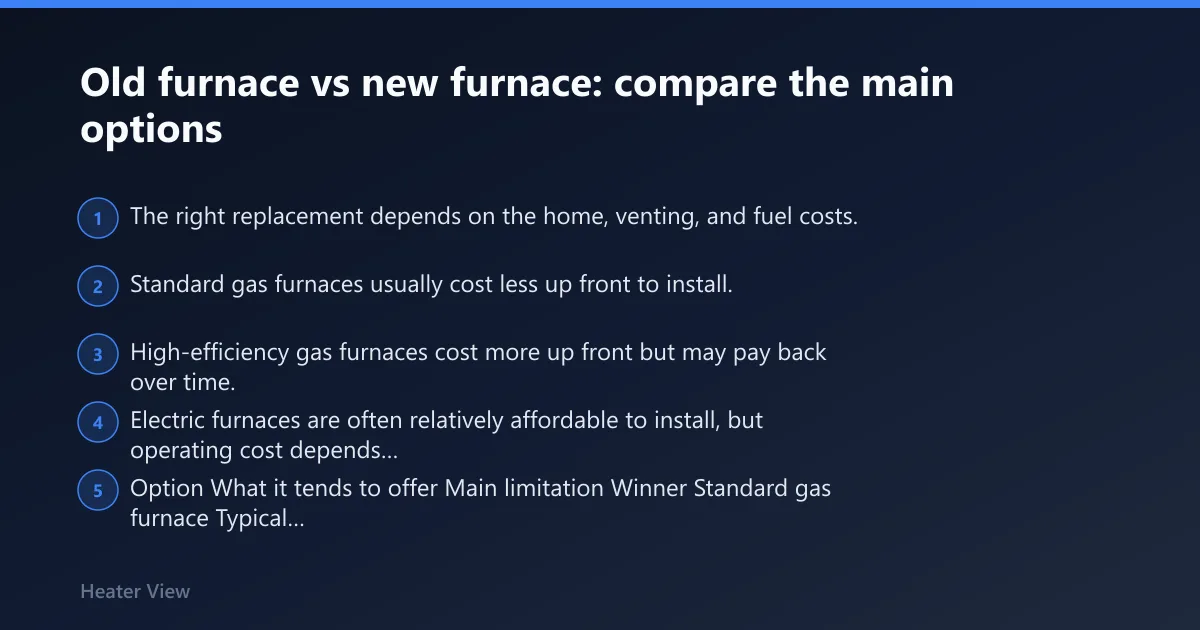
The right replacement depends on the home, venting, and fuel costs. Standard gas furnaces usually cost less up front to install. High-efficiency gas furnaces cost more up front but may pay back over time. Electric furnaces are often relatively affordable to install, but operating cost depends on local electricity prices.
| Option | What it tends to offer | Main limitation | Winner |
|---|---|---|---|
| Standard gas furnace | Typical installed cost $3,000-$5,000; often fits older homes with existing venting | Lower efficiency than condensing models | Budget fit |
| High-efficiency gas furnace | Typical installed cost $4,000-$8,000; potential payback in 5-12 years | Higher upfront cost | Long-term operating cost |
| Condensing furnace | 90%-97% AFUE; best fuel-use efficiency in this group | Often requires venting upgrades and higher upfront cost | Efficiency |
| Electric furnace | Typical installed cost $2,000-$4,000; approaches 100% efficiency at conversion | Operating cost depends on local electricity prices | Low installed cost |
Standard gas furnace
A standard gas furnace is often the easiest match for older homes that already have compatible venting. It is usually the lower-upfront-cost gas option, which makes sense when the goal is to restore dependable heat without reworking the house.
High-efficiency gas furnace
A high-efficiency gas furnace costs more to install than a standard model, but its operating cost can be better over time. The payback window can make sense in colder regions or in homes that use a lot of fuel each winter.
Condensing furnace
A condensing furnace runs at 90% to 97% AFUE, so it wastes less fuel than older units. The trade-off is higher upfront cost and, often, venting changes. That matters in older homes where the existing vent path may not support the new equipment.
Electric furnace
An electric furnace is relatively affordable to install and approaches 100% efficiency at conversion. The catch is operating cost: local electricity prices can make it a poor fit for homes with long heating seasons, even if the purchase price looks attractive.
What should you look at before you choose a replacement?
Home size, heating capacity, thermostat compatibility, venting requirements, duct condition, fuel type, and local energy prices all shape the right replacement. Bigger homes generally need bigger furnaces, but bigger is not the same as better if the system is oversized or badly matched.
Home size and heating capacity
Heating capacity has to match the home’s load. If the new furnace is too small, comfort suffers. If it is too large, cycling problems can shorten life and leave rooms unevenly heated.
Thermostat compatibility and controls
Some replacements work better with updated controls. A thermostat that struggles to communicate with the furnace can create odd runtime behavior, comfort complaints, or repeated service calls that look like furnace failure but are really control issues.
Venting requirements and duct condition
Condensing equipment may need venting upgrades. Duct condition matters too, because leaking or undersized ducts can drain comfort and make a healthy furnace look weak. Before replacing the unit, the airflow path should be checked.
Fuel type and local energy prices
Fuel type changes the math. Natural gas furnaces are often cheaper to use long-term, while electric furnaces can be attractive where electricity is inexpensive or where the home’s layout makes a gas system harder to support. Regional prices matter more than marketing claims.
Use the repair-vs-replace worksheet
This worksheet turns a messy furnace decision into a simple score. Add points for the items below. If the total points are high, replacement is the safer call. If the score stays low and the problem is isolated, repair is still reasonable.
| Factor | 0 points | 1 point | 2 points | 3 points |
|---|---|---|---|---|
| Furnace age | Under 10 years | 10-14 years | 15-17 years | 18 years or older |
| Repair frequency | First repair in several years | One recent repair | Two repairs in one season | Multiple breakdowns or repeat service calls |
| Estimated repair cost | Under $500 | $500-$1,000 | $1,000-$1,500 | More than half the cost of a new unit |
| Comfort problems | None | Minor uneven heating | Cold spots or weak airflow | Persistent cold air or major uneven heating |
| Utility bill trend | Stable | Slightly higher | Clearly rising | Rising sharply without another clear cause |
| Safety flags | None | Odor change | Yellow pilot light or combustion concern | Burning smell, rotten egg smell, gas leak risk, or CO alarm |
How to turn the score into a decision
A very low score usually favors repair. 6 to 9 points means the furnace is getting questionable, so a quote for replacement is smart. 10 points or more means replacement is the better path, especially if age, comfort loss, and safety concerns are all rising at once.
When to get a professional inspection before deciding
Get a professional inspection before final replacement decisions when the problem might be duct-related, thermostat-related, or tied to venting. The same inspection should check combustion, airflow, and heat exchanger condition, since those issues can change the answer from “repair” to “replace” fast.
Choose old furnace repair if… / Choose new furnace replacement if…
Choose repair if the furnace is younger, the failure is isolated, and the home is still heating evenly. Choose replacement if the furnace is older than 15 years and problematic, repairs keep repeating, utility bills are climbing, or any safety flag is present.
Choose old furnace repair if…
The furnace is under 15 years old. The problem is a single part, not a pattern. Comfort is still acceptable, bills are stable, and a professional inspection rules out heat exchanger damage, gas leak risk, or major venting trouble.
Choose new furnace replacement if…
The furnace is 15 to 20 years old and showing multiple warning signs. Repair costs are getting close to, or above, half the cost of a new unit. The system has frequent breakdowns, uneven heating, rising bills, or any serious safety symptom.
Frequently asked questions
How do I know when my old furnace should be replaced?
Replace it when age, repair history, comfort loss, and safety problems start pointing in the same direction. A furnace can last 15 to 20 years with proper maintenance, but once repairs repeat, bills rise, or a safety issue appears, replacement becomes the more practical choice.
Is it worth repairing a 15-year-old furnace?
Sometimes, yes. A 15-year-old furnace can still be worth repairing if the issue is small, the system is otherwise stable, and comfort is good. If the repair is large, repeated, or tied to efficiency loss or safety concerns, replacement is usually smarter.
What age is too old for a furnace?
There is no single cutoff, but furnaces older than 15 years may be better replaced than repaired when they are also problematic. Age alone should not decide it. Maintenance, installation quality, and the current condition matter just as much as the calendar.
What are the signs a furnace is failing?
Common signs include cold air, uneven heating, rising energy bills, banging or clanking noises, booming starts, odor changes, and frequent breakdowns. Cold spots and high bills are especially useful clues because they often show up before the furnace stops completely.
How much does a new furnace cost to install?
Typical installed cost ranges include $3,000-$5,000 for a standard gas furnace, $4,000-$8,000 for a high-efficiency gas furnace, and $2,000-$4,000 for an electric furnace. Final cost depends on heating capacity, venting, duct condition, and thermostat compatibility.
Will a new furnace lower my heating bills?
It can, especially if the old furnace has low AFUE and fuel prices are high. Older furnaces often waste more fuel than modern condensing models. The savings depend on local gas or electricity prices, climate, and whether duct losses are also part of the problem.
What AFUE rating should I look for in a new furnace?
For gas furnaces, a higher AFUE usually means lower fuel waste. Modern condensing furnaces run at 90% to 97% AFUE, while older furnaces often fall in the 60% to 80% range. The best choice depends on upfront cost, venting needs, and local fuel prices.
Can an old furnace be making my energy bills higher?
Yes. Older furnaces often lose efficiency with age, especially when maintenance has been inconsistent or installation was poor. Rising bills can also come from duct losses, airflow issues, or thermostat problems, so a full system check is better than guessing at the furnace alone.
Should I replace my furnace before it dies?
Often, yes, if it is old, unreliable, and showing warning signs. Replacing it before a total failure gives more control over timing, quotes, and equipment selection. It also helps avoid emergency replacement on the coldest night, when choices are limited and costs can jump.