Best efficient heaters for first-time buyers: top picks
For many first-time buyers, the most efficient heater is usually the one sized to the room and how it is used: roughly 700–1,500W for small spaces, ceramic for faster heat, oil-filled for steadier warmth, and a thermostat can matter more than raw wattage. Buy the wrong type and you pay for heat you never feel. This guide shows how to choose by room size, budget, noise, and heating habits.
For many buyers, a low-fuss pick is a ceramic fan heater with an onboard thermostat and timer, because it gives fast heat and can back off once the room reaches the set temperature. The best pick for quiet, all-evening comfort is an oil-filled radiator. The “most efficient” heater is the one that runs for the fewest unnecessary minutes in the space you actually use.
Best efficient heaters for first-time buyers: the top pick by use case
Quick picks by need
- Best for fast room heating: ceramic fan heater with thermostat and oscillation.
- Best for quiet overnight or background warmth: oil-filled radiator.
- Best for occasional spot heating in a small room: compact ceramic heater with a timer.
- Best for scheduled use and tighter control: smart ceramic heater with eco mode and app scheduling.
The most common mistake is buying by wattage alone. A 2000W heater can be useful, but it works best when the room size, heat loss, and run time match that output. A smaller heater in the right room can cost less to use than a bigger model that keeps struggling with drafts.
Which heater is best for your room size?
The best heater for your room size is the one that can warm the space without staying at full power for long stretches. A compact heater can be enough in a small, enclosed room. Larger or draftier rooms need better coverage, more stable output, or a different heating plan altogether.
Small room fit and when a compact heater is enough
For a small bedroom, study, or bathroom-sized space, a compact ceramic heater is often the practical choice. It warms quickly, takes little floor space, and is easy to move. If the room is closed off and you only need short bursts of heat, this is usually more efficient than running a larger unit longer than needed.
Large-room limits and why some heaters struggle to keep up
In a larger room, a small heater may run constantly and still leave cold corners. That is wasted runtime, not efficiency. Oil-filled radiators can work well for steady background warmth in bigger enclosed rooms, but they are slower to raise the temperature at the start.
How heat-up speed changes with room size and draftiness
Drafty rooms punish slow heaters. They also punish buyers who expect a small unit to warm open-plan space. Fast heat matters more when the room is only used briefly. In a leaky room, a heater with a thermostat and timer often saves more than one with a higher label wattage.
Ceramic fan heater: fast heat for short bursts
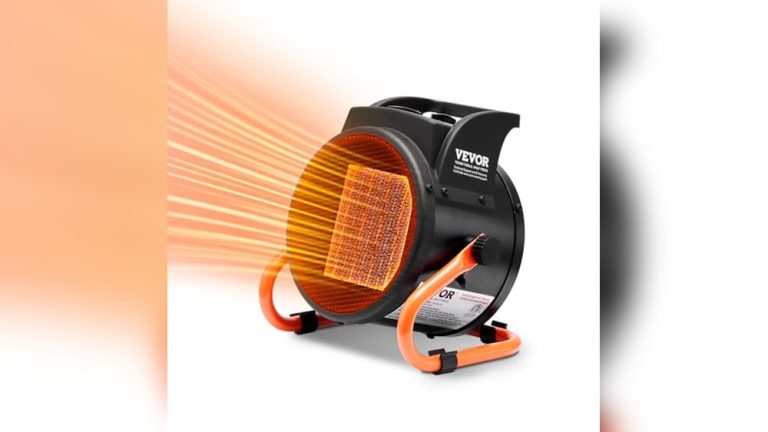
A ceramic fan heater is the strongest fit when the room needs heat quickly. These models are often around 1500W to 2000W, so they can bring a room from cold to comfortable fairly quickly. That speed is the main reason they suit first-time buyers who want simple, short-run heating.
What it does well
Ceramic fan heaters deliver quick heat output and are usually compact. Many include a thermostat, which matters because it lets the heater stop pushing full power once the target temperature is reached. That lowers wasted runtime and often matters more than the heater’s headline wattage.
Where it falls short
They can be noisy. That is the trade-off many buyers miss. In a bedroom, a fan’s sound can matter more than its fast warm-up. They are also less attractive for long, all-evening use, because a fan heater is better at short bursts than at quiet background comfort.
When a thermostat or oscillation helps this type
A thermostat helps a ceramic heater avoid running flat out longer than needed. Oscillation helps spread warm air across more of the room, which is useful in whole-room heaters. It does not directly make the heater more efficient, but it can reduce hot-and-cold spots that make people turn the unit up too far.
Oil-filled radiator: quieter heat for steady use
An oil-filled radiator is often a better choice when the room needs quiet, steady background warmth. It warms more slowly than a fan heater, but it keeps giving off heat after the element switches off. For bedrooms and evening use, that retained heat can make the run pattern calmer and more efficient.
Why it suits bedrooms and all-evening use
Noise matters in a bedroom. Oil-filled models are typically quieter than fan heaters because there is no constant fan blast. They fit people who want a stable temperature through the evening rather than a fast blast of warm air followed by repeated on-off cycling.
Why warm-up is slower but heat retention matters
The slow start is the trade-off. An oil-filled radiator is not the best answer when the room is cold and you want immediate comfort. But once warm, it can hold that warmth well enough to reduce how often it needs to run. That is useful for steady, predictable use.
When quiet operation beats speed
If the heater will sit in a room for hours, quiet operation often matters more than quick heat. A quieter unit is easier to live with, and that often means it gets used correctly instead of being turned off early. Comfort that people actually tolerate is the kind that saves energy in practice.
Do smart heaters actually save energy?
Yes, but only when the schedule and controls match real habits. A smart thermostat can cut unnecessary runtime by stopping heat when the room reaches target temperature, and eco mode is meant to save money. Scheduling helps most when the heater runs at the same times every day.
Smart thermostat control and eco mode explained
A smart thermostat adds temperature control that is more flexible than a basic switch. Eco mode aims to reduce output once the target is reached. That can help if the heater would otherwise keep pushing heat after the room is already comfortable. If the thermostat is inaccurate, the savings are weaker.
When scheduling matters for daily routines
Scheduling helps in regular patterns: morning wake-up, evening desk work, bedtime warm-up. A smart app can set heating to start before the room is used and stop when it is not needed. The Dreo smart whole-room heater is a ceramic heater, listed at 2000W in the UK and 1500W in the US, and the app can be used to schedule heating.
When smart features do little for occasional spot heat
If the heater is only used occasionally for a short burst, smart features may add convenience more than savings. A timer may be enough. If the heater is plugged in to warm one room for ten or fifteen minutes, scheduling can be too much unless that routine happens every day.
How to choose the right heater for less waste
Choose the heater by how you actually use heat, not by the biggest number on the box. Wattage affects power draw and running cost, but wattage alone does not equal efficiency. A heater that finishes the job faster, or shuts off sooner, can cost less to use than a larger one that runs longer.
Use wattage as a starting point, not the answer
Wattage tells you how much power the heater can draw. It does not tell you whether that power will be used well. The guide includes heaters that are too pricey to run at full power, which is why full-output use is rarely the right comparison for first-time buyers.
Check timer function, thermostat accuracy, and oscillation
A timer function can help prevent forgetfulness and limit runtime. It may be built into the heater or the remote. Thermostat control reduces wasted heat after the room reaches the set point. Oscillation helps spread air across the room, which matters for coverage, but it is not the same as lower energy use.
Know when running cost matters more than purchase price
The cheapest heater to buy is often the wrong one to run. A slightly better fit can cost less over a winter because it avoids long, unnecessary operating hours. That is why a low-priced heater with poor room fit can end up being expensive in practice.
First-time-buyer decision table and running-cost checklist
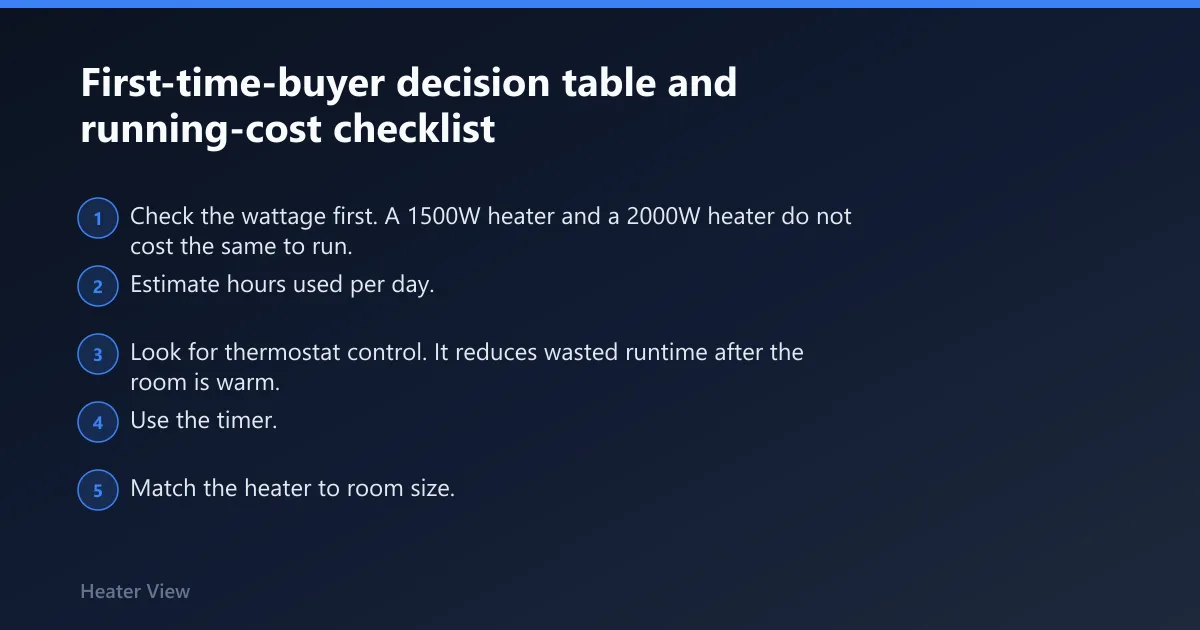
This table is the quickest way to avoid the usual mistakes. It ties room size, noise tolerance, warm-up speed, and usage pattern to the heater type that is most likely to use energy well for that job.
| Room size | Usage pattern | Noise tolerance | Warm-up speed | Most efficient heater type |
|---|---|---|---|---|
| Small room | Short bursts | Medium to high | Fast | Ceramic fan heater |
| Small room | All-evening warmth | Low | Slower | Oil-filled radiator |
| Medium room | Scheduled daily use | Medium | Fast to moderate | Smart ceramic heater with thermostat |
| Small room | Occasional spot heat | Low to medium | Fast | Compact ceramic heater with timer |
| Drafty room | Extended use | Low | Moderate | Oil-filled radiator or larger controlled heater |
Running-cost checklist
- Check the wattage first. A 1500W heater and a 2000W heater do not cost the same to run.
- Estimate hours used per day. Short bursts usually favor ceramic; longer sessions often favor stable, quieter heat.
- Look for thermostat control. It reduces wasted runtime after the room is warm.
- Use the timer. It stops forgetfulness from turning a short heating session into a long one.
- Match the heater to room size. Undersized units run too long; oversized units often cost more than needed.
- Choose smart scheduling only if the heater follows a regular routine.
Common mistakes this table helps avoid
Buying by wattage alone is the biggest one. Oversizing is next, because a bigger heater can be a worse fit for a small room. Another mistake is choosing a noisy fan heater for a bedroom, then avoiding use because it is annoying. A final error is buying a smart heater for occasional spot heat when a timer would have done the job.
What features help a heater use less energy?
Thermostat control, timer function, eco mode, and a good room fit do the real work. Smart scheduling helps when the heater follows a repeatable routine. Oscillation can spread heat more evenly, which may make the room feel warm sooner, but it is coverage control rather than a direct efficiency gain.
Should you buy a heater with a thermostat and timer?
Yes, for most first-time buyers. A thermostat stops the heater from running harder than needed, and a timer prevents wasted runtime when you forget to turn it off. The pair matters most in rooms used every day or for longer sessions, where small savings add up quickly.
Frequently asked questions
What is the most efficient heater for a first-time buyer?
The most efficient heater is the one that matches room size and use pattern. For quick, short heating in a small room, a ceramic heater with a thermostat is often best. For quiet, longer use, an oil-filled radiator is usually the better fit because it avoids noisy overrun and holds heat well.
Are plug-in heaters expensive to run?
They can be, especially at full power for long periods. Running cost depends on wattage, hours used, and whether the heater shuts off at the right time. A 2000W heater used carelessly will cost more than a smaller heater used briefly with a thermostat and timer.
What heater type is best for quick room heating?
A ceramic fan heater is usually the best choice for fast heat. It pushes warm air quickly and is compact enough for small spaces. The trade-off is noise, so it fits living rooms, studies, and short-use rooms better than quiet bedrooms.
How do I choose the right heater size for my room?
Start with the room size, then think about drafts, ceiling height, and how long you need heat. A small, closed room can work well with a compact heater. Larger or leakier rooms need more output or longer runtime, which can make the wrong heater cost more to use.
Is an oil-filled heater more efficient than a ceramic heater?
Not in every case. Oil-filled heaters are usually better for steady, quiet warmth, while ceramic heaters are better for quick bursts. Efficiency depends on how long the heater runs, how often it cycles, and whether the room needs short heat or all-evening comfort.