Is the Cheapest Heater Always the Least Efficient?
No. The cheapest heater to buy is often the costliest to run, because running cost depends more on wattage, thermostat control, and room heat loss than on sticker price. Pick the wrong one and you can pay more each month for less comfort. This guide compares purchase price, wattage, and real cost to warm a bedroom, small room, or drafty space.
What really decides running cost
Running cost comes from three things: the fuel price per kWh, the heater’s wattage, and the hours it actually runs. A low purchase price tells you almost nothing about those numbers. A cheap 2,000W unit can cost far more over a season than a better-controlled 700W heater used for the same room.
Wattage and hours turn into pounds
Wattage is the power input rating. I use it to work out hourly cost. The guide formula is watts divided by 1000 times cost per kWh. At 30p per kWh, a 1500W heater costs 45p per hour, and a 2000W heater costs 60p per hour.
That is why box price is only half the story. A heater that is cheap to buy can still be expensive to live with if it is oversized or left running longer than needed.
Cost per kWh matters more than the box
Cost per kWh is the cleanest comparison metric because it puts fuels on the same basis. Electricity and gas do not cost the same per unit of heat. If you compare only purchase price, you miss the larger cost driver, which is what the heater consumes over time.
According to Cheapest Heater to Run: Full Cost Comparison — A heat pump can deliver 300% efficiency.
Are all electric heaters equally efficient?
Yes, for electric resistance heating at the point of use, they are treated as 100% efficient. Fan, convector, halogen, and oil-filled heaters all turn electricity into heat in the room. That means the big difference is usually not conversion efficiency. It is wattage, controls, and how long the heater runs.
Resistance heater types all do the same basic job
Fan heaters move air quickly. Convector heaters warm the air more quietly. Halogen heaters give fast, direct warmth. Oil-filled heaters hold heat longer after switch-off. They feel different, but they do not change the basic 1:1 electricity-to-heat result at the socket.
That is why a small 700W oil-filled radiator can cost less to run than a 2000W fan heater if the use pattern is different. The heater type matters less than the wattage and the number of hours it stays on.
Controls matter more than the shell
A thermostat cuts waste from overheating. A timer trims hours you do not need. A cheap heater with poor control can end up cycling badly or running too long, which pushes bills up even when the heater itself is simple and low-cost.
When does a heat pump beat a space heater?
A heat pump can beat a space heater when it can move heat from outside air efficiently enough to offset the running cost. A heat pump can deliver 300% efficiency because it moves heat instead of creating it. In milder weather, that often makes it cheaper to run than resistance heating.
Why moving heat is different from making it
Electric resistance heaters make heat directly. A heat pump uses electricity to move heat, so one unit of electricity can deliver more than one unit of heat into the room. That is the main reason it can use less energy than a space heater.
Weather matters. When outside conditions are milder, a heat pump usually performs better. When it is colder or the installation is a poor match, the advantage shrinks. It is efficient in the right conditions, not magic in every room.
Installation and room fit still matter
A heat pump is not the answer for every single room. It depends on the system, the climate, and the room layout. For a small bedroom used for short periods, a simple heater with a timer may be the better fit. For longer heating seasons, the heat pump often wins on energy use.
Is gas cheaper to run than electricity?
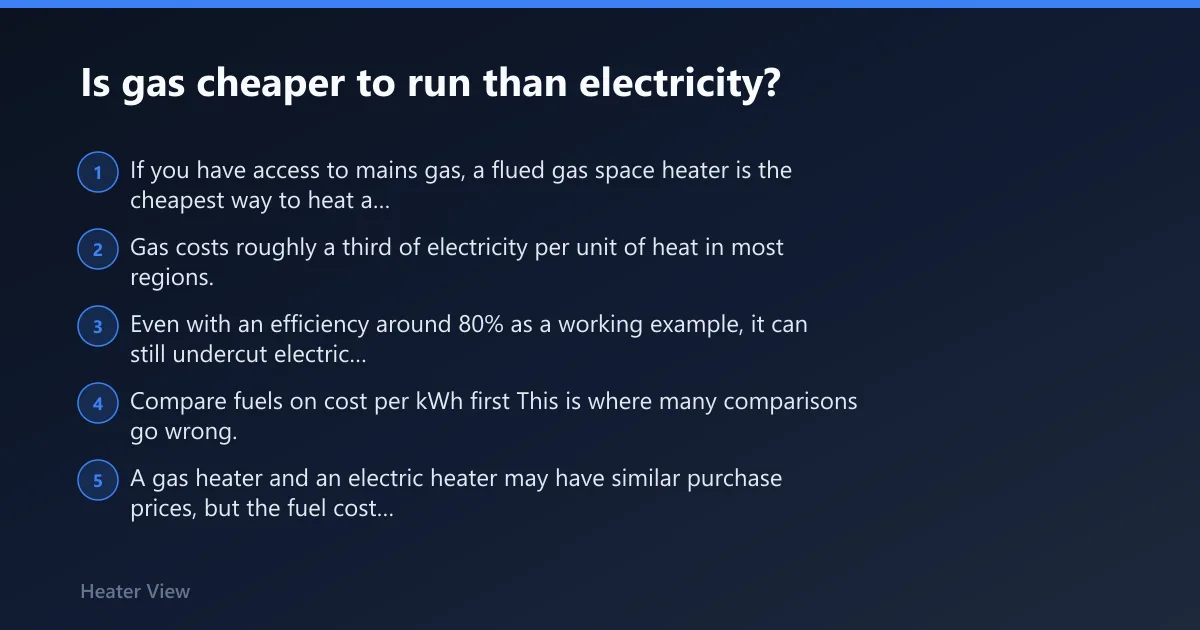
If you have access to mains gas, a flued gas space heater is the cheapest way to heat a single room. Gas costs roughly a third of electricity per unit of heat in most regions. Even with an efficiency around 80% as a working example, it can still undercut electric resistance heating.
Compare fuels on cost per kWh first
This is where many comparisons go wrong. A gas heater and an electric heater may have similar purchase prices, but the fuel cost is not the same. If gas is cheaper per unit of heat, the running cost can stay lower even when the gas heater is not perfectly efficient.
That is why the cheapest heater to buy is often not the cheapest to run. The fuel choice can overwhelm the sticker price within a single heating season.
Why access to mains gas changes the answer
Where gas is available, it often changes the ranking. Where gas is not available, the comparison becomes electric resistance versus heat pump. That is a different decision with a different cost outcome.
| Heater type | Upfront price | Wattage | Control quality | Estimated hourly cost |
|---|---|---|---|---|
| Fan heater | Low | 2000W | Basic thermostat | 60p per hour at 30p per kWh |
| Convector heater | Low to moderate | 1500W | Thermostat plus timer | 45p per hour at 30p per kWh |
| Oil-filled heater | Moderate | 700W | Thermostat, slower response | 21p per hour at 30p per kWh |
| Flued gas space heater | Moderate | Equivalent room output | Thermostat | Often lower than electric resistance where gas is available |
| Heat pump | High | Varies by system | Advanced controls | Often lower than resistance heating in milder climates |
How do I compare heater running costs by wattage?
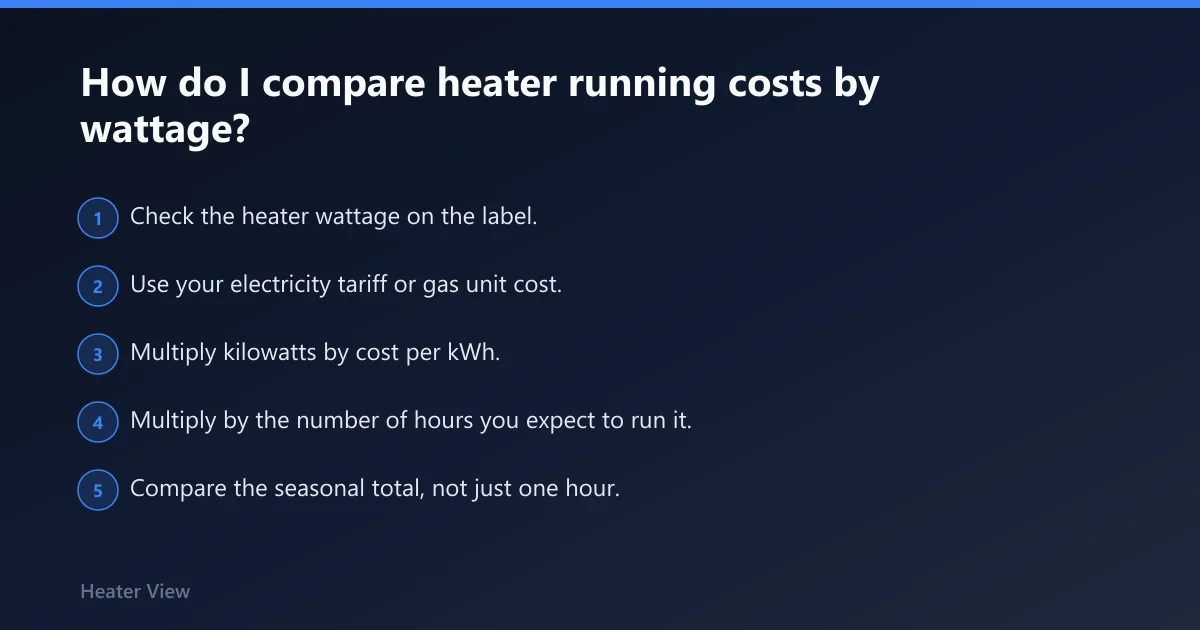
Use wattage, hours, and tariff. That gives a fair comparison. The guide formula is watts divided by 1000 times cost per kWh. If you know the heater’s wattage and your electricity tariff, you can estimate the hourly cost before buying.
A simple comparison method
- Check the heater wattage on the label.
- Use your electricity tariff or gas unit cost.
- Multiply kilowatts by cost per kWh.
- Multiply by the number of hours you expect to run it.
- Compare the seasonal total, not just one hour.
At 30p per kWh, a 1500W heater costs 45p per hour. At the same rate, a 2000W heater costs 60p per hour. A 1500W heater run 8 hours a day for a month is described as costing £108. A 2000W heater run 8 hours a day for a month is described as costing £144.
When a cheap heater becomes expensive over a season
A heater becomes the expensive choice when its lower purchase price is outweighed by extra running hours, poor thermostat control, or higher wattage. That break-even point arrives fast in bedrooms used every night or in drafty spaces that need longer runtimes.
If one heater costs less to buy but adds only a small amount each night, it may still be the better buy. If it runs far longer because it has weak control or is too powerful for the room, the season cost can overtake the pricier model.
What matters more than heater efficiency?
Thermostat quality, timer use, and room insulation often matter more than heater type. A good thermostat stops overheating. A timer limits runtime. Better insulation cuts heat loss, so the heater runs for fewer minutes and the bill falls.
Small rooms, bedrooms, and drafty spaces
In small rooms, a low-watt heater with good controls is usually the better match. Bedrooms often need steady, shorter heating periods, so a timer helps. Drafty spaces are different again; they lose heat quickly, so insulation and draught control can save more money than changing heater type.
Output should match room size and occupancy pattern. A heater that is too large can cycle on and off wastefully. A heater that is too small may run flat out and still fail to warm the room properly. Both cases raise cost per hour of comfort.
Failure cases that cost more than they look like
A low-price fan heater can be expensive if it is 2000W and used for long evenings. A cheap convector without a decent thermostat can overheat a room and waste power. A heater with no timer can keep running after the room is already warm.
Those failures are common because the purchase decision gets made on price alone. That is the wrong filter. The better filter is cost to warm the room for the hours it is actually used.
Frequently asked questions
Is the cheapest heater always the least efficient?
No. The cheapest heater to buy is often not the least efficient at converting electricity to heat, especially among resistance heaters that are effectively 100% efficient. The real issue is running cost, which depends on wattage, controls, fuel type, and how long the heater stays on.
Do cheaper heaters cost more to run?
Often, yes. A cheap heater can cost more to run if it has high wattage, poor thermostat control, or no timer. A lower purchase price does not protect you from a larger monthly bill when the heater runs longer or uses a pricier fuel.
What heater type is cheapest to run?
If mains gas is available, a flued gas space heater is typically the cheapest way to heat a single room. If you are choosing among electric options, a heat pump can often beat resistance heaters in milder climates. Among resistance heaters, running cost is mainly a wattage question.
Is a lower watt heater always better?
No. Lower wattage lowers hourly cost, but only if the heater can still warm the room in the time you need. In a drafty space or a larger room, a very low-watt heater may run longer and end up costing more than a well-matched unit with a thermostat and timer.
Does a heat pump use less energy than a space heater?
Usually yes, when conditions suit it. A heat pump can deliver 300% efficiency because it moves heat rather than creating it. That means it can use less electricity than a resistance space heater, especially in milder weather and in rooms that need regular heating.