When your home heater stops working, it can feel like a big problem, especially if you’re not used to fixing things. Many people worry about breaking something or making the issue worse. But guess what?
Some common heater problems are simpler to fix than you might think! This guide will show you exactly how to tackle them. We’ll walk through easy steps so you can get your heat back on.
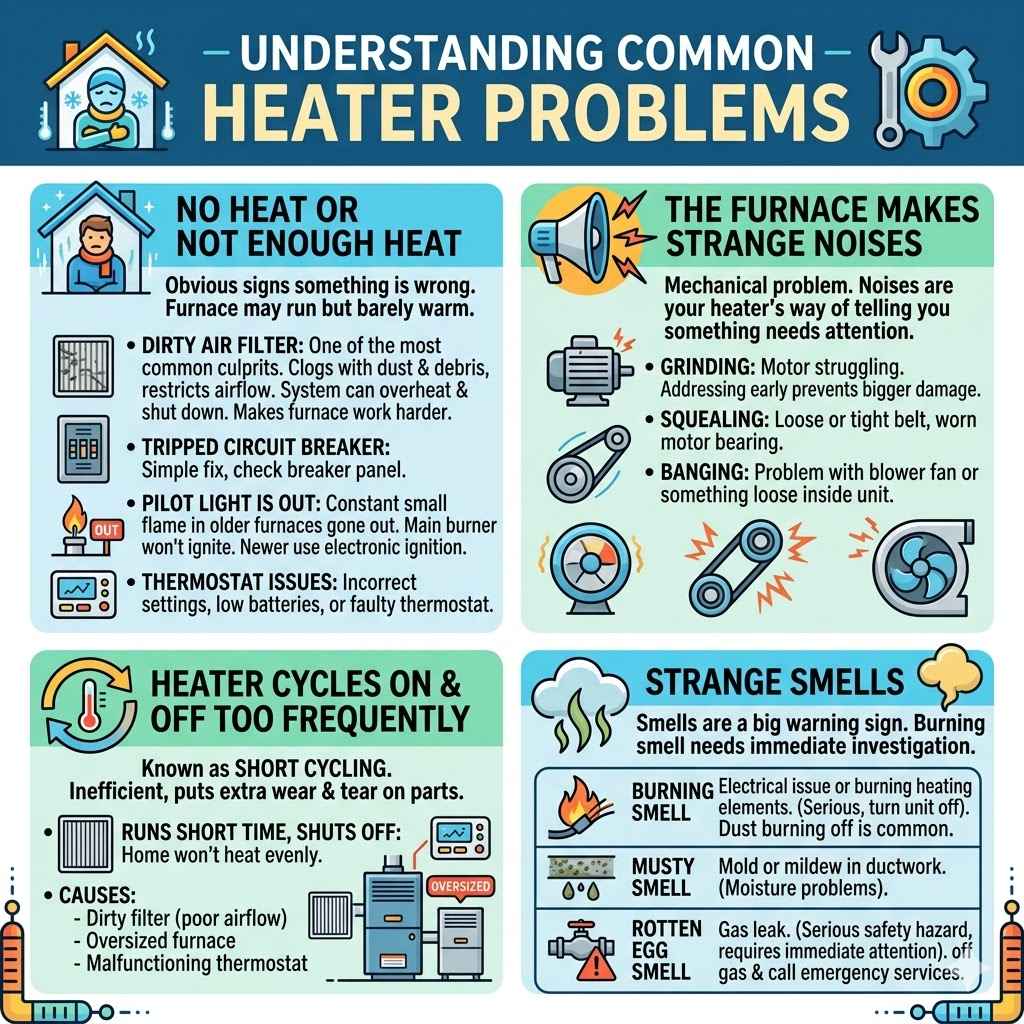
Understanding Common Heater Problems
Many home heating systems share similar issues. Knowing these common problems is the first step to fixing them yourself. This section will explore the most frequent reasons your heater might not be working.
We’ll explain what to look for and why these things happen. This helps you understand your heater better.
No Heat or Not Enough Heat
This is the most obvious sign that something is wrong. Your furnace might turn on, but no warm air comes out, or it’s barely warm. This can happen for several reasons.
Sometimes, it’s a simple fix like a tripped circuit breaker or a dirty air filter. Other times, it could be a more involved issue with a part like the pilot light or thermostat.
A dirty air filter is one of the most common culprits. When the filter gets clogged with dust and debris, it restricts airflow. This can cause the system to overheat and shut down.
It also makes the furnace work harder.
Another frequent issue is a pilot light that has gone out. Many older furnaces have a small, constant flame called a pilot light. If this goes out, the main burner won’t ignite.
Newer furnaces often use an electronic ignition system, so this won’t apply.
The furnace makes strange noises: Grinding, banging, or squealing sounds often indicate a mechanical problem. This could be a loose belt, a worn-out motor bearing, or a fan issue. Addressing these noises early can prevent bigger damage.
Noises are your heater’s way of telling you something needs attention. A grinding sound might mean a motor is struggling. A squealing sound could be a belt that’s too tight or too loose.
A banging noise might suggest a problem with the blower fan or something loose inside the unit. It’s important to listen carefully to the type of noise.
The heater cycles on and off too frequently: This is called short cycling. It means the furnace starts, runs for a short time, and then shuts off again before completing a heating cycle. This is inefficient and can be caused by a dirty filter, an oversized furnace, or a malfunctioning thermostat.
Short cycling is not good for your heater. It puts extra wear and tear on the parts. It also means your home won’t get heated evenly.
The system might be shutting off because it’s reaching the set temperature too quickly due to poor airflow or a thermostat problem.
Strange smells: A burning smell could indicate an electrical issue or something burning off the heating elements. A musty smell might point to mold or mildew in the ductwork. A rotten egg smell often signals a gas leak, which is a serious safety hazard and requires immediate attention.
Smells from your heater are a big warning sign. A burning smell needs immediate investigation. If it smells like burning dust, it could be a filter issue.
If it’s a more serious electrical burning smell, turn the unit off. A musty smell can mean moisture problems. Always be cautious with gas smells.
How to Fix Your Home Heater Easily Step-by-Step
This part is where we get hands-on. We will go through simple checks and fixes that most people can do. We aim to give you the confidence to handle common heater issues.
Follow these steps carefully.
Check the Thermostat
Your thermostat is the brain of your heating system. If it’s not set correctly, your heater won’t turn on. It sounds simple, but it’s often overlooked.
Ensure the thermostat is set to “Heat” mode: Sometimes, it might accidentally be set to “Cool” or “Off.”
This is the most basic check. Look at your thermostat. Is the switch or setting for the mode on “Heat”?
If it’s on “Cool,” the air conditioner might try to run. If it’s on “Off,” nothing will happen. Make sure it says “Heat.”
Check the temperature setting: Make sure the desired temperature is higher than the current room temperature.
Your heater will only turn on if the air inside your home is cooler than the temperature you’ve set on the thermostat. If you set it to 68 degrees and the room is already 70, it won’t kick on. Turn the temperature setting up a few degrees higher than the current room temperature.
Check the batteries (if applicable): Many digital thermostats use batteries. If they are low or dead, the thermostat might not function properly.
Some thermostats, especially newer digital ones, run on batteries. If the display is dim or flickering, it’s a good sign the batteries need changing.
Inspect the Air Filter
A dirty air filter can cause a lot of problems for your heater. It restricts airflow, making the system work harder and less efficiently. Replacing it is one of the easiest and most important maintenance tasks.
A clogged air filter can cause your furnace to overheat and shut down. It also leads to poor air quality in your home. You should check your air filter regularly, typically every 1-3 months, depending on your home environment and filter type.
Here’s how to check and change it:
Locate the air filter: It’s usually found in the return air duct, either in the wall, ceiling, or near the furnace itself.
The filter is typically in a slot near where the air gets pulled into your furnace. Look for a metal grille or a cover panel that you can open. This is where the air from your house enters the heating system for cleaning and warming.
Note the filter size: Filters have dimensions printed on their side, like 20x25x1.
Before you buy a new one, look at the old filter. The size is crucial for a good fit. A filter that is too small won’t seal properly, and air will bypass it.
A filter that’s too big won’t fit in the slot.
Remove the old filter: Slide it out carefully. Note the airflow direction arrow on the filter.
Gently pull the old filter out of its slot. Be careful not to let loose dust fall into the duct. Many filters have an arrow indicating which way the air should flow through them.
You’ll want to install the new one in the same direction.
Install the new filter: Make sure the airflow arrow on the new filter points in the correct direction, usually towards the furnace.
Slide the new, clean filter into place. Ensure the arrow is pointing towards your furnace. This ensures the air is being filtered correctly as it enters the system for heating.
Close and secure the filter cover: Make sure it’s sealed properly.
Once the new filter is in, close the cover or grille securely. This prevents air from leaking around the filter, ensuring all the air goes through it.
A statistic from the U.S. Department of Energy suggests that replacing a dirty air filter with a clean one can improve your heating system’s efficiency by 5% to 15%. This small action can save energy and money.
Reset the Circuit Breaker
Your furnace has its own circuit breaker in your home’s electrical panel. If it trips, the furnace won’t get power.
The circuit breaker panel usually looks like a metal box with a door. Inside, you’ll see rows of switches. Find the one labeled “Furnace,” “Heater,” or “HVAC.”
Locate your home’s electrical panel: This is usually in a basement, garage, or utility closet.
Your main electrical panel is where all the power for your house comes in and is distributed. It’s a box with many switches. You need to find the correct breaker that controls your heating system.
Find the breaker for your furnace: It might be labeled.
Look for a label on the panel door or near the switches. It might say “Furnace,” “HVAC,” “Heat,” or something similar. If you can’t find a label, you might need to check them one by one.
Check if the breaker is tripped: A tripped breaker will be in a middle position or fully off.
A breaker that’s working correctly is usually in the “ON” position. If it’s tripped, it will be somewhere in the middle or all the way in the “OFF” position. You’ll often see the switch handle sticking out differently than the others.
Reset the breaker: Firmly push the switch to the “OFF” position, then back to the “ON” position.
To reset a tripped breaker, you must first push it all the way to the “OFF” position. Then, push it firmly back to the “ON” position. This re-establishes the electrical connection.
If the breaker trips again immediately after resetting, there might be a more serious electrical issue with the furnace. In that case, it’s best to call a professional.
Check the Furnace Door and Safety Switches
Most furnaces have safety features that prevent them from running if panels or doors are not properly secured. This is a crucial safety measure.
Furnace doors often have a small switch that tells the system it’s closed. If this door is ajar or not latched correctly, the furnace will not operate. This prevents accidental contact with moving parts or extreme heat.
Ensure all furnace access panels are closed and latched: The main door and any panels covering components should be securely in place.
Walk around your furnace. Are all the metal covers and doors shut tight? They often have latches or screws that need to be fastened.
A slightly open panel is enough to stop the furnace from working.
Locate any safety interlock switches: These are often small buttons or levers that get pressed when the door is closed.
Many furnaces have a small switch, often a plunger type, that is pushed in when the door is closed. This tells the furnace’s control board that it’s safe to operate. Make sure this switch isn’t obstructed or stuck.
A common scenario: A homeowner replaced an air filter and didn’t quite close the furnace door. The furnace wouldn’t start. After checking the thermostat and breaker, they realized the door wasn’t fully shut, deactivating the safety switch.
Closing the door fixed the problem instantly.
How to Fix Your Home Heater Easily for Pilot Light Issues
If you have an older furnace with a pilot light, this is a common reason for no heat. The pilot light is a small flame that ignites the main burner. If it goes out, the furnace won’t produce heat.
Many modern furnaces use electronic ignition systems, so they don’t have a pilot light. However, if you have an older model, learning to relight your pilot light can save you a service call. Always follow the manufacturer’s instructions.
Relighting a Pilot Light
Safety first! Make sure you understand the process and your furnace. If you smell gas, turn off the furnace and open windows, then call for professional help immediately.
Turn off the gas supply to the pilot light: On the gas valve, there’s usually a knob. Turn it to the “OFF” position.
You’ll find a gas valve on the pipe leading to your furnace. It usually has a knob with settings like “ON,” “OFF,” and “PILOT.” Turn this knob to the “OFF” position. This stops the flow of gas to the pilot light assembly.
Wait for at least five minutes: This allows any residual gas to dissipate.
It’s important to be patient here. You need to let the area clear of any gas fumes. Waiting five minutes is usually sufficient.
If you smell gas, wait longer or ventilate the area more.
Turn the gas supply to “PILOT”: The knob should now be set to the pilot position.
Now, turn the gas knob to the “PILOT” setting. This allows gas to flow to the pilot light assembly, but not yet to the main burner.
Relight the pilot light: Use a long lighter or a match. Hold the flame to the pilot light opening until the pilot light ignites.
This is the moment of truth. Use a long utility lighter or a long match. Hold the flame to the small opening where the pilot light is supposed to be.
Keep it there until the pilot flame catches and stays lit.
Turn the gas supply to “ON”: Once the pilot light is stable, turn the gas knob to the “ON” position.
When the pilot light is burning steadily, turn the gas knob all the way to the “ON” position. This will allow gas to flow to your main burners when the thermostat calls for heat.
Test the furnace: Turn the thermostat up to call for heat and ensure the main burners ignite.
Go to your thermostat. Turn the temperature up a few degrees to make the furnace turn on. Listen and watch to see if the main burner ignites.
If it does, congratulations!
In a survey by a home repair service, 30% of homeowners reported that they were able to fix a simple furnace issue, like relighting a pilot light, without needing a professional technician. This shows the value of knowing these basic fixes.
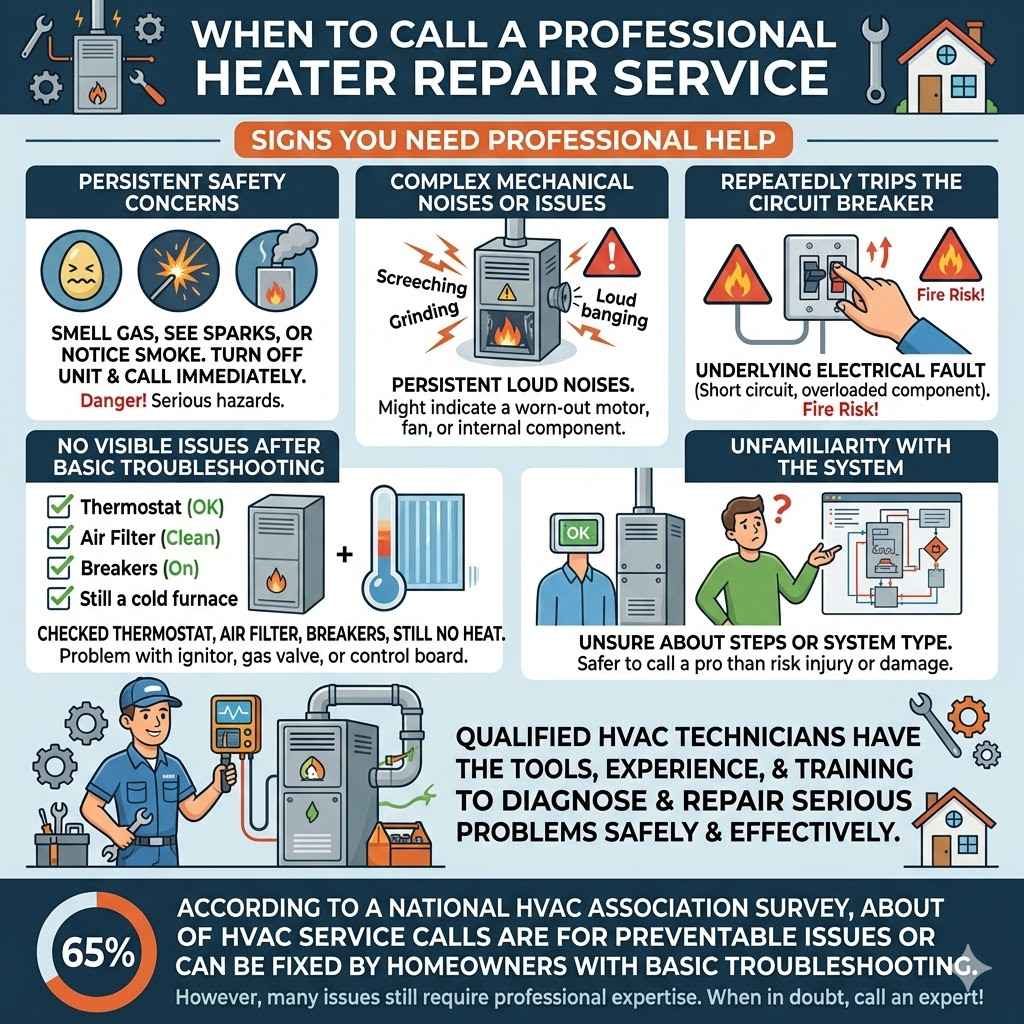
When to Call a Professional Heater Repair Service
While this guide helps you tackle many common heater issues, it’s important to know when to stop and call for expert help. Trying to fix complex problems without the right knowledge can be dangerous or lead to more costly damage.
If you’ve tried the basic steps and your heater still isn’t working, or if you’re dealing with something that feels beyond your comfort level, it’s time to reach out to a qualified HVAC technician. They have the tools, experience, and training to diagnose and repair more serious problems safely and effectively.
Signs You Need Professional Help
Persistent safety concerns: If you smell gas, see sparks, or notice smoke, turn off the unit and call a professional immediately. These are signs of serious hazards.
Safety is always the top priority. If your furnace is making alarming noises, giving off strange smells like burning plastic or gas, or if you see any electrical arcing or smoke, do not try to fix it yourself. These situations require immediate attention from a trained professional.
Complex mechanical noises or issues: Grinding, screeching, or loud banging sounds that don’t stop after basic checks might indicate a worn-out motor, fan, or other internal component.
Some noises are easy to ignore, but others are clear warnings. Persistent loud noises like grinding, squealing, or banging suggest a mechanical failure is occurring. These problems often involve parts that are difficult to access or require specialized tools to replace.
The furnace repeatedly trips the circuit breaker: This indicates an electrical fault that needs expert diagnosis.
If you reset the breaker and it trips again right away, there’s an underlying electrical problem. This could be a short circuit or an overloaded component. Trying to keep resetting it can cause further damage or create a fire risk.
No visible issues after basic troubleshooting: If you’ve checked the thermostat, air filter, and breakers, and still have no heat, the problem could be with the ignitor, gas valve, circuit board, or other internal parts.
You’ve done all the simple checks, and your heater is still cold. This suggests the problem lies deeper within the system. Issues with ignition systems, gas control valves, or the main control board are best left to experienced technicians.
Unfamiliarity with the system: If you’re unsure about any step or the type of system you have, it’s safer to call a professional.
Not everyone is comfortable working with heating systems. If you’re feeling uneasy about any part of the troubleshooting process, or if your furnace model is unfamiliar to you, don’t hesitate to call a pro. It’s better to pay for a service call than risk injury or expensive damage.
According to a national HVAC association survey, about 65% of HVAC service calls are for issues that could have been prevented with regular maintenance or addressed by the homeowner with basic troubleshooting. This highlights that while homeowners can fix some things, many issues still require professional expertise.
Frequently Asked Questions
Question: My heater makes a strange clicking noise when it tries to turn on, but no heat comes out. What should I do?
Answer: That clicking noise often means the ignitor is trying to spark, but the gas isn’t igniting. First, check your air filter. A very dirty filter can sometimes cause this.
If the filter is clean, it could be a problem with the ignitor itself or the gas valve, which might require a professional to fix.
Question: Can I clean my furnace myself if it looks dusty?
Answer: Yes, you can clean the exterior of your furnace gently with a damp cloth. However, do not attempt to clean the internal components of the furnace unless you are experienced. Dust buildup inside can affect performance, but cleaning the inside requires specific knowledge and tools to avoid damage or safety issues.
Question: How often should I change my furnace air filter?
Answer: It’s recommended to check your furnace air filter every 1-3 months. Depending on your home’s air quality, pet presence, and filter type, you might need to change it more or less often. A good rule of thumb is to replace it when it looks visibly dirty or clogged.
Question: My furnace is blowing cold air. Could it be the thermostat?
Answer: Yes, the thermostat is a common cause. Make sure it’s set to “Heat” and the temperature is set higher than the room temperature. Also, check the batteries in the thermostat if it uses them.
If those checks don’t help, the issue might be with the furnace itself.
Question: Is it safe to relight my pilot light if I smell gas?
Answer: Absolutely not. If you smell gas, do not attempt to relight the pilot light or operate any electrical switches. Turn off the gas supply valve to the furnace immediately, open windows to ventilate the area, and leave your home.
Call your gas company or emergency services from a safe distance.
Summary
You can often fix your home heater easily by checking the thermostat, replacing the air filter, and resetting the circuit breaker. Simple issues like these are common and manageable for homeowners. Knowing these steps gives you power.
If you encounter more complex problems or safety concerns, it’s always best to call a qualified professional.