Pellet Stove vs Gas Fireplace: Which Is Cheaper to Run?
Natural gas fireplaces are usually cheaper to run than pellet stoves, but pellets can win when gas is expensive, pellets are low-cost, and the stove is efficient. As a rough rule, pellet fuel needs a noticeable cost advantage, around 20% or so, to offset higher upkeep. If you ignore efficiency, delivery fees, and maintenance, the cheaper-looking option can cost more over a heating season. This guide compares fuel price, efficiency, upkeep, and storage so you can see when a pellet stove beats a gas fireplace.
| Decision factor | Pellet stove | gas fireplace: Which is cheaper to run | Winner |
|---|---|---|---|
| Fuel cost | Often lower per usable heat unit when pellets are priced well and the stove is efficient. | Usually lower with natural gas; usually higher with propane. | Pellet stove vs propane, gas fireplace vs natural gas |
| Convenience | Needs pellet loading, ash removal, and burn-pot cleaning. | Provides instant heat with less routine tending. | gas fireplace: Which is cheaper to run |
| Maintenance | More frequent cleanup and periodic service. | Typically lower routine upkeep, but still needs inspections and burner or vent cleaning. | gas fireplace: Which is cheaper to run |
| Storage and delivery | Needs dry storage for pellets; delivery fees can change the total cost. | Natural gas needs no on-site fuel storage; propane needs tank logistics. | gas fireplace: Which is cheaper to run for convenience; pellet stove only if pellet delivery stays low |
Pellet stove vs gas fireplace: the cost trade-off
Pellet stoves can cost less to fuel, but gas fireplaces usually cost less to maintain and are simpler to use. The cheapest choice is the one with the lowest total operating cost, not the lowest posted fuel price.
Pellet stoves burn compressed wood pellets and feed fuel with an auger. That automatic feed helps them produce strong heat output, and some units can hold enough pellets for 2 to 3 days. Gas fireplaces use natural gas or propane and provide instant heat, which changes how fast you feel the room warm up.
Fuel cost is only one line on the bill. Add efficiency, ash cleanup, burner or vent cleaning, installation, and, for pellets, storage or delivery charges. Pellets are sold by the ton, half-ton, or bag, so the final cost depends on the bag price, the ash content, and how far the delivery truck has to travel.
Why fuel price is only part of the answer
Wood pellets are often described as an efficient heating fuel source and are produced from compressed organic material. Pellets are also generally affordable and stable, but the total cost changes once you add delivery zones, storage space, and the amount of cleanup the stove needs.
Gas fireplaces avoid pellet handling, yet propane usually costs more than natural gas. That is why the same fireplace can look economical in a house with gas service and much less attractive in a propane-only home.
Where efficiency, maintenance, and storage change the result
Pellet quality matters. Premium pellets can have ash content under about 1.0%. Lower ash usually means less cleanup, which can lower the ownership burden even if the fuel price is similar.
Heat output matters too. One listed pellet product advertises up to 8980 BTU, and the page says softwood can provide up to 10-20% more heat than hardwood. A stove that burns cleaner and hotter can use less fuel for the same comfort, but only if the pellet quality is consistent.
📊 Pellets are often produced with moisture content below 10%. Source: Pellet fuel.
Which is cheaper to run?
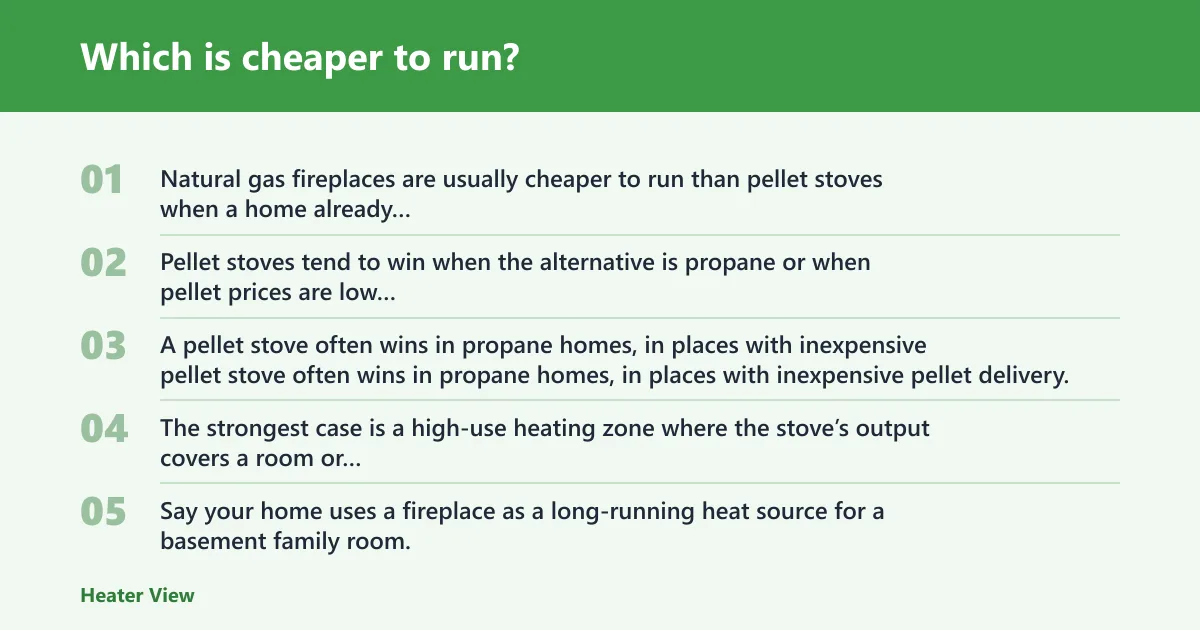
Natural gas fireplaces are usually cheaper to run than pellet stoves when a home already has gas service. Pellet stoves tend to win when the alternative is propane or when pellet prices are low enough to cover the added maintenance, delivery, and storage costs.
When a pellet stove usually wins
A pellet stove often wins in propane homes, in places with inexpensive pellet delivery, or where the stove runs enough hours to make fuel savings matter. The strongest case is a high-use heating zone where the stove’s output covers a room or small open-plan area for long stretches.
Say your home uses a fireplace as a long-running heat source for a basement family room. If propane prices are high and pellets can be stored dry and bought by the ton, the pellet stove can end up cheaper even after cleanup and delivery are included.
When a gas fireplace usually wins
Gas fireplaces usually win on total operating cost in natural gas homes because the fuel is often cheaper and the upkeep is simpler. They also win on convenience, since they provide instant heat without ash removal or pellet loading.
Suppose a 1,800-square-foot house already has a natural gas line and the fireplace is used mostly for short evening heating. The lower maintenance and immediate start-up can outweigh a pellet stove’s fuel advantage.
Why propane changes the answer faster than natural gas
Propane is the swing factor. It generally costs more than natural gas, so a propane fireplace can become expensive to operate even before service calls, vent cleaning, or tank fees are added.
That is why a pellet stove can beat a gas fireplace more quickly in propane homes than in natural gas homes. The fuel-price gap is simply larger.
Side-by-side monthly cost table: pellets vs gas
These are sample monthly operating cost scenarios meant to show the math, not fixed market prices. The pattern matters more than the exact dollar amounts: natural gas usually favors the fireplace, propane usually favors pellets, and pellet-delivery homes can swing either way depending on freight and storage.
| Scenario | Pellet stove: fuel | Pellet stove: maintenance | Pellet stove: delivery/storage | Pellet stove total | Gas fireplace: fuel | Gas fireplace: maintenance | Gas fireplace: delivery/storage | Gas fireplace total | Lower-cost option |
|---|---|---|---|---|---|---|---|---|---|
| Natural gas home | $55 | $10 | $5 | $70 | $40 | $5 | $0 | $45 | Gas fireplace |
| Propane home | $55 | $10 | $5 | $70 | $95 | $5 | $0 | $100 | Pellet stove |
| Off-grid pellet-delivery home | $55 | $10 | $15 | $80 | $95 | $5 | $0 | $100 | Pellet stove |
What the table is showing
The natural gas case favors the gas fireplace because fuel is cheaper and the maintenance burden is lighter. The propane case flips the result because propane’s fuel cost is high enough to overwhelm the fireplace’s convenience.
The off-grid pellet-delivery case is the warning label. If delivery fees rise or pellets must be stored in a dry outbuilding, the pellet stove’s total can climb fast. That is the failure case many comparison pages miss.
How fuel price and BTU output affect your bill
Fuel price and BTU output work together. A cheaper fuel does not automatically mean a cheaper bill if the appliance wastes heat, and a high-BTU appliance does not save money if it burns more fuel than the space needs.
Wood pellet pricing by bag, half-ton, or ton
My Pellet Store sells fuel by the ton, half-ton, or bag. Typical bag weights can range from roughly 28 to 50 lb, which makes pallet pricing and bag count more important than a single sticker price.
Storage matters because pellets must stay dry. A pellet stove can hold enough fuel for 2 to 3 days, but the rest still needs a clean storage area. If deliveries are priced in zones and 1-ton delivery is as low as $85 in one zone, the delivered cost can still vary a lot by location.
Natural gas and propane price differences
Natural gas is often the cheaper fuel for fireplaces. Propane usually costs more and is more sensitive to delivery and tank fill timing, so the same appliance can have a very different monthly bill depending on the fuel source.
This is why gas fireplaces should never be grouped together as one cost category. Natural gas and propane behave differently enough that the wrong comparison gives the wrong answer.
How BTU output and appliance efficiency shape usable heat
BTU output is the heating output measure that lets you compare appliances, but raw BTU ratings do not tell the whole story. A higher-BTU unit can still be more expensive if its fuel costs more or if the stove spends more time in start-up and cleanup.
Pellet stoves can produce high BTU output depending on the model and fuel, while gas fireplaces often give quicker room heat. For total cost, the useful question is how much heat reaches the room per dollar, after efficiency, ash handling, and fuel delivery are included.
Which heats faster and which heats more space?
Gas fireplaces heat faster because they provide instant heat. Pellet stoves can put out high BTUs, but they need start-up time, fuel feed, and a little more lead time before the room feels warm.
Instant heat from a gas fireplace
A gas fireplace is the simpler answer for short bursts of heat. Turn it on, and the burner starts producing heat right away, which is useful for evening comfort or spot heating.
Pellet stove heat output and warm-up time
Pellet stoves can produce strong heat once the auger-fed system is running and the burn pot is established. That makes them practical for longer heating sessions, especially when a homeowner wants steadier output instead of a quick burst.
A common first-timer mistake is expecting a pellet stove to act like a gas fireplace. It can heat well, but it is less immediate and asks for more operator attention.
Whole-house heating limits and room-size fit
Neither appliance should be treated as a whole-house solution without checking home size, climate, and output. A pellet stove may heat a larger open area better than a gas fireplace, but ducted central heat still wins for even whole-house coverage.
For a single-zone space, a pellet stove can make sense. For a room that needs fast, intermittent warmth, gas often fits better.
What do maintenance and installation add to the total cost?
Pellet stoves usually cost more to maintain than gas fireplaces. Gas fireplaces are simpler, but they still need inspections and burner or vent cleaning, and both systems carry installation costs that should be part of the operating-cost decision.
Pellet stove ash removal, burn-pot cleaning, and service needs
Pellet stoves require ash removal and burn-pot cleaning. Premium pellets with lower ash content can reduce the chore, but they do not remove it.
That routine care is the main reason a pellet stove can lose its fuel advantage in some homes. Lower fuel cost helps, but upkeep takes time and sometimes service money.
Gas fireplace inspections and burner or vent cleaning
Gas fireplaces typically have lower maintenance complexity. They still need professional installation in most cases, plus periodic inspection and burner or vent cleaning to stay safe and efficient.
The lower upkeep is one reason gas often wins on total operating cost in natural gas homes. Less cleanup means fewer hidden costs.
Installation and venting costs that affect ownership cost
Installation is often easier to price for a gas fireplace if the gas line already exists. Pellet stoves need venting, clearances, and storage space for fuel, while gas fireplaces need a proper gas supply and professional setup.
Choose the system that matches the fuel already available in the house. Buying the “cheaper” appliance is a poor deal if the installation path adds more cost than the monthly fuel savings can recover.
Choose Pellet stove if… / Choose gas fireplace: Which is cheaper to run if…
Choose a pellet stove if fuel savings matter most, you can store pellets dry, and your house would otherwise rely on propane. Choose a gas fireplace if convenience, instant heat, and lower maintenance matter more, especially in a natural gas home.
Choose a pellet stove if…
- You buy pellets in bags, half-tons, or by the ton at a good delivered price.
- You can handle ash removal and burn-pot cleaning.
- You need longer heating runs and can live with start-up time.
- Your alternative is propane, not natural gas.
Choose gas fireplace: Which is cheaper to run if…
- Your home already has natural gas service.
- You want instant heat with less routine cleanup.
- You value lower maintenance more than fuel flexibility.
- You do not want to store solid fuel indoors or nearby.
Frequently asked questions
Is a pellet stove cheaper to run than a gas fireplace?
Sometimes, but not usually in a natural gas home. Pellet stoves can be cheaper to run than propane fireplaces or high-priced gas setups, yet maintenance, delivery, and storage can erase the fuel savings. The cheapest option depends on fuel type, local pricing, and how often the appliance runs.
How much do wood pellets cost compared with natural gas or propane?
Pellet pricing is usually quoted by bag, half-ton, or ton, while gas is billed by utility usage or propane delivery. Pellets can be competitive, but delivered cost changes with zone pricing and storage needs. Natural gas is commonly cheaper than propane, which is why propane shifts the comparison.
Which heats faster: a pellet stove or a gas fireplace?
A gas fireplace heats faster because it provides instant heat. Pellet stoves need time for the auger-fed feed system and burn pot to come up to operating temperature. Pellet units can still put out high BTUs, but they are usually better for sustained heating than for quick bursts.
Do pellet stoves cost more to maintain than gas fireplaces?
Yes, usually. Pellet stoves need ash removal and burn-pot cleaning, and they may need more frequent attention if the pellets have higher ash content. Gas fireplaces still need inspections and burner or vent cleaning, but the day-to-day upkeep is generally lighter.
How many BTUs does a pellet stove produce?
BTU output varies by model and fuel quality, so there is no single number that fits every stove. One listed pellet product advertises up to 8980 BTU, and some stoves are designed for much higher output. Use the appliance rating and your room size together, not BTU alone.
Can a pellet stove heat a whole house better than a gas fireplace?
Sometimes in a small or open floor plan, but not by default. A pellet stove can hold enough fuel for 2 to 3 days and can deliver strong heat, yet whole-house performance still depends on layout, climate, and output. A gas fireplace is usually better viewed as zone heating.