Are Ceramic Heaters Efficient for Personal Heating?
Yes, ceramic heaters are efficient for personal heating when you warm only your desk, bedside, or one small zone; at 750 to 1,500 watts, they cut running cost only if they replace heating an entire room. Used poorly, they pay for warm air that drifts away. This guide explains when ceramic heaters lower electricity use, when they only heat quickly, and how they compare with other small-space options.
How efficiency works for personal ceramic heating
For personal heating, yes, when the heat stays near you. Ceramic heaters are electric heaters that use resistive heating, often with a PTC ceramic element, so they turn electrical energy into warmth quickly. That makes them useful for a desk or bedside zone, but fast warm-up does not automatically mean lower electricity use.
What efficiency means in personal heating
In this context, efficiency means heat reaches your body or a small occupied zone instead of warming air you do not need. A heater can be efficient for one person and still be a poor choice for a whole room. The real question is whether the heater can deliver enough comfort at the lowest useful wattage and runtime.
Why fast heat is not the same as low cost
Fast heat only means the heater begins producing warm air or radiant warmth quickly. It does not change the electrical input required to make that heat. If a 1,500 W heater runs for an hour, it uses 1.5 kWh whether the warmth arrives in two minutes or ten. (Wikipedia)
How ceramic heaters make heat
Ceramic heaters make warmth through resistive heating, also called Joule heating or Ohmic heating. The ceramic PTC element helps control output as it warms, which matters for comfort and safety.
PTC ceramic elements and self-regulating behavior
A PTC, or Positive Temperature Coefficient, ceramic element increases resistance as temperature rises. That self-regulating behavior helps prevent runaway heating and can smooth output near the set temperature. It is one reason ceramic heaters are common in portable heater systems and other efficient electric heating uses.
Resistive heating and Joule’s law
Resistive heating is simple: the heater converts electrical energy into thermal energy. Joule’s law explains why output depends on current and resistance. When you increase current through the element, heat output rises; when the element warms and resistance changes, output changes too. That is the basis of ceramic heater performance.
What wattage tells you
Wattage tells you the maximum power draw and sets the ceiling for heat output. Portable space heaters are often rated around 1,500 W, which is enough for targeted personal heating and many small rooms. It also sets the upper limit for running cost: more watts means more electricity per hour.
Do ceramic heaters use less electricity?
Not automatically. A ceramic heater uses less electricity only when its lower runtime or lower selected wattage replaces a higher-energy heating option, such as conditioning a larger room. Thermostat control matters a lot here. If the heater cycles off after it reaches the target temperature, it can use less energy than a unit that runs continuously.
Wattage, runtime, and energy cost
Energy use is simple arithmetic: watts multiplied by time. A 750 W setting uses 0.75 kWh in one hour if it runs without stopping. A 1,500 W setting uses about 1.5 kWh per hour. Lower wattage can reduce cost, but only if the comfort level stays acceptable.
Thermostat cycling and real-world consumption
Thermostat control reduces waste by turning the heater off and on instead of letting it run full time. In a small enclosed zone, cycling can trim energy use because the heater only tops up heat after losses. In a drafty room, the thermostat may call for heat again and again, which erodes any savings.
When a 1,500 W heater is enough
A 1,500 W unit is often enough for a desk nook, a bedside area, or a small room with a door closed and limited drafts. It is not a promise of low cost. It is simply a common upper range for portable heaters, giving you enough output to warm a nearby zone quickly.
Ceramic heater efficiency decision table
The table below compares personal-heating efficiency by use case, not by whole-room heating. The best choice depends on where the warmth needs to go, how quickly you need it, and whether the heater can keep cycling instead of running flat out.
| Scenario | Likely wattage range | Heat-up speed | Directional warmth | Thermostat cycling behavior | Comfort radius | Likely best-fit use case |
|---|---|---|---|---|---|---|
| Desk use | 250 to 750 W on low; up to 1,500 W on high | Fast | Moderate with fan, best when aimed at torso and hands | Often cycles well if the desk area is partly enclosed | About 2 to 4 feet | Short sessions at a workstation |
| Bedside use | 500 to 1,000 W | Fast | Good for warming the immediate sleeping area before bed | Can cycle effectively if the room is closed and set point is modest | About 3 to 6 feet | Preheating a small sleeping zone |
| Small enclosed room | 750 to 1,500 W | Fast | Fair to good, depending on fan strength and placement | Usually cycles normally if doors and windows stay closed | About 6 to 10 feet | One person in a compact room |
| Drafty room | 1,500 W | Fast, but heat loss is also fast | Poor to fair | Cycles often or runs longer to keep up with leaks | Small near-field comfort only | Temporary spot heating, not full-room comfort |
When are ceramic heaters the better choice?
Ceramic heaters are a strong choice when you want heat where you sit or sleep, not throughout a whole room. Their quick response, fan-assisted airflow, and common 1,500 W ceiling make them useful for targeted comfort. They are strongest in enclosed spaces where thermostat cycling can actually reduce runtime.
Personal heat at a desk
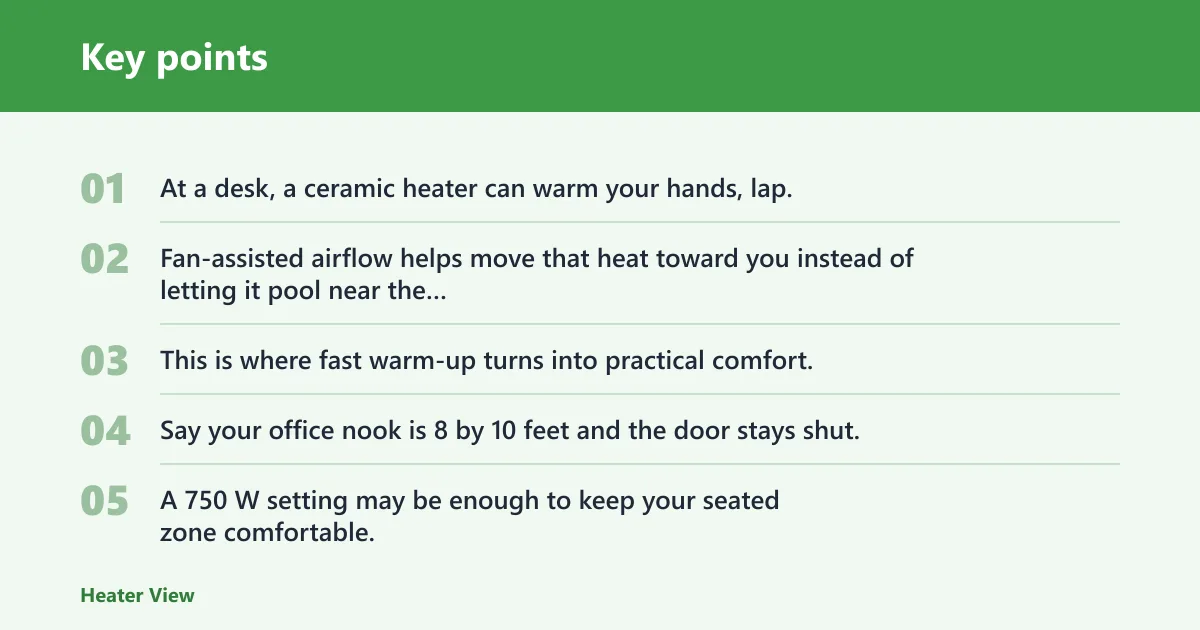
At a desk, a ceramic heater can warm your hands, lap, and lower torso without needing to heat the whole room. Fan-assisted airflow helps move that heat toward you instead of letting it pool near the heater. This is where fast warm-up turns into practical comfort.
Say your office nook is 8 by 10 feet and the door stays shut. A 750 W setting may be enough to keep your seated zone comfortable, especially if the heater points below desk height and the thermostat does not keep calling for full output.
Short bursts of warmth near you
Short bursts are where ceramic heaters make the most sense. You can turn them on only when you need them, then let the thermostat hold a narrow comfort band. The heater does not need to warm walls, floors, or far corners to feel useful.
Small rooms with limited drafts
In a small enclosed room, a ceramic heater can be practical if air leaks are limited. The smaller the heat-loss load, the more likely the heater can cycle instead of running flat out. That is what makes the unit feel efficient in real use.
When do ceramic heaters lose efficiency?
Ceramic heaters lose their advantage when they must fight a large heat load or poor control. Oversized rooms, leaky windows, bad thermostat placement, and long unattended heating all work against them. In those cases, the heater may still warm fast, but it will not use less electricity in any meaningful way.
Oversized rooms
A heater built for personal heating cannot keep a large open room comfortable without long runtime. The same 1,500 W output that works near a desk may be too little for a bigger space, which pushes the heater toward continuous operation and higher energy use.
Drafts and air leaks
Drafts make any heater look weaker. Warm air escapes, cold air enters, and the thermostat senses a drop that triggers more heating. That cycle can erase the comfort advantage of a ceramic heater, especially if the room has poor insulation or an open doorway.
Poor thermostat placement
If the thermostat sits where it sees the heater’s warm airflow too early, the unit may shut off before your body feels comfortable. If it sits too far from the occupied zone, it may overrun. Either problem hurts efficiency because the control point no longer matches the person who needs heat.
Long unattended heating
Leaving a personal heater on for long periods is usually a bad trade. The unit may keep heating an empty chair, an empty bedside, or a room you are not using. Personal heating works best when the heater serves a short, specific task.
A common first-timer mistake is to set a 1,500 W ceramic heater in the middle of a drafty room and expect it to feel efficient. The unit may sound active and blow warm air, but the room keeps losing that heat. The result is more runtime, not less electricity use.
How ceramic heaters compare with other heater types
Ceramic heaters compete well for personal heating, but they are not always the best fit. Infrared, convection, and oil-filled heaters warm people in different ways. The better choice depends on whether you want direct radiant warmth, moving air, slower storage heat, or quick spot heating.
Ceramic vs infrared
Infrared heaters send radiant heat directly toward nearby surfaces and people. That can feel more efficient for a single seated person because the warmth is more directional and less dependent on air circulation. Ceramic heaters are often better when you want a mix of quick warm-up and some air movement.
Ceramic vs convection
Convection heaters warm air and rely on circulation to distribute it. Ceramic fan heaters also use airflow, but they usually respond faster and feel more immediate. In a small zone, ceramic heaters can feel more efficient because they deliver noticeable warmth sooner at the same wattage class.
Ceramic vs oil-filled
Oil-filled heaters warm slowly and hold heat longer after the thermostat cuts power. That can help in steady, long-duration heating. Ceramic heaters are better when you want quick comfort on demand. For a desk or a short evening session, the ceramic unit usually feels more responsive.
Are ceramic heaters safe for personal heating?
They can be, but safety depends on the design, placement, and built-in protections. Ceramic heaters are valued for surface temperature safety and rapid heat-up time, yet they still get hot enough to matter. Look for stable placement, tip-over protection, overheat shutoff, and enough clearance from fabric and paper.
Surface temperature and burn risk
Lower surface temperature helps reduce burn risk, especially in small spaces where you may sit close to the unit. Ceramic elements and some housings stay cooler than exposed coils, but the grille, outlet air, and nearby surfaces can still become hot. Keep hands, curtains, and bedding away.
Fan noise and comfort limits
Fan-assisted heating moves warm air, but it also adds noise. That can affect comfort at a desk or bedside, even when the heater is thermally effective. If the fan is distracting, the heater may be less suitable for personal heating, no matter how quickly it warms the space.
Useful safety features to look
Tip-over shutoff, overheat protection, sturdy housing, and a thermostat that can hold a low set point all matter. So does stable airflow that does not blast hot air directly at paper, bedding, or feet. Safety features do not make a heater perfect, but they do make personal heating more practical.
- Match the heater to the occupied zone, not the whole room.
- Choose a wattage that fits the space, often 750 to 1,500 W for portable personal use.
- Use thermostat control so the heater can cycle instead of running nonstop.
- Place the unit where airflow reaches you without hitting curtains, bedding, or clutter.
- Close doors and reduce drafts before assuming the heater is underpowered.
- Check for tip-over and overheat protection before bedside or under-desk use.
Frequently asked questions
Are ceramic heaters efficient for personal heating?
Yes, when the goal is to warm a person or a small zone rather than a whole room. Ceramic heaters are efficient in that narrow sense because they make heat quickly and can direct it near the user. They are not automatically efficient for larger spaces or drafty rooms.
Do ceramic heaters use less electricity than other space heaters?
Not by default. Electricity use depends on wattage, runtime, thermostat cycling, and how much space needs heat. A ceramic heater can use less electricity than another heater type if it warms a small occupied area more directly, but the opposite can happen in a leaky or oversized room.
Is a ceramic heater cheaper to run for one person?
It often can be, if one person is the only target and the room is small. The savings come from heating less space, not from magic efficiency. If the heater runs at high wattage for long periods, or if heat escapes quickly, the running cost can climb fast.
How much electricity does a ceramic space heater use?
That depends on the wattage setting. A 750 W setting uses 0.75 kWh per hour of continuous running. A 1,500 W setting uses 1.5 kWh per hour. Thermostat cycling can lower that average, but only if the space holds heat well enough for the heater to switch off often.
Are ceramic heaters good for heating a desk or small room?
Yes, that is one of their best uses. They are well suited to a desk nook or a small enclosed room because they heat quickly and can aim warmth toward the occupied area. They are less effective when the room is large, open, or full of drafts.
What makes a ceramic heater efficient?
Three things matter most: a PTC ceramic element, enough wattage for the zone, and good temperature control. The PTC element helps regulate output as it warms. The wattage sets the ceiling. The thermostat decides whether the heater can cycle instead of wasting power on unnecessary heat.