Are micathermic heaters efficient compared with ceramic?
Micathermic heaters are not electrically more efficient than ceramic heaters at the same wattage; both turn nearly all input power into heat, so the real difference is how quickly and comfortably that heat reaches you. Miss that point, and you may pay more by choosing a heater that feels good but cannot cut runtime in your actual room. This guide compares micathermic and ceramic heaters on efficiency, noise, room fit, and the conditions that matter for bedrooms, offices, and small enclosed spaces.
Are micathermic heaters efficient compared with ceramic?
At equal wattage, no. A micathermic heater and a ceramic heater are both electric resistance heaters, so they turn most of the electricity they use into heat at the point of use. If each runs at 1,500W, each draws about the same power while on.
The practical question is not electrical conversion. It is runtime. A heater that feels comfortable sooner may let you lower the setpoint or switch it off earlier, which can reduce total kWh used over a day. That is comfort-driven efficiency, not a different heating physics.
What changes the bill
Three things matter more than the heater label: thermostat cycling, room heat loss, and room size. A well-insulated bedroom with the door closed may need short cycles. A drafty open space may force either heater to run much longer, which erases any comfort advantage.
Micathermic vs ceramic: side-by-side comparison
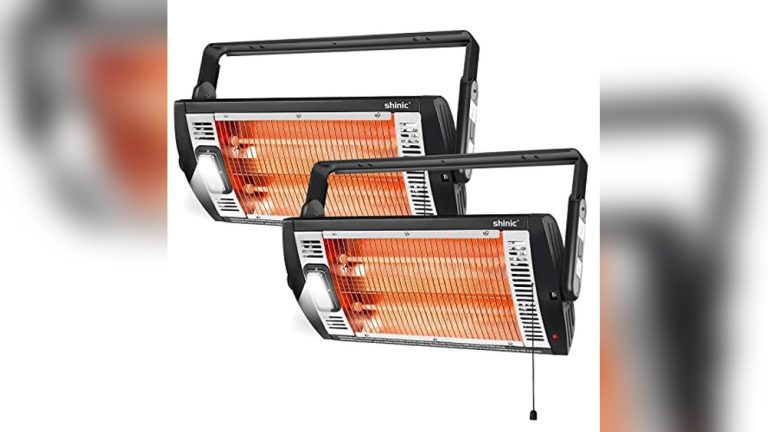
Micathermic heaters are usually quieter, slimmer, and often fanless or low-fan. Ceramic heaters usually use a PTC ceramic element with a fan, so they move warm air faster and usually sound louder. Neither type has a built-in electricity-cost advantage at the same wattage and runtime.
| Criterion | Micathermic heater | Ceramic heater |
|---|---|---|
| Heat method | Mica around the element; convection and radiant heat | PTC ceramic element with fan-forced airflow |
| Noise | Usually quieter because many units are fanless | Usually louder because the fan moves air |
| Warm-up feel | Steadier, less blast-like | Often feels faster |
| Common form factor | Slim panel, wall-mount or freestanding | Compact portable units |
| Typical controls | Often simple thermostat and heat settings | Digital thermostat, remote, timer, oscillation on some models |
| Electricity use at same wattage | Similar | Similar |
How each heater makes heat
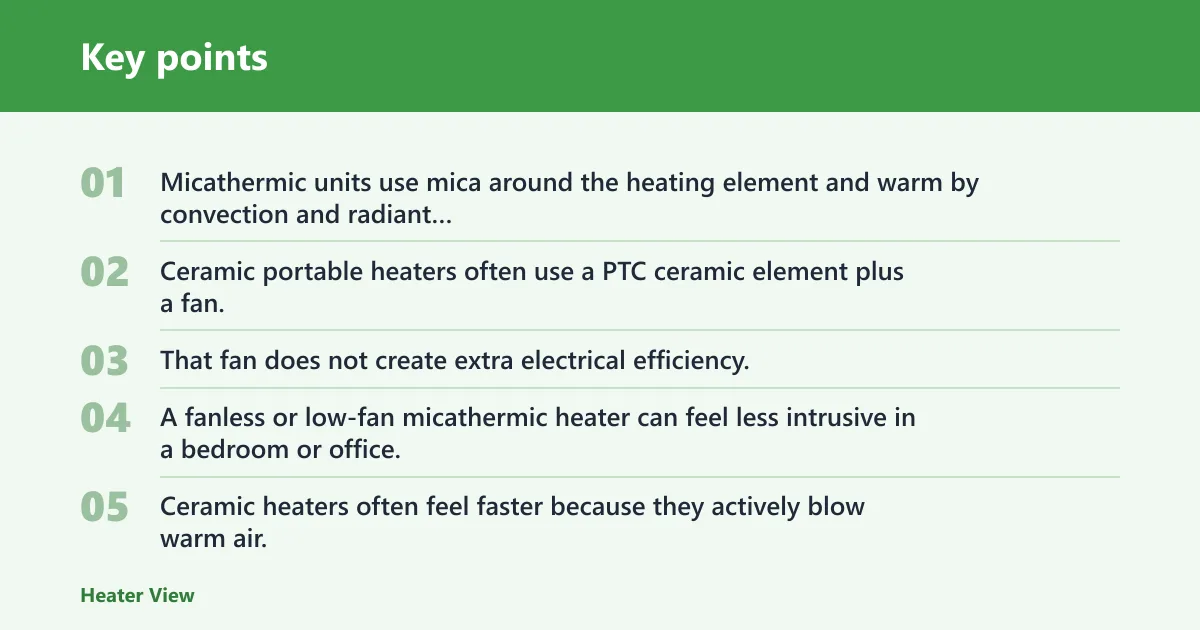
Micathermic units use mica around the heating element and warm by convection and radiant heat. Ceramic portable heaters often use a PTC ceramic element plus a fan. That fan does not create extra electrical efficiency; it changes how the heat is delivered to the room.
Noise, warm-up feel, and room comfort
Quiet matters in occupied rooms. A fanless or low-fan micathermic heater can feel less intrusive in a bedroom or office. Ceramic heaters often feel faster because they actively blow warm air, which can be useful when you want a quick boost near a desk or seat.
Typical wattage, controls, and form factor
A common maximum draw for both types is around 1,500W. Micathermic heaters often come as slim panels with wall-mount or freestanding options. Ceramic models often add digital thermostats, timers, remotes, and oscillation. Those controls affect convenience, not basic electric efficiency.
Do micathermic heaters use less electricity than ceramic heaters?
Not by design. At the same wattage and runtime, a micathermic heater and a ceramic heater use about the same electricity. The only way one uses less is if it helps the room reach comfort with less run time or lower thermostat demand.
Why 1,500W means 1.5 kWh per hour at full power
A 1,500W heater uses 1.5 kWh for each hour at full power. That is true for a micathermic heater and a ceramic heater. A 900W setting uses about 0.9 kWh in an hour. The label changes the draw, not the heater type.
How thermostat cycling changes actual use
Most real rooms do not keep a heater on full power every minute. Thermostat cycling turns the heater on and off to hold a target temperature. If one model reaches comfort faster and cycles off sooner, it may use less energy in practice, but that comes from runtime, not from being micathermic or ceramic.
Suppose a 120-square-foot bedroom is closed off and only needs short top-ups. A quieter heater may run long enough to keep the room comfortable without making the fan obvious. In a drafty open-plan living area, the same heater may never cycle down much at all.
Hourly cost worksheet for 900W and 1500W
Use this worksheet as a simple check. It compares equal-watt micathermic and ceramic heaters under the same room conditions. The cost per hour is the same at a given wattage; the difference appears only when thermostat cycling changes runtime.
| Setting | Power draw | Energy used in 1 hour at full power | Cost per hour at $0.15/kWh | Cost per hour at $0.25/kWh |
|---|---|---|---|---|
| Low setting | 900W | 0.9 kWh | $0.14 | $0.23 |
| High setting | 1,500W | 1.5 kWh | $0.23 | $0.38 |
Thermostat cycle assumptions you can change
Use simple cycle estimates to think about real use. If a heater runs 50% of the time on a 1,500W setting, average draw is about 750W, or 0.75 kWh per hour. At 30% duty cycle, average draw drops to 450W, or 0.45 kWh per hour.
That math applies to both heater types. If a ceramic heater’s fan makes the room feel warmer sooner, it may reach a lower duty cycle faster. If a micathermic heater feels more comfortable for longer stretches, you may leave it on less aggressively. The room decides the bill.
Room-fit checklist for bedrooms, offices, and drafty spaces
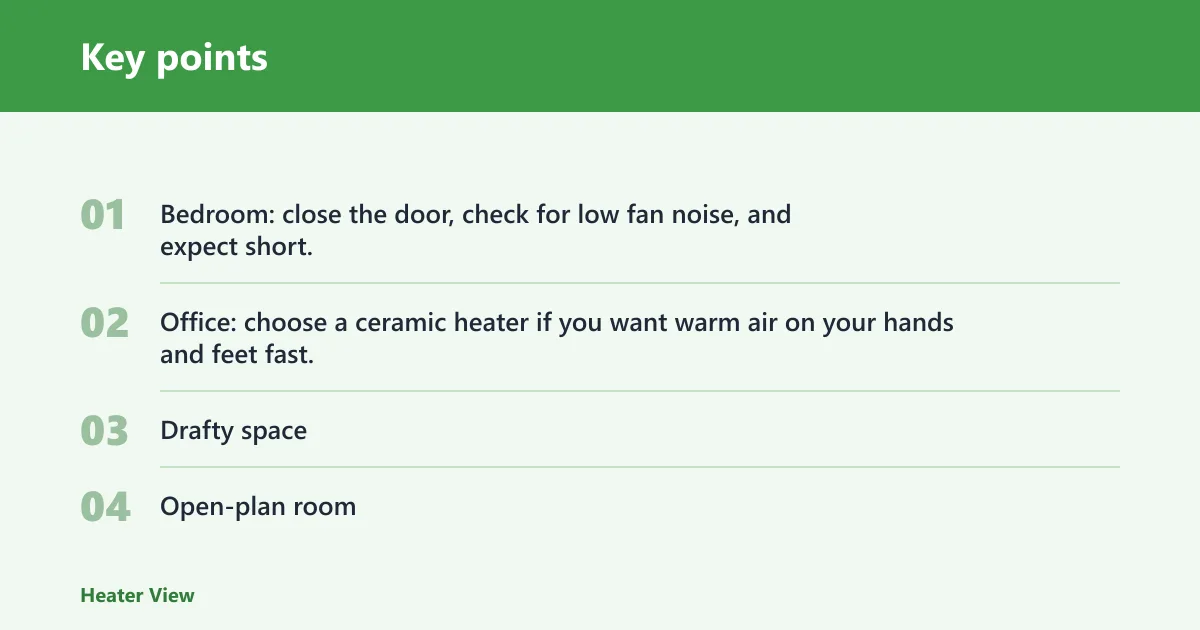
- Bedroom: close the door, check for low fan noise, and expect short, steady cycles rather than a hard blast of air.
- Office: choose a ceramic heater if you want warm air on your hands and feet fast, or pick micathermic heat if fan sound distracts you during calls or reading.
- Drafty space: seal gaps at windows and doors first. If cold air keeps pouring in, either heater can run too long and still leave the room uneven.
- Open-plan room: neither type is ideal as a main heater if the area is large and exposed.
Which heater is better for a bedroom or office?
For a bedroom, micathermic is often the better fit because it is usually quieter and less likely to create a fan sound that interferes with sleep. For a desk space, ceramic can be better if you want faster warm air and more control options.
Bedroom use: quiet heat and sleep-off guidance
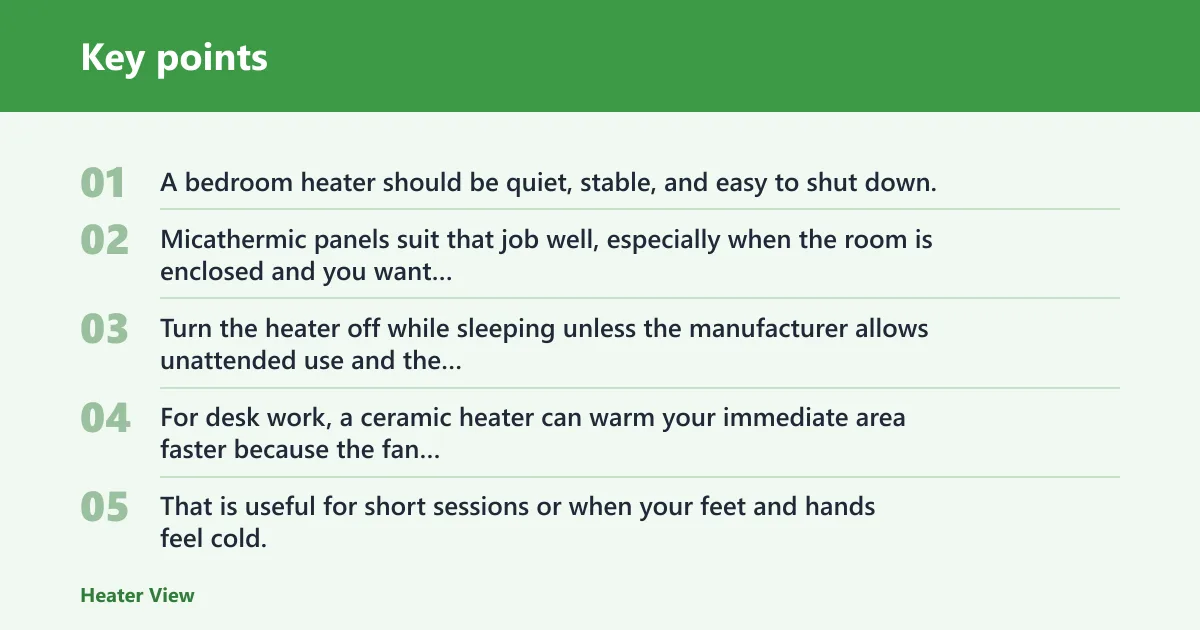
A bedroom heater should be quiet, stable, and easy to shut down. Micathermic panels suit that job well, especially when the room is enclosed and you want gentle heat. Turn the heater off while sleeping unless the manufacturer allows unattended use and the setup still follows safety guidance.
Desk work: fan noise versus quicker warm air
For desk work, a ceramic heater can warm your immediate area faster because the fan pushes heat toward you. That is useful for short sessions or when your feet and hands feel cold. If fan noise bothers you, a micathermic unit may be easier to live with for long work blocks.
Drafty or open rooms: when neither type is a good main heater
In a large or leaky room, both types can disappoint. A 1,500W heater is common, but common does not mean enough for every room. If heat escapes quickly, the heater may stay on too long and still not feel effective.
Picture a 14-by-16-foot den with an open doorway and a window that leaks air. A quiet panel heater may seem pleasant at first, then run and run without changing the room temperature much. In that case, sealing drafts or choosing a larger heating solution matters more than the heater type.
Choose micathermic if… / Choose ceramic if…
Choose micathermic if you want quieter, steadier heat in an occupied room and you do not need a fan to push warm air quickly. Choose ceramic if you want faster perceived warm-up, more compact portability, and controls such as a digital thermostat, timer, remote, or oscillation.
Choose micathermic if you want quieter, steadier occupied-room heat
- You are heating a bedroom and want low noise.
- You want a slim panel form factor or wall-mount option.
- You prefer steady warmth over a blast of air.
- You are using the heater in a small enclosed room where circulation is already decent.
Choose ceramic if you want faster perceived warm-up and more control options
- You need heat that feels immediate near a desk or chair.
- You want digital thermostat control, remote operation, or a timer.
- You are moving the heater from room to room.
- You do not mind fan noise.
When to skip both and size up or improve the room first
If the room is drafty, open, or much larger than the heater is meant to cover, start with insulation and air sealing. A space heater cannot compensate for a weak room shell forever. In that case, bigger heating capacity or a different heating plan is the better fix.
Safety and placement rules to follow
Keep portable heaters about three feet from combustibles, plug them directly into a wall outlet, and place them on a stable surface. These rules matter for both micathermic and ceramic units. Turn the heater off while sleeping unless the product instructions clearly allow otherwise and the room setup is safe.
Three-foot clearance from combustibles
The U.S. Consumer Product Safety Commission recommends keeping about three feet of space from anything that can burn. That includes bedding, curtains, paper, clothing, and furniture. Do not set a heater where towels or drapes can fall across it.
Tip-over, overheat, and sleep-off basics
Safety features help, but they are not a substitute for placement discipline. Consumer Reports says many heaters shut off instantly in tip-over testing, and many models include overheat protection. The DeLonghi HMP1500 includes thermal shutoff and a tip-over switch, while the Lasko 754200 includes overheat protection.
Product examples to anchor the comparison
The DeLonghi HMP1500 is a 1500W mica panel heater with two heat settings, an adjustable thermostat, thermal shutoff, and a tip-over switch. The Dreo Atom One uses a 41–95°F digital thermostat and includes 70° oscillation and a remote control. The Lasko 754200 offers 1500W high heat, 900W low heat, fan-only mode, a manual thermostat, and cool-touch housing.
Frequently asked questions
Are micathermic heaters more efficient than ceramic heaters?
No. At the same wattage, micathermic and ceramic heaters are both electric resistance heaters and use similar electricity while running. Any real-world savings come from shorter runtime, better thermostat cycling, or a room that matches the heater’s comfort pattern, not from a built-in electrical efficiency edge.
Do micathermic heaters use less electricity than ceramic heaters?
Not at the same wattage and runtime. A 1,500W micathermic heater and a 1,500W ceramic heater each draw about 1.5 kWh per hour at full power. If one type reduces how long you keep the heater on, that can lower total use.
Which is better for a bedroom, micathermic or ceramic?
Micathermic is often the better bedroom pick because it is usually quieter and less intrusive. Ceramic can still work if you want quicker warm air, but the fan may be noticeable at night. In either case, follow clearance rules and turn the heater off while sleeping.
Is a micathermic heater cheaper to run than a ceramic heater?
Not inherently. Cost depends on wattage, thermostat cycling, and how much heat the room loses. If a micathermic heater keeps a quiet bedroom comfortable with less on-time, it can cost less in practice. If not, the bill should be similar to a ceramic heater.
Do ceramic heaters heat faster than micathermic heaters?
Often yes, in terms of perceived speed. Ceramic heaters generally feel faster because the fan actively blows warm air toward you. Micathermic heaters warm by convection and radiant heat, so the feel is steadier and usually quieter, but not as forceful at first.
How do I choose between micathermic and ceramic for a small room?
Choose micathermic for quiet, steady heat in a bedroom or enclosed office. Choose ceramic if you want faster warm-up, a remote, oscillation, or a digital thermostat. If the room is drafty or open, fix the room losses first; otherwise neither type will feel efficient for long.