How to Fix Low Hot Water Pressure From a Water Heater
If hot water flow is low at one fixture, clean the aerator or showerhead first. If every hot tap is weak, check the water heater’s cold inlet valve, the mixing valve, and the heater-side fittings for restriction. Checking the wrong part wastes time and can lead to an unnecessary water heater replacement. This guide walks you from the tap back to the heater with a simple decision tree that separates fixture clogs, valve problems, and heater-side failures.
What you’ll need


- Bucket or towel
- Small wrench or pliers for accessible fixture parts
- Toothbrush or nylon brush
- White vinegar for mineral buildup
- Hose bibb pressure gauge for an outdoor spigot
- Flashlight
- Paper and pen for comparing readings and symptoms
Why is my hot water pressure low but cold water is fine?
That pattern usually means the restriction is on the hot side, not the whole house. Start at the affected fixture, then compare hot and cold at the same tap, because one hot tap can be limited by a clog, a hot-side valve, the mixing valve, or a heater-side fitting.
Step 1: Compare one fixture against the whole house
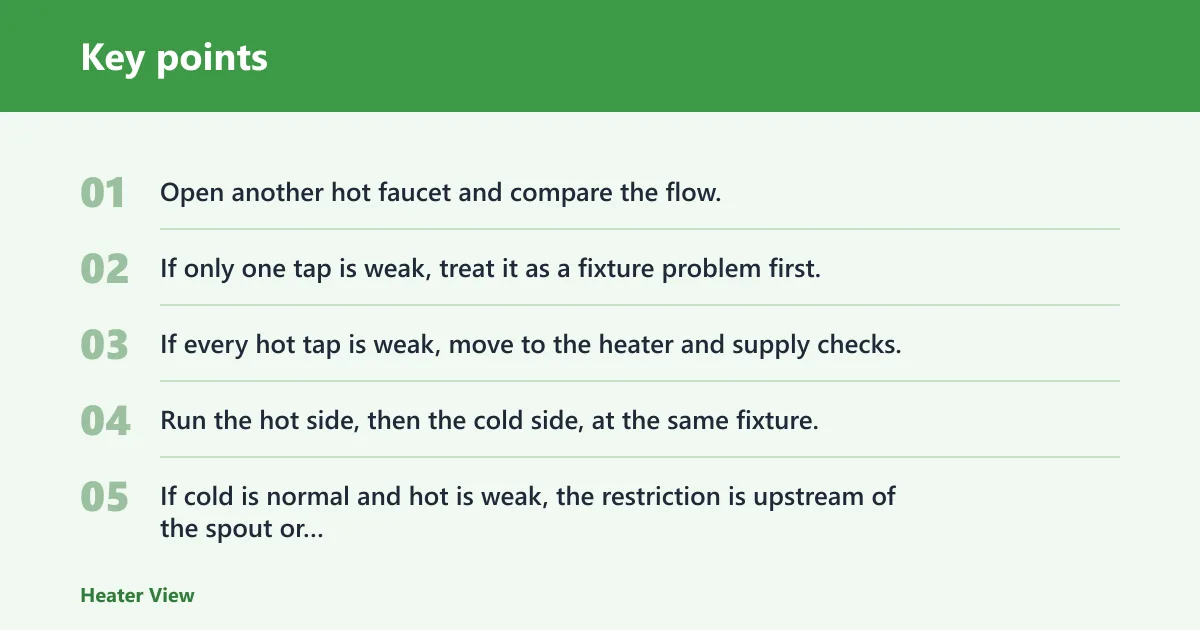
- Open another hot faucet and compare the flow.
- If only one tap is weak, treat it as a fixture problem first.
- If every hot tap is weak, move to the heater and supply checks.
Step 2: Compare hot flow with cold flow at the same tap
- Run the hot side, then the cold side, at the same fixture.
- If cold is normal and hot is weak, the restriction is upstream of the spout or showerhead on the hot path.
- If both are weak, look for a whole-house supply restriction.
Step 3: Watch for a drop after demand starts
- Let the hot water run for several minutes.
- If the flow starts normally and then falls off, note the timing.
- That pattern can point to a partially closed valve, a clogged heater-side fitting, or a mixing valve that limits usable hot flow.
Say your kitchen sink starts with strong hot flow, then slows after a minute while the cold side stays normal. That pattern fits a restriction that opens poorly under demand, such as a clogged aerator, a valve that is not fully open, or a restricted inlet fitting near the heater.
How do you tell if the faucet, shower, or heater is causing it?
Work from the fixture outward. A weak sink often points to the aerator, a weak shower often points to the showerhead, and weak hot water everywhere points back toward the heater, a mixing valve, or a whole-house valve problem.
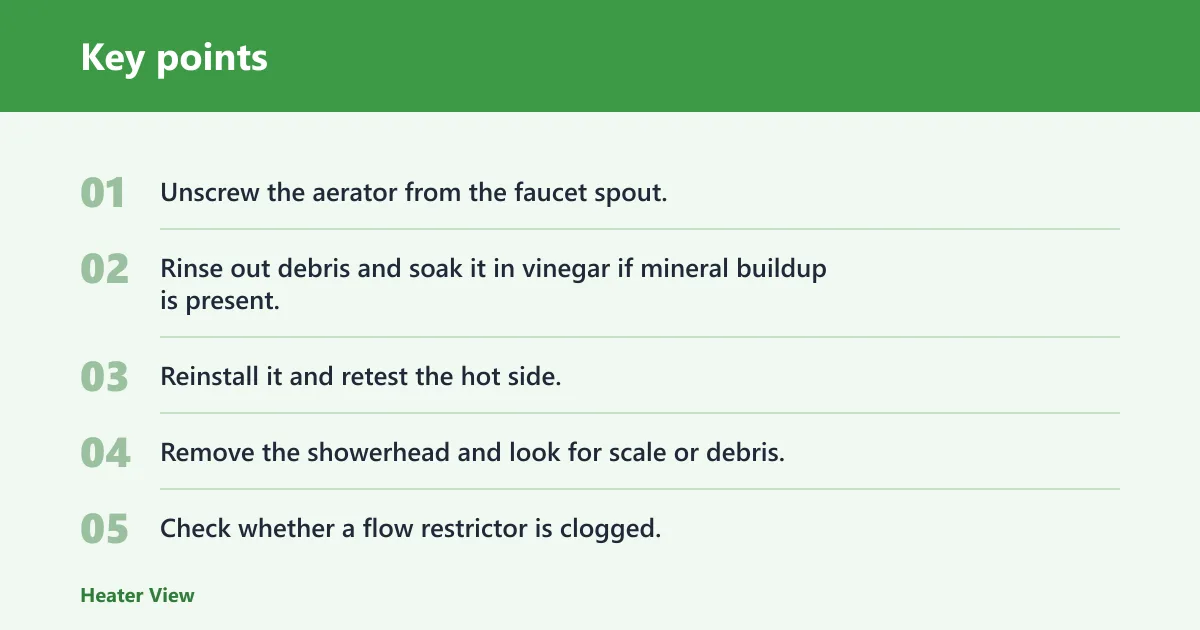
Step 4: Clean the aerator on a weak sink first
- Unscrew the aerator from the faucet spout.
- Rinse out debris and soak it in vinegar if mineral buildup is present.
- Reinstall it and retest the hot side.
Step 5: Check the showerhead and compare it with another fixture
- Remove the showerhead and look for scale or debris.
- Check whether a flow restrictor is clogged.
- Compare the shower flow with a nearby sink; if only the shower is weak, the showerhead is the likely restriction.
Step 6: Inspect visible shutoff valves and test the PRV if the whole house is weak
- Check that visible fixture shutoff valves are fully open.
- Find the pressure-reducing valve if the home has one, usually near the main supply entry.
- If adjustment changes the reading, note the result; if it does not, the PRV may need replacement.
Suppose a bathroom shower is weak but the vanity sink in the same room runs normally on hot water. That points to the showerhead, not the heater. If both fixtures weaken on hot while cold stays normal, the hot-side path or the heater itself becomes the better suspect.
Can a partially closed water heater valve cause low hot water pressure?
The water heater’s cold inlet valve should be fully open, and a partially closed valve can restrict hot flow throughout the house. Many heaters do not have a dedicated hot-outlet shutoff, so check the inlet valve first and do not assume the problem is on the outlet side.
Step 7: Check the cold inlet valve at the heater
- Locate the valve on the cold-water line entering the heater.
- Confirm it is fully open, not left partway shut after service work.
- If the valve is stuck, damaged, or leaks when moved, stop and call a plumber.
Step 8: Look for heat-trap nipples, inlet/outlet restrictions, and scale at the connections
- Inspect the visible connections at the top of the heater.
- Look for heat-trap nipples, debris, or scale that can narrow the hot path.
- Check whether a tempering or mixing valve is limiting usable hot flow before it reaches fixtures.
Step 9: Decide whether flushing is appropriate
- Check the owner’s manual for your model before flushing.
- If the issue is hot-side restriction at the heater, flushing may help only when sediment or debris is part of the problem.
- If the heater has corroded fittings, a bad valve, or a blocked mixing valve, service is the safer next step.
How do I check whether the problem is the faucet, shower, or water heater?
Use a hot-vs-cold comparison at the same fixture, then move from one fixture to the next. One fixture usually means a local clog. Several hot fixtures with normal cold flow point to the heater, its inlet valve, a mixing valve, or hot-side piping.
Step 10: Use the hose bibb gauge for a supply check
- Screw the hose bibb pressure gauge onto an outdoor spigot.
- Read the static pressure with no fixtures running.
- Many home water systems operate between 40 and 60 psi; pressure below 40 psi can indicate a problem that needs attention.
Step 11: Compare static and flowing pressure
- Note the gauge reading with all fixtures off.
- Open a few faucets and watch for a large drop.
- If the drop is large across the house, the restriction is upstream of the fixtures and may involve the PRV, main shutoff, or supply piping.
Step 12: Use the water meter leak indicator if the whole house seems weak
- Turn off all water using fixtures and appliances.
- Check the meter leak indicator for movement.
- If it moves with everything off, a hidden leak may be present and should be checked before more diagnosis.
What pressure should a home water system be at?
For many homes, a normal gauge reading is between 40 and 60 psi. A reading below about 40 psi can point to a supply issue, a failed pressure-reducing valve, or a main valve that is not fully open, but the diagnosis should still compare several fixtures before anyone changes parts.
Step 13: Inspect the pressure-reducing valve
- Find the PRV near the main water entry if your home has one.
- Check whether adjustment changes the gauge reading.
- If adjustment does not change the reading, the PRV may be failed and replacement is safer than continued tweaking.
When is low hot water pressure a sign of corroded pipes?
Galvanized pipes are a common suspect when the restriction has built gradually over time and affects more than one hot fixture. They corrode from the inside out, so the pipe opening shrinks and flow falls off even when the home pressure gauge still looks acceptable.
Step 14: Look for age patterns and fixture-wide symptoms
- Check whether several hot fixtures have become weaker over months or years.
- Look for older galvanized piping visible in basements, crawl spaces, or utility rooms.
- If the problem spans multiple fixtures and returns after cleaning aerators, pipe replacement is often the long-term fix.
Hot water diagnosis matrix
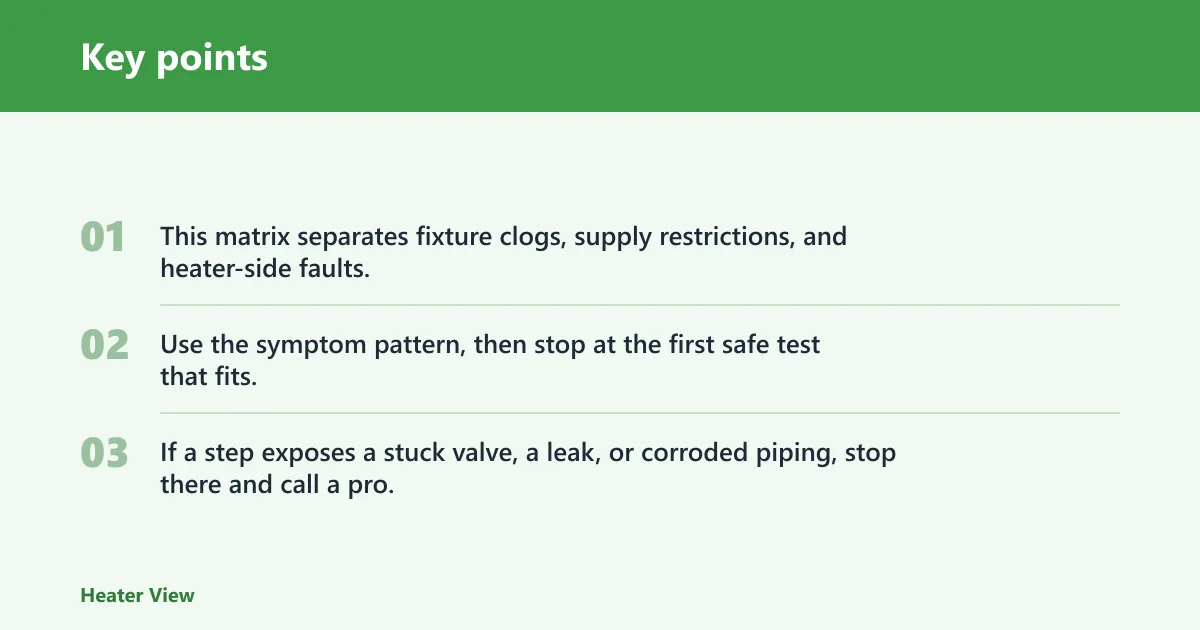
This matrix separates fixture clogs, supply restrictions, and heater-side faults. Use the symptom pattern, then stop at the first safe test that fits. If a step exposes a stuck valve, a leak, or corroded piping, stop there and call a pro.
| Symptom pattern | Likely cause | Next safe test | Stop-callout |
|---|---|---|---|
| Hot-only at one sink | Clogged aerator or faucet cartridge | Remove and clean the aerator, then retest | Stop if the faucet body leaks or seizes |
| Hot-only at one shower | Blocked showerhead or flow restrictor | Remove the showerhead and compare it with a nearby fixture | Stop if the shower arm is corroded |
| Hot-only throughout the house | Water heater valve, mixing valve, or heater-side restriction | Check the cold inlet valve at the heater and compare several fixtures | Stop if the valve is stuck or leaking |
| Cold water is normal, hot water is weak | Hot-side restriction | Inspect heater fittings, heat-trap nipples, and visible hot piping | Stop if access requires disassembly beyond simple visual checks |
| Flow drops after hot water runs for a while | Partially closed valve, heater-side debris, or mixing valve issue | Check the heater inlet valve position and the mixing valve setting | Stop if the valve cannot be moved by hand |
| Static home pressure reads below 40 psi | Supply restriction or PRV problem | Use the hose bibb gauge on another spigot and compare readings | Stop if the PRV is damaged or leaking |
| Normal static pressure, weak hot flow at multiple fixtures | Heater-side restriction or galvanized hot piping | Compare hot-only symptoms at three fixtures, then inspect visible piping | Stop if old piping is heavily corroded |
| Weak shower only, sink normal | Showerhead scale or debris | Clean the showerhead and retest | Stop if the shower valve drips or binds |
| Weak sink only, shower normal | Aerator clog or faucet restriction | Clean the aerator and inspect the spout screen | Stop if the faucet body is cracked |
| Water meter indicator moves with all fixtures off | Hidden leak | Shut off fixtures, read the meter indicator again, and check visible piping | Stop if water is pooling or damage is spreading |
| Hot is weak after recent heater service | Cold inlet valve partly closed or a connection issue | Verify the valve is fully open and inspect the top connections | Stop if service work exposed a leak |
Common mistakes
The biggest mistake is jumping straight to the heater when only one fixture is weak. Another is treating tank sediment as the usual direct cause of low hot-water pressure; sediment is worth checking, but a clogged aerator, showerhead, valve, or fitting is often more likely.
Do not confuse pressure with flow. A gauge can show acceptable pressure while a clogged fitting still limits hot-water flow at the tap. Also avoid assuming the heater has a hot-outlet shutoff valve; many units only have a cold inlet shutoff.
A common first-timer mistake is cleaning the showerhead, then stopping before checking the valve at the heater. Suppose the shower improves after cleaning but the kitchen still runs weak on hot water. That split result points away from the shower and toward a separate restriction on the hot line.
Frequently asked questions
How do I tell if the water heater is causing low hot water pressure?
Compare hot flow at several fixtures. If every hot tap is weak while cold flow stays normal, inspect the heater inlet valve and visible connections first. A hose bibb gauge can help confirm whether the home pressure is normal or whether a supply issue is involved.
Will flushing a water heater fix low hot water pressure?
Only sometimes. Flushing may help if sediment or debris is part of the restriction, but it will not fix a bad valve, clogged heat-trap nipple, mixing valve problem, or corroded piping. Check your model’s manual before flushing, and do not treat it as the default fix.
Should I call a plumber for low hot water pressure?
Yes, if the cold inlet valve is damaged, the PRV seems failed, the meter leak indicator moves with everything off, or galvanized piping looks badly corroded. Call sooner if the heater-side parts are leaking or if the problem remains after fixture cleaning and basic valve checks.