Why Does My Tankless Water Heater Go Cold During Showers?
A tankless water heater usually goes cold during showers when the shower valve mixes in cold water, the flow drops below the unit’s minimum activation rate, or the heater faults. Ignoring it can waste water, trigger repeated resets, and send you toward the wrong repair. This guide separates fixture problems, flow-threshold issues, and heater faults so you can diagnose the cause before touching the unit.
Tankless troubleshooting decision table

- Measures AC/DC current and voltage
- Includes alligator clips for hands-free testing
- Non-contact voltage detection adds safety
Use the symptom first. Do not start at the heater. A shower-only problem often points to the fixture, while a whole-house temperature drop can point to flow demand, gas supply, electric limits, or a heater shutdown.
| Symptom | Likely cause | Quick at-home check | Next action | Call a pro now |
|---|---|---|---|---|
| Only one shower goes cold | Mixing valve or shower cartridge issue, or a low-flow showerhead dropping below activation | Run hot water at a nearby sink. If the sink stays hot, the problem is likely at that shower. Remove the showerhead and retest. | Clean or replace the showerhead, then inspect the mixing valve or cartridge. | No, unless the shower valve leaks internally after the trim is removed or the fixture cannot hold temperature. |
| All hot water goes cold | Flow demand exceeds heater output, gas or electric supply limits, or a heater-side shutdown | Run one fixture at a time, then two. If every fixture loses temperature together, suspect the heater or supply. | Check the heater display for fault codes, then review gas pressure, electrical supply, venting, and inlet filter condition. | Yes, for repeated shutdowns, gas odor, ignition failure, vent blockage, or persistent fault codes. |
| Cold water appears after a pause in the shower | Cold-slug effect in the line, plus a flow sensing delay on restart | Pause the shower for a short time, then restart at the same setting. If a brief burst of cooler water arrives first, the line is acting like a cold slug. | Keep the shower at a steady flow and expect a short lag. If the heater never recovers, inspect activation and fault behavior. | Yes, if the unit repeatedly shuts off instead of recovering after restart. |
| Issue happens only in winter | Colder inlet water reduces output, and the same heater may feel weaker in cold weather | Compare the shower setting with summer use. If the same setting now feels cooler, the inlet water temperature has changed the load. | Reduce simultaneous fixture use and, if needed, lower demand at the shower. | No, unless the heater also faults, loses ignition, or shows vent or gas concerns. |
| Issue appears during multiple fixture use | Combined GPM demand exceeds heater output | Run the shower while another hot tap is open. If temperature drops, the total demand may be too high. | Reduce simultaneous use, or size the heater for the expected combined load. | Yes, if the unit shuts down, cycles erratically, or cannot hold flame under normal demand. |
Why does only one shower go cold?
When only one shower goes cold, the heater is often fine. A mixing valve, shower cartridge, or low-flow showerhead can create a shower-only problem that does not appear at sinks or other fixtures. That difference matters because it keeps you from replacing a working heater for a fault that lives in the bathroom.
Mixing valve or shower cartridge problems
A shower-side mixing valve controls how much hot and cold water reaches the head. If it sticks, wears out, or lets pressure shift across the valve, the shower can go cold while the rest of the house stays normal. That pattern usually points to a fixture, not the heater.
Check a nearby sink on the same hot line. If the sink holds temperature while the shower swings cold, the shower cartridge or valve is the better suspect. A mixed outlet problem can mimic heater failure because the user feels the temperature change at the shower only.
Low-flow showerheads and activation threshold
Tankless units need enough water moving through them to activate the burner or heating elements. An eco showerhead can drop below the heater’s activation threshold, especially if the valve is only partly open or the spray head is restricted. Then the heater never fully stays on.
Try the shower without the showerhead attached for a brief test. If the water now stays hot, the fixture was likely limiting flow enough to fall below the minimum flow activation threshold. In that case, the heater is reacting to low demand rather than failing.
Mineral buildup at the fixture
Mineral buildup at the showerhead can cut flow, disturb spray pattern, and make a good heater act weak. Calcium and magnesium deposits can reduce flow enough to trigger temperature swings. Clean or replace the showerhead before you assume the unit itself is bad.
Picture a shower that runs fine with the head removed but turns cool once the head goes back on. That points to fixture restriction. A clogged head, a sticky mixing valve, or both can reduce the effective flow rate enough to trip the heater’s activation logic.
Why does the whole house go cold?
When every hot fixture goes cold, the problem is less likely to be a single shower part. Look at total flow rate, gas or electric supply limits, and heater-side shutdowns first. A tankless water heater heats water on demand, so output depends on both flow rate and temperature rise.
Flow demand beyond heater output
If the combined demand from a shower, a sink, and a dishwasher exceeds the heater’s output, temperature drops are predictable. That is true even when the unit is working normally. Simultaneous fixture demand can push the system past what it can heat at once.
A practical check is simple: run one hot tap, then add another. If the water cools when a second fixture opens, the heater may be undersized for the real load. How many showers a tankless water heater can run at once depends on the heater’s GPM output and the temperature rise needed at that moment.
| Example demand | Approximate combined flow | What it means |
|---|---|---|
| One shower with a standard head | 2.0 to 2.5 GPM | Often manageable on its own, if the heater is sized for the temperature rise. |
| Shower plus a sink | About 3 GPM or more | Can exceed a smaller unit once inlet water gets colder. |
| Two showers plus another hot fixture | Often 5 GPM or more | Commonly beyond the practical output of a single residential unit in winter. |
Gas supply or electric power limits
Gas tankless units depend on enough BTU input and stable combustion. An undersized gas line, low inlet pressure, or ignition trouble can reduce output or make the flame fail under load. Electric models behave differently. They can trip on power limits or flow sensing issues rather than combustion problems.
For a gas unit, a weak flame or repeated shutdown under shower load points to supply or combustion trouble. For an electric unit, the usual pattern is less dramatic but still annoying: the water may turn lukewarm, then cold, when the heater cannot maintain heating elements at the needed demand.
Error codes, lockouts, and shutdowns
Tankless systems can shut down to protect themselves. That may happen because of overheating, poor venting, bad ignition, sensor faults, or restricted flow. If the shower goes cold and the unit shows an error code, do not keep resetting it without finding the reason.
Repeated shutdowns are a different class of problem than a simple temperature swing. They often point to a heater-side fault that needs service, especially if the same code returns after reset or the unit will only run briefly before cutting out again.
Why does it go cold after a pause?
A brief pause can create a cold slug in the line. The water sitting between the heater and the shower cools while the shower is off, then reaches the head first when you restart. That can feel like the heater went cold, even if the unit is recovering normally.
Cold-slug effect in the line
This effect is common in longer runs. The farther the shower is from the heater, the more line volume can cool while the water is off. When you restart, that cooler water comes out before the heated stream arrives, which makes the shower feel like it suddenly went cold.
Suppose a shower is paused for 90 seconds and then restarted. The first water out may be noticeably cooler for a short stretch, then return to normal. That pattern fits the line, not a failed heater. The question is whether the cool burst ends quickly or keeps repeating.
Flow sensing and restart delay
Tankless heaters depend on flow to stay active. If the restart flow is weak, the unit may take a moment to relight or re-engage the elements. A low-flow showerhead, a partly closed valve, or a restrictive cartridge can stretch that delay.
If the shower goes cold after every pause, check whether the flow changes when you reopen the valve. A heater that responds normally to a steady flow but stumbles on restart is often dealing with the minimum activation threshold, not a permanent failure.
How to confirm the pattern at the shower
Keep the shower on a steady setting for several minutes, then pause it briefly and restart without changing the valve position. If the water comes back hot after a short cold burst, the issue is likely the line or flow restart behavior. If it never recovers, look harder at the heater.
Why does my tankless water heater go cold mid-shower in winter?
Winter makes the same heater work harder because colder inlet water needs a larger temperature rise. Tankless output depends on both flow rate and temperature rise, so a summer-capable unit may deliver less in winter. That can expose a sizing issue that stayed hidden in warmer months.
Colder inlet water and reduced output
When incoming water is colder, the heater must add more heat to reach the same shower temperature. That leaves less headroom for high flow. A unit that feels fine in summer may feel underpowered in winter, especially during long showers or multiple fixture use.
This is why a shower that stays stable in July can drift cold in January without any new failure. The heater is doing more work per gallon, and the available hot water capacity drops as the inlet temperature falls.
Simultaneous fixture demand
Cold weather can turn a borderline setup into a real problem. If one shower already uses much of the heater’s output, opening another hot tap may push the system past its practical limit. The result is cooler shower water, not necessarily a broken unit.
Reduce competing hot-water use during cold months and recheck the pattern. If the shower stays stable once the other fixture closes, the heater may be healthy but undersized for winter demand.
Why gas models can feel weaker in cold weather
Gas units may lose effective output in winter for several reasons at once: colder inlet water, more demand, and venting or combustion conditions that are less forgiving. Snow, leaves, and salt spray can obstruct intake or exhaust openings, which affects airflow for combustion.
If a gas unit that seemed fine in summer starts cycling off in winter, inspect the intake and vent path before assuming the heat exchanger has failed. Obstructions can create performance problems that look like a capacity issue.
Tankless water heater maintenance steps
Maintenance will not fix every temperature swing, but it can clear common flow and restriction problems. Start with the simplest checks: the inlet screen, the heat exchanger, venting, and the gas or power supply. Those are the service points most likely to affect shower temperature.
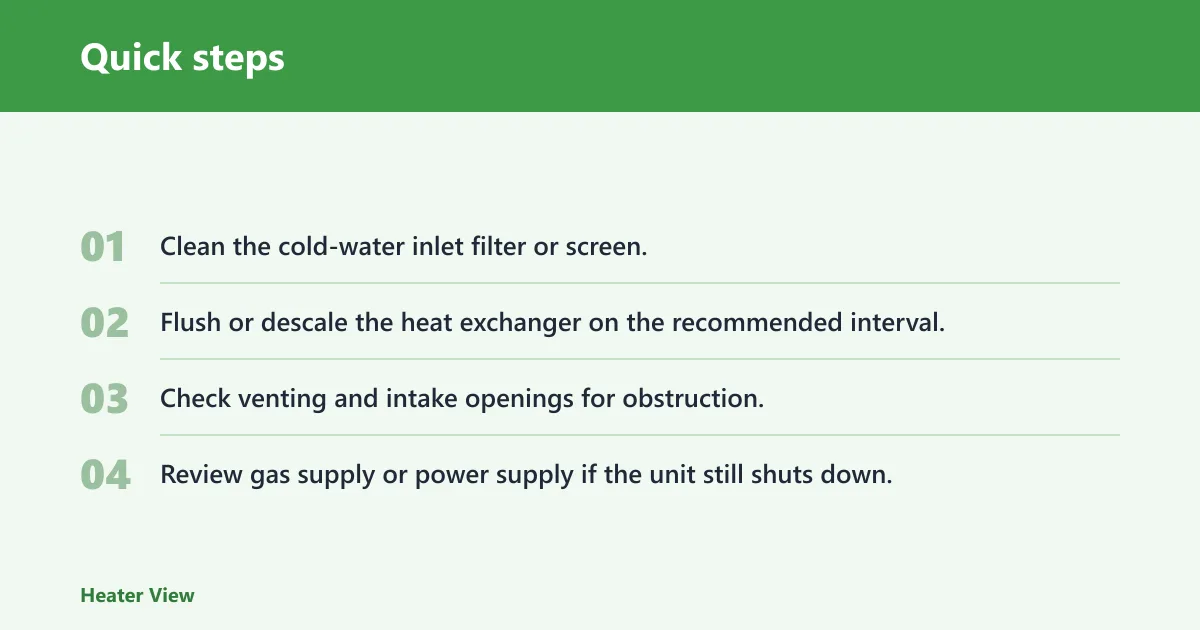
- Clean the cold-water inlet filter or screen.
- Flush or descale the heat exchanger on the recommended interval.
- Check venting and intake openings for obstruction.
- Review gas supply or power supply if the unit still shuts down.
Clean the inlet filter
The cold-water inlet screen is a maintenance point that can reduce error codes when cleaned. A clogged filter restricts flow, which can keep the unit from activating properly or can trigger unstable operation. Remove and clean it if the manufacturer allows user service for that part.
Flush or descale the heat exchanger
Hard water mineral scale can collect inside narrow heat-exchanger passages. Calcium and magnesium deposits reduce efficiency and flow, which can cause temperature swings. Annual descaling is recommended for hard-water maintenance in New Jersey, and tankless heaters should be flushed about once a year as a baseline.
That maintenance matters because the heat exchanger depends on narrow passages and good heat transfer efficiency. If scale builds up, the unit may still run but deliver less stable hot water. Descaling is preventive work, not a fix for a broken gas valve or failed sensor.
Check venting and intake openings
Gas models need clear airflow for combustion. Look for leaves, snow, insect nests, or salt spray around the intake and exhaust. Any obstruction can interfere with combustion and push the unit toward a shutdown or poor heating performance.
Review gas supply or power supply
If a gas unit starves for fuel, it can lose flame or shut down under shower load. If an electric unit loses power or trips a protection circuit, output can collapse abruptly. Either case can look like a shower valve issue until you compare the problem across fixtures.
A common first-timer mistake is replacing the showerhead first because that seems easiest, then discovering the whole house still loses hot water when two fixtures run at once. Start by separating the symptom pattern. That step usually tells you whether the next check belongs at the shower or at the heater.
Frequently asked questions
Why does my tankless water heater go cold during shower?
A tankless water heater usually goes cold during a shower when the shower valve mixes in cold water, the flow drops below the activation threshold, or the heater shuts down for a fault. If only that shower changes, inspect the fixture first. If every hot tap changes, look at the heater or supply.
Why does my tankless water heater go cold in the middle of a shower?
Mid-shower temperature loss often means the heater is reacting to a flow change, a cold slug after a pause, or reduced output from scale, winter inlet water, or simultaneous use. The key is whether the problem happens at one shower or at all fixtures.
Why does my electric tankless water heater go cold in the middle of a shower?
An electric tankless water heater can go cold when its power limit is reached or when flow sensing becomes unstable. If the unit does not have enough electrical capacity for the demand, output falls. Repeated trips or erratic heating deserve an electrical and heater inspection.
Why does my tankless hot water heater go cold?
When a tankless hot water heater goes cold, the usual causes are fixture mixing, low flow, scale in the heat exchanger, winter inlet water, or a heater shutdown. Separate a shower-only issue from a whole-house issue before you touch the unit. That saves time and points you to the right part.
Why is only my shower cold?
If only one shower is cold, the shower valve, cartridge, or showerhead is the first place to look. A nearby sink that stays hot usually rules out the heater. Fixture-specific problems can mimic a bad water heater because the temperature change shows up at one outlet only.
How many showers can a tankless water heater run?
It depends on the heater’s GPM output and the temperature rise required at the time. One shower may be fine, but two or more showers plus another hot tap can exceed capacity in practice, especially in winter. The combined demand matters more than the fixture count alone.