Natural Gas Heater vs Propane Heater: Which Fuel Is Cheaper?
Natural gas is usually cheaper than propane on a useful-heat basis. Compare delivered BTUs, appliance efficiency, and fixed charges, and propane often lands higher, especially once tank rental, delivery minimums, or winter price spikes are included. Use delivered cost, useful heat output, and annual operating cost for the same heating load.
| Decision factor | gas heater | propane heater | Winner |
|---|---|---|---|
| Fuel price basis | Utility gas billed per therm or MCF; one therm equals 100,000 BTU | Liquid fuel billed per gallon; one gallon equals 91,547 BTU | gas heater |
| Delivered heat cost in a worked example | At about $1.70 per therm and 95% efficiency, gas works out to about $17.89 per useful MMBtu. | At about $2.80 per gallon and 95% efficiency, propane works out to about $32.23 per useful MMBtu. | gas heater |
| Annual cost for an 80 MMBtu useful heat load | An 80 MMBtu useful heat load is about $1,431 with gas. | An 80 MMBtu useful heat load is about $2,578 with propane. | gas heater |
| Upfront switching cost sensitivity | Can include gas-main connection or conversion cost | Usually lower if propane equipment already exists | tie |
| Access and availability | Best where a gas main is already at the street or house | Works where no gas main exists, including rural homes | tie |
| Price stability | Usually less retail volatility than propane | More seasonal price swings and delivery sensitivity | gas heater |
Which fuel is cheaper?
Gas heater operating cost is usually lower, but only after you put both fuels on the same heat basis and include delivery charges. For a homeowner, the real question is simple: does the lower fuel rate pay back any gas-main hookup cost, or is the current propane setup cheaper to keep?
Fuel-cost comparison table
| Scenario | Local fuel price | BTU content | Assumed appliance efficiency | Cost per useful MMBtu | Annual heating cost for an 80 MMBtu load | Break-even gas-main or conversion payback |
|---|---|---|---|---|---|---|
| Utility-gas home | $1.70 per therm | 100,000 BTU per therm | 95% | $17.89 | $1,431 | If gas-main hookup and conversion total about $3,000, payback is about 2.1 years versus propane at the example rate. |
| Rural propane home | $2.80 per gallon | 91,547 BTU per gallon | 95% | $32.23 | $2,578 | No gas-main payback unless a main can be extended; the operating-cost gap is about $1,147 per year versus the gas example |
| Propane home considering conversion | $2.80 per gallon now; gas option at $1.70 per therm | 91,547 BTU per gallon vs. 100,000 BTU per therm | 95% | Propane: $32.23; gas: $17.89 | Propane: $2,578; gas: $1,431 | At $3,000 upfront, conversion pays back in about 2.6 heating seasons on this load |
The table uses the same 80 MMBtu useful heat load across all three cases. That keeps the comparison honest. Fuel price alone does not decide the bill; delivered BTU cost does.
How do you compare costs correctly?
Start by converting each fuel to BTUs, then divide by appliance efficiency so you compare useful heat, not raw fuel. Natural gas is usually billed per therm or per thousand cubic feet, while propane is billed per gallon. Use the same efficiency because the appliance, not the fuel, controls how much of that input becomes room heat.
Use the same energy basis
One therm equals 100,000 BTU in this comparison, and propane is shown at 91,547 BTU per gallon. Natural gas may also appear on a bill as MCF, which is roughly 10 therms. Actual gas energy content per cubic foot varies by utility, so utility bill comparisons should use the supplier’s stated energy content when available.
For a plain-language worksheet, use this sequence:
- Find the delivered price of gas or propane.
- Convert that price into cost per BTU.
- Adjust for appliance efficiency.
- Multiply by your annual heat load.
- Add fixed charges, delivery fees, and any rental or connection cost.
Example math: at $1.70 per therm and 95% efficiency, useful heat costs about $17.89 per MMBtu. At $2.80 per gallon and 95% efficiency, useful heat costs about $32.23 per MMBtu. That gap is why propane often ends up more expensive even before tank fees.
Why the bill and the fuel price are different
The posted fuel rate is only part of the bill. Natural gas usually includes a utility rate plus fixed monthly charges and local distribution fees. Propane usually includes a delivered price, possible tank rental, fill minimums, and delivery charges that rise when demand spikes or your home is far from the supplier.
Natural gas bills
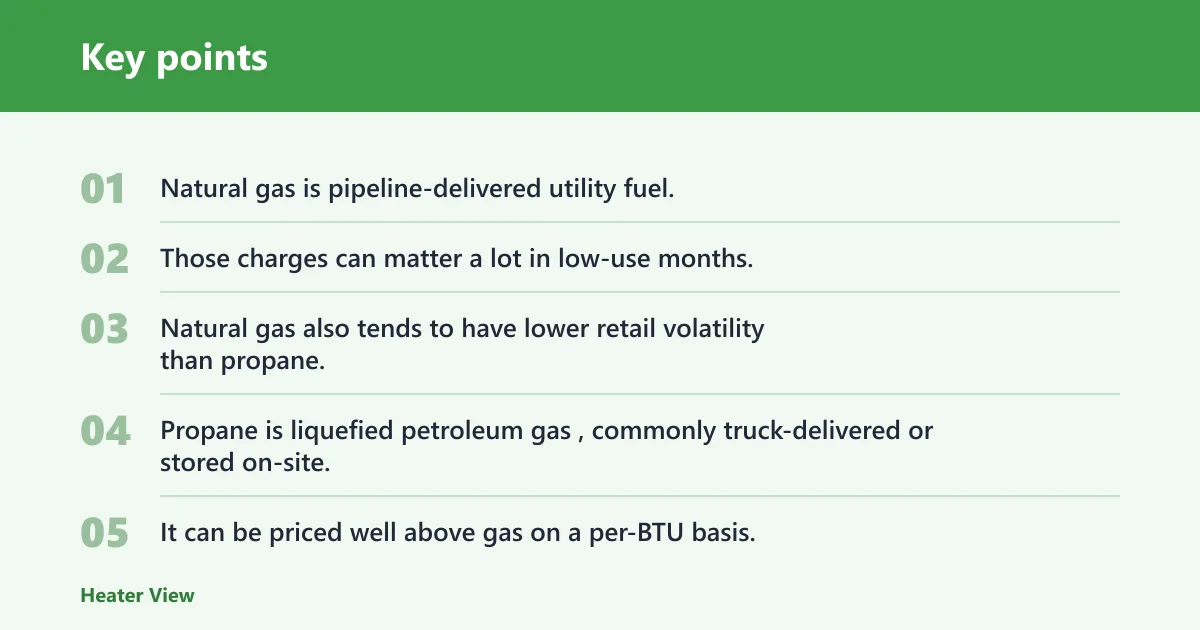
Natural gas is pipeline-delivered utility fuel, so the homeowner usually pays per therm or per MCF plus service charges. Those charges can matter a lot in low-use months, but they are often spread across a full heating season. Natural gas also tends to have lower retail volatility than propane.
Propane bills
Propane is liquefied petroleum gas, commonly truck-delivered or stored on-site. It can be priced well above gas on a per-BTU basis, and winter demand can push prices higher just when homes need the most fuel. Delivery minimums and rural surcharge effects can make the cheapest advertised fill price a bad indicator of the full-season bill.
Suppose a rural home receives propane at a low posted price early in fall, then faces a midwinter refill when demand is high. The second delivery can erase the savings from the first. That is why the delivered cost, not the headline quote, should guide the decision.
What changes the answer in real homes?
Gas-main access changes everything. If a gas main already reaches the property line, the extra cost may be a one-time hookup and conversion expense. If no gas main exists, propane may remain the practical choice unless an electric alternative is cheaper over time.
Existing equipment matters
A house with an owned propane tank already installed has a lower barrier to staying on propane than a house that would need a new tank, pad, regulator work, and fuel delivery setup. A rented tank can add recurring cost. That recurring fee can matter more than a small swing in fuel price.
Fixed charges matter more on small loads
When the heating load is small, fixed fees can outweigh fuel savings. A cabin, small bungalow, or tightly sealed house may not burn enough fuel each year to recover a large gas-main extension quickly. In that case, the cheapest bill is not always the cheapest fuel.
Picture a 1,600-square-foot home with a modest heating demand and a quoted gas-main hookup cost of $4,500. If the fuel savings versus propane are only a little over $1,000 a year, the payback is long enough that the owner may prefer to keep propane and replace one appliance at a time instead of converting the whole house at once.
Choose gas heater if… / Choose propane heater if…
Choose a gas heater if a gas main is already available, the hookup and conversion cost can pay back in a reasonable number of heating seasons, or local gas pricing stays well below propane after delivery and fixed charges. Choose a propane heater if there is no gas main, the propane system is already installed, or the conversion cost would take too long to recover.
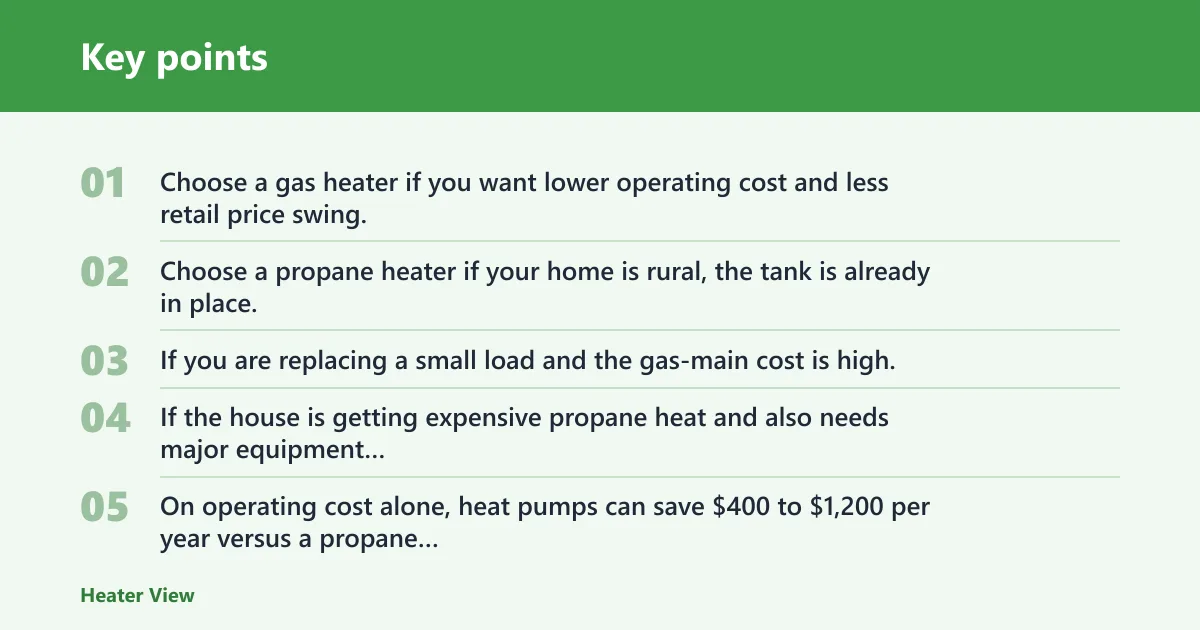
Choose a gas heater if you want lower operating cost and less retail price swing. Choose a propane heater if your home is rural, the tank is already in place, or the local utility quote includes a large connection fee. If you are replacing a small load and the gas-main cost is high, staying with propane can still be the cheaper short-run move.
If the house is getting expensive propane heat and also needs major equipment replacement, a heat pump can change the calculation. On operating cost alone, heat pumps can save $400 to $1,200 per year versus a propane furnace. At that point, the gas-vs-propane question may matter less than whether a heat pump can cover most of the heating season.
Frequently asked questions
Is natural gas cheaper than propane for heating?
Usually yes. Natural gas is commonly cheaper per useful BTU, especially when you compare delivered heat instead of posted fuel price. The gap can shrink if gas has high fixed charges or if propane is bought at a low seasonal rate, but gas usually wins on operating cost.
How much more expensive is propane than natural gas per BTU?
A common comparison puts propane at about 1.3 to 2 times the cost per BTU of natural gas. In the worked example here, propane comes out to about $32.23 per useful MMBtu versus $17.89 for gas, so the propane cost is noticeably higher even after the same efficiency is applied.
What is the propane-to-natural-gas cost break-even price?
Using $1.70 per therm for natural gas and 95% appliance efficiency, propane breaks even around $1.56 per gallon. Above that propane is more expensive on a useful-heat basis. Below that, propane can match or beat the gas example, though local delivery and fixed fees still matter.
Does propane or natural gas cost less to run a furnace?
Natural gas usually costs less to run a furnace. Compare useful BTUs, not the tank or meter reading alone. If both furnaces are similarly efficient, the lower fuel price per delivered BTU usually favors gas, unless propane pricing is unusually low in that market.
How do I compare propane and natural gas prices correctly?
Convert both fuels to BTUs first, then divide by efficiency. Natural gas is priced per therm or per MCF, and propane is priced per gallon. Once both are on the same useful-heat basis, add delivery fees, tank rental, connection costs, and any minimum charges before deciding.
What if natural gas is not available at my home?
If no gas main reaches the property, propane is often the default fossil-fuel option. In many rural homes, the real choice is propane versus electric heat, not propane versus gas. If the home is a good fit for heat pumps, electrification may offer lower operating cost than keeping a propane furnace.
Is propane cheaper than natural gas in rural areas?
Usually not on fuel cost alone. Rural propane homes often face higher delivery costs, more volatile winter pricing, and possible tank rental. A rural setup can still make propane the practical choice if there is no gas main, but that is a convenience decision, not a cheaper-fuel decision.
How much can a propane home save by switching fuels or electrifying?
On the fuel side, switching from propane to gas can save about $800 to $2,000 per year in many cases, depending on local rates and the load. Heat pumps can save $400 to $1,200 per year versus a propane furnace. The best option depends on hookup cost, equipment condition, and climate.