What Is a Mixing Valve on a Water Heater?
A water-heater mixing valve blends hot water from the tank with cold water so the tap delivers safer water, usually near 120°F, while the tank can store water hotter. Without it, you risk scalds, lukewarm water, or incorrect thermostat adjustments. This guide explains what the valve does, how it differs from the tank thermostat, and how to spot valve problems versus heater problems.
What does a mixing valve do?


A thermostatic mixing valve blends hot and cold water to a safer delivery temperature. It sits on the outlet side of the system, so its job is to temper water before it reaches the tap, shower, or appliance. That is different from the heater’s tank control, which changes storage temperature inside the tank.
In residential plumbing, the same part is commonly called a tempering valve. It is used where the tank can store water hotter than the tap should ever deliver, letting the system keep heat in reserve while the fixture receives a safer outlet temperature.
Why does delivery temperature matter at the tap?
Anti-scald protection is the main reason to install one. Hot water at the fixture can burn quickly, especially for children and older adults. A correctly set valve keeps tap water in a usable range while the tank can remain hotter behind the scenes.
That matters because the hazard is the water leaving the spout, not the heater’s internal setpoint. If the valve is mis-set, scaled, or drifting, outlet temperature can move away from the intended safe range even when the tank itself seems normal.
Mixing valve vs thermostat: what is the difference?
The water-heater thermostat sets the tank storage temperature. The mixing valve controls the outlet temperature. Those are separate controls, and they solve different problems. One tells the heater how hot to keep the tank; the other blends water at delivery so the tap is not too hot.
That confusion causes many homeowner mistakes. A lukewarm tap does not always mean the tank thermostat is too low. A scalding tap does not always mean the heater is overheating. The fault could be the mixing valve, the thermostat, the dip tube, sediment, or a failing heating element.
How do people confuse the two parts?
If the tank is set hotter but the tap feels around 120°F, the mixing valve may be doing its job. If the tank is set low and the tap is still too hot, the outlet control may be missing or mis-set. The fault location matters before anyone turns dials.
Suppose a tank is set high for storage but the shower suddenly runs cold after a short burst. That can point to a mixing valve issue, but it can also point to a cracked dip tube sending incoming cold water to the wrong spot in the tank. The symptom is similar. The cause is not.
Is there a mixing valve on every water heater?
No. Many water heaters do not ship with a mixing valve, and many homes do not need one in the simplest setup. It is often added when a system needs code compliance, a specific comfort target, hotter storage with safer delivery, or tighter control for a recirculation loop.
Tank, tankless, and indirect systems can all use one, but the placement and reason change. Tank systems usually use an outlet mixing valve near the heater. Tankless and point-of-use setups may use a smaller valve close to the fixture. Recirculation systems may use one on the loop or manifold.
Where is a mixing valve usually installed?
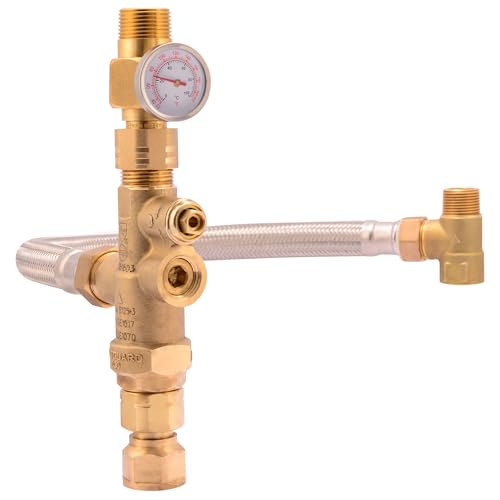
On a typical residential tank heater, the valve is usually on the hot outlet piping near the water heater. It may also sit on a recirculation branch or on a manifold that feeds multiple fixtures. Look for a body with three pipe connections: hot in, cold in, and tempered out.
That location matters. If the valve is mounted on the outlet side, it can blend water just before the distribution piping sends it to the home. If it is missing or bypassed, the tank may still be hot, but the tap will follow the tank temperature more closely.
How do you spot a mixing valve on the piping?
Visually, a mixing valve often looks like a brass or composite body with three connections and an adjustment cap or dial. Some units have markings for temperature. Others use a scale or a locking screw. The body usually sits on the hot-water piping rather than on the tank shell itself.
A mechanical thermostatic mixing valve uses an internal element to react to temperature changes. A digital mixing valve uses sensors and a controller to monitor inlet and outlet water, then adjusts the blend electronically. Digital systems are used more often where tighter control is needed.
Mechanical versus digital control
Traditional thermostatic mixing valves use an internal thermal element to respond to changing water temperature. Digital systems use sensors and a controller to read inlet and outlet conditions, then adjust the blend electronically. That is a different control method from the heater’s own thermostat.
Because digital systems are manufacturer-specific, any precision claim should be checked against the product’s own specification sheet before it is treated as a general rule. In commercial use, the appeal is stable delivery temperature under changing demand, not the brand name alone.
Common commercial applications include hotels, hospitals, dormitories, and office buildings. Those systems often need steadier delivery temperatures because usage changes through the day and hot-water demand can be high.
Why are anti-scald and Legionella balance important?
A mixing valve helps prevent dangerously hot tap water while still allowing hotter storage in the tank. That balance matters for children and older adults, who are more vulnerable to scald injury. The valve must be calibrated correctly, or the safety margin shrinks quickly.
Some systems store water above hotter domestic setpoints as part of a Legionella risk-management strategy, then mix it down at delivery to a safer tap temperature. That approach can be useful, but it is not automatic protection. It depends on the full system design, the storage target, and the valve setting.
What calibration mistakes create risk?
If the valve is set too high, the tap may become unsafe. If it is set too low, the hot-water supply may feel weak or turn lukewarm too soon. Either error can create a false diagnosis, because the symptom may point toward the wrong component.
A common first-timer mistake is turning the tank thermostat instead of checking the outlet valve first. That can make the tank hotter than needed and still not fix the tap temperature if the mixing valve is stuck or scaled.
Hot-water troubleshooting table
| Symptom | Likely cause | Quick check | When to call a pro |
|---|---|---|---|
| Lukewarm water | Mixing valve set too low, scaled internals, cracked dip tube, or low tank temperature | Check whether the tank feels hot near the outlet and whether other fixtures behave the same. If the tank is hot but every tap feels cool, the outlet valve is suspect. | Call if the valve will not hold its setting, or if lukewarm water follows a recent part failure, sediment issue, or dip tube suspicion. |
| Scalding hot water | Mixing valve missing, mis-set, stuck open to hot, or thermostat set too high | Compare the tank setting with the tap behavior. If the outlet is far hotter than expected, check whether the mixing valve is present and whether the adjustment changed recently. | Call right away if the tap is hot enough to burn, or if the temperature keeps rising after a setting change. |
| Temperature swings | Sticking valve, mineral buildup, pressure changes, or a failing thermostat | Run a steady fixture and watch whether the temperature bounces between hot and cool. If the swing starts only at one fixture, the issue may be local piping or a valve there. | Call if the swing is large, repeated, or paired with noisy piping or pressure changes. |
| Short hot-water supply | Oversized mixing valve issue, low tank temperature, sediment, dip tube damage, or heater capacity limits | Notice whether the hot water runs out faster than before. If the tank is storing hot water but usable hot water disappears quickly, the outlet blend or dip tube may be involved. | Call if the supply shortfall is new, worsening, or tied to sediment, an element fault, or a recirculation setup. |
When should you repair or replace it?
Repair or replacement depends on the failure mode. A stuck valve, a scaled valve, an oversized valve, or a mis-set valve can all produce the same complaint. The right fix depends on whether the outlet control is still responding and whether the rest of the heater is sound.
-
Check the symptom pattern. If the problem affects every hot tap in the house, start with the outlet mixing valve, the tank thermostat, or the dip tube. If only one fixture is affected, the issue may sit closer to that fixture than to the heater.
-
Compare tank and tap temperature. A hot tank with lukewarm delivery points toward the mixing valve or dip tube. A cold tank with poor hot-water delivery points more toward the heater itself, including thermostat or element problems.
-
Look for physical clues. Mineral buildup, corrosion, noisy operation, or a valve that will not hold adjustment are signs the part may need service. If the valve is digital, sensor faults or controller issues can also drive unstable temperature.
-
Escalate when safety is involved. Call a pro if water is scalding, if the temperature and pressure relief valve opens, or if the system overheats. The T&P valve is a separate safety device, and any discharge or repeated lift needs prompt attention.
There is one more reason not to guess: a cracked dip tube can mimic a bad mixing valve by sending incoming cold water to the wrong level in the tank. The result can be sudden lukewarm water even when the outlet valve is fine. That is why symptom location matters as much as symptom type.
Picture a home with a hotter storage target and a valve near the heater set for a safe tap temperature. If the shower suddenly runs too cool, the owner may blame the heater thermostat and turn it up. The better first question is whether the outlet valve is drifting, scaled, or bypassed.
Frequently asked questions
What is used to control a mixing valve on an instantaneous water heater?
On an instantaneous water heater, a mixing valve may be controlled by a mechanical thermostatic element or by an electronic controller with temperature sensors. The mechanical type reacts directly to water temperature, while the digital type adjusts the blend through sensors and controls. That is separate from the heater’s own temperature control.
What is a mixing valve on a water heater?
A mixing valve on a water heater is a delivery-side valve that blends hot water from the tank with colder water before it reaches the tap. Its job is to keep the outlet safer and more usable than the tank’s storage temperature, which may be set much higher than the fixture should receive.
What does a mixing valve on a water heater do?
It controls the final water temperature leaving the system. The tank thermostat controls storage heat; the mixing valve controls delivery heat. That difference matters because a hot tank can support system needs while the valve keeps the faucet from sending water that is too hot for normal use.
What is the purpose of a mixing valve on a water heater?
The purpose is anti-scald protection and temperature control at the tap. It helps keep the delivery temperature in a safer range for children, older adults, and anyone using the fixture. In some systems, it also allows hotter storage for a Legionella strategy while mixing down at delivery.
What is a tempering valve on a hot water heater?
Tempering valve is a common alternate name for a thermostatic mixing valve used on domestic hot-water systems. The term usually means the same kind of outlet-side device that blends hot and cold water to a set delivery temperature. Brand design varies, but the function is the same.
Is there a mixing valve on a water heater?
Not always. Many water heaters do not include one, and some homes do not need one in the basic installation. It may be added near the heater, on a recirculation loop, or at a manifold when code, comfort, or hot-water safety strategy calls for controlled delivery temperature.
What does a mixing valve on a water heater look like?
It usually has three pipe connections and a valve body mounted on the hot-water piping. Many have an adjustment cap, temperature markings, or a locking feature. A digital version may also include sensors or a controller. The visual clue is the three-way connection, not the tank shell itself.
How can you tell if a valve is present or not?
Start at the hot outlet near the heater and follow the piping. If you see a three-port body with hot in, cold in, and tempered out, a mixing valve is present. If the hot line runs straight out with no blending body, the home may be relying on the tank thermostat alone.
How do you distinguish it from other water-heater valves?
The mixing valve is on the delivery side and has three ports. The temperature and pressure relief valve is a safety valve on the tank itself, and it is not used to blend water. A check valve stops reverse flow, and the tank thermostat controls storage temperature rather than delivery temperature.