Are Infrared Heaters Efficient in High Ceilings?
Infrared heaters can be efficient in rooms with high ceilings when the emitter points at the occupied zone and the size matches room heat loss rather than floor area; a common rule of thumb is to mount it so the beam covers where people sit or stand, roughly 7–10 feet above that zone. Mount it too high or aim it wrong, and the heat passes above people, so you pay for watts that warm the ceiling. This guide explains placement, sizing, and the ceiling-height limits that matter most.
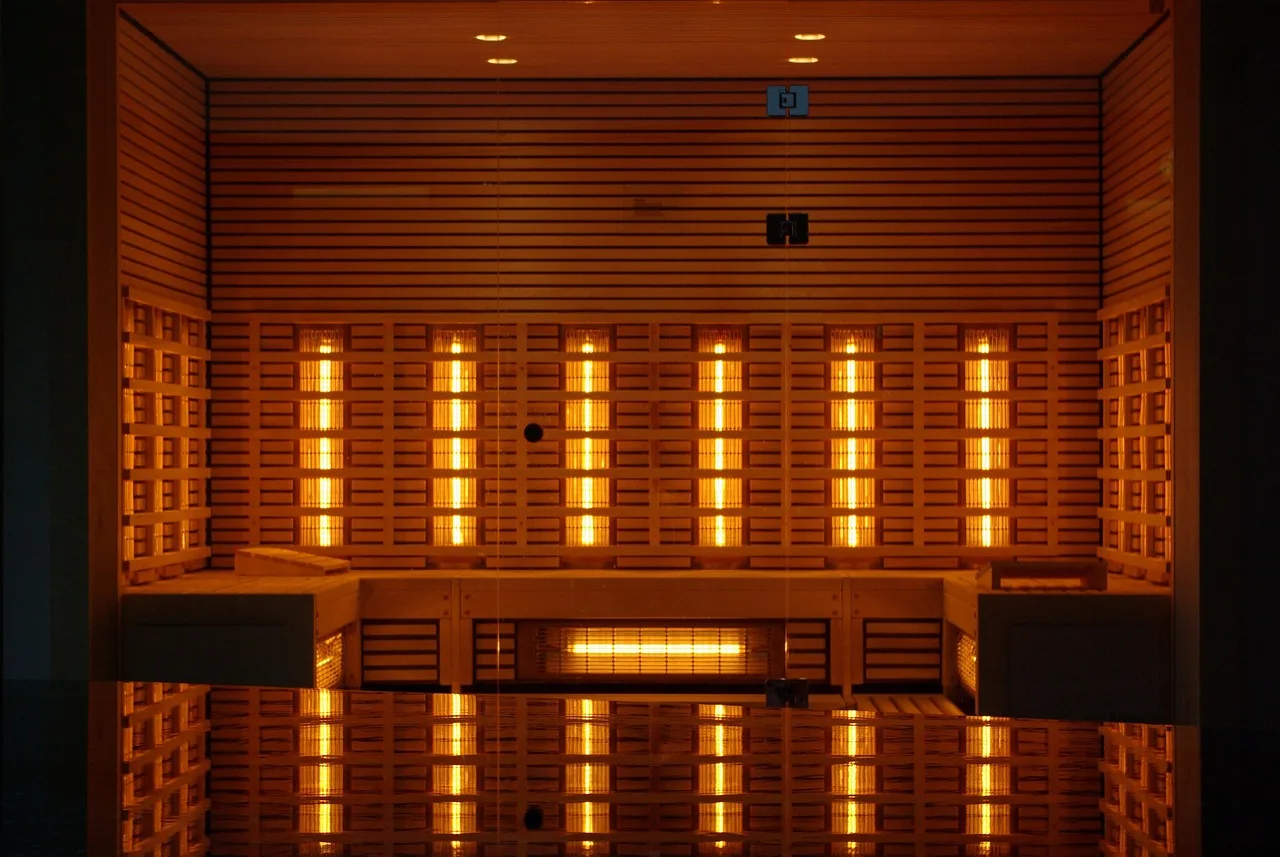
Infrared heaters use direct radiant heat, not air-first heating. That matters in tall rooms because the heater can warm people and objects in its path instead of spending most of its output on the larger air volume above them.
Are infrared heaters efficient in high ceilings?
The catch is geometry. In a room with a high ceiling, the heater can still look efficient on paper and disappoint in use if the radiant field misses the occupied area or if the room loses heat faster than the unit can replace it.
How infrared heat works in tall rooms
Infrared heat is a line-of-sight heating method. The emitter sends energy toward surfaces, furniture, and bodies, and those surfaces then feel warmer than the surrounding air would suggest. In tall rooms, that direct path is the main advantage.
Warm air still moves upward after the room absorbs some heat. So the air near the ceiling can become warmer than the air where you stand or sit, which is why a tall room can feel underheated even when the top of the space is quite warm.
Why does heat stratification matter with high ceilings?
Heat stratification matters because warm air collects above the occupied zone while cooler air stays lower, where people actually feel the room. In a standard-height room, that gap is smaller. In a vaulted or double-height room, it can become large enough to change comfort and raise the heating demand.
A high ceiling room has more air volume than a standard room, so floor area alone does not tell you the full load. A room around 200 square feet with a vaulted ceiling can need more heat than a similar-size room with an 8-foot ceiling, especially if it has large windows or poor insulation.
Vaulted ceilings versus standard 8-foot ceilings
Vaulted ceilings change how heat is distributed. The higher the ceiling, the more room there is for warm air to collect away from the floor, and the more important it becomes to heat the zone where people are present.
That is why the same heater can feel acceptable in one room and weak in another with the same floor plan. The difference is not only square footage; it is the amount of space between the emitter and the people below it.
Do infrared heaters work well in rooms with 10-foot ceilings?
They can work well in rooms with about 10-foot ceilings, especially when the heater is mounted to aim at the occupied zone and the room’s heat loss is moderate. At that height, placement still matters, but the ceiling is usually not so high that radiant heat cannot reach people effectively.
What changes is the margin for error. A heater placed too high, aimed at open air, or undersized for the room can leave the lower half of the space feeling cool. Window area and insulation begin to matter more as the ceiling rises.
Can infrared heaters be used as supplemental heat in a room with high ceilings?
Yes. Supplemental heat is often the safest expectation in tall rooms, because infrared can raise comfort in the occupied zone without needing to condition every cubic foot of air. That is a good fit for a seating area, desk zone, workshop bench, or a spot used for short periods.
WarmlyYours describes infrared panels as wall-mounted electric heaters that radiate warmth directly to people and objects, and says they can add clean supplemental heat to any room. That is the right framing for many tall spaces: targeted warmth, not whole-room replacement in every case.
Suppose a vaulted family room has a cold seating area under a tall peak. A wall- or ceiling-mounted infrared unit aimed at the sofa can improve comfort there without pretending to heat every corner evenly.
Is ceiling-mounted infrared better than wall-mounted in tall rooms?
Ceiling mounting is often better when you want the heater centered over the occupied zone and out of the way. Wall mounting can be better when you need a simpler install, want to aim heat at one side of the room, or need to avoid a ceiling that is too high for good coverage.
Both can work. The right choice depends on line of sight, mounting height, and where people actually spend time. A heater that misses the occupied area is a poor choice no matter how efficient the unit is on its label.
Ceiling-mounted infrared heaters in high-ceiling rooms
Ceiling-mounted infrared heaters fit rooms where overhead placement can aim heat directly downward over the use zone. TECHNOTHERM says infrared heaters can be mounted on walls or ceilings, and it offers a ceiling cassette infrared heater for suspended or cassette ceilings. That cassette emits downward infrared heat over a large area.
This can help when the room has a clear seating or work zone below the mounting point. It also keeps the heater visually discreet. The downside is simple: if the mount is too high, the beam spreads before it reaches the people who need it.
Ceiling mounting makes the most sense when the room has a defined center zone, the ceiling system can accept that kind of unit, and the heater can be placed where its output lands on people or objects rather than on open air.
Wall-mounted infrared heaters in tall spaces
Wall-mounted infrared heaters are useful when you want targeted warmth with a smaller wall footprint. The same source says its infrared heaters can be mounted on walls, and WarmlyYours describes wall-mounted electric panels that radiate warmth directly to people and objects.
Wall mounting can work well for spot heating along a seating wall, a desk wall, or a workshop bench. It can also be easier to aim at a known use area than a ceiling unit mounted far above the room.
But wall mounting can miss the occupied zone if furniture gets rearranged or if the room layout is open and shallow. In that case, the heater may warm one side while the people sit outside the main radiant path.
How do you size an infrared heater for a high-ceiling room?
Size it from heat loss, not floor area alone. The same source recommends planning from room size, insulation, window area, and desired room temperature, and notes that its heat-demand calculator is guidance only, not professional planning. That is the right way to think about tall rooms.
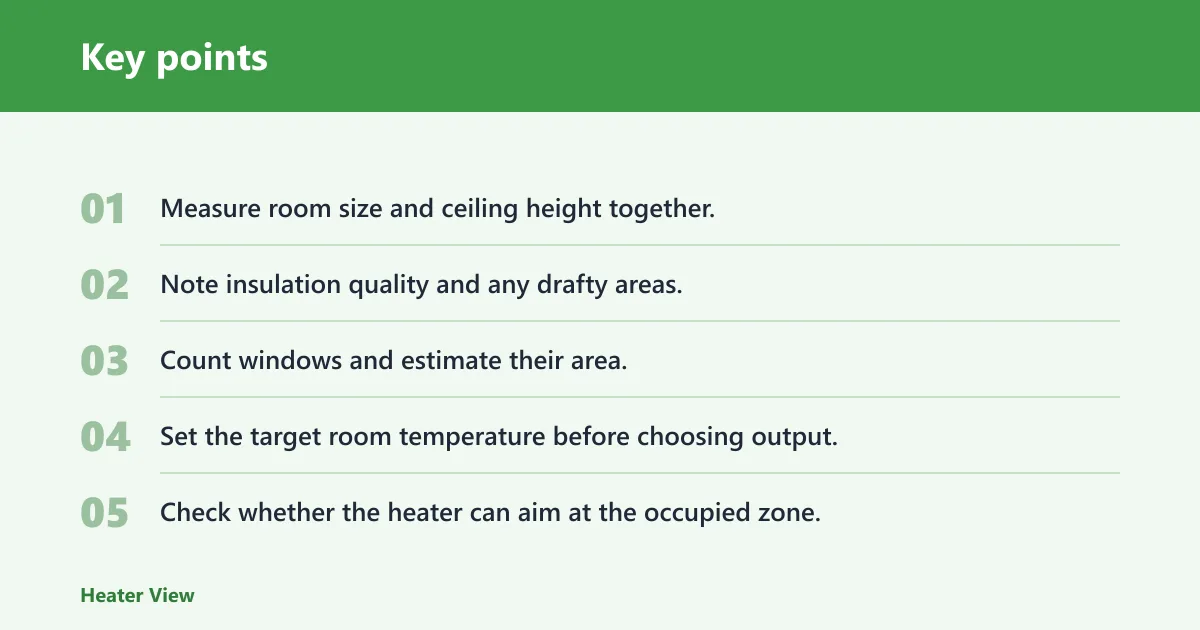
High ceilings increase the air volume, so the same floor area can need different output depending on insulation and glazing. A heat demand calculator should estimate the room’s real load, then you match the heater’s wattage to that estimate and the intended mounting height.
Infrared sizing checklist for high ceilings
- Measure room size and ceiling height together.
- Note insulation quality and any drafty areas.
- Count windows and estimate their area.
- Set the target room temperature before choosing output.
- Check whether the heater can aim at the occupied zone.
- Compare the wattage draw with the room’s heat loss.
- Decide whether you need supplemental heat or whole-room heating.
- Choose thermostat control if you want tighter run-time control.
A common mistake is choosing an infrared heater based only on square footage and ignoring the height of the ceiling. A 12-foot ceiling with large glass can need a different heater approach than a smaller, well-insulated room with the same footprint.
Watts, output, and room size
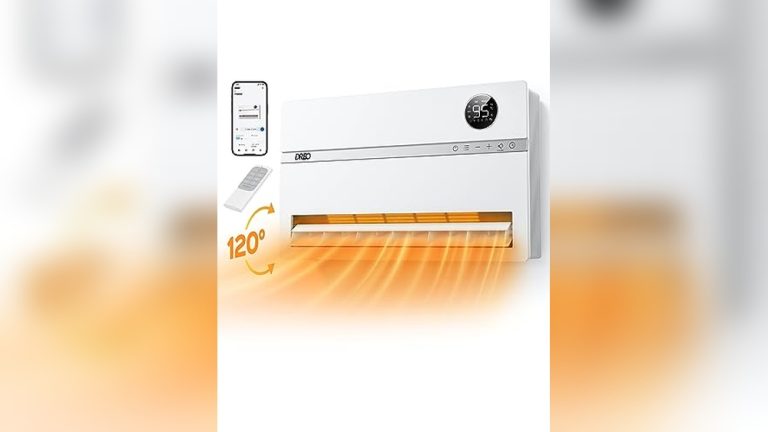
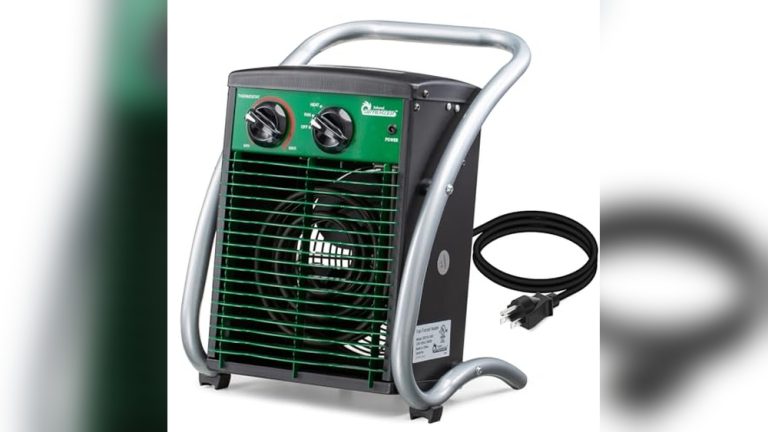
Watts matter because they show power input, not magic coverage. The Heat Storm Phoenix runs at 750 to 1500 watts and is rated for 150 square feet of coverage. The Dr. Infrared Heater DR-268 is a 1500-watt model and can be wall- or ceiling-mounted.
Those figures are useful as a comparison point, not a promise. In a tall room, the same wattage can feel different depending on insulation, window area, ceiling height, and how well the heater is aimed at the occupied zone.
A heater with enough wattage but poor placement can still underperform in practice. A smaller unit placed correctly may feel better than a larger unit aimed over people’s heads.
Thermostat control and energy use
A built-in thermostat helps limit run time and reduce waste by turning the heater off once the set point is reached. That matters in tall rooms because the top of the room can warm faster than the occupied zone if the heater runs without enough control.
The same source says its infrared heaters are efficient and can pair well with PV. That matters most when the unit is matched with sensible controls, correct sizing, and a mounting position that avoids heating unused air.
When IP55 matters
An IP55 water-resistant rating matters when the heater may be used in a damp indoor area or a sheltered outdoor space. It is a practical durability marker, not a sizing shortcut. If the room has moisture, splash risk, or a covered patio setup, that rating becomes more relevant.
For a dry upstairs vaulted room, IP55 may not be the main decision point. For a garage-like space, covered porch, or similar sheltered area, it can be part of the selection.
Infrared heater decision table for high ceilings
The table below gives a plain-language way to judge fit by ceiling height, room type, and mounting position. It is not a substitute for a heat demand calculator, but it helps you separate good matches from poor ones before you buy.
| Ceiling height | Room type | Mounting position | Likely performance | Recommendation |
|---|---|---|---|---|
| 8 to 9 feet | Small living room or bedroom | Wall mount near the occupied zone | Usually good for supplemental warmth | Good fit if insulation is decent and output matches heat loss |
| 10 feet | Family room or open-plan nook | Ceiling mount over seating, or wall mount facing the zone | Can work well if aim and wattage are correct | Good fit for targeted heat, not floor-area-only sizing |
| 11 to 12 feet | Vaulted living room or loft | Ceiling mount preferred if the beam can land on people | Comfort depends heavily on placement and room loss | Use as supplemental heat unless the room is well insulated and compact |
| 13 feet and above | Double-height great room | Ceiling or high wall only if the occupied zone is clearly defined | Often uneven if aimed too high | Consider another heater type for primary heat unless the layout is highly controlled |
| Any height with large glazing | Sunny room with tall windows | Wall or ceiling, but aimed away from glare-prone open areas | Losses can be higher than expected | Check heat loss carefully; infrared may be best as support heat only |
Picture a 12-foot vaulted den with a sofa under the center slope. A ceiling-mounted panel aimed at the seating area can help there. If the same room has a tall bank of windows and a wide open plan, the heater may still be useful, but only as part of a broader heating plan.
Are infrared heaters better than convection heaters in large rooms?
Not always. Infrared can be better when you want direct warmth in a specific occupied zone, while convection or forced-air systems may be better when you need to condition the whole room and move warm air more uniformly. Large tall rooms expose the limits of both approaches.
If the goal is to warm people in one area, infrared often has the edge. If the goal is to heat a sprawling, open room from corner to corner, a system built around air movement may be the safer choice.
Frequently asked questions
Will an infrared heater heat a vaulted ceiling room evenly?
Not necessarily. A vaulted room often has stratification, so heat can collect higher up while the lower zone stays cooler. Infrared can improve comfort where people are located, but even heating across the whole volume is not guaranteed, especially in open rooms with large glass areas.