Best Water Heater for Hard Water Homes
For most hard-water homes, the best water heater is a glass-lined tank model with a serviceable anode rod and a drain valve you can flush yearly. If hardness is severe or upkeep will be skipped, choose a unit that makes sediment service easier. Ignored scale shortens element life, cuts hot-water output, and can drive repair costs up fast. This guide compares the best picks by water hardness level, shower demand, and how much upkeep you’ll actually do.
Hard water and heater damage
Hard water usually means about 7 grains per gallon or higher, which is roughly 120 ppm and up. The minerals behind the problem are mainly calcium and magnesium. As water heats, those minerals drop out and form scale on tanks, elements, burners, and heat exchangers.
That scale does three things that matter. It insulates heat-transfer surfaces, restricts flow in narrow passages, and makes components run hotter than intended. Warranty language often excludes damage from scale, poor maintenance, or untreated water, so the risk is mechanical and financial.
Hardness levels that change the choice
- Moderate hard water: about 7 to 10 gpg, or 120 to 170 ppm. Most heater types can work if you maintain them.
- Hard water: about 10 to 15 gpg, or 170 to 256 ppm. Scale service becomes part of the buying decision.
- Very hard water: above 15 gpg, or above 256 ppm. A softener becomes the practical first line for most homes.
Water quality also varies by source. Municipal water can be hard in one neighborhood and moderate in another. Well water can swing more widely because mineral content changes with aquifer conditions and local treatment choices.
Water heater comparison table
The right choice depends less on brand and more on how much scale the unit must tolerate. A tank heater is the simplest to maintain. A tankless heater is the most sensitive to scale at the heat exchanger. A heat pump water heater sits between them, but its tank and filter still need regular access.
| Type | Hard-water severity fit | Maintenance burden | Scale risk | Softener needed? | Simple score |
|---|---|---|---|---|---|
| Tank water heater | Moderate to severe, with flushing | Low to medium | Medium | Recommended in severe hardness | 4/5 |
| Tankless water heater | Moderate only, unless softened | Medium to high | High | Usually yes above 10 gpg | 3/5 |
| Heat pump water heater | Moderate to severe, with access | Medium | Medium | Recommended in severe hardness | 4/5 |
Tank water heater at a glance
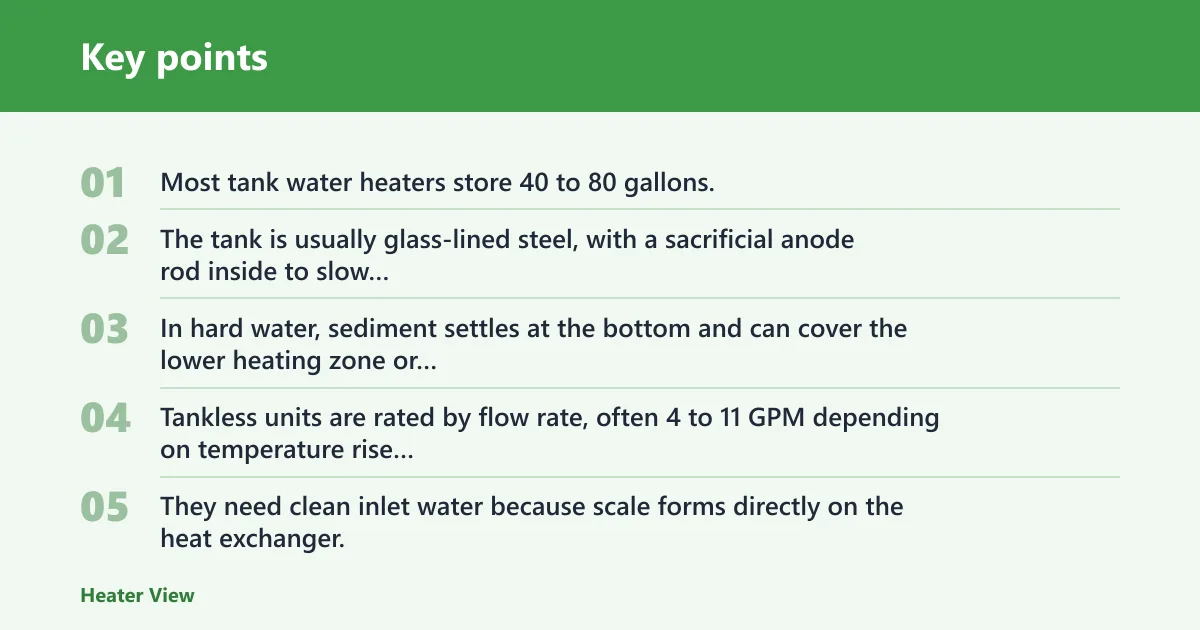
Most tank water heaters store 40 to 80 gallons. The tank is usually glass-lined steel, with a sacrificial anode rod inside to slow corrosion. In hard water, sediment settles at the bottom and can cover the lower heating zone or burner area, which cuts recovery and increases strain.
Tankless water heater at a glance
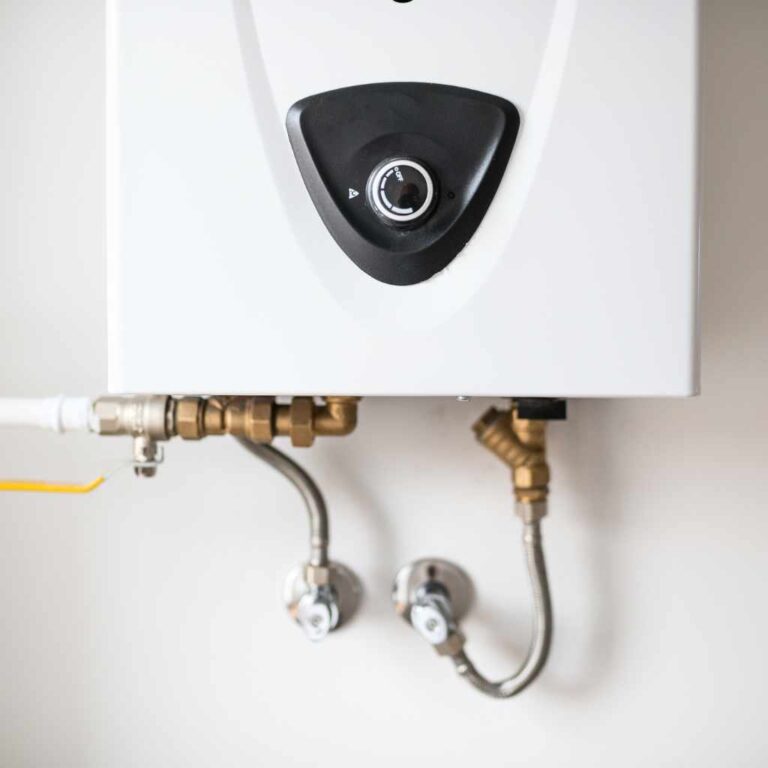
Tankless units are rated by flow rate, often 4 to 11 GPM depending on temperature rise and fuel type. They need clean inlet water because scale forms directly on the heat exchanger. In hard water, descaling often lands on a 6- to 12-month cycle, and condensing units still need that service even though they capture more heat than non-condensing units.
Heat pump water heater at a glance
Heat pump water heaters are tank units with a high efficiency rating, often expressed as a Uniform Energy Factor or similar efficiency number on the spec sheet. They work best in an air-conditioned or temperate space, and many models need enough room for airflow around the cabinet. Filter cleaning and condensate drain access matter more than many buyers expect.
What type lasts longest?
The longest-lived option in hard water is usually the one you can service on schedule and protect from scale. With that condition met, a tank water heater often lasts well because it is simple to flush and its sacrificial anode can be checked. Without maintenance, all three types can fail early.
Tank water heaters in hard water
Tank units tend to be the most forgiving when no softener is installed. Their weak point is sediment. Once the bottom layer thickens, it can insulate the heat source, create noisy operation, and speed tank wear. In hard water, a practical lifespan is often shorter than the nameplate expectation unless you flush regularly and replace the anode on time.
Tankless water heaters in hard water
Tankless heaters can last a long time on treated water, but scale can narrow passages in the heat exchanger and trigger overheating or error codes. If inlet hardness is high and descaling is skipped, flow can fall and parts can wear sooner. That makes them a poor fit for homes that want low attention and no softener.
Heat pump water heaters in hard water
Heat pump units can do well if the tank is flushed and the filter and condensate parts stay clear. Their lower operating temperature can slow scale formation compared with a high-fire tankless system, but they still store water, so sediment control remains important. Access for maintenance matters as much as efficiency.
Hard water heater decision matrix
This matrix turns water hardness and maintenance tolerance into a practical buying call. Higher scores mean lower risk and lower upkeep for the stated scenario. The “softener required” column shows whether a whole-house softener is optional, recommended, or the safer path.
| Household scenario | Tank | Tankless | Heat pump | Best fit |
|---|---|---|---|---|
| 6 to 8 gpg, 2 showers, municipal water, annual service likely | Score 5, softener optional | Score 3, descaling required | Score 4, space needed | Tank |
| 10 to 15 gpg, 2 to 3 showers, no softener, moderate upkeep | Score 4, flush yearly | Score 2, softener strongly recommended | Score 4, filter and drain access needed | Tank or heat pump |
| Above 15 gpg, 3 to 4 showers, well water, low maintenance tolerance | Score 2, softener recommended | Score 1, softener needed | Score 3, softener recommended | Heat pump or tank with softener |
| Above 15 gpg, 4+ showers, high hot-water demand, no softener | Score 1, high scale risk | Score 1, highest service burden | Score 2, limited by space and access | Softener first, then tank or heat pump |
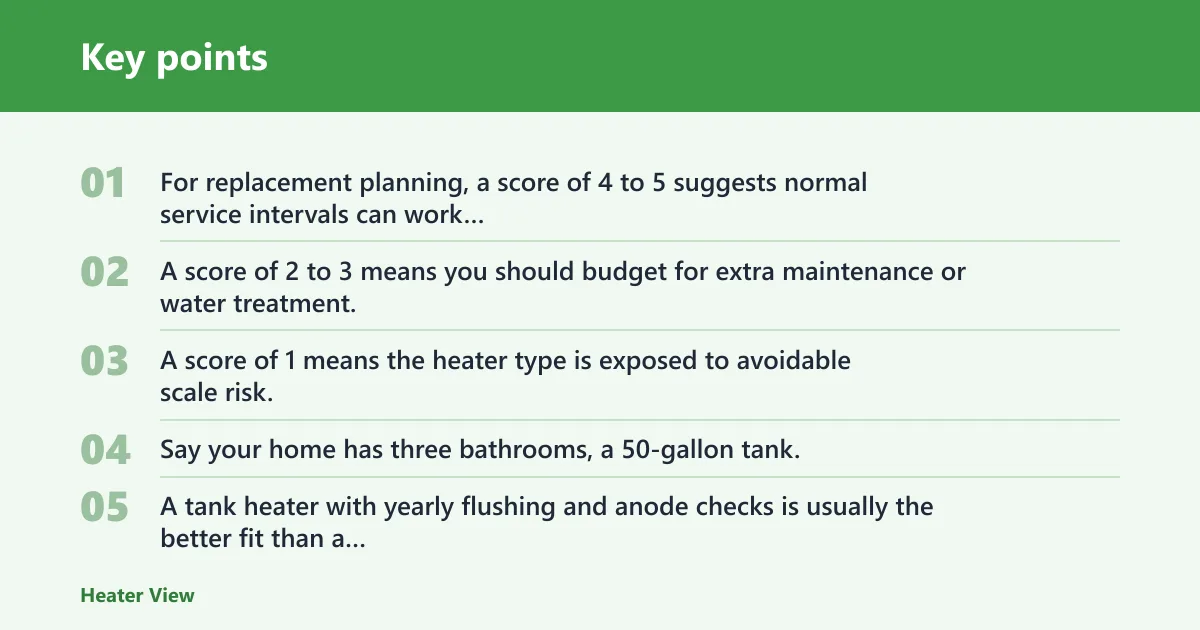
For replacement planning, a score of 4 to 5 suggests normal service intervals can work if you keep up with flushing or filter cleaning. A score of 2 to 3 means you should budget for extra maintenance or water treatment. A score of 1 means the heater type is exposed to avoidable scale risk.
Say your home has three bathrooms, a 50-gallon tank, and 12 gpg water from a municipal supply. A tank heater with yearly flushing and anode checks is usually the better fit than a tankless unit, because the tank can tolerate sediment better than a narrow heat exchanger.
Suppose a house with two adults and two teens pulls showers back to back on 18 gpg well water. A tankless unit without a softener is a weak match because scale can collect fast in the heat exchanger. A tank or heat pump model paired with whole-house softening is the safer route.
Which heater should you buy?
Choose tank if you want simpler upkeep, lower upfront cost, and a heater that can keep working even when water quality is not ideal. Choose tankless only if you are ready for descaling and you can keep inlet water quality under control. Choose heat pump if the install space works and the room stays within the model’s allowed air temperature range.
Choose tank if…
- You have moderate to severe hardness and want the most forgiving maintenance path.
- You need a familiar 40- to 80-gallon storage format.
- You can flush the tank yearly and inspect the anode rod through its access point.
Choose tankless if…
- You have moderate hardness and a softener or treatment system upstream.
- You want high-flow delivery, often 4 to 11 GPM depending on model and temperature rise.
- You can commit to descaling on a 6- to 12-month schedule.
Choose heat pump if…
- You have space for the cabinet, airflow, and maintenance access.
- The installation area stays within the manufacturer’s ambient temperature limits.
- You want a tank format with lower energy use and you can keep up with filters and condensate drainage.
Water softener and treatment options
A whole-house ion-exchange softener removes hardness minerals before they enter the heater. It is measured in grain capacity, and sizing should match daily water use and water hardness, not just bathroom count. The unit belongs upstream of the water heater so the heater sees softened water, not hard water and scale.
Softeners and grain capacity
Typical residential softeners are sized in grains, such as 30,000, 40,000, or 64,000 grains. Higher grain capacity means the system can treat more hardness before regeneration. During regeneration, the unit uses salt and flush water to recharge the resin bed, so you need a drain, power, and a salt supply.
Scale inhibitors and point-of-entry treatment
Scale inhibitors can reduce deposit formation, and point-of-entry filters can catch sediment before it reaches the heater. Some systems use cartridge media that must be replaced on a set interval. They can help, but they are not a substitute for true softening when hardness is severe.
Point-of-use treatment protects one fixture, not the whole house. That is fine for a single sink or appliance, but it does little for a water heater that serves every shower, tub, and laundry load in the home.
Maintenance that extends life
Most hard-water heaters need a simple routine: flush sediment, inspect corrosion protection, and keep drain paths open. For tank units, that means the drain valve, hose connection, and anode access matter. For tankless units, that means descaling valves and a service loop. For heat pump units, it means the filter and condensate path stay clear.
Annual flushing and sediment removal
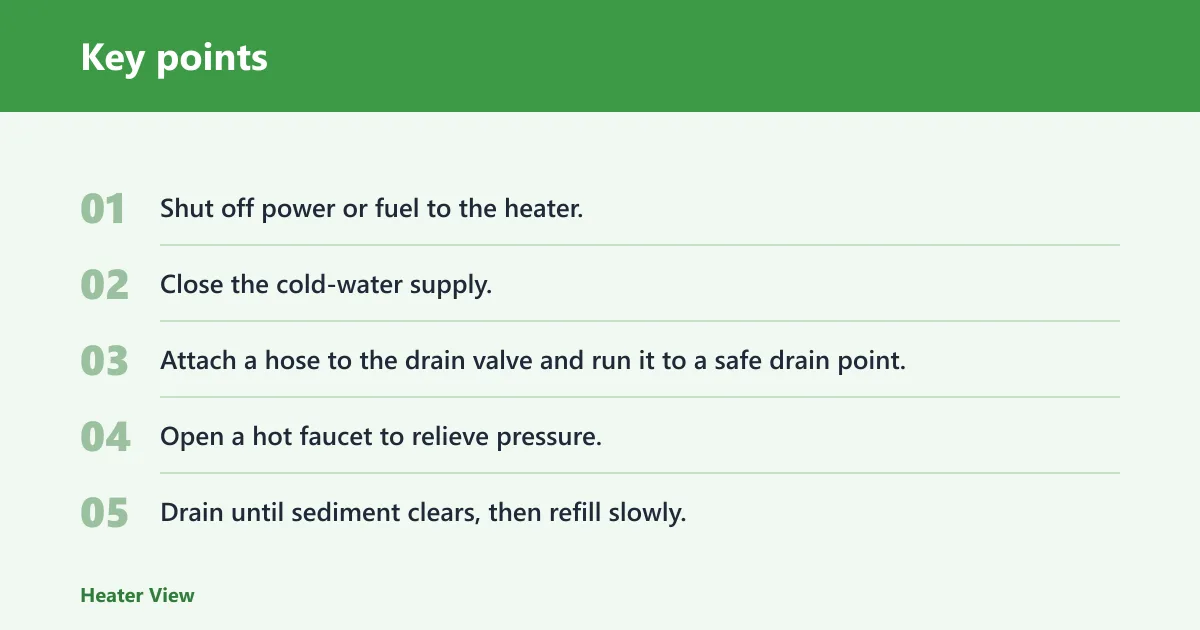
- Shut off power or fuel to the heater.
- Close the cold-water supply.
- Attach a hose to the drain valve and run it to a safe drain point.
- Open a hot faucet to relieve pressure.
- Drain until sediment clears, then refill slowly.
- Restore power only after the tank is full.
For heavy scale or stubborn sediment, use vinegar or an approved descaler only if the manufacturer allows it. Never skip the safety shutoff steps. Dry-firing a tank or energizing elements before refilling can damage the heater fast.
Anode rod inspection and replacement
The anode rod protects the steel tank by corroding first. Magnesium rods are common and offer strong protection in many water conditions. Aluminum rods can last well in some aggressive waters. Powered anode systems use an electrical current and can reduce the need for sacrificial rod replacement.
In hard water, inspect the rod through its access point on the schedule in the manual, often about every 1 to 3 years depending on water quality. Replace it when it is heavily worn. If the rod is buried under scale or inaccessible, service gets harder and tank life usually suffers.
Tankless descaling and heat pump access
Tankless units should be descaled on a schedule set by hardness and use, often once a year in hard water and more often in severe cases. That service usually uses pump hoses, service valves, and an approved descaler. Heat pump heaters need their air filter cleaned and condensate line checked so water does not back up or freeze.
Frequently asked questions
What is a good water heater for hard water homes?
A good water heater for hard water homes is usually a glass-lined tank model with a drain valve and an accessible anode rod, or a heat pump model if the installation space fits. If hardness is severe, pair the heater with a whole-house softener. Without treatment, tankless units need the most care.
Which water heater is best for hard water?
For most homes, the best water heater for hard water is a tank unit because it tolerates sediment better and is easier to flush. If the home has a softener and strong maintenance habits, tankless can work well. If space and air conditions allow, heat pump units are also a solid choice.
What’s the best water heater for a house with hard water?
The best water heater for a house with hard water depends on hardness level and upkeep. Moderate hardness can work with any type if maintained. Severe hardness shifts the answer toward a tank or heat pump unit plus softening. Tankless is the least forgiving when scale is left alone.
What type of water heater lasts longest in hard water?
The longest-lasting type in hard water is usually the one that gets regular service and has softened inlet water. In practice, a tank heater with flushing and anode checks often holds up better than a neglected tankless unit. Heat pump models also last well when filters, drains, and sediment are kept in order.
Are tankless water heaters good for hard water?
Tankless water heaters can be good for hard water only if you can control scale. They have narrow passages and a heat exchanger that is sensitive to mineral buildup. In harder water, most models need descaling every 6 to 12 months, and many homes should add a softener upstream.
Do water softeners help water heaters last longer?
Yes. A whole-house ion-exchange softener removes calcium and magnesium before they reach the heater, which reduces scale and slows wear on elements and heat exchangers. It also lowers the chance of flow restriction and overheating. In severe hard water, a softener is often the difference between normal upkeep and frequent service.
How often should a water heater be serviced in hard water areas?
In hard water areas, plan on about yearly flushing for tank or heat pump water heaters, and descaling for tankless units on a roughly annual to semiannual schedule depending on water hardness. Inspect the anode rod every 1 to 3 years, or sooner in very hard water. If service is skipped, scale and sediment build quickly.
What features should I look for in a water heater for hard water?
Look for a glass-lined steel tank, a drain valve you can actually use, accessible anode rod service, and clear maintenance instructions. For tankless models, look for service valves and descaling access. For heat pump units, check for good filter access, condensate drainage, and enough room around the cabinet.