Condensing Water Heater vs Tankless: Which Is Best?
A condensing gas tankless water heater usually wins on efficiency, but a non-condensing tankless unit can deliver better payback when retrofit venting, condensate drainage, and gas piping add roughly $1,000 to $3,000 or more. In this article, “condensing water heater” means a condensing gas tankless model. Both types are tankless, but they differ in exhaust temperature, venting, and whether they need condensate handling. Ignore installed costs, and you may pay for efficiency you never recover in utility savings.
| Decision factor | Condensing water heater | Non-condensing tankless | Winner |
|---|---|---|---|
| Fuel efficiency | Typical UEF runs about 0.90-0.98, and Rheem lists condensing models around 0.93-0.96 UEF. | Typical UEF runs about 0.80-0.85, with Rheem non-condensing models around 0.81-0.82 UEF. | Condensing water heater |
| Venting | Many models can use standard Schedule 40 PVC or polypropylene, which lowers material cost in some retrofits. | Requires Category III stainless steel vent pipe for hotter exhaust. | Condensing water heater |
| Drain and condensate handling | Needs a condensate drain, and many installs need a neutralizer for acidic condensate. | No condensate drain or neutralizer. | Non-condensing tankless |
| Installed cost risk | Lower operating cost, but more parts and more labor if the drain path or vent route is missing. | Lower sticker price and fewer drain-related parts, with simpler replacement in many homes. | Non-condensing tankless |
| Best fit | Best when hot-water use is high and the home already has a drain path or an easy vent route. | Best when retrofit work is tight, the vent path is costly, or the owner wants the simplest replacement. | tie |
How do these tankless heaters differ?
Condensing and non-condensing tankless water heaters both heat water only when you call for it, but they move heat out of the exhaust differently. A condensing water heater pulls more heat from flue gas, while a non-condensing tankless unit sends hotter exhaust out the vent and keeps the hardware simpler.
For homeowners, the practical difference is not just efficiency. It is whether your house can handle condensate drainage, lower-temperature venting, and the added fittings or labor that come with a condensing gas tankless model.
Condensing tankless water heater
A condensing tankless water heater uses two heat exchangers. That second pass pulls more usable heat from the exhaust stream, which is why these units post higher UEF numbers and lower gas use. The tradeoff is extra hardware, a condensate drain, and usually more attention to vent routing.
Non-condensing tankless water heater
A non-condensing tankless water heater uses a single heat exchanger and sends out hotter exhaust. That is why it needs Category III stainless steel vent pipe instead of plastic venting. The design is simpler, and the installed price often starts lower because there is no condensate system to build out.
What UEF means here
Uniform Energy Factor is the residential efficiency metric that lets you compare fuel use across models. For this category, typical non-condensing ranges are about 0.80-0.85, while typical condensing ranges are about 0.90-0.98. It is useful, but it does not tell you the full installed cost. Manufacturer spec sheets commonly publish UEF, while venting and condensate requirements are usually listed in the installation manual.
Which is more efficient?
Condensing units use less fuel than non-condensing units, and that shows up in UEF as well as in gas use. The real question is whether that fuel savings is large enough to justify the added venting, drainage, and labor costs in your house. For a rough comparison, a 12% efficiency gap is a reasonable estimate when one model is about 0.82 UEF and another is about 0.92 UEF, but actual savings depend on usage and local gas rates.
Typical efficiency ranges
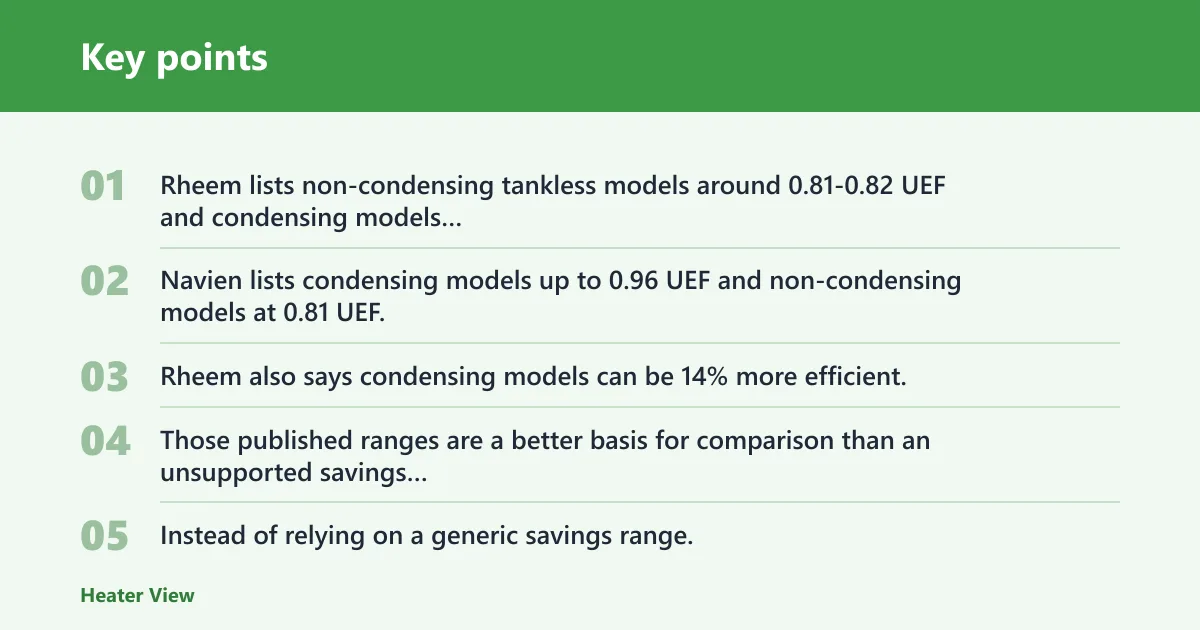
Rheem lists non-condensing tankless models around 0.81-0.82 UEF and condensing models around 0.93-0.96 UEF. Navien lists condensing models up to 0.96 UEF and non-condensing models at 0.81 UEF. Rheem also says condensing models can be 14% more efficient. Those published ranges are a better basis for comparison than an unsupported savings claim.
What that means for annual gas use
Instead of relying on a generic savings range, use a simple estimate based on your annual hot-water therms and gas price. If a condensing model reduces hot-water gas use by about 10% to 15%, annual savings scale with your consumption. Homes with higher draw volumes and higher gas prices usually have the strongest case for condensing.
Why cold incoming water matters
Colder incoming water gives a condensing unit more room to recover heat before exhaust leaves the system. That is why cold-climate homes can see a wider operating gap, especially with long showers, larger families, or homes that use lots of hot water at once. The climate effect still depends on actual usage, not just the zip code.
If a home uses about 1,100 hot-water therms a year and gas costs about $1.75 per therm, a 12% fuel reduction would save about 132 therms, or about $231 a year. In a house that already has usable venting and a drain path, that can be enough to justify condensing on payback alone.
What changes the install cost
Installed cost changes most when venting and condensate management turn a simple swap into a retrofit. The unit price matters, but the bigger swing often comes from vent material, drain access, neutralizer work, and whether the old vent route can stay in service. Manufacturers such as Rinnai and Rheem publish venting and condensate requirements in their install manuals; those details should guide the quote more than marketing language.
Venting material
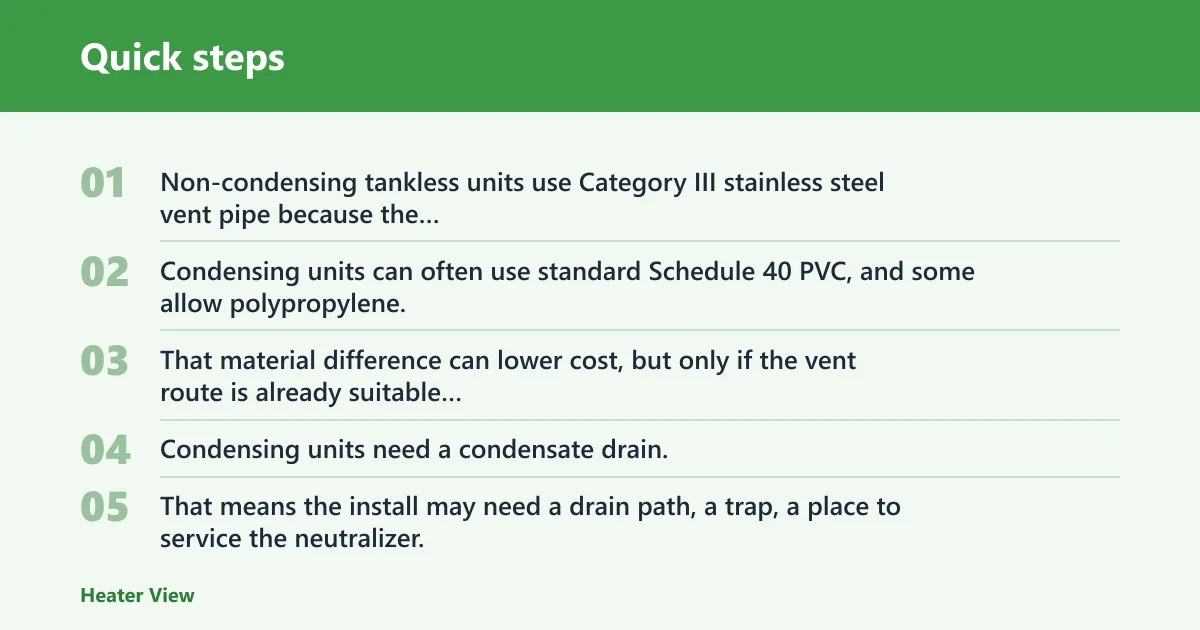
Non-condensing tankless units use Category III stainless steel vent pipe because the exhaust is hotter. Condensing units can often use standard Schedule 40 PVC, and some allow polypropylene. That material difference can lower cost, but only if the vent route is already suitable for plastic pipe and local code accepts it.
Drain and neutralizer work
Condensing units need a condensate drain, and many installs need a pH neutralizer because the condensate is acidic. That means the install may need a drain path, a trap, a place to service the neutralizer, and a route that will not freeze. If any of those pieces are missing, labor rises fast.
Common replacement paths
A direct replacement over an existing Category III vent is one of the easiest paths for a non-condensing tankless unit. Condensing becomes more attractive when you already have a drain nearby, can abandon a chimney cleanly, or can run plastic vent without opening finished walls. A tight mechanical closet pushes the other way because access work adds time and cost.
| Scenario | Annual hot-water therms | Gas price per therm | Added installed cost for condensing | Estimated annual fuel savings | Simple payback | Likely winner |
|---|---|---|---|---|---|---|
| Easy replacement | 600 | $1.50 | $900 | About $108 | About 8.3 years | Condensing water heater |
| Moderate retrofit | 900 | $1.75 | $2,500 | About $189 | About 13.2 years | Non-condensing tankless |
| Difficult retrofit | 1,200 | $2.00 | $4,000 | About $288 | About 13.9 years | Non-condensing tankless |
That table uses a simple 12% fuel-savings assumption to keep the comparison readable. The point is not the exact decimal; it is the break-even shape. When the retrofit is light, condensing can pay back. When venting and drainage turn into a project, the higher-efficiency unit can lose on total installed cost.
How do maintenance and code limits affect the choice?
Maintenance is where many owners miss the full cost difference. Both types need annual descaling, but condensing models add condensate management tasks and code checks that can stop a project before the unit is installed. National Fuel Gas Code and manufacturer instructions often govern vent termination, clearances, and condensate routing, so the “cheaper” model is not always the easier permit path.
Maintenance items that are the same
Annual descaling is part of maintenance for both types. Hard water can build scale on the heat exchanger, so that service still matters even if the unit is condensing. A good owner plan should include water quality, service access, and isolation valves either way.
Extra service on condensing models
Condensing models can need neutralizer replacement and drain-trap service. The neutralizer media wears out and the trap can collect debris or dry out if the system is not maintained. Those are small jobs, but they are still real upkeep that a non-condensing tankless model avoids.
Code and site limits that block condensing
Condensing can lose on fit if there is no drain path, freeze risk at the drain or vent, or code limits on the vent route. Chimney abandonment can also be costly if the old vent chase needs patching or sealing after the tank is removed. In a tight mechanical closet, the extra piping can create a layout problem before it creates a savings problem.
Picture a townhouse with a unit in a narrow utility closet and a long vent run to the outside wall. If the only drain is across finished space, the condensate line may need a pump, a trap, and freeze protection. In that setup, the fuel savings may not beat the added labor and parts.
Choose Condensing water heater if… / non-condensing tankless if…
Condensing water heater is the better pick when annual hot-water use is high and the retrofit is light enough that the fuel savings can catch up to the added install cost. Non-condensing tankless is the better pick when the vent, drain, or code work is expensive enough that payback stretches beyond the time you expect to keep the unit.
Choose Condensing water heater if…
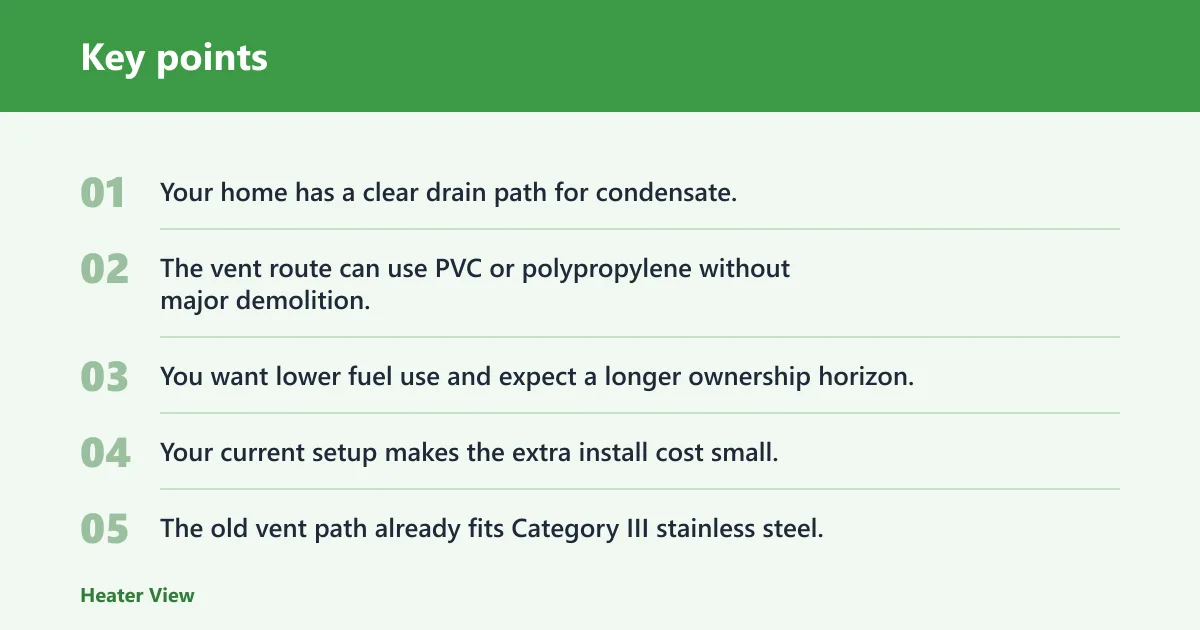
- Your home has a clear drain path for condensate.
- The vent route can use PVC or polypropylene without major demolition.
- You want lower fuel use and expect a longer ownership horizon.
- Your current setup makes the extra install cost small.
Choose non-condensing tankless if…
- The old vent path already fits Category III stainless steel.
- There is no simple place to add a condensate drain or neutralizer.
- The install sits in a cold, tight, or hard-to-access mechanical space.
- You want the lower upfront cost and the simplest replacement path.
- Check the existing vent material and route.
- Find a real drain path for condensate, not a guessed one.
- Confirm whether a neutralizer is required by the install plan.
- Ask whether the vent run or chimney needs abandonment work.
- Compare the added installed cost against your annual hot-water therms.


Homeowner decision tool
Use this quick decision table to see whether condensing is likely to pay off in your home. The higher-efficiency model makes the most sense when hot-water use is high, gas is expensive, and retrofit complexity is low. If two or more factors are unfavorable, a non-condensing tankless model often wins on total project cost.
| Input | Low / favorable for condensing | Medium | High / unfavorable for condensing | What it suggests |
|---|---|---|---|---|
| Annual hot-water therms | Under 700 | 700-1,000 | Over 1,000 | Higher usage favors condensing more strongly. |
| Local gas price | Under $1.50 per therm | $1.50-$2.25 per therm | Over $2.25 per therm | Higher gas prices shorten payback for condensing. |
| Retrofit complexity | Existing drain nearby, simple vent route, easy service access | One upgrade needed | Multiple changes needed: drain pump, vent reroute, wall repair, or freeze protection | High complexity usually favors non-condensing tankless. |
Condensing water heater vs tankless checklist
This checklist highlights the details that most often change the installed price or the permit path. If you cannot check several of these boxes, the lower-UEF model may not be the better buy after labor is included.
- Drain access: Is there a reliable gravity drain or an approved route for a condensate pump?
- Vent route: Can the vent be run with the required material without major demolition?
- Freeze risk: Will the condensate line, trap, or vent termination be exposed to freezing conditions?
- Neutralizer need: Does the manufacturer or installer call for a condensate neutralizer?
- Code and termination constraints: Do local code clearances, termination location, or chimney abandonment requirements add work?
Model-level examples
Model choice matters because not every condensing gas tankless unit is built the same way. The examples below show how UEF, vent compatibility, and condensate requirements influence where each model fits best. Always confirm the exact installation manual for the specific size and fuel type before comparing quotes.
| Model series | UEF | Vent material compatibility | Condensate requirements | Where it fits best |
|---|---|---|---|---|
| Rinnai RX199iN | Manufacturer-published UEF is commonly listed around 0.95 | Supports plastic venting types when installed per manual, which helps in retrofit jobs with a suitable route | Requires condensate management because it is a condensing model | Good fit when you want high efficiency and have a practical drain path or easy condensate plan |
| Rheem RTGH series | Commonly published around 0.93-0.96 UEF depending on model | Typically supports PVC/CPVC or polypropylene venting on condensing models, subject to the specific manual | Requires a condensate drain and may need a neutralizer | Good fit for homes that want condensing performance and already have workable venting and drainage |
| Rheem RTG series | Commonly published around 0.81-0.82 UEF | Uses Category III metal venting because exhaust is hotter | No condensate drain or neutralizer required | Good fit when replacement simplicity and lower upfront cost matter more than maximum efficiency |
Frequently asked questions
Is a condensing water heater more efficient than a tankless water heater?
Yes, if “tankless water heater” means a non-condensing model. Condensing units are typically more efficient, with UEF ranges around 0.90-0.98 versus about 0.80-0.85 for non-condensing units. The bigger question is whether the higher efficiency pays back after venting and drain work.
What is the difference between condensing and non-condensing tankless water heaters?
Condensing models use two heat exchangers and reclaim more heat from exhaust gas. Non-condensing models use a single heat exchanger and send hotter exhaust through Category III stainless steel vent pipe. Condensing units also need a condensate drain, while non-condensing units do not.
How much money does a condensing tankless water heater save each year?
A better estimate comes from your annual hot-water therms and local gas price, not a one-size-fits-all savings claim. If condensing improves efficiency by about 10% to 15%, annual savings may be modest in a low-use home and much larger in a high-use home with expensive gas.
Does a condensing water heater need a condensate drain?
Yes. Condensing tankless water heaters produce condensate from the exhaust stream, and that liquid needs to go somewhere. Many installs also need a pH neutralizer because the condensate is acidic, which adds another maintenance item to the system.
Can a condensing tankless water heater use PVC venting?
Often yes. Many condensing models can vent through standard Schedule 40 PVC, and some allow polypropylene. That is a major reason they can be cheaper to vent than non-condensing units, which require hotter-duty metal venting.
Is non-condensing tankless cheaper to install than condensing?
Often yes, especially in retrofit jobs. The unit itself usually costs less, and the install can be simpler because there is no condensate drain or neutralizer. But if the existing vent route already favors plastic pipe, the cost gap can narrow.
Which type is better in a cold climate, condensing or non-condensing?
Condensing usually has the edge in a cold climate because colder incoming water lets it recover more heat from the exhaust. That does not erase the install math, though. If freeze risk, drain access, or vent length are poor, the better efficiency can still lose on total project cost.
When does a non-condensing tankless water heater make more sense?
Non-condensing makes more sense when you want lower upfront cost and the retrofit would be messy. If drain access is poor, the vent route is complicated, or code constraints add labor, the simpler unit can be the better buy even with lower UEF.