Heat Pump Water Heater vs Gas Water Heater: Which Saves More?
A heat pump water heater can often cost about 50% to 70% less to run than a standard gas water heater, though high hot-water demand, a cold installation space, or very cheap gas can narrow that gap or even reverse it. Choose the wrong type and you can lock in higher monthly bills or slower recovery than your household can handle. This guide compares operating cost by demand, room conditions, and local gas-versus-electric rates. ENERGY STAR and DOE efficiency labels show why the gap can be large, but local therm and kWh prices still decide the final winner.
| Decision factor | pump water heater | gas water heater | Winner |
|---|---|---|---|
| Typical efficiency | Commonly around 3.0 to 4.0 UEF; ENERGY STAR certified models may be higher depending on size and type | Efficiency depends on model; storage units use fuel combustion and UEF varies by design | pump water heater |
| Recovery speed | Slower on heat-pump-only mode; many units add resistance backup | Faster recovery than heat pump models | gas water heater |
| Installation space | Often needs about 700 to 1,000 cubic feet; some units can work in about 450 cubic feet | Fits more easily in smaller mechanical spaces | gas water heater |
| Upfront cost | Usually higher purchase and install cost | Usually lower upfront cost | gas water heater |
| Monthly operating cost | Usually lower when electricity is not far above gas and the room is suitable | Can be lower where gas prices are cheap and hot-water demand is high | depends on local rates |
Operating cost vs recovery time
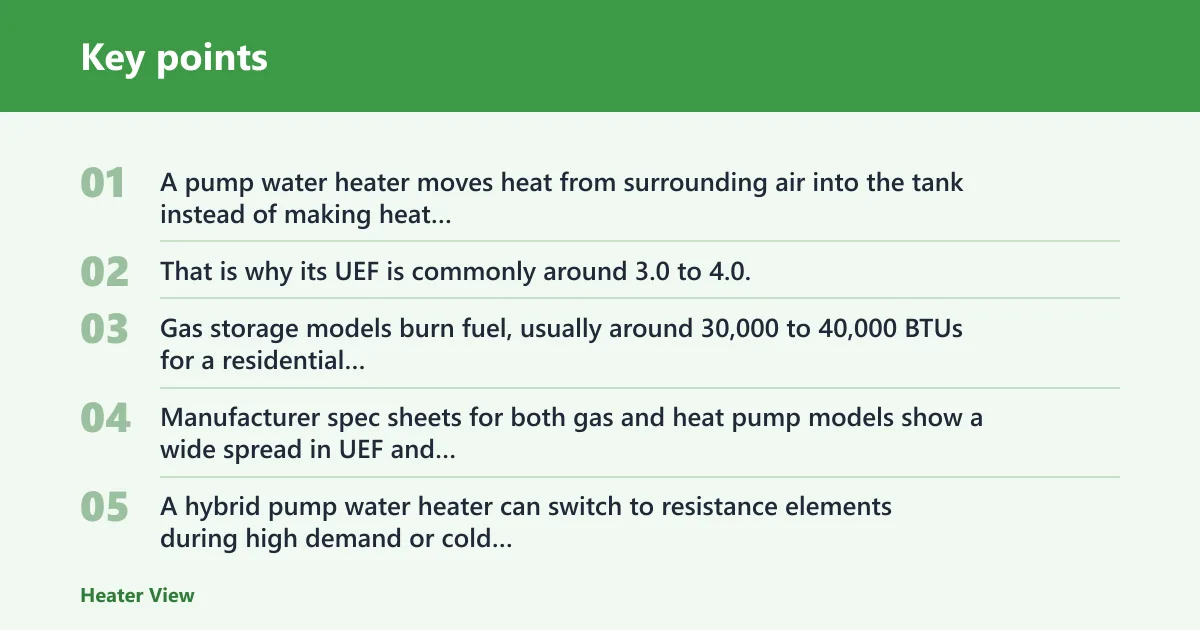
The trade-off is direct: a pump water heater usually costs less to run, while a gas water heater usually recovers faster and costs less to buy. The better value depends on how much hot water you use, how much room the unit gets, and whether local electricity or gas prices are kinder to your bill. DOE and ENERGY STAR both emphasize that installation conditions and usage pattern matter as much as the efficiency label.
Operating cost and recovery point in different directions
A pump water heater moves heat from surrounding air into the tank instead of making heat directly. That is why its UEF is commonly around 3.0 to 4.0, while standard electric tanks usually land around 0.9 to 0.95 UEF. Gas storage models burn fuel, usually around 30,000 to 40,000 BTUs for a residential tank, and that burner output helps recovery. Manufacturer spec sheets for both gas and heat pump models show a wide spread in UEF and input ratings, so exact model comparison matters.
Recovery matters when showers stack up. A hybrid pump water heater can switch to resistance elements during high demand or cold air, but that backup mode uses more electricity and narrows the operating-cost gap. Gas storage units still have the edge when you need hot water fast and often. For a separate comparison with tanked electric storage, see heat pump water heater vs electric tank.
Local rates can flip the answer
Electricity and gas prices matter more than most shoppers expect. A unit with strong efficiency on paper can still cost more to run if electricity is expensive and gas is cheap. The reverse is also true: a pump water heater can beat gas by a wide margin when electric rates are moderate and the home gives the tank enough warm air to work with. Utility calculators and bill comparisons are the best way to test your own rates.
What to compare before you replace your tank
Look at four items together: your local utility rates, your household hot-water demand, your installation space, and the first-hour rating. If one of those is off, the label efficiency alone will not tell you which option saves more. A small household in a warm basement can get a very different answer from a large family in a cold closet. DOE guidance and manufacturer spec sheets are the best sources for space and capacity checks.
Heat pump savings matrix
Use this matrix as a shortcut before you compare model labels. It ties the likely winner to household size, space conditions, and the risk that can erase the savings. ENERGY STAR and DOE both note that ambient temperature, room size, and hot-water demand can change real-world results materially.
| Scenario | Expected winner | Key reason | Red-flag risk |
|---|---|---|---|
| Small family | pump water heater | Lower daily demand lets the higher UEF matter more than fast recovery | A very small closet can cut performance if the room does not have enough air volume |
| Large family | gas water heater | Faster recovery handles stacked showers and back-to-back draws better | Heat-pump-only mode can lag during morning peaks |
| Basement install | pump water heater | A basement often offers the surrounding space and air volume a pump unit needs | Cold basement air can reduce efficiency unless the room stays temperate |
| High utility-rate area | pump water heater | Higher electric efficiency can outweigh the gas burner advantage when rates are unfavorable | Very cheap gas can still change the math |
Small family: expected winner and why
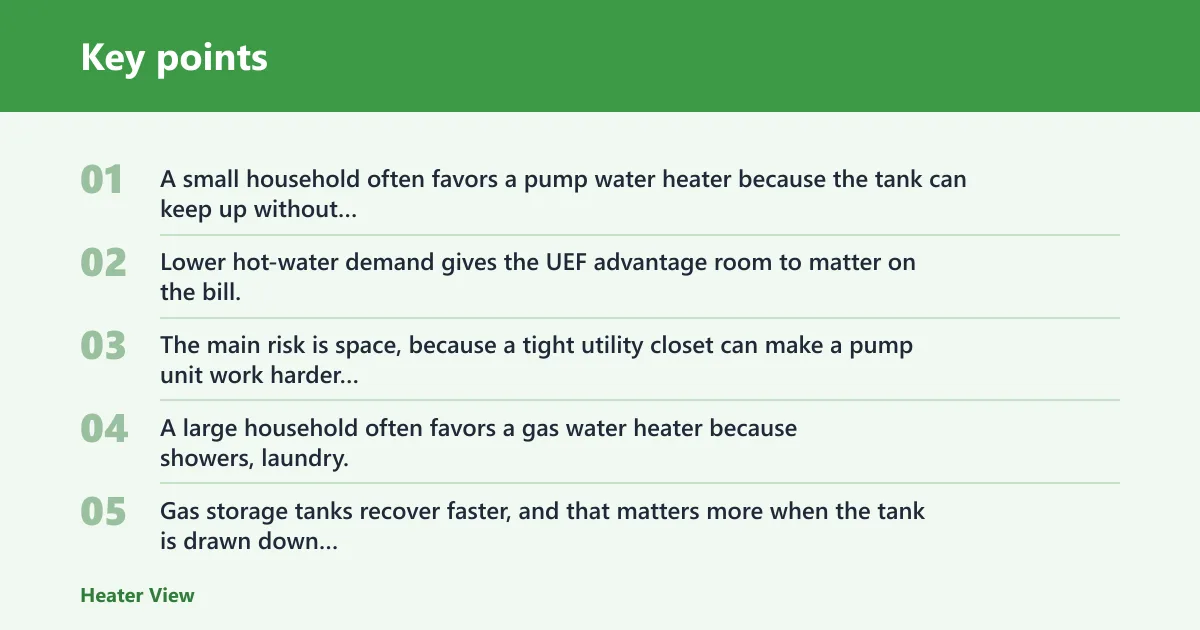
A small household often favors a pump water heater because the tank can keep up without constant high-output recovery. Lower hot-water demand gives the UEF advantage room to matter on the bill. The main risk is space, because a tight utility closet can make a pump unit work harder than expected.
Large family: expected winner and why
A large household often favors a gas water heater because showers, laundry, and dishwashing can overlap. Gas storage tanks recover faster, and that matters more when the tank is drawn down several times a day. A pump unit can still work, but only if the first-hour rating matches the peak load and the room conditions are good. This is also where comparing gas storage vs tankless gas matters: tankless gas can deliver endless hot water in theory, but only within its flow-rate limits.
Basement install: expected winner and why
A basement is often the best setting for a pump water heater because it can supply the space and air volume many units need. Some installations need about 700 to 1,000 cubic feet, and many manufacturers call for louvered doors or ducting when the room is too small. If the basement runs cold for long periods, the efficiency edge shrinks. Those room-volume figures appear in manufacturer installation manuals and ENERGY STAR placement guidance.
High utility-rate area: expected winner and why
When electricity is expensive, the savings from a pump water heater can shrink fast. When gas is expensive, the pump unit usually pulls ahead. The winner depends on the local rate gap, not on a generic national average. Utility calculators that plug in your actual kWh and therm prices are the most reliable way to compare.
Which costs less to run?
A pump water heater usually costs less to run when electricity is not much higher than gas on an equivalent energy basis and the unit has enough surrounding air to work normally. The cleanest way to judge it is to compare your monthly hot-water load against local rates, then check the unit’s UEF. Cheap gas can still win in some homes.
Simple monthly operating-cost formula using local rates, UEF, and hot-water use
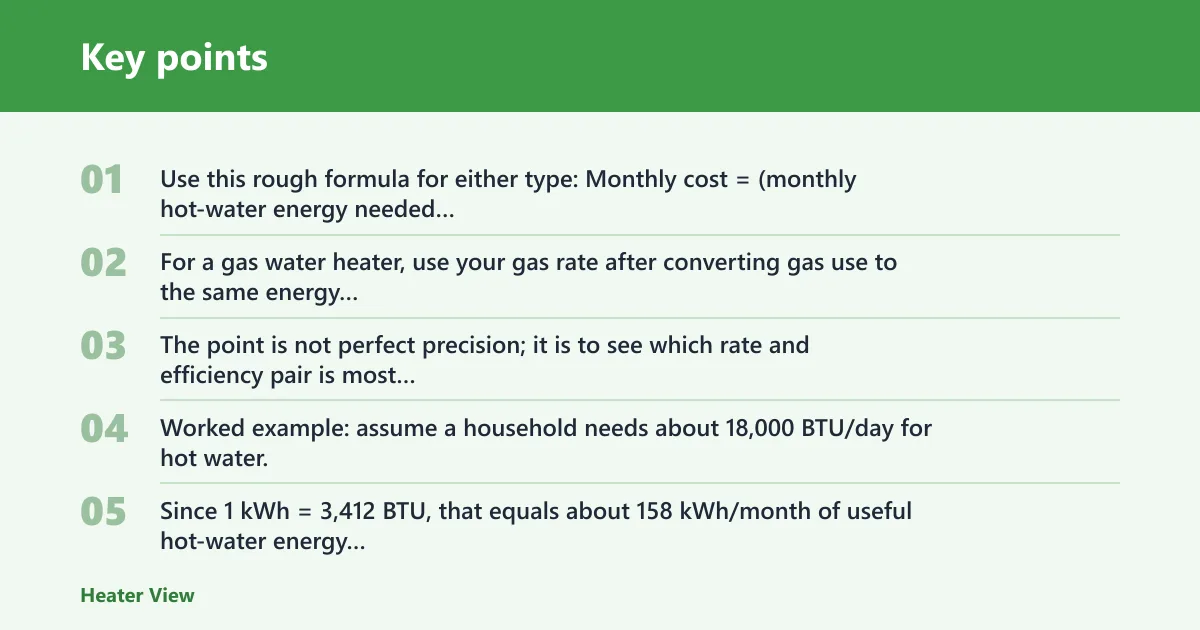
Use this rough formula for either type:
Monthly cost = (monthly hot-water energy needed ÷ UEF) × local energy rate
For a pump water heater, use your electricity rate. For a gas water heater, use your gas rate after converting gas use to the same energy basis your bill uses. The point is not perfect precision; it is to see which rate and efficiency pair is most favorable in your home.
Worked example: assume a household needs about 18,000 BTU/day for hot water, or about 540,000 BTU/month. Since 1 kWh = 3,412 BTU, that equals about 158 kWh/month of useful hot-water energy before losses. With a 3.5 UEF heat pump water heater, input use is about 45 kWh/month; at $0.18/kWh, that is about $8.10/month. With a 0.70 UEF gas water heater, input use is about 771,000 BTU/month, or 7.71 therms/month; at $1.50/therm, that is about $11.57/month. In this example the heat pump water heater wins, but local therm and kWh prices decide the winner.
When heat pump efficiency beats gas fuel cost
Heat pump models commonly rate about 3.0 to 4.0 UEF, which is far above standard electric tanks and gives them a strong operating-cost advantage. A heat pump water heater can cut electricity used for water heating by roughly two-thirds or more, depending on the model and duty cycle. That advantage shows up fastest in homes with average demand and space that is not too tight or too cold. ENERGY STAR certified models are designed to meet higher efficiency thresholds than standard electric storage tanks.
When cheap gas still wins
Gas can still win when the household demand is heavy, the family wants rapid refills, and the gas price is low enough to offset the pump unit’s efficiency. That is common in homes with morning shower peaks, frequent laundry, or several people using hot water at once. In that situation, the cheaper monthly bill may belong to gas even if the pump unit has the higher UEF. This is especially true for gas storage water heaters, which should not be confused with tankless gas units that heat on demand.
How much hot water can each deliver?
The answer is not just tank size. First-hour rating tells you how much hot water a storage unit can deliver during a busy hour, and that matters more than a label number when several people shower before work or school. A pump water heater can run out of hot water sooner if the load outruns its recovery mode. Check the manufacturer’s first-hour rating before comparing gallon sizes.
First-hour rating and morning shower demand
A heat pump water heater uses first-hour rating to show how much hot water it can deliver in a busy hour. That makes it a practical sizing tool for households with a morning shower peak. If the rating is too low for the peak, the tank may feel smaller than its gallon label suggests. ENERGY STAR and DOE both recommend matching capacity to peak demand rather than average daily use alone.
Why heat-pump-only recovery feels slower
Heat-pump-only mode usually recovers more slowly because it is pulling heat from surrounding air rather than generating it directly. Many home units are hybrids with electric resistance backup elements, and that backup helps with faster recovery when demand spikes or the room gets too cool. If the backup runs often, operating cost rises. Manufacturer spec sheets typically list recovery ratings and input power, which are the best way to judge this tradeoff.
Picture a four-person household with two showers, a load of laundry, and a dishwasher cycle in the same hour. A gas water heater is more likely to keep pace without falling behind. A pump water heater may still work, but only if the tank’s first-hour rating and backup mode cover that peak.
Where gas storage or tankless gas fits better
Gas storage water heaters fit households that want faster recovery with a familiar tank format. Tankless gas water heaters fit a different need: they heat on demand without a storage tank, but flow rate limits can still cap simultaneous showers and appliances. High-output tankless gas units often use 120,000 BTUs or more, so they are not a direct apples-to-apples match with a standard storage tank. Compare first-hour rating for storage units and flow rate for tankless units separately.
Will a heat pump water heater work in your space?
Many will, but not all rooms are a good match. A pump water heater often needs about 700 to 1,000 cubic feet of surrounding space, and tight closets can reduce efficiency. Some units can work in about 450 cubic feet, but the room still needs to be set up carefully. Manufacturer installation manuals, DOE guidance, and ENERGY STAR placement notes are the right references for those limits.
The 700 to 1,000 cubic foot rule
That space requirement is not cosmetic. The unit needs enough ambient air to pull heat from, and a cramped room can limit performance. If the room is undersized, the unit may rely more on resistance backup and give up part of the operating-cost advantage. Some models can be installed in smaller spaces, but the air-volume requirement is model-specific.
Basements, closets, louvered doors, and ducting
Basements are often the easiest fit because they tend to have more usable air volume. Small closets can still work if the installation meets the manufacturer’s space requirements, and many manufacturers call for louvered doors or ducting when the room is too small. That extra airflow can protect efficiency. DOE and utility installation guides commonly suggest checking the room volume before purchase.
Cold rooms and efficiency loss
Cold air around the unit can reduce efficiency because the pump has less useful heat to pull from. That is one reason a cold garage or unconditioned utility room can erase savings. If the room stays cool for long stretches, a gas water heater may be the safer choice for predictable performance. Climate and room temperature matter as much as tank size in these settings.
- Measure the installation room’s air volume before you shop.
- Check your hot-water peak, not just average use.
- Compare local electricity and gas rates, not national averages.
- Confirm the first-hour rating for the storage size you need.
- Verify whether the room needs louvered doors, ducting, or a different location.
Choose pump water heater if… / Choose gas water heater if…
Choose a pump water heater if you want lower operating cost, your household hot-water demand is moderate, and the unit can sit in a room with enough surrounding air. It also fits better when local gas is cheap enough to be competitive only at very high demand, or when you have a basement that can support the installation.
Choose a gas water heater if you need faster recovery, your family stacks showers and appliance use in a short window, or the installation space is too small or too cold for a pump unit to run well. It also makes sense when upfront cost matters most and you want a simpler fit in a tight mechanical space.
A hybrid pump water heater is the middle ground when the room works but demand spikes sometimes. A tankless gas water heater fits households that want on-demand hot water and can live with flow-rate limits on simultaneous use. Compare gas storage vs tankless gas carefully so recovery rate is not mistaken for unlimited output.

- Heat pump technology extracts heat from air.
- 3.75 UEF supports efficient operation.
- ENERGY STAR, UL, and AHRI certified.
Frequently asked questions
Is a heat pump water heater cheaper to run than a gas water heater?
Often yes, but not always. A pump water heater usually runs cheaper when local electricity rates are reasonable, the room is suitable, and hot-water demand is moderate. Cheap gas, heavy daily use, or a cold installation space can shrink the gap or give gas the edge. The local therm and kWh price spread is the deciding factor.
How much does a heat pump water heater save per year?
There is no single number that fits every home. Savings depend on local rates, hot-water usage, and whether the unit spends much time in resistance backup. A household with average demand and a good installation space can save a meaningful amount, while a high-use home in a cold utility room may save far less. Utility calculators are the best way to estimate your annual dollars.
What is the first-hour rating of a heat pump water heater versus gas?
First-hour rating measures how much hot water a storage unit can deliver during a busy hour. Gas storage units usually recover faster, so they often hold up better under repeated draws. A pump water heater can still perform well if the rating matches the household peak and the backup elements are sized well. Always compare the label rating for the exact model and tank size.
Do heat pump water heaters work in basements or small closets?
Basements are often a good fit because they usually offer enough surrounding air. Small closets can work only if the space meets the manufacturer’s requirements, and many manufacturers call for louvered doors or ducting when the room is too small. Tight, cold closets are a poor match. Room temperature and air volume are the main limits, not just physical fit.
How much space does a heat pump water heater need?
Many installations need about 700 to 1,000 cubic feet of surrounding space. Some units can work in about 450 cubic feet, but that depends on the model and room setup. If the room is undersized, the unit may lose efficiency or rely more on resistance backup. Check the manufacturer’s installation manual before you commit to a location.
When does a gas water heater still make more sense than a heat pump model?
Gas makes more sense when the household has high hot-water demand, wants fast recovery, or has a room that is too small or too cold for a pump unit. It also remains attractive when upfront cost is the priority and local gas prices are low enough to keep operating cost in check. Gas storage and tankless gas are different choices, so compare the recovery and flow limits before deciding.