Gas Water Heater vs Electric: Which Heats Faster?
Gas water heaters usually reheat water faster than standard electric tank models, but the real answer depends on tank size, burner or element input, and whether you mean recovery time or the first hot shower. Choose the wrong fit, and you can get lukewarm showers or a heater that cannot keep up with peak demand. This guide compares heating speed, recovery rate, first-hour rating, and the settings that matter most.
| Decision factor | Gas water heater | electric water heater | Winner |
|---|---|---|---|
| Recovery speed after drawdown | Usually faster in standard tank models because burner input is commonly much higher than resistance-element input, especially in high-BTU tanks. | Usually slower in standard tank models because one or two heating elements warm the water more gradually, though high-wattage models can narrow the gap. | Gas water heater |
| Performance during a power outage | Conditional. Many modern gas tank heaters still need electricity for ignition, controls, blowers, or power venting; some standing-pilot atmospheric models may still heat during outages. | Cannot run without electricity in normal operation. | Gas water heater |
| Installation constraints | Needs a gas line plus proper venting and ventilation. | Depends on electrical service capacity and usually avoids gas-line and flue requirements. | electric water heater |
| Best fit for heavy use | Often better for big homes and high draw patterns, especially when the input rating is high enough for the tank size. | Can work well if demand is moderate or the tank and electrical supply are sized well. | Gas water heater |
| Efficiency rating range | Modern listings usually use UEF, not EF. Representative gas tank UEF ranges are often about 0.55 to 0.85, while gas tankless units are commonly higher. | Modern listings usually use UEF, not EF. Representative electric resistance tank UEF ranges are often about 0.90 to 0.95, while heat-pump models can be much higher. | electric water heater |
Which heats faster?
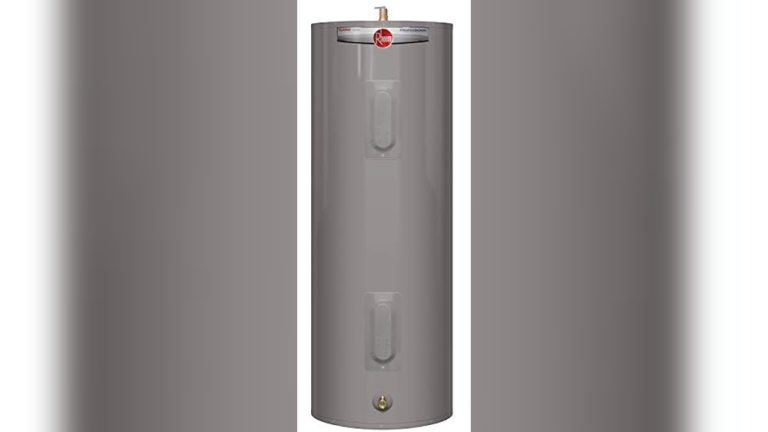
Gas water heater models usually recover hot water faster than standard electric tank models, so they often feel quicker after a shower or laundry draw. That speed edge is strongest when the gas tank has a high burner input and the electric tank is a common 4.5 kW resistance model. In representative manufacturer spec sheets, a 40-gallon electric tank with a 4.5 kW element often posts a lower recovery rate than a comparable gas unit with a 36,000 to 40,000 BTU input; larger or high-input gas tanks can go higher still. In short, the winner is usually gas, but the input rating and tank size decide by how much.
Why gas usually recovers hot water faster
A gas water heater uses a burner beneath the tank, and that direct heat input is why it typically rebounds faster after hot water is drawn down. Manufacturer specifications commonly show gas recovery rates measured in gallons per hour, while electric tank models are often limited by element wattage. A typical 40-gallon gas tank with a 36,000 to 40,000 BTU input can recover around 30 to 40 GPH, while a 40-gallon electric tank with a 4.5 kW element is often closer to about 20 to 25 GPH. Higher-input gas models can exceed that range.
Fuel type is only part of the answer. A larger tank, a higher BTU input, and a cleaner burner setup can all change how quickly hot water returns. The same is true on the electric side: a 4.5 kW element will recover more slowly than a higher-wattage element, even when the tank size is identical.
When an electric tank can feel fast enough
An electric water heater can still feel quick enough for a smaller household or a lighter usage pattern, especially if the tank is sized correctly and the elements are healthy. The comparison shifts again if the home has low demand, short showers, or enough storage to absorb repeated draws.
Say your home has two people, a 40-gallon electric tank, and spaced-out showers. In that case, slower recovery may never become a problem because the total hot-water demand stays modest. A heat-pump water heater changes the picture further because it trades some recovery speed for much higher efficiency.
Recovery time vs first-hour rating
Recovery time is the reheating speed after drawdown. First-hour rating measures how much hot water the tank can deliver in about the first hour, and total hot-water availability describes what happens across back-to-back showers, laundry, and dishwashing. Those are related, but they are not the same number. Modern product pages and efficiency labels typically use UEF, while older literature may still refer to EF, so it helps to separate efficiency from hot-water output.
| Metric | What it tells you | What affects it most | Common mistake |
|---|---|---|---|
| Recovery time | How quickly the tank reheats after hot water is used. | Fuel type, burner or element input, tank size, and sediment. | Assuming all gas units recover at the same pace. |
| First-hour rating | How much hot water the heater can deliver in the first hour of use. | Tank capacity, recovery speed, and starting water temperature. | Reading it as the same thing as reheating speed. |
| Total hot-water availability | How the system holds up during repeated draws. | Household demand, tank size, and the time between uses. | Ignoring the number of showers or loads stacked back to back. |
Recovery time
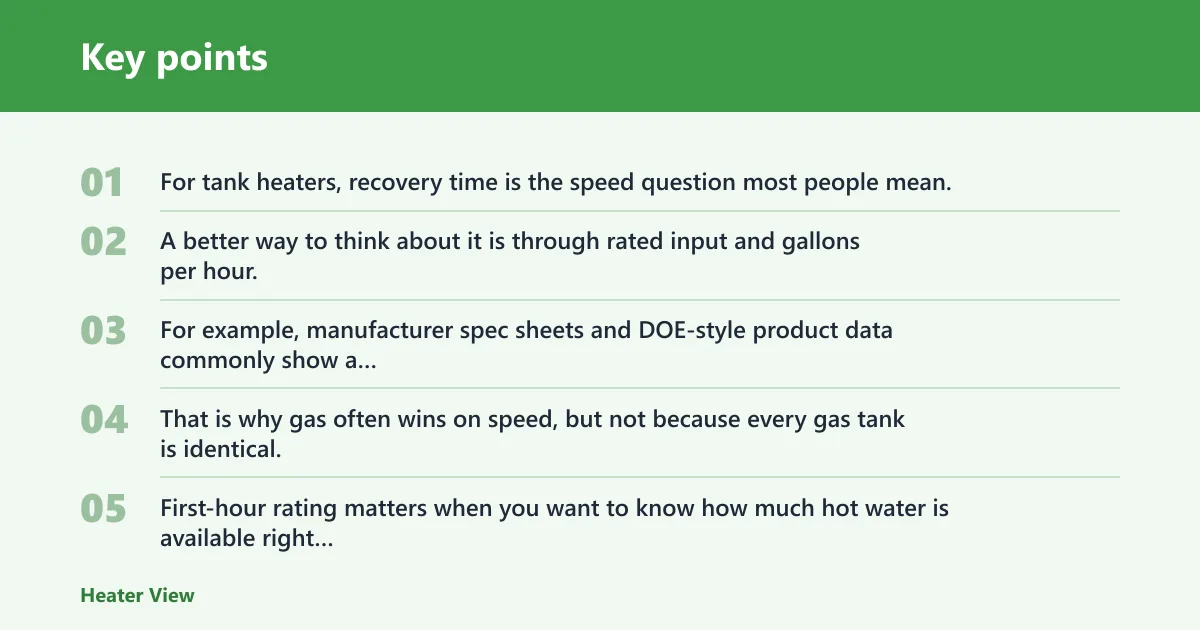
For tank heaters, recovery time is the speed question most people mean. A better way to think about it is through rated input and gallons per hour. That is why gas often wins on speed, but not because every gas tank is identical.
First-hour rating
First-hour rating matters when you want to know how much hot water is available right away. A heater with a strong first-hour rating can feel better in a busy household even if its recovery is only average, because it can deliver more usable hot water before the tank is fully drawn down. That is also where tank size matters: a 50-gallon high-input gas model can have a meaningfully higher first-hour rating than a 40-gallon unit with the same fuel type.
Total hot-water availability
Total availability is what you feel during a busy morning. Suppose three showers, a dishwasher run, and a load of laundry all land in the same hour. A larger tank with a good recovery rate usually handles that better than a smaller tank with a faster but limited recovery cycle. A high-FHR unit can buy you time, but recovery rate determines how quickly the tank resets for the next round.
Gas and electric speed table
This table ties the speed question to real household patterns. The likely winner changes when the home already has gas, when the electrical service is limited, or when outage tolerance matters. The comparison is strongest when you look at both recovery rate and first-hour rating together rather than tank size alone.
| Household size | Typical hot-water use pattern | Existing utility hookup | Outage tolerance | Likely winner for fastest recovery |
|---|---|---|---|---|
| 1 to 2 people | Short showers, spaced-out use, light laundry | Electric only | Low priority | electric water heater |
| 3 to 4 people | Morning shower cluster, dishwasher, laundry | Gas line already present | Moderate priority | Gas water heater |
| 4 to 6 people | Back-to-back showers and frequent fixture use | Gas line and venting available | High priority | Gas water heater |
| Small apartment | One shower at a time, low simultaneous draw | No gas line | Low priority | electric water heater |
| Large home with frequent outages | High draw plus backup needs | Gas line already present | High priority | Gas water heater, if the model can operate without household power or has backup ignition support |
Example configurations: tank size, input, recovery, and FHR
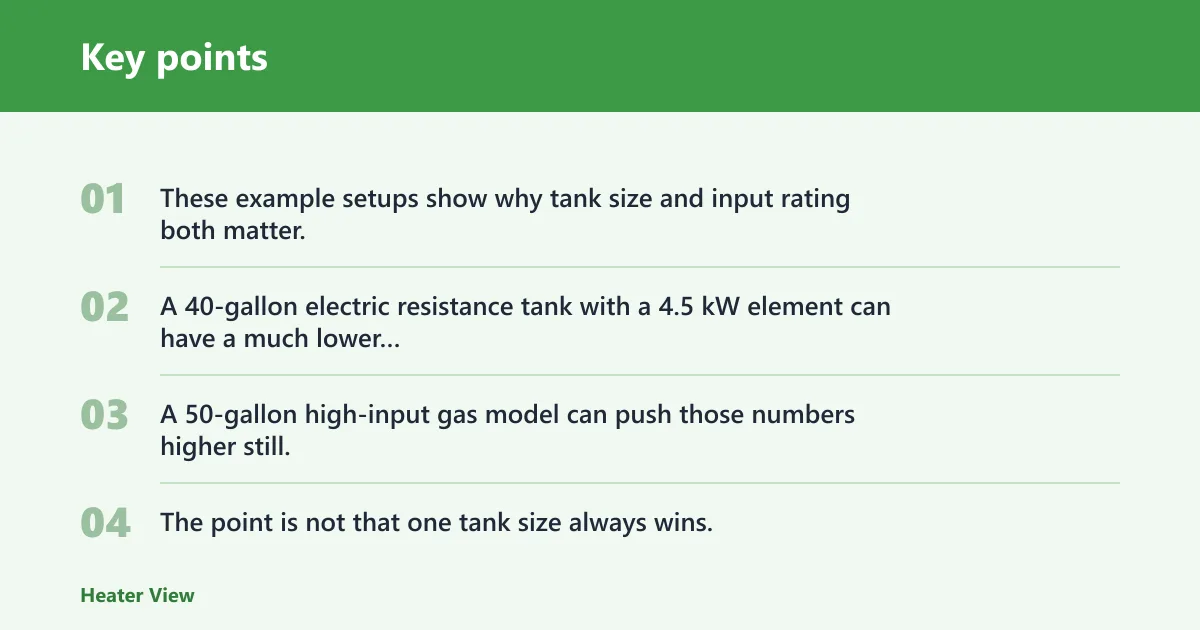
These example setups show why tank size and input rating both matter. A 50-gallon high-input gas model can push those numbers higher still, especially if the spec sheet lists a stronger first-hour rating. The point is not that one tank size always wins; it is that higher input usually turns into faster recovery and more usable hot water.
| Example configuration | Typical input rating | Typical recovery rate | Typical first-hour rating | What it usually means in practice |
|---|---|---|---|---|
| 40-gal electric resistance | 4.5 kW element | About 20 to 25 GPH | Often moderate, depending on tank design | Works well for modest demand, but back-to-back use can outpace recovery |
| 40-gal gas tank | 36,000 to 40,000 BTU | About 30 to 40 GPH | Often higher than a same-size electric tank | Usually a faster rebound after showers and laundry |
| 50-gal high-input gas | 40,000 to 50,000+ BTU | Often above a standard 40-gallon gas unit | Often the strongest in the group | Better for busy households that need both storage and rapid recovery |
How each heater makes hot water
Gas water heater
A gas water heater has a burner situated beneath the tank. It uses natural gas or propane, and the heat from combustion can warm the stored water faster than standard electric tank heating in many homes.
That speed comes with venting and ventilation needs. Many modern gas units also need electricity for ignition, controls, blowers, or power venting, so outage performance depends on the exact design. Standing-pilot atmospheric models are the main exception that may still heat during outages, provided the draft and venting system work as designed.
Electric water heater
An electric water heater can have one or two heating components, and it turns electrical energy into hot water without combustion or a flue. That design is simpler in many installations, but standard resistance models usually recover more slowly than gas tank models.
Electrical service matters. If the panel, circuit, or wiring is undersized, the heater may not reach its intended recovery rate. Resistance models are straightforward, while heat-pump water heaters use a different process altogether and should be judged separately from standard electric tanks.
Why input rating changes recovery speed
Tank size alone does not tell you how fast a heater rebounds. BTU input on gas models and wattage on electric models determine how much heat reaches the tank over time, which is why two units with the same capacity can perform very differently.
A common mistake is assuming a high-capacity electric unit will heat a cold tank as quickly as a gas water heater just because it has a bigger tank. If the input is weak, the tank can still lag after a heavy draw. In comparison shopping, look for the BTU input, kW element size, recovery rate, and first-hour rating together.
Does faster heating mean lower cost?
Not automatically. Uniform Energy Factor, or UEF, is the modern efficiency metric on many current listings and labels, while older pages may still mention EF. UEF measures efficiency, not recovery speed, so a heater can be efficient and still feel slow, or recover quickly and use more energy to do it. Representative UEF ranges are often about 0.55 to 0.85 for gas tank units, 0.90 to 0.95 for electric resistance tanks, much higher for heat-pump water heaters, and often stronger for tankless gas than for storage gas units. Tankless electric units vary widely and depend heavily on electrical capacity.
Efficiency and speed are different questions
Electric heaters are often very efficient in resistance form because most of the electrical energy becomes heat in the water. Gas heaters can still win on speed, though, because faster heat transfer is a separate design question from efficiency. Heat-pump units complicate the comparison further because they can be highly efficient but slower to recover than straight resistance electric or high-input gas tanks.
That is why a higher UEF does not automatically mean faster hot water. It only tells you more about how effectively the heater converts its energy input into stored hot water. For speed, the more useful questions are how many BTUs or watts the heater has, what its recovery rate is, and how much hot water its first-hour rating can deliver.
Representative UEF ranges by heater type
Current spec sheets and regulatory labels commonly show the following pattern: gas tank water heaters are usually lower on UEF than electric resistance tanks; heat-pump water heaters are typically the most efficient of the storage types; tankless gas units often post stronger efficiency numbers than standard gas tanks; and tankless electric models can be efficient but are limited by incoming electrical service and flow demand. If an older page uses EF, read it as the previous terminology rather than the current label format.
Choose gas water heater if… / Choose electric water heater if…
Choose Gas water heater if your home uses a lot of hot water, you already have a gas line, and you care about faster recovery after showers or laundry. Choose electric water heater if you do not have gas service, want simpler installation, or need a unit that fits an electrical setup without venting.
Choose Gas water heater if…
- You have a large family or frequent back-to-back showers.
- You want the better odds of fast recovery after a full tank draw.
- You already have gas service, venting, and ventilation in place.
- You want hot water to keep flowing during a power outage, but only if the specific gas model does not depend on household electricity for ignition, controls, or venting.
Choose electric water heater if…
- Your household demand is moderate and you value simpler installation.
- You do not have a gas line or do not want to add venting.
- You have enough electrical service capacity for the heater you want.
- You want a system with no combustion products from the heater itself.
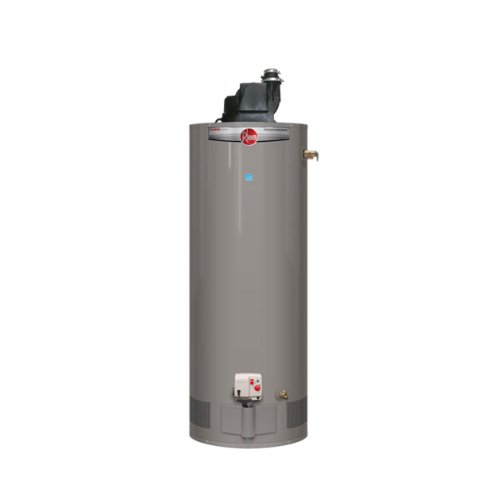
- Uses indoor air for combustion
- Blower exhausts flue gases
- Long venting runs up to 100 equivalent feet
Tankless and hybrid options
Tankless gas vs tankless electric
Tankless models change the speed discussion because there is no storage tank recovery cycle. Gas tankless units often deliver strong hot-water output and can support high flow when sized correctly, while electric tankless units depend heavily on electrical capacity and can require major service upgrades.
Heat-pump water heaters and why they change the comparison
Heat-pump water heaters are electric, but they are not the same as resistance electric models. They often have much lower operating cost than standard electric resistance heaters, and their speed and recovery behavior should be judged on that different design, not on the basic gas-versus-electric tank comparison.
Condensing gas models and venting tradeoffs
Condensing gas water heaters use a secondary heat exchanger to pull more heat from combustion. They can improve efficiency, but they also add venting and condensate considerations that matter during installation. In UEF terms, these models often sit above standard atmospheric gas tanks, though installation complexity can rise with the efficiency gain.
Frequently asked questions
Which heats faster: gas or electric water heater?
Gas water heater models usually heat faster in standard tank form because the burner under the tank can recover water quickly. Electric tank models are usually slower in recovery, although a well-sized electric unit can still be fast enough for a lighter household demand. The best answer depends on the specific BTU input or wattage, not just the fuel type.
How much faster does a gas water heater recover than an electric one?
The answer depends on tank size and input rating, but representative manufacturer data often puts a 40-gallon gas tank at about 30 to 40 GPH versus about 20 to 25 GPH for a 40-gallon electric resistance tank with a 4.5 kW element. A 50-gallon high-input gas model can be faster still, especially in first-hour output. That makes gas faster in many real-world comparisons, but not by a fixed amount.
Does a gas water heater save money if it heats faster?
Faster heating does not automatically mean lower cost. UEF tells you about efficiency, not speed, and operating cost still depends on local gas and electricity rates, the unit’s efficiency, and how much hot water the home uses.
Is electric water heater installation easier than gas?
Usually yes. Electric installation is often more convenient because it avoids a gas line and venting, but the electrical service still has to be adequate for the heater you choose.
Will a gas water heater still work during a power outage?
Sometimes, but not always. Many modern gas tank heaters still need electricity for ignition, controls, blowers, or power venting. Standing-pilot atmospheric models are the main gas units that may still heat during outages if their venting setup works, while electric water heaters cannot run without electricity.
Which type is better for a large family that runs out of hot water?
Gas water heater models are usually the better starting point for a large family because they tend to recover faster and handle heavy use more comfortably. A properly sized electric unit can work too, but the installation has to support the demand, and recovery may still lag behind gas in tank models. The best choice often comes down to a balance of tank size, input rating, and first-hour rating.