What heater efficiency means for monthly bills and costs
A quick shortcut is monthly heating cost ≈ the heat your home needs ÷ heater efficiency, so an 80% unit turns $100 of delivered heat into about $125 of fuel use. I have seen a winter budget miss by hundreds when someone guessed low. This guide gives the fast math, then shows how weather, runtime, and insulation shift the bill.
What heater efficiency means for your bill
Heater efficiency tells you how much of the energy you buy becomes usable heat inside the home. AFUE, COP, and percent efficiency describe that conversion in different ways. The rating matters, but it is only one piece of the bill. Runtime, fuel price, thermostat setting, insulation, and outdoor temperature can push the final monthly cost up or down.
AFUE, COP, and percent efficiency explained
AFUE, or annual fuel utilization efficiency, is used for gas and oil furnaces. An 80% AFUE furnace turns roughly 80% of the fuel energy into heat and loses the rest through exhaust and cycling losses. A 95% AFUE furnace wastes less fuel for the same delivered heat.
COP, or coefficient of performance, is used for heat pumps and some electric systems. A COP of 3 means the unit delivers about 3 units of heat for each 1 unit of electricity it uses. Percent efficiency is often used for electric resistance heat, where nearly all input electricity becomes heat in the room, so the efficiency is close to 100%.
What the rating measures, and what it misses
The rating measures conversion efficiency at or near rated conditions. It does not measure how long the heater runs, how cold it is outside, how leaky the house is, or how much heat the room actually needs. Two homes can have the same heater and very different bills because one house loses heat much faster.
Why efficiency and capacity are different
BTU is a heat quantity, and BTU per hour is a rate or capacity rating. Capacity tells you how much heat the equipment can deliver at a moment in time. Efficiency tells you how much energy it takes to make that heat. A large heater can still be inefficient, and a small heater can still be costly if it runs constantly.
How to turn a rating into monthly dollars
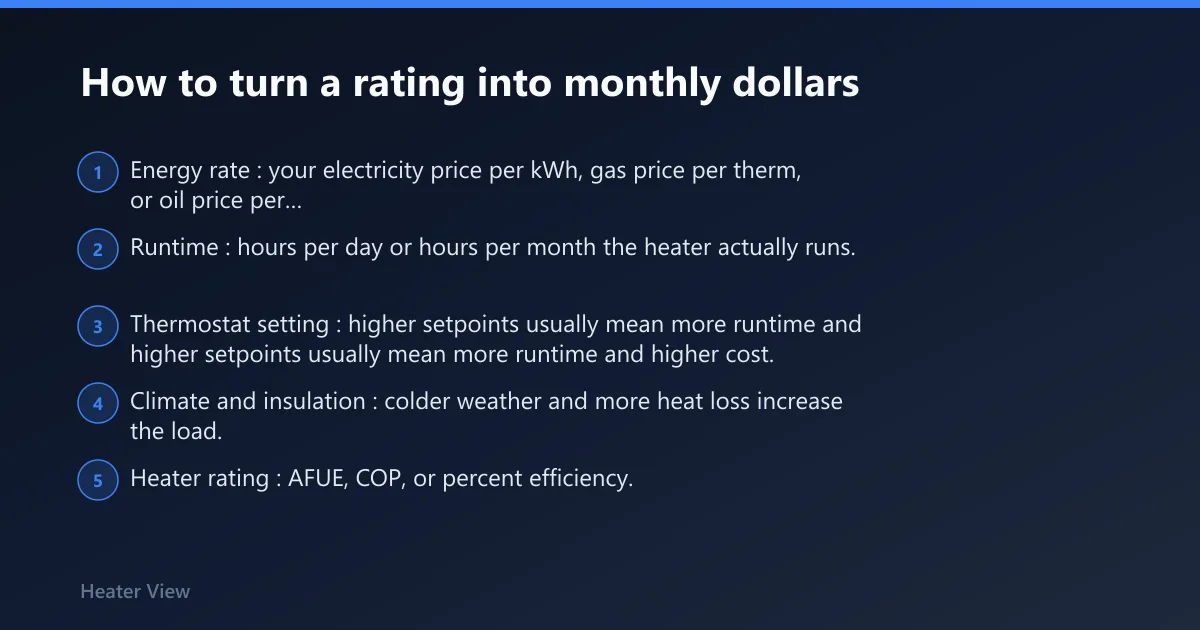
To estimate monthly heating cost, start with the energy your home needs, then divide by heater efficiency, then multiply by your local energy rate and runtime. For electricity, use kWh price. For gas, use therm price. For oil, use gallon price. The answer will still be rough, but it will be close enough to budget with.
The inputs you need
- Energy rate: your electricity price per kWh, gas price per therm, or oil price per gallon.
- Runtime: hours per day or hours per month the heater actually runs.
- Thermostat setting: higher setpoints usually mean more runtime and higher cost.
- Climate and insulation: colder weather and more heat loss increase the load.
- Heater rating: AFUE, COP, or percent efficiency.
- BTU output: useful for sizing and for estimating delivered heat.
The basic formulas for electric, gas, and heat pump systems
Electric resistance space heater: monthly cost = watts ÷ 1000 × hours used × electricity rate per kWh.
Gas furnace: monthly fuel cost = delivered heat needed ÷ AFUE ÷ 100,000 × therm rate, since 1 therm equals about 100,000 BTU.
Heat pump: monthly electric cost = delivered heat needed ÷ COP ÷ 3412 × electricity rate per kWh, because 1 kWh equals 3412 BTU.
How BTU output fits into the estimate
BTU output helps you estimate how much heat a room or house needs. A small room may need only a modest BTU load, while a drafty whole house in winter needs far more. Once the heat demand is known, efficiency converts that demand into fuel use. Capacity sets whether the heater can keep up; efficiency sets what that heat costs.
How much can a higher efficiency rating save?
A higher rating can save a lot when the heater runs many hours, the fuel is expensive, or the home needs a large amount of heat. The same rating change can save very little in a mild climate or in a house that hardly calls for heat. Savings depend on how often the heater runs, and the dollar gap depends on runtime and local utility rates as much as on the label.
A small rating change versus a large one
Going from roughly 80% AFUE to around 95% AFUE can reduce fuel use by something like 10–20% for the same delivered heat. That is a meaningful change when the furnace runs often. Going from 90% to 95% is a much smaller change, and the monthly savings are smaller too.
When the savings are obvious
Savings stand out in colder regions, in older homes with steady heat loss, and in households that keep the thermostat high. In those cases, the heater runs enough hours that each percent of efficiency matters. The monthly bill reflects that runtime directly.
When the savings are modest
If the heat is used only part time, or if the house has low heating demand, even a better rating may save only a few dollars in a month. The equipment may still be worth it for comfort or fuel reduction, but the bill change can be smaller than homeowners expect.
Bill estimator worksheet with three real examples
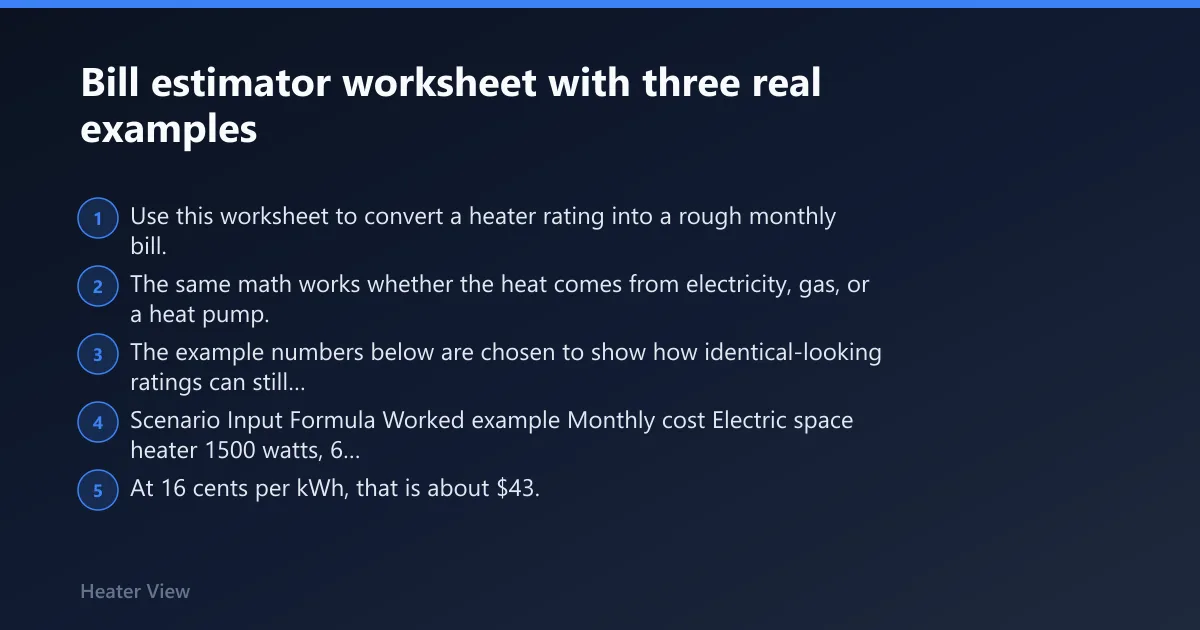
Use this worksheet to convert a heater rating into a rough monthly bill. The same math works whether the heat comes from electricity, gas, or a heat pump. The example numbers below are chosen to show how identical-looking ratings can still produce very different bills once runtime and fuel price change.
| Scenario | Input | Formula | Worked example | Monthly cost |
|---|---|---|---|---|
| Electric space heater | 1500 watts, 6 hours/day, 30 days, $0.16/kWh | (1500 ÷ 1000) × 6 × 30 × 0.16 | 1.5 × 6 × 30 = 270 kWh; 270 × 0.16 | $43.20 |
| Gas furnace | 50,000 BTU of heat needed per day, 90% AFUE, $1.40/therm, 30 days | (50,000 × 30) ÷ 0.90 ÷ 100,000 × 1.40 | 1,500,000 ÷ 0.90 = 1,666,667 BTU fuel; 16.67 therms × 1.40 | $23.34 |
| Heat pump | 50,000 BTU of heat needed per day, COP 3.0, $0.16/kWh, 30 days | (50,000 × 30) ÷ 3.0 ÷ 3412 × 0.16 | 1,500,000 ÷ 3.0 = 500,000 kWh-BTU equivalent; 146.6 kWh × 0.16 | $23.46 |
Electric space heater example
A 1500-watt space heater running 6 hours per day uses about 270 kWh in a 30-day month. At 16 cents per kWh, that is about $43. The unit can be efficient in the sense that nearly all the electricity becomes heat, yet the bill still climbs if it runs many hours.
Gas furnace example
Suppose a home needs 50,000 BTU of heat each day. At 90% AFUE, the furnace must burn more fuel than the delivered heat alone would suggest. Over 30 days, that becomes about 16.7 therms of gas, or about $23.30 at $1.40 per therm. If the same furnace were 80% AFUE, the monthly fuel cost would be higher for the same heat output.
Heat pump example
Using the same 50,000 BTU daily heat load, a heat pump with COP 3.0 needs much less electricity than a resistance heater. Over 30 days, the estimate comes out to roughly 147 kWh, or about $23.50 at 16 cents per kWh. If outdoor temperatures drop and COP falls, the bill rises even though the unit is still doing its job.
Why the same rating can lead to very different bills
Two homes can have the same AFUE furnace or the same COP heat pump and still face very different monthly bills. One house may be tight and well insulated, while the other leaks heat through walls, windows, and ducts. The rating stays the same, but the heat required changes a lot.
Why your bill can stay high even with an efficient heater
A high-efficiency heater can still produce a large bill when the home needs a lot of heat. Efficiency cuts waste, but it does not cancel heat loss. If the heater must run for long stretches because the house leaks energy, the monthly cost can remain high even with a strong rating.
Heat loss from insulation and air leakage
Poor insulation and air leakage increase the heating load. Warm air escapes, cold air enters, and the heater runs longer to hold the setpoint. In that case, efficiency helps, but the house itself is still demanding more heat than a tighter home would need.
Longer runtime in cold weather
Cold weather raises the temperature difference between indoors and outdoors, which increases heat loss. That is why a February bill can be much higher than an October bill, even if the heater setting never changes. More runtime means more energy use, and more energy use means more cost.
Thermostat setbacks and setpoint changes
Lowering the thermostat at night or when the home is empty reduces heat demand. Raising it does the opposite. A few degrees may seem minor, but over many hours it changes runtime enough to show up on the bill. Setbacks can help, but only if recovery heat does not erase the gain.
Regional climate and degree days
Heating degree days are a simple way to compare seasonal heating demand across climates. A colder region accumulates more degree days, which usually means more monthly heating cost for the same house and heater. This is why a rating alone cannot predict the bill without climate context.
Does a space heater use less money than central heat?
A space heater can cost less than central heat when it warms one small room for a short time and lets the rest of the home stay cooler. It can cost more when it is used for many hours, when it replaces central heat for a large area, or when electricity prices are high.
When a space heater can be cheaper
For one occupied room, a space heater may be the lower-cost option if the central system would otherwise heat the whole house. A bedroom, office, or workshop is the best case. The savings come from heating less space, not from the space heater being magically efficient.
When it costs more
Electric resistance heat is usually expensive per BTU compared with gas or a heat pump. If a space heater runs all day, the bill can climb fast. That is especially true in a cold house or when several rooms each need their own heater.
How room size and runtime change the answer
Room size sets the heat load. Runtime sets how long that load lasts. A 1500-watt heater used for 2 hours is a very different bill from the same heater used for 10 hours. Central heat can beat a space heater on cost when it serves the full home more efficiently than several point heaters.
What efficiency rating should I compare before buying a heater?
Compare the rating that matches the fuel type you will actually use. Use AFUE for gas or oil furnaces, COP for heat pumps, and wattage plus runtime for electric resistance heat. A better rating matters, but only if it applies to the system and climate you have.
What to match before you shop
Start with heating load, fuel type, and local utility rates. Then compare capacity in BTU per hour or watts, not efficiency alone. A heater that is too large may cycle too often. A heater that is too small may run nonstop and still leave the room cold.
Frequently asked questions
How much does heater efficiency affect my monthly bill?
Efficiency affects how much fuel or electricity it takes to deliver the same heat. The bigger the runtime and the higher the energy price, the larger the monthly effect. In a mild month, the difference may be small. In a cold month, a few efficiency points can matter a lot.
What does a higher AFUE or efficiency rating actually save me each month?
A higher AFUE usually saves a share of the fuel that would have been wasted. If a furnace heats the same home load, 95% AFUE uses less fuel than 80% AFUE. The monthly savings depend on therm price, outdoor temperature, and how many hours the furnace runs.
Why is my bill still high even with an efficient heater?
An efficient heater only reduces waste. It does not reduce the heat your home loses through walls, windows, ducts, and air leaks. If the house needs a lot of heat because of weather or poor insulation, the bill can stay high even when the heater rating is good.
How do I estimate heating costs from BTU, watts, or fuel use?
Use the delivered heat needed, then divide by efficiency, then convert to your utility unit. Watts become kWh. BTU become therms or kWh equivalents. Fuel gallons need the fuel’s BTU content. Once the units match your utility bill, multiply by the local rate.
Does a space heater use less money than central heat?
Sometimes, yes. A space heater can be cheaper if it warms one small room and lets the rest of the house stay cooler. It can be more expensive if it runs for many hours or replaces a fuel-based central system across a large area.
How do outside temperature and run time change monthly heating bills?
Colder outdoor temperatures increase heat loss, so the heater runs longer. Longer runtime means more energy use and a larger bill. This is why two identical homes can pay very different amounts in different climates, or even in the same home across mild and cold months.