Quiet Heater Efficiency: Which Models Waste Less Power?
Quiet heaters waste the least power when they can switch off on their own. A thermostat, ECO mode, or a low-watt radiant panel usually beats a fan heater that runs constantly in a small room. If you ignore runtime control, you can pay for heat you do not need, especially in bedrooms and offices where an oversized unit keeps cycling. This guide separates noise from electricity use and shows which features actually cut kilowatt-hours.
Quiet heater efficiency: the trade-off in one line
What electricity use really means for electric resistance heaters
All-electric resistance heat is rated at 95 to 100 percent efficient. There is no flue loss, so the heater does not waste energy the way a combustion unit can. The same 1,500-watt heater and another 1,500-watt heater produce the same heat per hour at the point of use, so differences in electricity use come from wattage, controls, and runtime, not from the element itself.
That means noise and power are separate questions. A fanless heater can be quieter than a fan-forced one, but quiet operation alone does not guarantee lower kWh use. A low-watt heater can use less electricity each hour, yet it may need to run longer to reach the same comfort target.
Quiet heater waste score table
This table ranks common quiet-heater configurations by estimated waste in normal room use, not by loudness. Lower waste usually comes from matching wattage to the job, then letting a thermostat, timer, or schedule stop empty-room runtime.
| wattage band | control type | best use case | waste risk notes |
|---|---|---|---|
| 500 W to 700 W | Thermostat plus timer or auto-off | Desk, personal heat, very small zone | A 500 W to 700 W range is often presented as among the lowest hourly kWh options for common quiet heaters, and it can waste less when heat is needed only near one person. Risk rises if the room is too large and the heater runs all the time. |
| 700 W to 1000 W | Thermostat, ECO mode, timer | Small bedroom, home office, close-range spot heat | Good balance for modest rooms. Waste increases if the unit is oversized for the space and short-cycles without reaching a stable setpoint. |
| 1000 W to 1500 W | Digital thermostat, schedule, auto-off | Small-to-medium room heating with scheduled use | More useful when you need quicker warm-up, but higher wattage means higher hourly draw. Without scheduling, the extra output can become wasted runtime in an empty room. |
| 1500 W | Room thermostat and scheduling | Short bursts in a closed room, larger small-room loads | Common maximum for portable quiet heaters. It is not automatically efficient; if the room only needs a little heat, 1500 W can overshoot and cycle more than needed. |
Which quiet heater wastes the least power?
The least wasteful quiet heater is usually the one that matches the heating job with the lowest practical wattage and then shuts off quickly when the target is reached. For desk heat, a fanless radiant unit is often the leanest choice. For a small room, a low-watt infrared or ceramic heater with a thermostat and timer is usually better than a larger model left on high.
Best answer for desk heat
For desk heat, fanless radiant units waste the least power in practice because they warm a small zone without trying to heat the whole room. The WHISPERHEAT Under Desk Warmer uses radiant heating and is fanless, with three heat settings and a 2- or 4-hour auto-shutoff timer. That mix suits personal heat, where a full-room heater would need more runtime to deliver the same comfort where you sit.
Best answer for small bedrooms
For a small bedroom, a heater with a thermostat, timer, and lower wattage setting usually wastes less than a full-power unit left running. The VOCRS PTC-903B offers 700 W, 1,000 W, or 1,500 W heat settings, plus a 1 to 12 hour timer. That kind of control matters more than fan noise when the goal is to stop heating once the room is comfortable.
Best answer for spot heating
For spot heating, infrared often wastes less in real use because it heats people and objects directly instead of trying to condition the whole room. The WEWARM HT1198QX uses infrared quartz and has a 1,000 W low setting. That can be a better fit for a seated person, a couch corner, or a desk zone than a louder, larger heater that spreads warm air farther than needed.
Say your room needs only a corner of heat. Say your home office is a closed room and you sit near the heater for three hours. A 500 W or 700 W personal unit with auto-off can waste less than a 1500 W heater set high, because the smaller unit is less likely to overheat the space and cycle uselessly. The key is not the noise level; it is the heat load.
How much power do 500W, 700W, 1000W, and 1500W use?
Hourly energy use is simple: watts divided by 1000 equals kilowatt-hours per hour. A 500 W heater uses 0.5 kWh in one hour, 700 W uses 0.7 kWh, 1000 W uses 1.0 kWh, and 1500 W uses 1.5 kWh. If the heater runs for 3 hours, multiply those numbers by 3.
| heater setting | kWh used in 1 hour | kWh used in 3 hours |
|---|---|---|
| 500 W | 0.5 | 1.5 |
| 700 W | 0.7 | 2.1 |
| 1000 W | 1.0 | 3.0 |
| 1500 W | 1.5 | 4.5 |
If your utility rate is 15 cents per kWh, 1 hour at 500 W costs about 7.5 cents, 700 W about 10.5 cents, 1000 W about 15 cents, and 1500 W about 22.5 cents. The exact bill varies by region and rate, but the wattage math does not change.
Lower wattage lowers hourly use. It does not guarantee lower total use for the same heating job, because the heater may need more time to reach the same comfort level. That is why control features matter so much.
What controls cut waste the most?
Thermostats, timers, schedules, and ECO mode cut waste more reliably than a quiet cabinet alone. A thermostat stops the heater once the set temperature is reached. A timer or auto-off stops empty-room runtime. ECO mode lowers output when full power is not needed. Together, these controls reduce wasted kilowatt-hours far more than a noise rating does.
Thermostat cycling and 1 F step control
A thermostat cuts runtime by switching the heater off at the set temperature, then back on only when the room cools. Digital displays can make setpoint control easier, and 1 F step control gives finer control over when cycling starts and stops. That matters because a tighter setpoint can avoid unnecessary overshoot and shorten runtime in a small room.
Timer, auto-off, scheduling, and ECO mode
Timers and auto-off features are a direct guard against wasted runtime. The VOCRS PTC-903B runs from 1 to 12 hours, which is useful when you want heat for a sleep window or a work block, not all night. The DREO HSH009S Wall Heater includes app scheduling and smart-home support, and the DREO Atom One listing highlights ECO mode. Those features matter because they limit heat when you do not need full output.
Tip-over and overheat protection are safety features, not efficiency features. They matter, but they do not lower kWh use by themselves.
Quiet heater types compared by use case
Different quiet designs change comfort and heat delivery more than they change the physics of resistance heating. A fanless heater stays silent. An infrared heater sends energy straight to people and objects. A ceramic heater moves warm air. A mica panel combines convection with far-infrared heat and often adds scheduling. The best pick depends on where the heat needs to land.
Fanless radiant heaters for personal heating
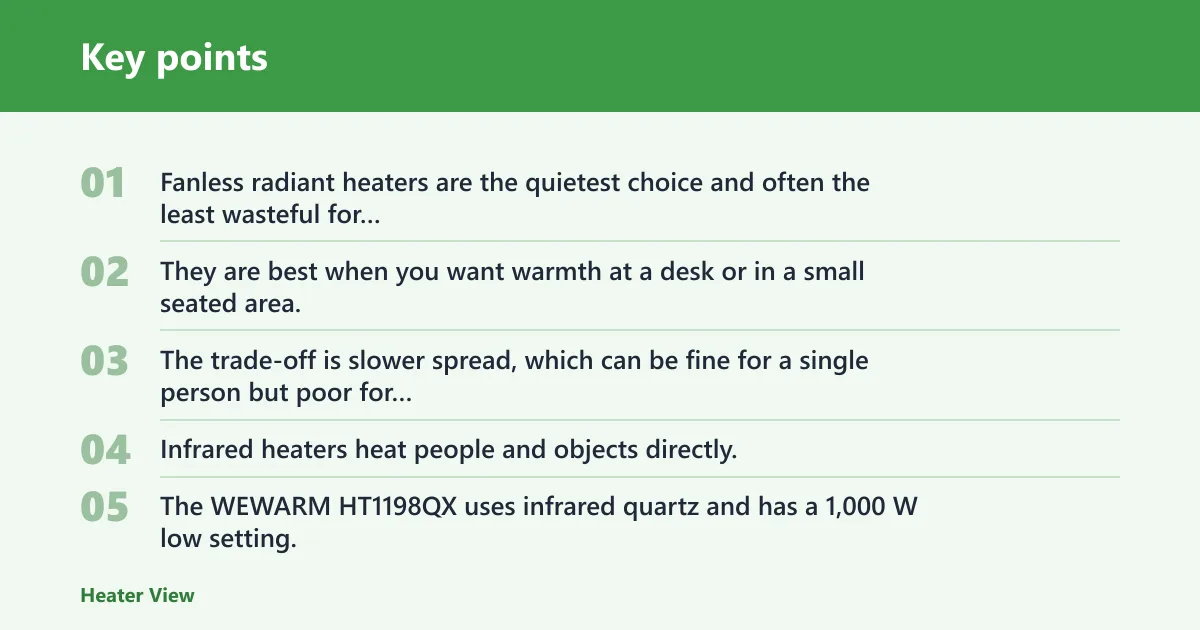
Fanless radiant heaters are the quietest choice and often the least wasteful for close-range use. They are best when you want warmth at a desk or in a small seated area, not when you want to raise the temperature of an entire room. The trade-off is slower spread, which can be fine for a single person but poor for whole-room comfort.
Infrared heaters for targeted warmth
Infrared heaters heat people and objects directly, so they are a strong fit for spot heating. The WEWARM HT1198QX uses infrared quartz and has a 1,000 W low setting. Infrared can waste less power than a larger heater when the goal is to warm a body zone, a chair, or a work area, but it does not change the fact that the same wattage still uses the same kWh per hour.
PTC ceramic heaters for flexible room heating
They usually use fan-assisted convection, so they move heat through the room more quickly than a silent radiant unit. That makes them useful for general small-room heating, as long as the wattage is not bigger than the room needs.
Mica infrared panel heaters for quiet wall or portable use
Mica infrared panel heaters are a quiet middle ground for rooms where a wall-mount or caster setup makes sense. The Ballu Mica Infrared Panel Heater is described as a 1500W indoor panel heater and offers WiFi app scheduling and voice commands. It uses both convection and mica far-infrared heat. That can be convenient, but 1500W output is still 1500W output, so scheduling and thermostat behavior matter more than the panel label.
Are fanless heaters more efficient than fan heaters?
Fanless heaters are usually quieter, but they are not automatically more efficient in electricity use. A fan can help move heat faster, which may shorten the time the heater needs to stay on. The real comparison is runtime and control, not the presence or absence of a fan. For personal heat, fanless often wins on comfort and low-waste use. For room heating, a fan-assisted heater can finish the job sooner.
Choose fanless radiant if… / Choose ceramic if…
Choose fanless radiant if you need silent, localized warmth at a desk, beside a bed, or in another tight zone where only one person needs heat. Choose ceramic if you want broader room heating, multiple wattage settings, and a thermostat that can cycle the unit off in a small bedroom or office. The better choice depends on whether you are heating a person or a room.
Fanless radiant if the heat target is close
Choose fanless radiant if the heater will sit within a few feet of the person using it, if background noise must stay low, and if the room already holds some heat. In that setup, the heater can waste less because it is not trying to condition unused air across the whole room.
Ceramic if you need faster room coverage
Choose ceramic if you want a simple portable unit with low, medium, and high settings, especially when you need a small room warmed before sleep or work. A fan-assisted ceramic heater can be the better buy when the alternative is leaving a quiet but underpowered unit on for too long.
Frequently asked questions
Which quiet heater uses the least electricity?
The quiet heater that uses the least electricity is usually the one with the lowest practical wattage and the shortest runtime for your task. For desk heat, a fanless radiant model often wins. For a small room, a low-watt infrared or ceramic heater with a thermostat and timer usually wastes less than a larger unit left on high.
Are all electric heaters basically equally efficient?
Yes, for point-of-use heating they are very close. The real differences are wattage, controls, and how long the heater runs.
How many watts should a quiet heater use to save power?
For close-range or personal heat, 500 W to 700 W is often the lowest practical band. For a small bedroom or office, 700 W to 1000 W is a more realistic starting point. The wrong answer is simply choosing the lowest number without checking whether the heater will run much longer to do the same job.
Do infrared heaters waste less power than ceramic heaters?
Not by default. Infrared heaters can waste less in spot-heating use because they send heat directly to people and objects. Ceramic heaters can waste less when you need quicker room-wide mixing and a thermostat that ends runtime sooner. The better choice depends on where the heat needs to land.
What heater settings reduce electricity use the most?
Thermostat control, ECO mode, timers, auto-off, and scheduling reduce electricity use the most because they stop unnecessary runtime. Lower wattage settings also reduce hourly kWh. The strongest setup is usually a heater that can start at a lower output, hold a set temperature, and shut off when the room no longer needs heat.
Is a thermostat better than a timer for heater efficiency?
They do different jobs. A thermostat cuts runtime by responding to room temperature, so it is better for ongoing control. A timer stops empty-room runtime, so it is better for scheduled use. The most efficient quiet heater often has both, because one handles temperature and the other handles time.
What quiet heater is best for a bedroom or home office?
For a bedroom or home office, a quiet heater with a thermostat, low-watt setting, and timer is usually the best fit. A fanless radiant unit works well for desk heat. A ceramic or mica panel heater works better when you want more even room heating. The right pick depends on whether you need spot heat or room heat.