Tankless Water Heater vs Storage Tank: Which Is More Efficient?
Tankless water heaters are usually the more efficient option because they heat water only when needed, avoiding storage standby loss. A standard tank can still be the better choice when a home has heavy simultaneous use, cold incoming water, or a retrofit that would erase years of energy savings. The best choice depends on efficiency, capacity at your local inlet temperature, and installed cost.
| Factor | Tankless water heater | Storage tank | Winner |
|---|---|---|---|
| Operating efficiency | Heats water only when the faucet opens, so there is no stored water and no standby heat loss. Consumer Reports notes that this on-demand design is the core efficiency advantage. | Keeps water hot 24/7, which creates standby loss and usually lowers total efficiency even when the tank is well insulated. | Tankless water heater |
| Installed cost | Usually costs more to install, especially if gas lines, venting, or electrical service need upgrades. | Usually lower installed cost in a like-for-like replacement, particularly when the existing location, fuel, and vent path already fit the new unit. | Storage tank |
| Simultaneous hot-water output | Flow is limited by gallons per minute and temperature rise, so output falls as groundwater gets colder. | Can supply several fixtures at once until stored hot water runs down, which helps during short bursts of peak demand. | Storage tank |
| Lifespan | Often lasts more than 20 years with maintenance. | Typically lasts 8 to 15 years, with many replacements landing near the 10- to 15-year mark. | Tankless water heater |
| Best fit for | Low- to moderate-use homes that can support the retrofit and do not need many fixtures at once. | Homes with heavy bursts of demand, lower upfront budgets, or simpler replacement projects. | Depends on the home |
How efficiency and payback compare
Yes. Tankless water heaters are usually more efficient because they heat water only when the faucet opens, which removes standby loss. That advantage is real in UEF comparisons, but it does not automatically make tankless the better total-value choice. The right answer still depends on hot-water demand, incoming water temperature, and how much installation work the upgrade requires.
How on-demand heating changes the math
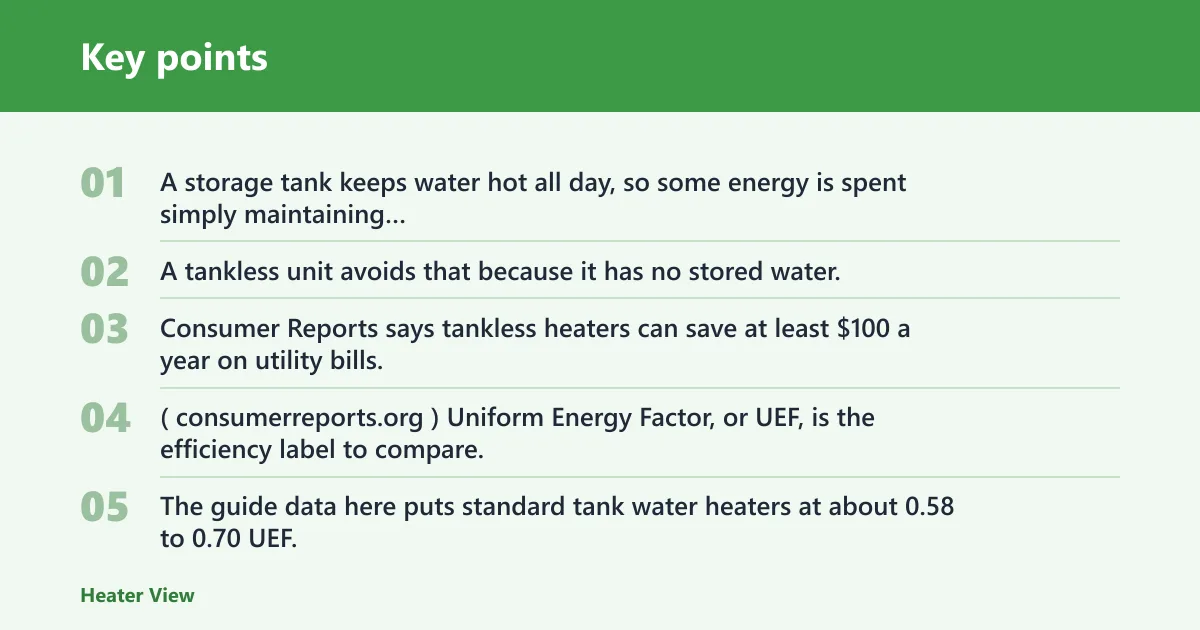
A storage tank keeps water hot all day, so some energy is spent simply maintaining temperature. A tankless unit avoids that because it has no stored water. Consumer Reports says tankless heaters can save at least $100 a year on utility bills, which is why they often look attractive on operating cost alone. (Consumerreports)
Uniform Energy Factor, or UEF, is the efficiency label to compare. Higher UEF means better efficiency. The guide data here puts standard tank water heaters at about 0.58 to 0.70 UEF, while tankless units are about 0.82 to 0.98 UEF. That gap supports lower operating loss for tankless, but it says nothing about whether the unit is correctly sized or whether the retrofit cost is reasonable.
Why higher UEF does not always mean lower total cost
Tankless units often cost more upfront, and switching may require a plumbing retrofit. It may also require an upgrade to gas lines, venting, or electrical service. If those changes are minor, the efficiency gain can pay back. If they are large, the payback can stretch out or disappear.
A common mistake is to judge a tankless unit and a storage tank only by the utility bill, without factoring in standby loss, peak demand, and installation differences. A low-use home may save enough for the higher-efficiency unit to make sense. A house with frequent simultaneous showers, laundry, and dishwashing may still get better comfort and lower total project cost from a tank.
How do you size a water heater?
To size a water heater, estimate your peak hot-water demand in gallons per minute, then compare it with the unit’s rated output at your local inlet temperature. The key inputs are fixture flow, how many fixtures run at once, the outlet temperature you want, and the incoming cold-water temperature. Colder groundwater means a larger temperature rise and less usable output from the same tankless unit.
Common fixture flow assumptions
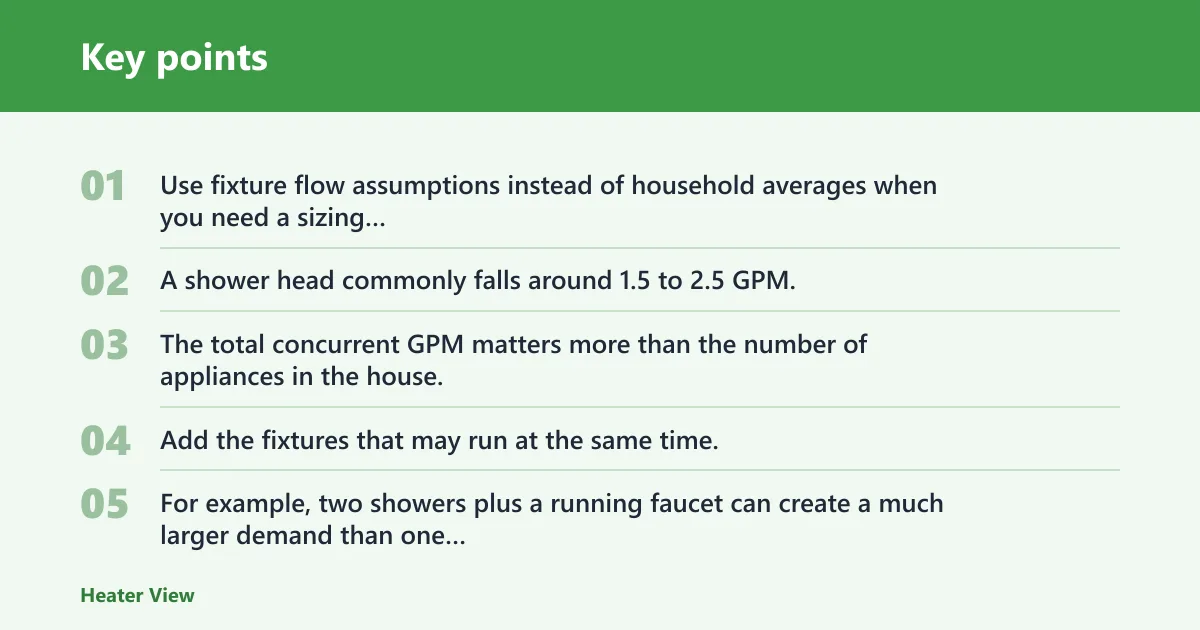
Use fixture flow assumptions instead of household averages when you need a sizing estimate. A shower head commonly falls around 1.5 to 2.5 GPM, a bathroom faucet around 0.5 to 1.5 GPM, and a dishwasher or clothes washer can add a further intermittent draw. The total concurrent GPM matters more than the number of appliances in the house.
Peak-demand calculation
Add the fixtures that may run at the same time, then compare that total to the heater’s output at your temperature rise. For example, two showers plus a running faucet can create a much larger demand than one shower alone. A tankless unit must be sized to meet that total at the chosen outlet temperature, not just the label rating at ideal conditions.
Temperature rise and inlet water
Temperature rise is the difference between incoming water temperature and the outlet target. A common hot-water target is 120°F. Consumer Reports testing used an inlet temperature of about 58°F, plus or minus 2 degrees, as a reference point. In colder regions, a tankless unit may need to raise water by 70°F or more, which reduces its usable GPM compared with the same unit in a mild climate.
What that means in real homes
When the inlet water is mild, a tankless unit can cover more simultaneous demand. When the inlet water is cold, the same unit must work harder and may deliver less flow. That is why the label GPM alone is not enough; the effective GPM depends on the incoming temperature and the hot-water setpoint.
Water heater decision matrix
This matrix turns household use into a likely winner. It separates efficiency, output, and payback because those are not the same thing. A model can be more efficient and still be the wrong purchase for a specific home. The payback column assumes a simple replacement versus a retrofit that adds gas-line, venting, or electrical work, with a rough payback window of several years when the installation is straightforward and much longer when it is not.
| Household type | Hot-water use band | Groundwater temperature | Fixture concurrency | Likely winner | Efficiency edge | Installation-risk level | Payback range |
|---|---|---|---|---|---|---|---|
| Small home, 1 to 2 people | Under about 40 gallons a day | Mild to moderate | Low, such as one shower and one faucet at a time | Tankless water heater | High | Medium | Short to moderate if no major retrofit is needed |
| 2 to 4 people, steady daily use | About 40 to 80 gallons a day | Mild | Low to moderate, such as a shower plus a faucet or dishwasher | Tankless water heater | Moderate | Medium | Moderate if the infrastructure already fits |
| 4+ people, morning peak use | Above about 80 gallons a day | Cool to cold | High, such as two showers plus laundry or a dishwasher | Storage tank | Low to moderate | Low to medium | Poor unless retrofit is minimal and usage is well staggered |
| Long pipe runs, cold-climate home | About 60 to 100+ gallons a day | Cold, especially in winter | Moderate to high, with delayed hot-water arrival | Storage tank | Low | Low to medium | Poor because cold inlet water reduces tankless output |
| Budget-sensitive replacement | Under about 60 gallons a day | Mild | Low | Storage tank | Moderate | Low | Good if no upgrade is needed |
Household type and daily hot-water use
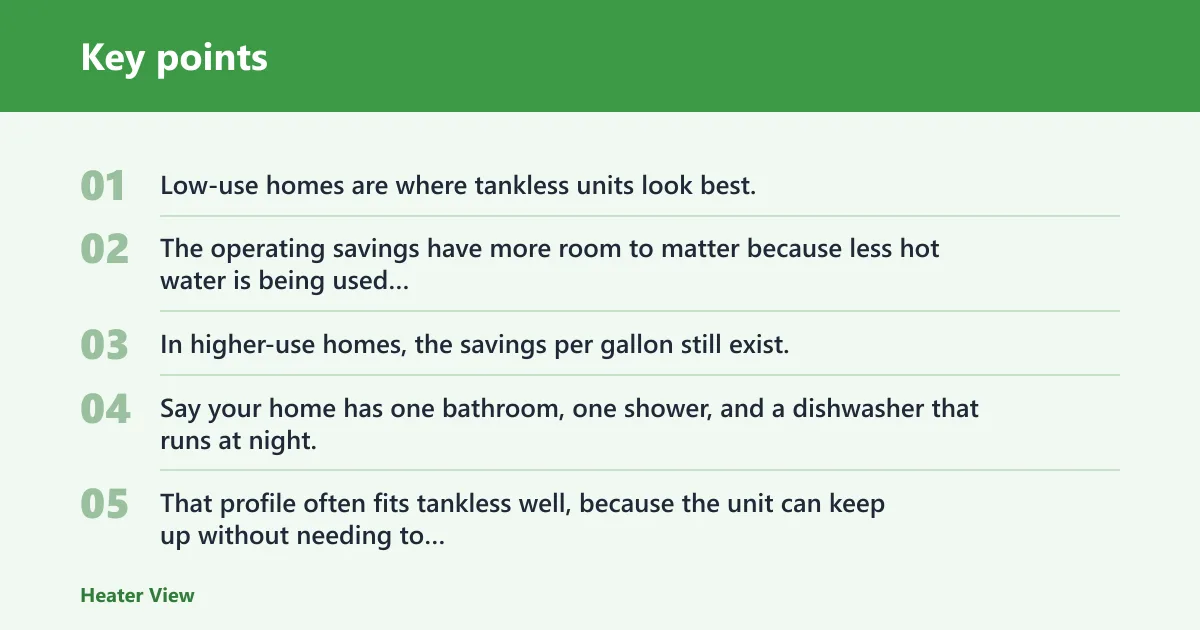
Low-use homes are where tankless units look best. The operating savings have more room to matter because less hot water is being used overall, so standby loss takes a bigger share of the bill. In higher-use homes, the savings per gallon still exist, but the bigger issue becomes whether the unit can keep up during busy periods.
Say your home has one bathroom, one shower, and a dishwasher that runs at night. That profile often fits tankless well, because the unit can keep up without needing to store large amounts of hot water. A four-person home with back-to-back morning showers is a different case because the same heater has to handle a much heavier burst of demand.
Groundwater temperature and temperature rise
Temperature rise is the difference between incoming water temperature and the outlet target. Consumer testing used a starting temperature of about 58°F, plus or minus 2 degrees, and a target outlet temperature of 120°F. Cold groundwater increases the rise needed, which cuts a tankless unit’s output and can reduce its effective flow rate.
That matters because tankless sizing is tied to gallons per minute, or GPM. A guide cited here lists tankless hot-water flow at about 2 to 5 GPM under typical conditions, but real-world output changes with temperature rise. In colder months, the same unit may deliver less usable hot water, especially if several fixtures open together.
Fixture concurrency and real-world use
Concurrency is the hidden limit. Two showers, a clothes washer, and a dishwasher can all pull from the same supply at once. Storage tanks buffer that demand with stored hot water, while tankless units must meet the load in real time.
Picture a family that starts two showers, then runs laundry. A tankless unit may need to throttle flow or let outlet temperature drift if the total load exceeds its GPM capacity at that inlet temperature. A storage tank can absorb that burst better, even if its efficiency rating is lower.
How much money can tankless save?
Tankless water heaters can lower annual energy use, but the savings are usually modest compared with the purchase and retrofit cost. The same source says tankless heaters can save at least $100 a year on utility bills. HVAC Base lists a gas tankless water heater at about $345 a year to run in its default four-person household example, but that number only matters if you compare it with a like-for-like tank setup and your own use pattern.
Annual energy cost versus installed cost
Annual operating cost is only one side of the ledger. A tankless unit can have a lower bill because it avoids standby loss, yet still cost more overall if the installation needs gas-line upsizing, venting changes, or electrical work. The more complex the retrofit, the longer the payback. A simple replacement in a home with the right infrastructure is the best-case scenario for tankless payback.
Gas tank water heaters usually have a lower installed cost than tankless in most replacement jobs. Electric tank water heaters can be cheaper to place in a small or low-use home, but they may have higher operating cost than gas and can be much less efficient than heat pump water heaters. That makes installed cost only part of the decision.
Why retrofit expenses can erase the savings
Switching to tankless may require a plumbing retrofit. It may also require an upgrade to electric service or gas lines. Those changes can absorb years of utility savings before the owner sees a net gain.
That is why payback varies so much. A simple replacement in a home with the right infrastructure can make sense. A whole-home retrofit in a house with undersized gas service, limited panel capacity, or difficult vent routing can push the project outside a reasonable payback window.
When does tankless not make sense?
Tankless does not make sense when the home needs large bursts of hot water, when the inlet water is cold enough to cut output too far, or when retrofit cost outweighs the likely savings. It can still be the more efficient unit on paper. It just may not be the better buy for your house.
Multiple showers and other high-concurrency demand
Tankless units are flow-rate limited. The guide figure of about 2 to 5 GPM is enough for some homes, but not for every peak load. If several fixtures run together, the unit can become the bottleneck.
Consumer Reports tested four electric and five gas whole-house tankless water heaters under a heavy-use pattern that drew 84 gallons of water a day. That kind of demand profile is where sizing mistakes show up fast. The wrong unit can deliver lukewarm water or a noticeable drop in pressure when the house gets busy.
Cold-climate homes and long pipe runs
Cold groundwater raises the temperature rise requirement, and that reduces how much hot water a tankless unit can deliver at a given time. Long pipe runs add another issue: the water in the line cools before it reaches the tap, so the user waits longer for hot water and wastes more water at the fixture.
In those homes, a storage tank often gives a better blend of cost and comfort. The tank can supply a larger burst right away, and the equipment is less sensitive to winter inlet temperature swings.
Small homes where payback is weak
Tankless can be a poor fit for some small homes too. If the water heater replacement is simple and the existing tank is already inexpensive to replace, the extra installation cost for tankless may never come back through utility savings. In that case, a standard tank can be the cleaner financial choice.
What installation upgrades matter most?
Tankless often needs more than a simple swap. The biggest issues are gas-line capacity, venting, and electrical service. Storage tanks are usually easier to replace in place, which is one reason they remain the most common type.
Gas-line and venting changes for gas tankless units
Gas tankless units often need more fuel flow than an older tank heater. That can mean gas-line upsizing. Condensing models may also need different venting than non-condensing models, and that can change both installed cost and placement options.
Non-condensing tankless units are usually simpler to install than condensing ones, but they are typically less efficient. Condensing units tend to cost more up front, yet they can reach higher efficiency numbers and use cooler exhaust, which can help in the right home.
Electrical service and panel limits for electric units
Electric tankless units can be even more demanding on the electrical system than a storage tank. If the panel lacks capacity, an upgrade may be needed. That can change the project from a simple replacement into a larger home-improvement job.
Storage tank water heaters can also need code-related work, but the retrofit burden is usually lighter. That is why electric tank replacement is often practical in small homes, while electric tankless can be hard to justify unless the panel and wiring already have room.
- Check the existing fuel type, vent path, and panel capacity.
- Estimate household peak use, not just daily average use.
- Compare the unit’s UEF and the likely installation upgrades.
- Match the unit to GPM demand at your local inlet temperature.
- Only then compare payback against the installed cost.
Lifespan and maintenance comparison
Tankless units usually last longer than storage tanks, but longer life only helps if the unit is kept in service. Storage tanks are simpler and cheaper to replace, yet they typically wear out sooner. Maintenance matters for both, especially in areas with hard water or sediment-heavy supply.
Typical service life
Tankless water heaters often last more than 20 years with proper maintenance. The same source lists storage tank water heaters at 10 to 15 years, and that range is broadly consistent with common replacement timing. The longer life of tankless can help offset its higher installed cost, but only over a long enough ownership period.
Descaling, flushing, and anode rod maintenance
Tankless units need descaling or flushing to deal with mineral buildup. Storage tanks need flushing too, and many rely on an anode rod to slow tank corrosion. Skip maintenance on either type, and efficiency and service life can fall faster than expected.
The maintenance burden is different, not one-sided. Tankless owners need to be more careful about mineral scaling in hard-water areas. Tank owners need to watch for tank corrosion and sediment buildup. The right maintenance plan depends on water quality and how long you plan to keep the unit.
Choose Tankless water heater if… / Choose storage tank if…
Choose Tankless water heater if your home has low to moderate hot-water demand, your peak use is spread out, and your gas line, venting, or electrical service can support the upgrade without a large retrofit. It also makes sense if you want higher efficiency, less standby loss, and a longer service life.
Choose storage tank if your household has multiple showers, laundry, and dishwashing happening at the same time, if the groundwater is cold enough to strain tankless output, or if you need the lowest installed cost. It is also the safer choice when payback is weak or the house already has a simple replacement path.
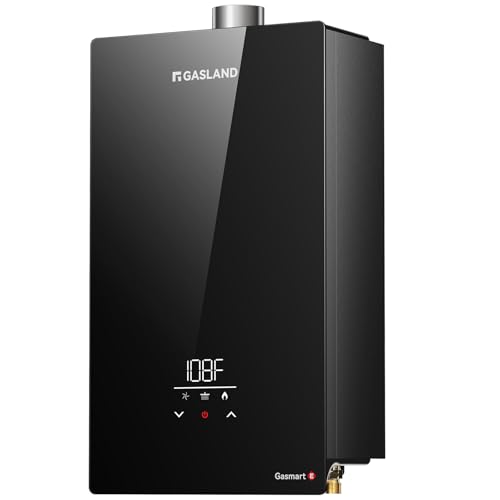
- On-demand heating avoids standby loss
- Compact design saves space
- Built for whole-house hot water
Frequently asked questions
How does cold groundwater affect tankless water heater performance?
Cold groundwater raises the temperature rise a tankless unit must deliver, and that lowers its effective output. In winter, the same heater may provide less hot water at once than it does in warmer months. That is why cold-climate homes should size tankless carefully by GPM and inlet temperature.
Does a tankless water heater work well for a family with multiple showers?
Sometimes, but only if the unit is sized for the actual peak load. Multiple showers can push flow demand past the heater’s GPM limit, especially when the incoming water is cold. In many four-person homes, a storage tank is the easier fit for simultaneous use.
Which water heater is cheaper to install: tankless or tank?
A storage tank is usually cheaper to install. Tankless often needs plumbing retrofit work, and it may also require gas-line, venting, or electrical upgrades. Those extra steps can make the project much more expensive than a direct tank replacement.
How long do tankless and tank water heaters last?
Tankless units often last more than 20 years, while storage tanks typically last 8 to 15 years. That longer tankless life can help offset higher upfront cost, but only if the unit is maintained and the installation cost does not overwhelm the savings.
How much money can a tankless water heater save per year?
The same source says tankless heaters can save at least $100 a year on utility bills. Actual savings depend on household size, hot-water use, fuel type, and whether the retrofit was simple or expensive. A low-use home sees the best chance of a meaningful payback.
What installation upgrades are needed for tankless vs storage tank?
Tankless may need gas-line upsizing, venting changes, or an electrical service upgrade. Storage tanks usually need far less retrofit work in a replacement job. That difference is one reason tankless can be more efficient yet still cost more to own in the first few years.