Best Water Heater for Cold Climates
For most cold-climate homes, a gas tankless with enough minimum flow and inlet-temperature capacity is the best fit. If gas is unavailable, a correctly sized high-efficiency tank or hybrid electric model may be the better choice. Choose the wrong size or type, and you can end up with cold showers, slow recovery, higher winter bills, or a unit that cannot meet demand when incoming water drops. This guide compares heater types, winter performance limits, installation constraints, and fuel-source fit so you can choose the right model for your home.
Winter challenges for water heaters
Cold weather changes more than comfort. It lowers incoming water temperature, can reduce usable flow from tankless units, and makes installation location matter more. A heater that looks strong on a product label may still struggle if it sits in an unconditioned garage or has no backup heat when demand spikes.
The short version is simple: cold inlet water hurts tankless output the most, heat pump units need warmer surrounding air, and tank heaters depend more on storage plus recovery. Gas usually has the fastest recovery, but electric can still fit when fuel access, venting, or budget rules out gas.
How the comparison is organized
This article compares four common options: heat pump water heater, gas tankless water heater, condensing gas tank water heater, and electric tank water heater. It uses four practical checks: winter inlet temperature, installation location, fuel source, and backup heat need.
Two product-label terms matter throughout. Uniform Energy Factor, or UEF, is an efficiency metric printed on many water heater labels; higher is generally better. First-hour rating is the gallons delivered in one hour from a storage tank, and it matters most when demand peaks at the same time.
Cold-climate decision matrix
This matrix gives the quickest match between home conditions and heater type. It is not a substitute for local code, utility rates, or a load calculation, but it does separate mild cold from deep-freeze conditions and points out where freeze protection or backup heat becomes non-negotiable.
| Home scenario | Winter inlet-water risk | Fuel availability | Installation location | Freeze risk | Backup heat needed? | Recommended heater type |
|---|---|---|---|---|---|---|
| Sheltered interior closet, moderate family demand | Moderate seasonal drop | Electric only | Conditioned indoor space | No, if piping stays indoors | Yes, for a heat pump model | Heat pump water heater |
| Large family, winter showers stacked back to back | High | Natural gas available | Basement or utility room | No, if venting and piping stay protected | No, if sized for peak draw | Gas tankless water heater |
| Older house, colder basement, steady daily draw | High | Natural gas available | Basement or garage | Yes, if any piping crosses exterior walls | No | Condensing gas tank water heater |
| Budget-first replacement, limited service upgrades | Moderate to high | Electric only | Indoor utility area | Low if indoor | No | Electric tank water heater |
| Outdoor install or unheated garage | High | Gas or electric | Unconditioned space | Yes | Yes, unless the unit is rated for the space | Usually a tank model indoors instead |
For freeze risk, the answer should usually be yes or no, not maybe. If the heater or any exposed piping sits in a garage, attic, crawlspace, or outside wall bay, freeze protection becomes part of the purchase decision, not an add-on after the fact.
Which water heater is best in freezing weather?
In freezing weather, the best choice depends on whether you need high flow, steady storage, or simple replacement. Gas tankless is strongest for large homes with gas service and enough venting capacity. A condensing gas tank works well when you want steadier recovery. Electric tanks are easier to install, but they recover more slowly in winter.
Heat pump water heater for sheltered indoor spaces
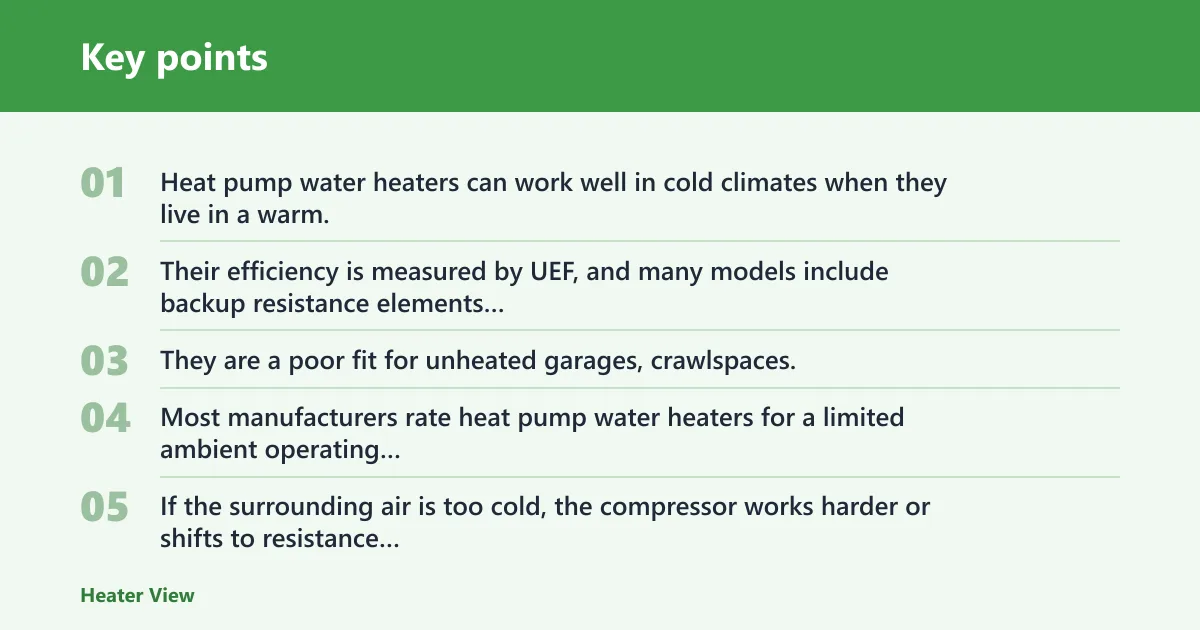
Heat pump water heaters can work well in cold climates when they live in a warm, enclosed room and have enough airflow. Their efficiency is measured by UEF, and many models include backup resistance elements for colder conditions or higher demand periods. They are a poor fit for unheated garages, crawlspaces, or spots that stay cold for long stretches.
Most manufacturers rate heat pump water heaters for a limited ambient operating temperature range. If the surrounding air is too cold, the compressor works harder or shifts to resistance heat, which raises operating cost. That is why location matters as much as the unit itself.
Gas tankless water heater for high-demand homes with gas service
Gas tankless units can be a strong winter choice because they heat water on demand, but their output falls as inlet water temperature drops. A model with adequate BTU input and enough gallons per minute at your winter temperature can still cover a large household, while an undersized unit may disappoint on the coldest days.
Venting and gas line sizing are not minor details. High-BTU tankless models often need specific vent materials, longer vent planning, and a gas supply that can support the load without pressure drop. If those pieces are not in place, the heater may never deliver its rated output.
Condensing gas tank water heater for colder homes that want steady recovery
A condensing gas tank water heater is a good middle ground for cold regions. It stores hot water, recovers faster than most electric tanks, and often posts a higher UEF than standard storage models. Common sizes are about 40 to 75 gallons, which can help when winter showers and laundry overlap.
These models usually need special venting, often PVC or another approved plastic vent system, because exhaust temperatures are low enough for condensing operation. Installation cost is usually higher than a basic tank, but the tradeoff is steadier winter delivery and less sensitivity to brief demand spikes.
Electric tank water heater for lower upfront cost and simpler installs
Electric tank water heaters are the simplest route when gas is not available or when the panel can support the load. Most electric tank water heaters use standard 240-volt service in homes, and tank sizes commonly range from about 30 to 80 gallons. They usually cost less up front than gas alternatives.
They also have slower recovery than gas in many cases, so winter sizing matters. Better insulation helps reduce standby losses, but it does not change the basic fact that the recovery rate is tied to electric element size and available service.
How winter inlet water changes performance
Cold groundwater inlet temperature can drop sharply in winter, especially in northern regions. That seasonal drop affects usable output, recovery assumptions, and the size you need. The colder the inlet water, the harder any heater must work to raise it to shower temperature.
Groundwater inlet temperature and seasonal drop
In many cold regions, incoming water may be much colder in winter than in summer. That matters most for tankless systems because they heat water continuously as it passes through. A colder inlet means less flow at the same outlet temperature, or a lower outlet temperature at the same flow.
Tank systems feel the same cold inlet, but storage gives them a buffer. They can deliver a strong first few draws, then rely on recovery. That is why first-hour rating is useful for winter planning.
Tankless flow rate loss in winter
Tankless ratings are often listed at a specific temperature rise. If winter inlet water is colder, the same unit may deliver fewer gallons per minute at your desired output. A model that looks adequate on paper can fall short in a deep-freeze climate if the winter rise is larger than the label condition.
Say your home needs two showers at once and a dishwasher cycle in the evening. A tankless unit sized for mild weather may handle the load in October, then struggle in January because the incoming water is colder and the outlet flow has to slow down.
Tank recovery and first-hour rating in peak demand
First-hour rating matters when several fixtures run close together. It reflects the gallons a storage tank can deliver in one hour, including stored hot water plus recovery during that hour. For a large family in winter, this number is often more useful than tank size alone.
A 50-gallon tank with a strong first-hour rating may outperform a larger tank with weak recovery if the household draws hot water in short bursts. Check the label and compare it against the number of bathrooms, laundry patterns, and winter usage timing.
Does a heat pump water heater work well in cold climates?
Yes, but only when installed in a suitable indoor location with enough surrounding air and realistic expectations. A heat pump water heater can work well in a cold climate when installed in a sheltered indoor space with enough room air, and when its backup resistance elements are available for colder periods or high-demand days.
Ambient operating temperature limits
Ambient temperature is the air around the heater, not the weather outside the house. If the installation space stays too cold, the heat pump portion becomes less effective and the unit may fall back to resistance heat. That protects hot water supply, but it lowers efficiency.
Efficiency rating and location requirements
Heat pump water heaters often have some of the best UEF numbers on the label, which is why they are attractive in many homes. The catch is location. They need enough surrounding air volume and a room that does not stay near freezing for long periods.
Picture a unit in a conditioned basement with a closed door and no cold air leaks. That is very different from one in a detached garage where temperatures swing below freezing. The first setup can work; the second can be a poor match.
Backup resistance elements for colder regions
Backup resistance elements matter because they keep hot water available when the heat pump output drops. They also help during large draw events. In a cold region, that backup function is not a luxury feature; it is part of the sizing plan.
If a household expects winter guests, extra laundry, or long showers, the backup elements should be part of the sizing math. Without them, the heat pump may be efficient but still short on usable hot water during peak periods.
Should I choose gas or electric for a cold climate home?
Gas is often the better winter performer when you need fast recovery, high flow, or a large family load. Electric can still be the right choice when gas service is absent, venting is difficult, panel capacity is adequate, or the budget favors a simpler replacement. The best answer depends on the house, not the label.
Gas tankless: BTU input, venting, and gas line sizing
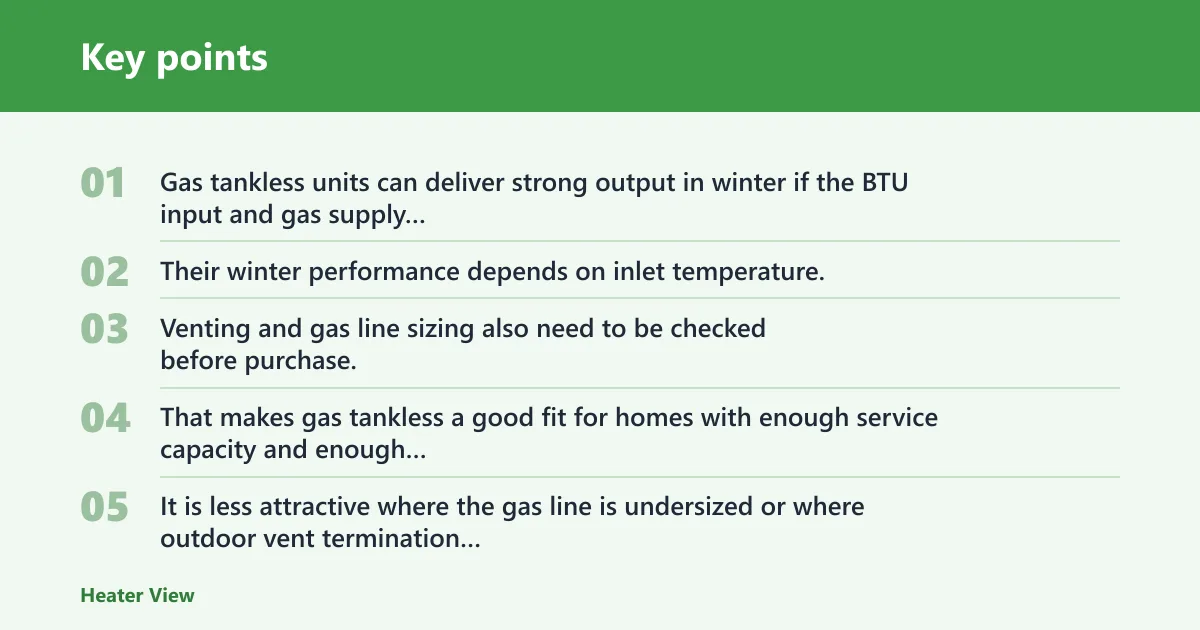
Gas tankless units can deliver strong output in winter if the BTU input and gas supply match the load. Their winter performance depends on inlet temperature, so a unit that is barely sized for summer may underdeliver when groundwater gets colder. Venting and gas line sizing also need to be checked before purchase.
That makes gas tankless a good fit for homes with enough service capacity and enough space for the vent run. It is less attractive where the gas line is undersized or where outdoor vent termination is hard to place safely.
Condensing gas tank: UEF, recovery rate, and venting type
Condensing gas tanks bring a good balance of efficiency and winter recovery. Their UEF is usually stronger than older standard tanks, and their recovery rate is often high enough to handle back-to-back winter showers better than a comparable electric tank. Venting type is part of the installation, not an afterthought.
This option often makes sense in homes that want gas performance without the temperature-rise sensitivity of tankless. It also suits families that prefer predictable storage and fewer flow surprises on the coldest days.
Electric tank: standard voltage, capacity, and lower upfront cost
Electric tanks are common because they are straightforward and usually cheaper to install. Standard 240-volt service is typical, and the tank capacity can be chosen to fit the household. Their main weakness in cold regions is slower recovery, which shows up when several fixtures draw hot water in a short period.
If the home already has adequate electric service and gas would require major retrofitting, an electric tank may be the practical answer. It is especially reasonable when the budget matters more than winter recovery speed.
Choose gas tankless if…
Choose gas tankless if you need compact equipment, high flow, and strong winter delivery from a unit that can match your actual inlet temperature. It is the best fit when gas service is available, venting is practical, and you can size for the coldest months rather than the mild season.
Choose condensing gas tank if…
Choose a condensing gas tank if you want steady hot water, a higher first-hour rating, and less sensitivity to brief demand spikes. It works well for larger households that want gas recovery without the cold-weather flow drop that tankless units can face.
Choose electric tank if…
Choose an electric tank if gas is unavailable, venting is a problem, or you want the lower upfront cost of a simple replacement. It is also the safer pick when the service panel can support it and the installation space stays above freezing.
Installation and freeze protection
Freeze protection is not just about the heater cabinet. Pipes, drains, and the space around the unit matter too. If you expect outdoor installation limits, use pipe insulation, proper drain-down features, and anti-freeze controls where the manufacturer allows them.
- Check whether the unit is approved for the planned location.
- Insulate all exposed supply and condensate lines.
- Keep the heater away from unheated exterior walls when possible.
- Confirm drain-down or freeze-protection controls before winter.
- Verify gas line size, venting, and electrical service before purchase.
A common first-timer mistake is placing a high-end heater in a cold garage and assuming the label ratings will hold. They usually will not. The room temperature, pipe exposure, and backup heat plan can matter more than the brand tier.
What is the best hot water heater for a cold house?
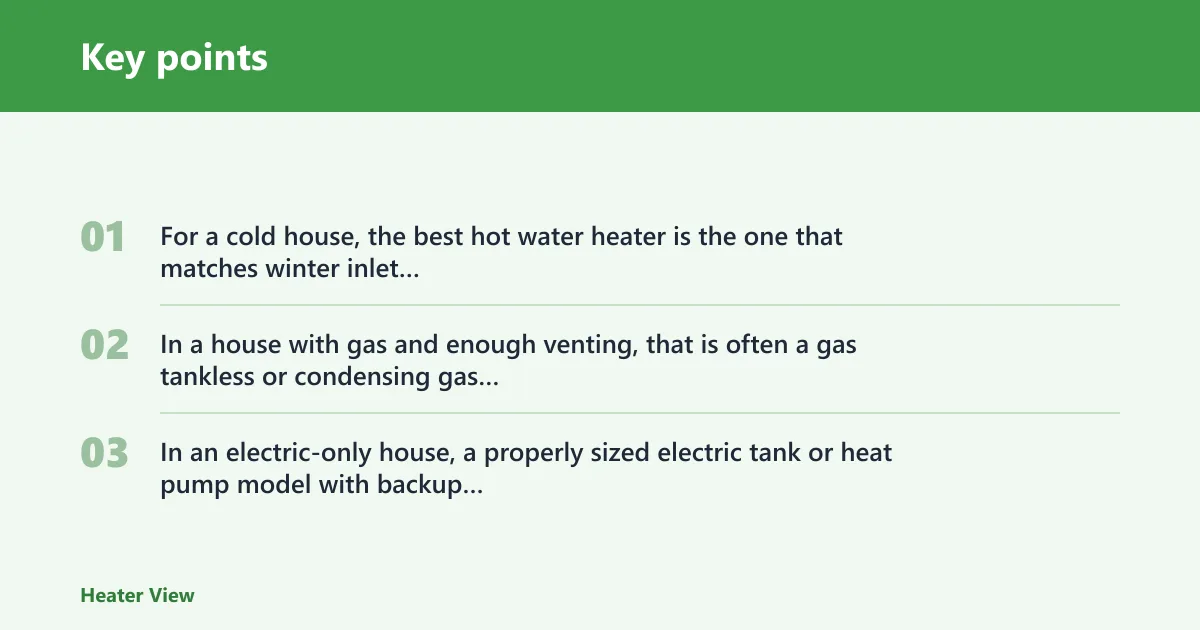
For a cold house, the best hot water heater is the one that matches winter inlet temperature, available fuel, and the installation space. In a house with gas and enough venting, that is often a gas tankless or condensing gas tank. In an electric-only house, a properly sized electric tank or heat pump model with backup resistance can be the better fit.
What are good water heaters for homes in cold regions?
Good water heaters for cold regions are models that keep their output when inlet water drops and the installation area stays cold. That usually means gas units with enough recovery, or a heat pump water heater placed in a sheltered indoor room with backup elements. Oversized storage alone is not a cure for poor location.
Can cold weather affect a water heater?
Yes. Cold weather can lower groundwater inlet temperature, slow tankless flow, increase recovery time, and expose piping to freeze risk. It can also move a heat pump water heater outside its preferred ambient range. The effect is strongest in basements, garages, crawlspaces, and outdoor installs.
Frequently asked questions
Which water heater is best for cold climates?
For many cold-climate homes, a gas tankless with enough winter flow capacity is the strongest overall choice. If gas is not available, a condensing gas tank or a correctly sized electric tank can be better. The real answer depends on inlet temperature, fuel access, and where the unit will sit.
Which type of water heater is best in freezing weather?
In freezing weather, a gas tank or gas tankless model usually holds up better than an electric unit if gas service and venting are already in place. A heat pump water heater can still work, but only in a sheltered indoor space with backup resistance elements and realistic cold-weather sizing.
What size water heater do I need for a large family in winter?
For a large family in winter, size by first-hour rating for tanks and by winter gallons per minute for tankless units. Winter inlet water lowers output, so a size that looks fine in mild weather may not be enough in January. Match the unit to bathroom count, shower timing, and laundry habits.
What’s the best water heater?
The best water heater is the one that fits winter inlet temperature, fuel availability, installation space, and household demand. There is no universal winner. A gas tankless often leads in cold homes with gas service, while a high-efficiency tank or electric model can be the better match elsewhere.