Water Heater Efficiency Ratings Explained
Compare water heaters by UEF for new models: higher is better, but only when you compare the same metric and fuel type; EF is the older label, not directly equal to UEF. Choosing by the wrong number can leave you with higher bills and a heater that fits the label but not your household. This guide shows how to read the label, compare models side by side, and choose the right efficiency rating for your needs.
How to read EF and UEF ratings on water heater labels
Efficiency ratings show how much useful hot water a unit delivers for each unit of energy it consumes. Higher ratings usually mean lower operating costs, but the number only makes sense when you also look at fuel type, tank or tankless design, and how much hot water your home actually uses.
Water heating can account for up to 18% of home energy use. That is why this label matters more than many shoppers expect. A model with a strong rating can still cost more to run if it is matched to the wrong household size or draw pattern.
Think of the rating as a screen for comparison, not a full answer. It helps you rule out wasteful models quickly. It does not tell you install cost, recovery speed, or whether a unit fits your hot-water schedule.
EF versus UEF
Energy Factor, or EF, was the former DOE efficiency metric commonly used for residential water heaters. UEF replaced EF as the required rating metric for residential water heaters. That means EF may still appear on older materials, but UEF is the number to use on current residential labels.
EF treated efficiency as a single number. UEF is more useful for comparing current models because the federal test procedure, 10 CFR Part 430, Appendix E, uses four draw profiles to simulate real use. Those profiles are very small at 10 gallons per day, low at 38 gallons per day, medium at 55 gallons per day, and high at 84 gallons per day.
That matters because a water heater can look strong under one use pattern and weaker under another. A small household and a larger household do not stress the same tank the same way. UEF reflects that better than EF does.
How do you read the EnergyGuide label?
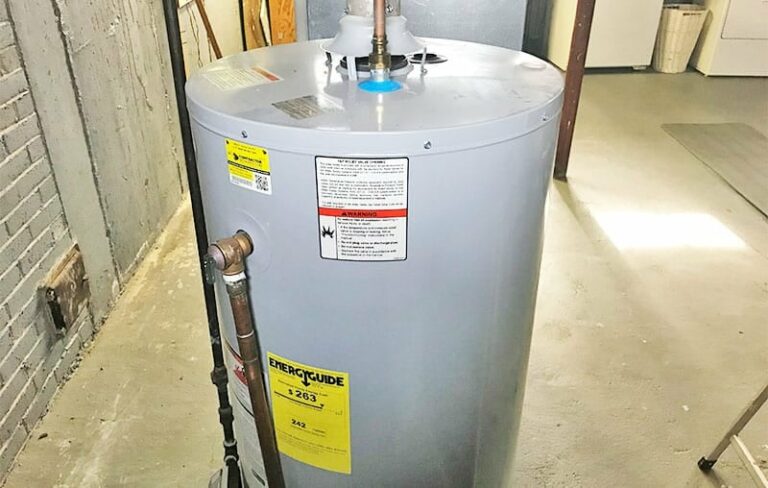
Start with the annual operating cost, then check the rating metric and fuel type that produced it. The EnergyGuide label lets you compare models side by side, but only if you compare like with like. A gas unit and an electric unit, or a tank and a tankless model, may not belong on the same performance line.
The label is a comparison tool, not a promise. It estimates operating cost using the federal test basis, not your exact showers, laundry schedule, or utility rate. Still, it is the fastest way to separate a cheap-to-buy model from a cheaper-to-run model.
Where to find annual operating cost
Look for the annual cost figure on the EnergyGuide label. That number converts the tested efficiency into dollars, so you can compare likely running cost across similar models. It is especially useful when two heaters have close ratings but different fuel use or draw assumptions.
Use that figure as a first screen. If two tanks have similar purchase prices, the one with the lower annual cost often wins over time. If one model costs more upfront but has a much lower annual cost, check the break-even point before you buy.
How to compare two models side by side
Compare four items in order: fuel type, water-heater type, UEF, and annual operating cost. Do not compare a tankless gas unit with a standard electric tank as if the numbers were directly interchangeable. The label only works well when the comparison is narrow.
- Match fuel type first.
- Match heater type second: tank, tankless, or heat pump.
- Compare UEF for current models.
- Use EnergyGuide annual cost to estimate ongoing expense.
- Check ENERGY STAR status and possible incentives.
Suppose two gas tankless models both show a 0.87 UEF, but one lists a higher annual operating cost. That can happen because the label calculation also reflects the federal test assumptions, not just the single UEF number. Same rating. Different expected cost.
What the label can and cannot tell you
The label can tell you which model is more efficient under a federal test procedure. It can also show whether a model reaches ENERGY STAR thresholds and may qualify for rebates or incentives. It cannot tell you how a unit will perform in your exact home without considering demand and fuel price.
That is the common mistake: treating the highest number as the only answer. A heat pump water heater can be very efficient, yet the best choice still depends on space, recovery needs, and whether your household benefits from its operating pattern.
Water heater ratings table
| Scenario | Best label to compare | What the number can tell you | What it cannot tell you | Buying guidance |
|---|---|---|---|---|
| Standard tank replacement | UEF and EnergyGuide annual cost | How much standby loss and recovery performance affect running cost under the federal test | Exact bill impact for your showers, laundry, and local fuel rate | Use this when replacing an existing storage tank. Look for better UEF than the common baseline tank range around 0.5 to 0.7, then compare annual cost on the label. |
| Tankless upgrade | UEF, plus ENERGY STAR status | Whether the unit has reduced standby losses and whether it reaches a strong current rating | Whether your gas line, venting, or demand pattern fits the unit without issue | Use this when you want on-demand heating and lower standby loss. Compare gas tankless models to other gas tankless models, not to a tank on a different test basis. |
| Heat pump upgrade | UEF and annual operating cost | How much heat the unit moves compared with electrical input | Whether the unit fits your space, noise tolerance, or hot-water timing needs | Use this when efficiency is the main goal and you can accept a different operating pattern. UEF can reach 3.0 or more, so these units often post very low running costs. |
This table is the shortest practical way to read the labels. Pick the scenario first. Then compare the metric that matches that scenario. That keeps you from choosing a number that looks strong but solves the wrong problem.
Which water heater type is more efficient?
The answer depends on the type of heater and the use case. Storage tank units lose heat while they keep water hot. Tankless units avoid most standby loss because they heat water on demand. Heat pump water heaters often post the highest efficiency because they move heat rather than create it directly.
Storage tank water heaters and standby loss
Storage tank water heaters hold hot water in reserve, so they lose energy to the surrounding space even when no one is using hot water. That standby loss is why many standard tank models often fall in an EF range of about 0.5 to 0.7. They remain common, but they are usually the baseline for comparison, not the top performer.
A common first-timer mistake is to read tank size as efficiency. A larger tank may meet demand better, but it does not automatically run more efficiently. The relevant question is how much heat it loses between draws and how much energy it uses to recover.
Tankless water heaters and on-demand heating
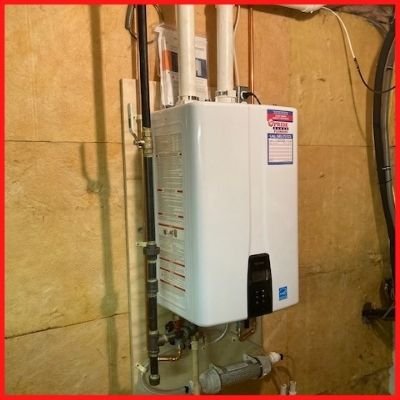
Tankless water heaters heat water only when you call for it, so they cut standby loss. That usually gives them better efficiency ratings than standard tanks. Typical condensing gas tankless units have UEF between 0.87 and 0.96, while typical non-condensing gas tankless units fall between 0.80 and 0.86 UEF.
Electric tankless units are near or at 1.0 under both EF and UEF. A gas-fired tankless unit with a continuous pilot flame has lower EF than one with electronic ignition. So the details inside the category matter.
Tankless is not always the best answer. If your home has high simultaneous demand, the unit must still supply enough hot water at the required flow. Efficiency does not fix undersizing.
Heat pump water heaters and high UEF values
Heat pump water heaters use electricity to move heat from the surrounding air into the water. That is why they can reach UEF values of about 3.0 or higher. Among common residential options, that is a very strong efficiency profile.
High UEF does not remove every tradeoff. Heat pump units may need more space and may behave differently from a standard tank. Their operating cost can be low, but the right fit still depends on installation conditions and household demand.
What changes the number on the label?
Two homes can buy the same water heater and see different real-world costs because the label assumes test conditions, not your exact pattern of use. Fuel type, draw pattern, and household demand all change what the rating means. That is why the annual cost line matters as much as the efficiency number.
Fuel type and energy source
Gas and electric heaters do not translate the same way. Gas models may have combustion losses, venting considerations, and pilot-light effects. Electric models avoid combustion, but that does not make every electric heater automatically cheaper to run. Utility rates still matter.
ENERGY STAR is a third-party certification program. It sets a higher threshold than minimum code compliance and can help identify models that may qualify for rebates or incentives. It pairs with the EnergyGuide label, which shows estimated annual operating cost.
Household draw pattern and demand
UEF uses four draw profiles because homes do not use hot water the same way. Very small at 10 gallons per day, low at 38 gallons per day, medium at 55 gallons per day, and high at 84 gallons per day all stress a heater differently. That is why the same heater can rank differently under different use assumptions.
Picture a two-person home with low, steady morning use. A compact tank may look fine on paper. Now picture the same model in a house with back-to-back showers and laundry at night. The label number does not change, but the usefulness of that number does.
Why the same UEF can still mean different annual cost
UEF tells you how efficiently the unit performs under the test basis. Annual operating cost adds the economic side. Two models can share the same UEF and still show different annual costs because the label calculation reflects fuel type, test conditions, and the assumptions built into the federal label.
That is why you should never stop at a single number. If annual cost is lower, you usually have a better operating deal. If UEF is higher but annual cost is not, check whether you are comparing the same fuel and the same heater type.
How do you calculate the efficiency of a water heater?
You can estimate efficiency by dividing useful hot-water output by energy input, but for shopping you usually do better by using the published UEF and EnergyGuide annual cost. The federal test procedure, 10 CFR Part 430, Appendix E, is the basis for those ratings, so the label is the cleaner tool for comparison.
If you want a simple homeowner method, use this order: match the heater type, read the UEF, then compare annual operating cost. If two models are close on UEF, use the annual cost line to break the tie. If the costs are close, look at installation price, rebates, and space needs.
For gas tankless models, the numbers can matter a lot. The ENERGY STAR gas tankless threshold cited is 0.87 UEF, the DOE minimum cited for some gas tankless units is 0.82 UEF, and gas tankless units at 0.95 UEF can qualify for the 30% federal credit up to $600. Those thresholds can change the value of a model even before you look at utility bills.
Frequently asked questions
What does a water heater efficiency rating mean?
It shows how much useful hot water you get for the energy the unit uses. Higher ratings usually mean lower operating costs. The label matters most when you compare the same heater type and fuel type, because a number from one category does not cleanly translate to another.
What is the difference between EF and UEF?
EF is the older DOE rating for residential water heaters. UEF is the current metric and replaces EF on current residential labeling. UEF is based on four draw profiles, so it gives a better picture of how a unit may behave under different household use patterns.
What is a high efficiency water heater vs standard?
A standard storage tank often lands in the 0.5 to 0.7 EF range and loses energy to standby heat loss. A high-efficiency model has a stronger UEF and lower annual cost, with heat pump units often reaching UEF around 3.0 or more. The right choice still depends on your home’s demand.
Are tankless water heaters more efficient than tank models?
Usually, yes, because tankless heaters avoid standby losses. But that does not mean every tankless model beats every tank in every home. Compare gas tankless units with gas tankless units, and use UEF plus annual operating cost to judge which one fits your usage pattern and budget.
How do I compare water heater efficiency ratings on the EnergyGuide label?
Start with the annual operating cost, then confirm the fuel type and UEF. Compare only similar models. If the models are not the same type, such as tank versus tankless or gas versus electric, the numbers will be much less useful for a direct comparison.