How to Heat a Garage for Auto Repair Work
Use a sealed-combustion unit heater or overhead infrared heater sized to raise the garage about 30–40°F in the coldest weather; for many insulated two-car garages, that works out to roughly 20,000–40,000 BTU. Bad sizing leaves you with slow warm-up, cold tools, and unsafe fumes. This guide shows how to choose heater type, estimate load, place it for repair work, and keep ignition risks low.
What you’ll need
- Tape measure or a floor plan for square footage
- Insulation details for walls, doors, and ceiling
- Heater fuel and power source information
- Carbon monoxide detector for garage-adjacent spaces
- Thermostat or timer plan for temperature control
- Manufacturer clearance and venting instructions
Garage heating decision matrix
For auto repair work, the best heater is the one that regains heat quickly after the door opens, keeps the work zone comfortable near the floor, and fits the garage’s ventilation limits. Whole-room comfort matters less than steady temperature where you stand, kneel, and reach under a vehicle.
| Heater type | Door-open recovery | Fume sensitivity | Install complexity | Operating cost direction | Ceiling-height fit | Best use case |
|---|---|---|---|---|---|---|
| Electric unit heater | Moderate | High; no exhaust | Low to moderate | Usually higher per hour | Best in low to medium ceilings | Attached or sealed garages with strong insulation |
| Gas unit heater | Fast | Lower; needs venting and combustion air | Moderate to high | Usually lower per hour than electric | Works well in taller spaces | Detached or well-vented garages with frequent door cycling |
| Infrared heater | Fast for people and surfaces | Medium; no room air exhaust, but still needs safe placement | Moderate | Often favorable for intermittent use | Good in open bays and high ceilings | Task-zone heat where the door opens often |
Electric heater compared with repair-shop needs
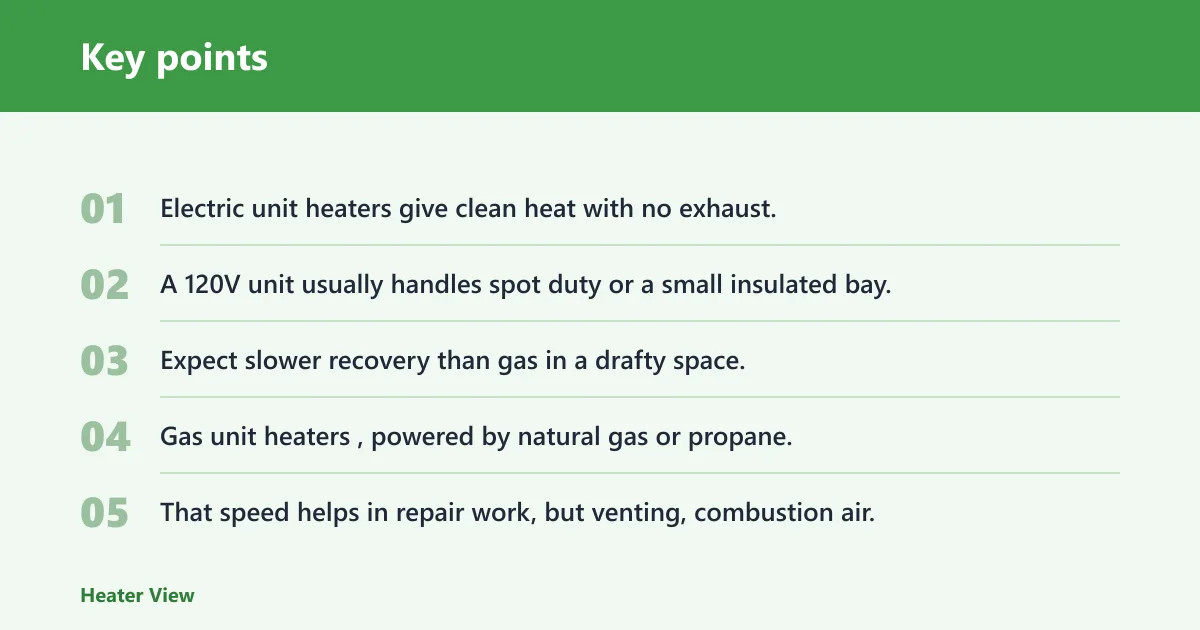
Electric unit heaters give clean heat with no exhaust, so they suit attached garages and tighter spaces where fumes are a concern. A 120V unit usually handles spot duty or a small insulated bay; a 240V unit is the more practical choice for a full garage workshop. Expect slower recovery than gas in a drafty space.
Gas heater compared with repair-shop needs
Gas unit heaters, powered by natural gas or propane, recover heat quickly after the overhead door opens. That speed helps in repair work, but venting, combustion air, and carbon monoxide control are nonnegotiable. These units fit detached garages best, especially where the ceiling is high and the door cycles often.
Infrared heater compared with repair-shop needs
Infrared heaters warm people, tools, and surfaces instead of trying to heat every cubic foot of air. That makes them useful in open bays, high ceilings, and intermittent work. They are less effective when the goal is even whole-room air temperature at floor level during long jobs.
Best fit for attached garages and detached garages
Attached garages favor electric or sealed-combustion systems because exhaust control matters more. Detached garages have more flexibility, so gas or infrared can make better sense if you need faster recovery and frequent door cycling. If the garage shares a wall or ceiling with living space, treat combustion safety as the first filter.
How do you choose the right heater?
Start with the garage’s physical limits, then decide whether you need whole-room warmth or a heated work zone. For auto repair, that choice matters because the door opens, floor-level comfort matters, and fumes may linger near the vehicle and the floor.
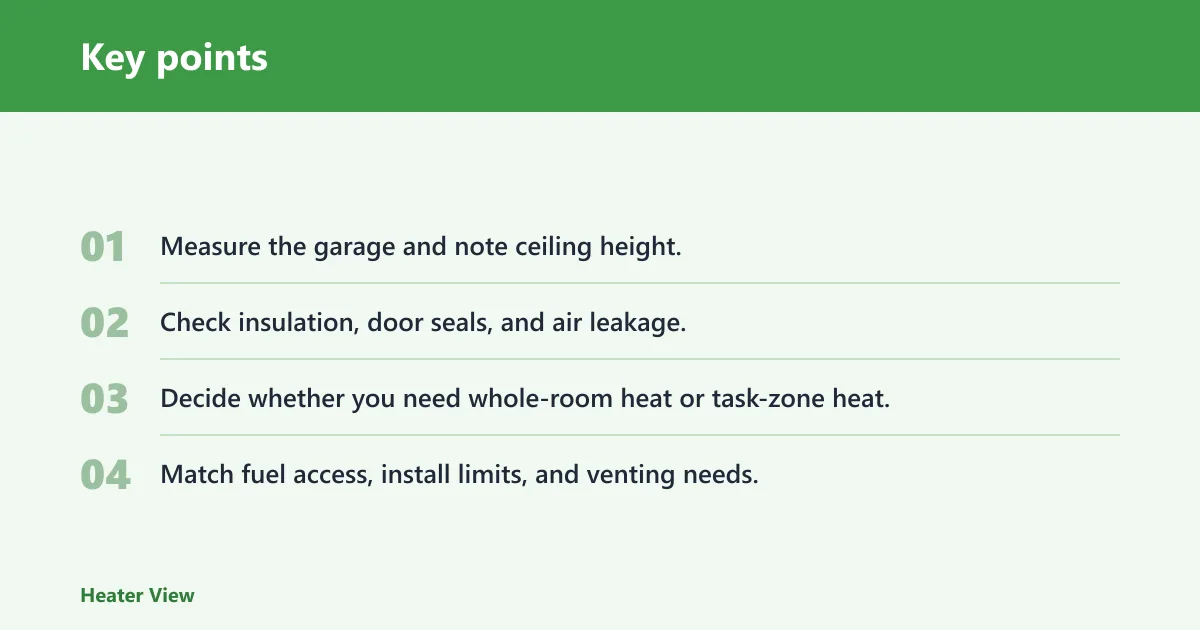
- Measure the garage and note ceiling height.
- Check insulation, door seals, and air leakage.
- Decide whether you need whole-room heat or task-zone heat.
- Match fuel access, install limits, and venting needs.
Use the garage’s layout as the first filter
A one-car bay with an 8-foot ceiling behaves very differently from a deep two-car shop with a 12-foot ceiling. Taller spaces hold more air to warm, and open-bay layouts lose heat faster near the door. Frequent vehicle movement changes the load more than a simple square-foot estimate suggests.
Choose task-zone heat when the work is intermittent
If you do brake work, suspension work, or inspections in short bursts, infrared heat can be the better fit. It gives comfort where you stand and where tools sit, without waiting for the whole garage volume to heat evenly. For long engine or transmission work, whole-room heat is steadier.
Suppose a 24-by-24 detached garage with a 10-foot ceiling opens every 15 minutes during a project. A gas unit heater may recover faster than an electric unit heater, while an infrared unit may keep the person and work area warm even when the air temp drops briefly.
How do you size a garage heater?
Use square footage as the starting point, then adjust for insulation, ceiling height, and door leakage. For many insulated two-car garages, 20,000–40,000 BTU is a common range, but a leaky or uninsulated garage can need more, while a tight, insulated bay may need less.
Start with square footage
Multiply length by width to get the floor area. A 20-by-20 garage is 400 square feet, and a 24-by-24 garage is 576 square feet. That number is only the starting point, because repair-shop use adds heat loss every time the door opens.
Adjust for insulation quality and air changes
Weatherstripping, door seals, and wall and ceiling insulation can lower the heater size you need. An uninsulated garage loses heat quickly, so insulating first is usually cheaper than buying a larger heater. Door leakage and repeated air changes can matter as much as the wall area.
Account for high ceilings and open-bay losses
High ceilings increase the air volume above the work zone. If the ceiling is tall, floor-level comfort gets harder to maintain, and mounted unit heaters may stratify warm air near the roof. In that case, infrared placement or a higher-output mounted heater often works better than a small portable unit.
Plan for fast recovery after door openings
A garage door opening can wipe out the heat you just built. A heater with faster recovery is more useful for auto repair than one that simply maintains a mild idle temperature. If the door opens repeatedly, size up enough to restore comfort within minutes rather than about half an hour.
How do you safely heat a garage?
Keep combustibles clear, give fuel-burning units the venting they need, and place a carbon monoxide detector in nearby living spaces. Fume control comes before heater output, especially in attached garages where exhaust and combustion byproducts can travel into the house.
- Keep oil rags, solvent cans, cardboard, and spray materials away from the heater’s clearance zone.
- Provide venting and combustion air for gas units.
- Place a carbon monoxide detector in garage-adjacent spaces, not inside the garage where temperature swings can be severe.
- Control fumes before you choose the heat source.
Know the safety tradeoff by heater type
Electric unit heaters avoid combustion exhaust, which simplifies safety in attached garages. Gas heaters warm faster, but they are less forgiving if venting or combustion air is wrong. Infrared heaters reduce air heating demand, yet they still need safe clearance from shelving, lifts, and vehicle surfaces.
Picture a 2-car attached garage with a vehicle idling briefly for diagnostics. The exhaust issue is the same whether the heater is on or off, so the correct order is ventilation first, heating second. A heater does not replace exhaust control.
How do you heat a garage in winter without wasting energy?
Insulate and air-seal first, then use a thermostat or timer so the garage only heats when work is scheduled. A heater that runs against leaks wastes energy and still leaves the floor cold. Zoning helps when one corner is for tools and another is for the vehicle.
Use controls that match repair work
A thermostat with setback scheduling is useful when the garage sits unused for part of the day. Set it lower between jobs, then bring it back up before work starts. For intermittent use, a timer can keep the space from heating all day just because the garage was opened once.
Reduce the load before you buy more output
Add weatherstripping around the overhead door, seal obvious wall gaps, and insulate the ceiling before upsizing the heater. Those steps can improve comfort at floor level and reduce recovery time after door openings. They also make the same heater more useful in winter.
Common mistakes
Most heating problems in repair garages come from choosing for comfort alone instead of repair use. The best fix is usually a better match between heater type, garage leakage, and the way the door is used.
- Buying before sealing the garage: fix obvious leaks first so the heater is not fighting constant air loss.
- Sizing only by square footage: include insulation, ceiling height, and door cycling.
- Using a heater that cannot recover after door openings: choose output and heater type for fast recovery.
- Ignoring venting and carbon monoxide risk: treat fuel-burning heaters as ventilation-dependent equipment.
- Treating infrared heat as whole-room air heat: use it for task zones and open bays, not as a full substitute for air heating.
A common mistake is assuming a portable space heater will keep a tall, poorly sealed garage warm enough for brake jobs when cold air pours in around the roll-up door. The heater may run constantly, the tools stay cold, and the floor-level work area never reaches a stable temperature.
Frequently asked questions
How do I heat a garage for auto repair work?
Start with insulation and air sealing, then choose a heater for frequent door openings and floor-level comfort. For many insulated two-car garages, about 20,000–40,000 BTU is often used as a common range. Electric suits cleaner, sealed spaces; gas suits faster recovery; infrared suits task-zone heating.
How do I heat an attached garage for car repairs?
Use a clean, vented, or sealed-combustion approach and place a carbon monoxide detector in the house side of the shared wall or nearby hallway. Attached garages need tighter control over exhaust and combustion air than detached spaces, so electric or sealed-combustion heat usually fits best.
How do I heat a detached garage for auto repair work?
A detached garage can usually accept more heater options, including gas unit heaters and overhead infrared units. If the door opens often, prioritize recovery speed and ceiling height. A mounted heater with proper clearances is often better than a portable unit on the floor.
Can I use an electric heater in a garage workshop?
Yes, especially in an attached or well-sealed garage. A 120V unit can cover light or supplemental heat, while a 240V unit is better for full-time workshop use. Electric heat is clean, but it may cost more to run than gas in long winter sessions.
What is the cheapest way to heat a garage for working on cars?
Cheapest depends on both installation and operating cost. Electric usually has the lowest install complexity, but gas often costs less per hour to run. The lowest overall cost often comes from insulating first, then using a thermostat-controlled heater sized to the actual load.
How do I keep a garage warm while the door is opening and closing?
Pick a heater with fast recovery and use it with tighter door seals, a thermostat, and task-zone heat where possible. Gas and infrared usually recover faster than a small electric unit in a leaky garage. Minimize door-open time and keep the work area close to the heat source.