Can a Garage Heater Run on Solar Power?
A garage heater can run on solar power only if the heater’s wattage and runtime fit your solar array, battery, and inverter; for overnight or cloudy use, most setups need grid or generator backup. Undersized systems leave you cold, and they can waste money on panels, batteries, and wiring that still cannot cover peak heat demand. This guide separates solar air heating from solar-electric heating and shows what solar can actually cover for daytime, overnight, and backup garage use.
When solar heating works and when it fails
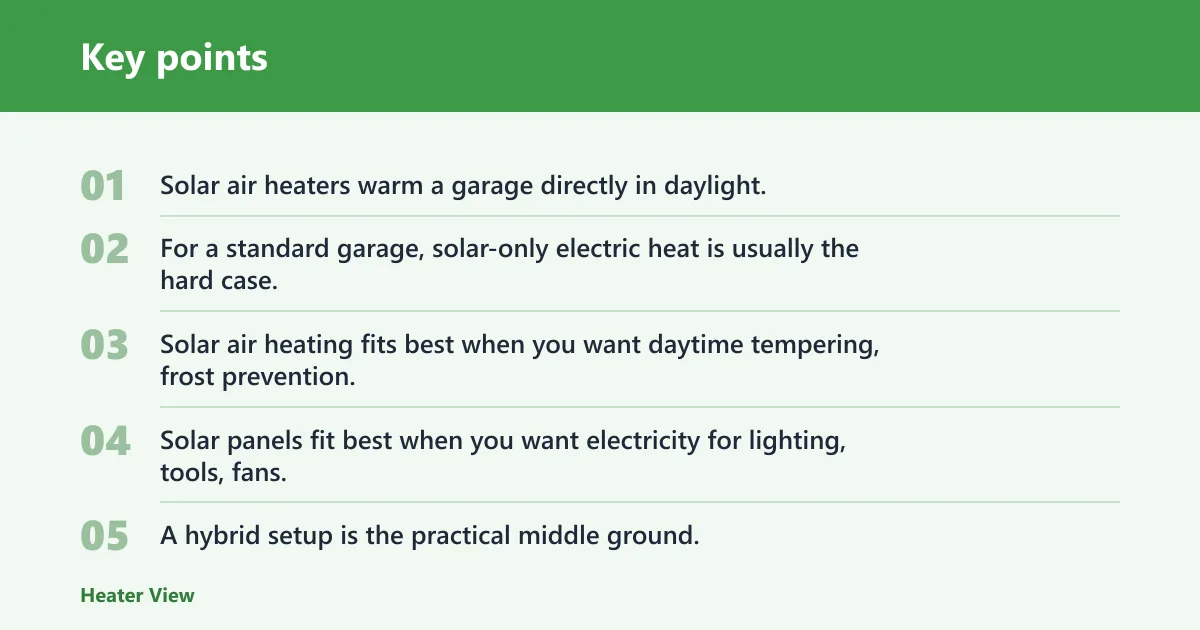
Yes, but only in specific setups. Solar air heaters warm a garage directly in daylight, while solar panels feed electric heaters only after you convert sunlight into electricity through an inverter or charge storage. For a standard garage, solar-only electric heat is usually the hard case, especially at night or in winter.
Where solar fits
Solar air heating fits best when you want daytime tempering, frost prevention, or a modest boost in a well-insulated garage. Solar panels fit best when you want electricity for lighting, tools, fans, or short heater runs during sunny hours. A hybrid setup is the practical middle ground.
Where solar fails
Solar struggles when the garage is leaky, uninsulated, large, shaded, or expected to stay warm after sunset. Electric garage heaters usually draw far more power than small solar kits can supply. A 2,000W heater running about 4 hours a day is also a meaningful energy load, even before winter losses are added.
Suppose a detached 6×6m garage has thin walls and drafty doors. A small panel kit may support a fan or light, but it will not carry a 1,500W space heater for long, especially once clouds, short winter days, and inverter losses are included.
Solar heater options for garages
Use the right type of solar heat for the job. Solar air heaters move warmed air directly into the garage. Photovoltaic panels make electricity, which can run an electric heater only through a compatible inverter, battery, or grid-tied circuit.
Solar air heater versus PV panels
A solar air heater uses direct sun, a collector, and moving air. It is usually mounted on a south-facing wall or roof in the northern hemisphere and works best in daytime. A photovoltaic system uses solar panels to generate electricity, but that electricity does not become heat until it powers an electric heater.
Glazed versus unglazed collectors
Glazed collectors hold heat better and usually work better in cold, windy conditions. Unglazed collectors are simpler and often cheaper, but they lose more heat to outdoor air. That makes unglazed designs better for milder climates or shoulder seasons, not for serious winter garage heating.
A DIY solar air heater can produce 200–700W per square meter in the right conditions. A 1m² collector may be enough to provide a modest daytime boost in a small, well-insulated single garage under favorable sun, while larger or less insulated garages generally need more collector area. The example of a single garage at 3×6m and roughly 43 m³ volume, and a double garage at 6×6m and roughly 86 m³ volume, is one way to think about the scale.
Commercial solar air heaters are listed at roughly 1,500–5,000 BTU/hr for a single garage. Fan-assisted units can produce 30–50% more output than passive convection units, which matters when you need faster mixing or more even temperature rise.
Can a solar panel run a heater?
Yes, but only if the panel output, inverter, and any storage are sized for the heater’s actual draw. Solar panels make electricity, not heat, so a PV system must cover the heater’s wattage plus conversion losses. Daytime operation is the easiest path; cloudy weather and night use are the hard limits.
Heater wattage versus panel output
Most space heaters draw between 750W and 1,500W. Many garage heaters go to 2,000W or more. A 400W panel plus microinverter and a 500W panel heater do not make a practical continuously off-grid heating setup, and that is only suitable for modest heat delivery, not a large or poorly insulated garage.
Why inverter and wiring size matter
AC heaters need an inverter that can handle the continuous load. A small inverter may trip even when the panel wattage looks adequate on paper. Wiring, breakers, and receptacles also need to match the heater draw, especially for 240V hardwired units.
Daytime-only output and cloud loss
Solar output falls with cloud cover, low sun angle, and snow on panels. That is why a PV heater setup often works for daytime tempering, not steady overnight heat. If you need the garage warm at 6 a.m., the system must store energy, not just make it.
Garage heater solar matrix
This matrix shows the minimum viable setup, expected runtime, and likely fail case by garage size, insulation, heating goal, and sun exposure. It separates solar air heating, PV plus electric heat, battery-backed electric heat, and no-solar cases.
| Garage scenario | Minimum viable setup | Expected runtime | Fail case |
|---|---|---|---|
| Small single garage, well insulated, daytime tempering, full sun | 1m² solar air collector or small PV array with fan load only | Best in daylight; output rises while sun is on the collector | Night use or large air leaks overwhelm the gain |
| Single garage, moderate insulation, short daytime heat, full sun | 1m² glazed solar air heater or PV plus 750W electric heater | Solar air: daylight only; PV heater: short daytime bursts | Clouds cut output below heater demand |
| Single garage, poor insulation, winter use, partial sun | No-solar recommended or hybrid with grid backup | Solar contribution is intermittent and unreliable | Heat loss exceeds collector output |
| Double garage, well insulated, daytime workshop use, full sun | 2m² solar air collector or PV plus modest electric heater | Useful daytime boost; runtime follows sun hours | Night heating needs storage or backup |
| Double garage, moderate insulation, overnight comfort target | Battery-backed electric heat with large battery and inverter | Only a short night window unless battery is large | Battery drains quickly on 1,500W to 2,000W loads |
| Detached garage, shaded roof, intermittent use | No-solar recommended unless you add a clear south-facing collector location | Little predictable runtime | Shade blocks both panel and collector performance |
How much solar do you need?
The answer depends on whether you want daytime heat, night heat, or just support for a small heater. PV systems need enough panel wattage to cover the heater load, while battery systems need enough usable kWh to cover runtime after inverter losses and cold-weather derating.
Panels needed for heater loads
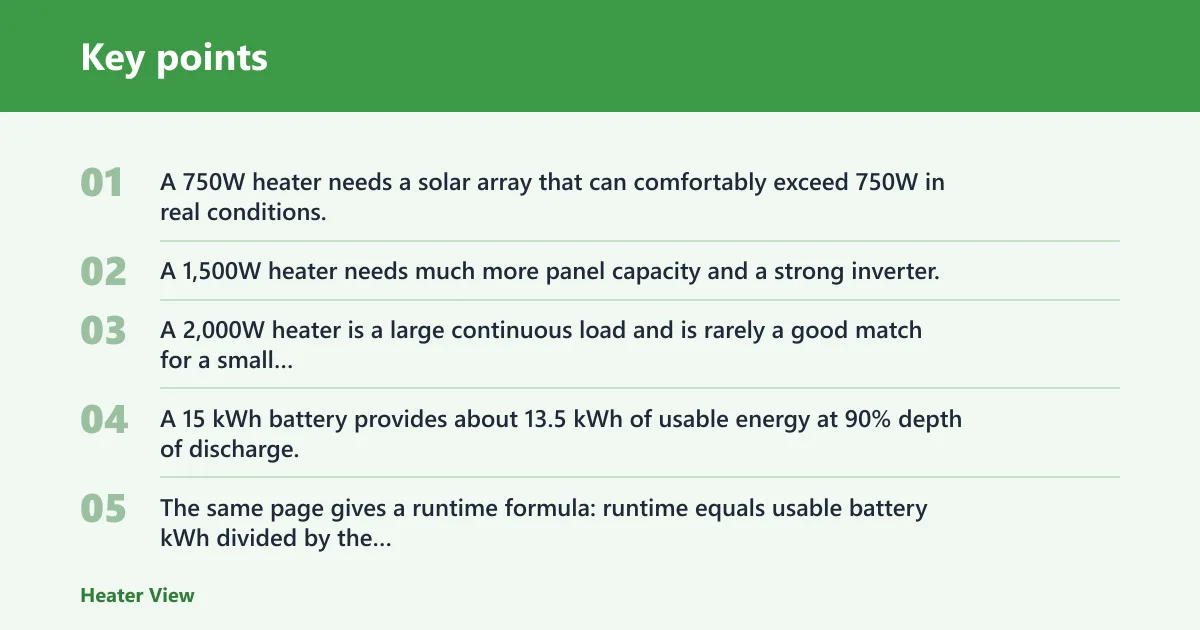
A 750W heater needs a solar array that can comfortably exceed 750W in real conditions, not just on the label. A 1,500W heater needs much more panel capacity and a strong inverter. A 2,000W heater is a large continuous load and is rarely a good match for a small off-grid garage setup.
Battery size for overnight heat
A 15 kWh battery provides about 13.5 kWh of usable energy at 90% depth of discharge, and a 15 kWh battery can run a heat pump for about 5–7 hours at night. The same page gives a runtime formula: runtime equals usable battery kWh divided by the pump’s draw in kW. That logic applies to resistive heaters too, but heater loads drain batteries much faster.
A 30 kWh battery is listed as covering most of a winter evening for a heat pump, but a resistive garage heater is a harder load. Cold-weather performance also matters, because battery output and charging efficiency tend to drop in low temperatures.
Portable power station limits
Portable power stations are often the wrong size class for garage heaters. A 1,000Wh power station running a 750W heater gives about 1.13 hours of heat. That makes them useful for short bursts, not for full evening heating, and many portable power stations cannot sustain high-resistance-heater loads even when the energy capacity looks sufficient.
| Heater draw | 1,000Wh station | 3,000Wh station | 10,000Wh battery | 15 kWh usable battery |
|---|---|---|---|---|
| 750W | About 1.13 hours | About 4.0 hours | About 13.3 hours | About 20 hours |
| 1,500W | About 0.57 hours | About 2.0 hours | About 6.7 hours | About 10 hours |
| 2,000W | About 0.43 hours | About 1.5 hours | About 5.0 hours | About 7.5 hours |
Those runtimes are theoretical and assume the battery can supply the load continuously. Real systems lose some energy in inversion, wiring, and low-temperature operation. Continuous output wattage matters too, because a power station may have enough stored energy but still fail to sustain the heater’s draw.
What garage conditions change the answer?
Garage size, insulation, air leaks, and sun exposure change the system more than most people expect. A small, tight garage can work with a modest collector. A big, drafty, shaded garage often needs either much more collector area or a backup heat source.
Air leaks and insulation level
Air leaks are heat leaks. If the garage door, sill, and service penetrations leak badly, collector output gets spent replacing lost air instead of warming the room. Better insulation lowers the required collector output and makes battery-backed heat more realistic.
Single versus double garage size
Size changes the total air volume and the heat-loss surface area. The cited guide gives about 43 m³ for a single garage at 3×6m×2.4m and about 86 m³ for a double garage at 6×6m×2.4m. The larger space generally needs more collector area and more runtime to reach the same temperature rise.
South-facing placement and collector area
South-facing wall or roof placement matters because the collector needs direct sun in the northern hemisphere. The same is true for PV panels. If the only available roof plane is shaded or faces the wrong direction, the system may need a different mounting location or a backup heater.
A common first-timer mistake is to compare a 30W kit to a 1,500W garage heater and assume a few extra panels will close the gap. It will not. A 30W solar heater kit can warm a tiny enclosure or support a small fan, but it cannot handle a standard garage as the main heat source.
What garage heater options work best with solar?
The best option depends on whether you want daytime warmth, night coverage, or the lowest system cost. Solar air heating is the easiest fit for daytime use. PV plus electric heat works when you already need electricity for other loads. Battery-backed heat is the hardest and most expensive path.
Best fit for occasional daytime use
For a workshop used in sunlight, a solar air heater is usually the cleanest answer. It avoids inverter losses, avoids battery sizing, and converts direct sun into warm air immediately. Glazed collectors are better when the garage sits in a colder climate or sees windy conditions.
Best fit for stored power at night
For night use, PV plus battery plus electric heat is possible, but only when the heater runtime is short or the battery bank is large. A 750W heater is the easiest electrical load to support. A 2,000W heater quickly pushes the system into large-battery territory.
When to keep a backup heater
Keep a backup heater when the garage is poorly insulated, the climate is cold, or the use case depends on exact morning temperature. Backup heat also makes sense if the garage is attached and you want the option to protect plumbing or stored equipment during long cloudy periods.
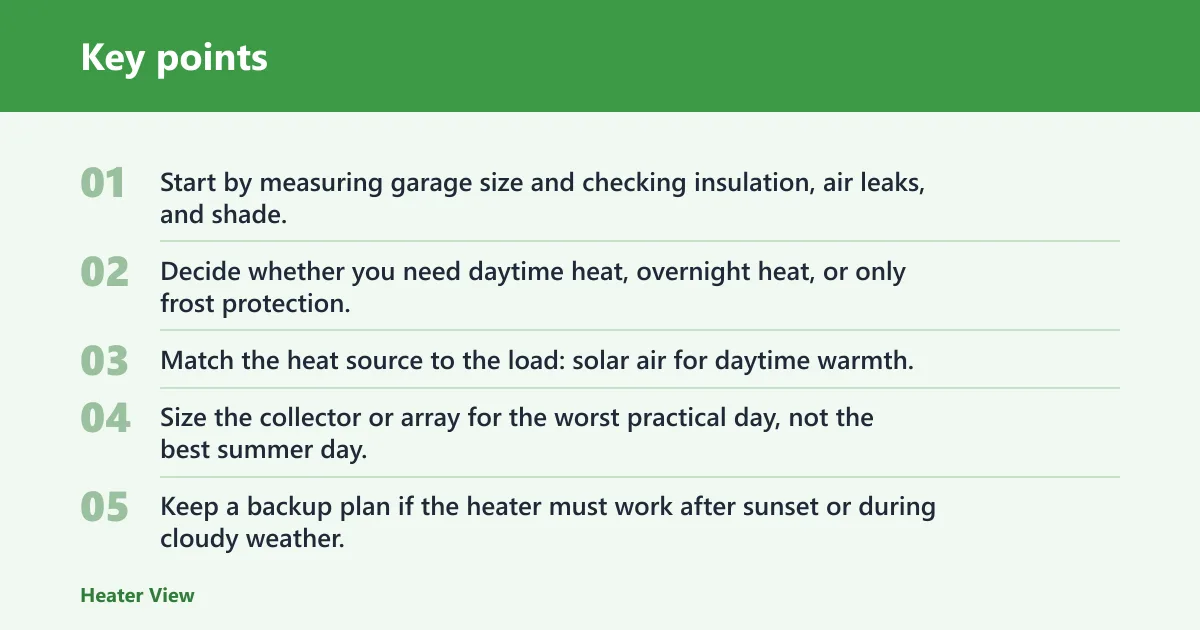
- Start by measuring garage size and checking insulation, air leaks, and shade.
- Decide whether you need daytime heat, overnight heat, or only frost protection.
- Match the heat source to the load: solar air for daytime warmth, PV plus inverter for electric heat, battery only for short runtime.
- Size the collector or array for the worst practical day, not the best summer day.
- Keep a backup plan if the heater must work after sunset or during cloudy weather.
Picture a well-insulated single garage used for weekend projects. A 1m² solar air heater may be enough to take the chill off during sunny hours. Now change only one variable: the same garage stays heated after dark. At that point, PV plus battery storage or a backup heater becomes the real requirement.
Frequently asked questions
How many solar panels do I need to run a garage heater?
It depends on the heater draw and how much sun you can count on. A 750W heater needs a solar array that comfortably exceeds 750W in real conditions. A 1,500W or 2,000W heater usually needs a much larger array plus an inverter sized for the full load.
Can a solar battery run a garage heater overnight?
Yes, but only for limited runtime unless the battery bank is large. One 15 kWh battery can provide about 13.5 kWh usable energy at 90% depth of discharge, which is enough for only a few hours on a resistive heater. Cold weather and inverter losses shorten that window.
What size solar power system do I need for a garage heater?
For daytime use, size the array to the heater load and add margin for clouds and conversion losses. For night use, size the battery bank by usable kWh, not just nameplate capacity. A 30 kWh battery is far more realistic than a small portable unit if you expect a full winter evening of heat.
Is a solar heater for a garage actually effective?
Yes, when the goal is daytime warming in a reasonably insulated garage with good sun exposure. A 1m² solar air collector can be effective on a small, well-insulated garage. It is much less effective for large, leaky, or shaded garages, or for heating after sunset.
Can a power station run an electric heater in a garage?
Yes, for short periods only. Higher-watt heaters drain portable stations quickly, so check continuous output, battery capacity, and inverter rating before relying on one for garage heat.