Are Heaters Safe Near Christmas Trees?
Portable heaters near a Christmas tree are only acceptable if you keep at least 3 feet of clearance, monitor the room the entire time, and remove every other ignition source. NFPA and the U.S. Fire Administration both stress keeping heating equipment away from combustible decorations, and CPSC warns against leaving heaters unattended.
Christmas trees are a major holiday fire hazard, especially when a live tree dries out, lights are damaged, or heat is aimed at the branches. NFPA’s holiday safety guidance and the U.S. Fire Administration both emphasize water for live trees, working smoke alarms, and strict separation from heat sources. space heater safety, overloaded outlets, Christmas light safety, smoke alarms, and extinguisher use all matter here.
Christmas tree fire risk

Real trees and artificial trees are not the same risk
Real trees need water from the moment they come inside, and they should stay watered until disposal. NFPA says a fresh tree dries out more slowly when the stand is kept full, while a dry tree ignites faster and burns more intensely. Artificial trees are safer only if the wiring and materials are intact.
Artificial trees still need the same room discipline around heaters, cords, curtains, and exits. CPSC guidance on holiday decorating emphasizes checking lights and keeping heat sources away from combustible materials. A plastic tree with cracked sockets or brittle branches near a hot air stream can still add fuel to a fire.
How placement changes the risk
Placement changes exposure more than room size does. A heater aimed at the tree stand, a bundle of cords under the skirt, or a chair blocking the exit raises the risk even in a large living room. Keep trees away from heaters and vents, and leave the area around the base free of combustible decorations.
Space heater safety basics
A space heater is a portable indoor heat source, and it should not be left on when not in use. CPSC and the U.S. Fire Administration both warn that unattended heaters are a leading cause of household heating fires. Keep it away from curtains, wrapping paper, tree skirts, and any other combustible item.
Knockover risk matters because children or pets can bump a heater easily. Thermostat cycling matters because the heater may switch on again after a short pause, sending hot air back toward the tree. If the heater cannot be watched, it does not belong in the same setup as holiday decorations.
What to keep away from the heater
Keep the heater away from curtains, upholstery, gift wrap, ornaments, and extension cords. Electrical Safety Foundation International guidance also stresses using heaters on a flat surface with a clear space around them. Do not aim it toward the tree stand or the lower branches.
How far should a heater be from a Christmas tree?
Use at least 3 feet of clearance between a Christmas tree and a portable heater. That 3-foot rule appears in federal holiday fire safety guidance from the U.S. Fire Administration and in CPSC heater safety advice. If that distance cannot be maintained in every direction that matters, the heater should not stay in the room.
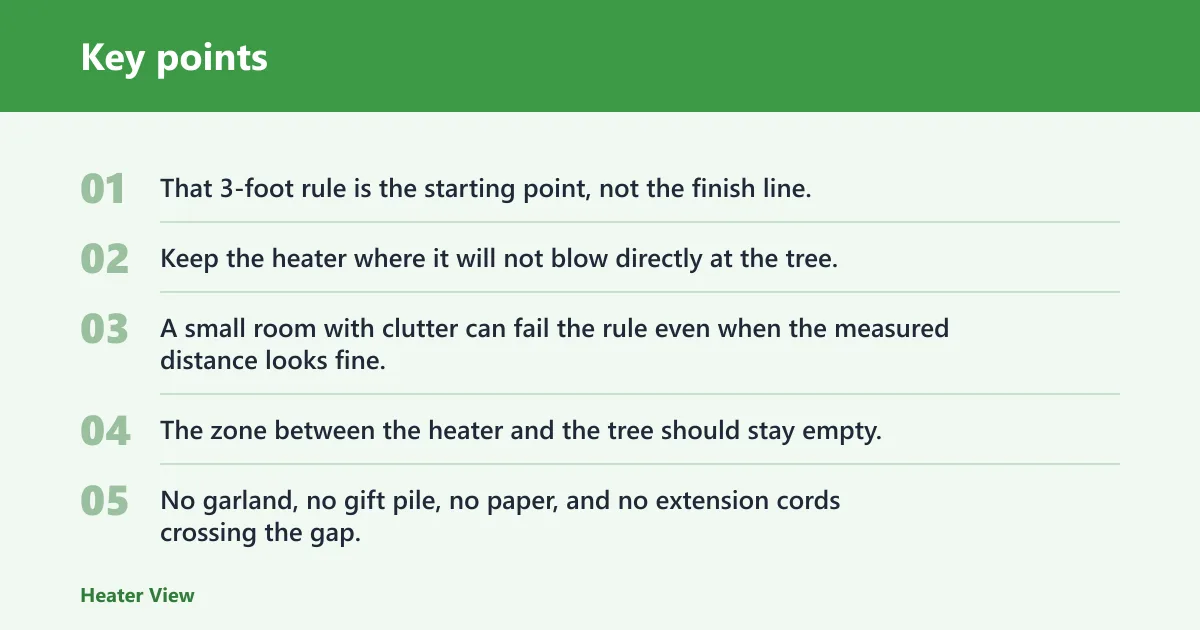
That 3-foot rule is the starting point, not the finish line. Keep the heater where it will not blow directly at the tree, and make sure the path to the door stays open. A small room with clutter can fail the rule even when the measured distance looks fine.
Clear the whole zone
The zone between the heater and the tree should stay empty. No garland, no gift pile, no paper, and no extension cords crossing the gap. A clean buffer matters because heat, sparks, or a tip-over can spread across anything flammable in that path.
Say your heater sits 4 feet from a live tree, but a stack of gift bags is tucked between them. That setup still fails. The clearance is not only a distance check; it is a combustibles check.
Keep exit paths open
Keep the route out of the room clear. If the heater or tree narrows the passage, moving around it during an emergency gets harder and slower. A good setup leaves you able to reach the door without stepping over cords or decorations.
Can a heater dry out a Christmas tree?
Yes. A space heater can dry out a live Christmas tree faster if it blows warm air toward the branches or stand, or if it keeps cycling on near the tree for long periods. NFPA and the U.S. Fire Administration both warn that dry trees ignite faster and burn more intensely. Live indoor trees should be watered on arrival and checked daily.
Watch the stand, not just the needles. If the water reservoir dries out, the tree loses moisture and the fire risk rises. Dropping needles, brittle tips, and a dry trunk are warning signs that the tree needs water and possibly a better location away from heat.
What to do if the tree is already drying out
Water it right away and move it farther from heat if you can. If the tree is already shedding heavily or the stand has gone dry more than once, the safer choice is to reduce heat exposure in that room or remove the heater temporarily. A dry tree and a heater should not share a tight space.
Suppose a 6-foot live tree is beside a heater in a small den, and the stand is nearly empty by evening. The fix is not to run the heater harder. Add water, separate the heat source, and keep the room monitored. If that cannot be done, choose a different room.
Christmas tree safety checklist
Use this room-setup tool before you keep a heater in the room with a tree. If any answer is no, the safer recommendation is to move the heater or remove the tree from that setup.
1. Is the heater at least 3 feet from the tree and all combustibles? Yes / No
2. Is the heater a portable indoor model used only while monitored? Yes / No
3. Will someone stay in the room and watch the setup? Yes / No
4. Will the heater stay off when the room is unattended? Yes / No
5. Is the tree stand full of water and the tree not dry? Yes / No
6. Is the light set intact, with no frayed wiring or cracked sockets? Yes / No
7. Is the circuit not overloaded by lights or other devices? Yes / No
8. Do cords stay out of walkways, exits, and the heater path? Yes / No
9. Is a working smoke alarm installed near the tree area? Yes / No
10. Can the room be left quickly without moving decorations?
Recommendation: Pass only if every answer is yes. If any answer is no, fail the setup and move the heater, move the tree, or remove one of them from the room.
| Check | Yes | No |
|---|---|---|
| Clearance: the heater is at least 3 feet from the tree and all combustibles | ☐ | ☐ |
| Heater type: it is a portable indoor heater used only while monitored | ☐ | ☐ |
| Supervision: someone will stay in the room and watch the setup | ☐ | ☐ |
| Thermostat cycling: the heater will not run unattended through repeated cycles | ☐ | ☐ |
| Tree moisture: the stand has water and the tree is not dry | ☐ | ☐ |
| Light condition: the light set is intact, with no frayed wiring or cracked sockets | ☐ | ☐ |
| Outlet load: the circuit is not overloaded by lights or other devices | ☐ | ☐ |
| Cord routing: cords do not cross walkways, exits, or the heater path | ☐ | ☐ |
| Smoke alarm: one is installed near the tree area and works | ☐ | ☐ |
| Exit blockage: the room can be left quickly without moving decorations | ☐ | ☐ |
Pass: every check is yes. Fail: any check is no. If you fail, move the heater, move the tree, or remove one of them from the room.
| Setup factor | Safer choice | When the setup fails | What to do |
|---|---|---|---|
| Tree type | Fresh, well-watered live tree or intact artificial tree | Dry, dropping, or damaged tree | Water the tree, move heat away, or remove the tree |
| Heater placement | At least 3 feet away, with no direct airflow toward branches | Any combustible item is inside the buffer or the path is blocked | Relocate the heater or clear the room |
| Operation | Monitored only, never unattended | No one can watch the room | Turn the heater off |
| Action if any condition is not met | Maintain the setup only if every check passes | One or more checks fail | Change the layout or choose a different room |
Lights, outlets, and cords
Tree lights should be certified by recognized testing labs. Inspect each set for frayed wiring, cracked sockets, bent plugs, and damaged insulation. CPSC holiday lighting guidance and major electrical safety authorities recommend replacing damaged sets rather than repairing them with tape or hiding them behind branches.
Too many connected light strings can overheat outlets. Follow the manufacturer’s maximum connection limit, and do not overload the circuit with heaters, lights, and other appliances at the same time. Unplugging lights before sleeping is recommended, and it is also recommended before leaving the home.
What kind of lights are safest
Choose lights that are UL or CSA certified, and check the package directions for how many strings may be connected together. Certification does not make a damaged set safe, and it does not cancel the need to keep cords away from the heater and the tree stand.
Smoke alarms and fire extinguishers
Put a smoke alarm near the tree area rather than in a distant hallway. NFPA and the U.S. Fire Administration both stress working smoke alarms in sleeping and living areas because they provide the earliest warning when a holiday fire starts to spread. Test them on the regular schedule recommended by the manufacturer or local guidance.
Keep a Class ABC fire extinguisher easy to reach near the room. Know how to use it before you need it. If the fire is already growing fast, leave the room and call emergency services instead of trying to fight it from a blocked path.
Frequently asked questions
Are heaters safe near Christmas trees?
Only under a strict setup: at least 3 feet of clearance, constant supervision, and no other ignition sources in the room. NFPA and CPSC guidance both support keeping portable heaters away from combustible holiday décor. If any part of that setup fails, the safer answer is no.
Can a space heater dry out a Christmas tree faster?
Yes, especially if warm air reaches the branches or the heater cycles on near the tree for long periods. A drier tree is more flammable, so daily watering matters for live trees. If the stand runs dry, the risk rises and the heater should be moved farther away.
What kind of heater is safest to use near holiday decorations?
The safest choice is the heater that can stay far enough away to meet the 3-foot rule and can be watched the entire time it runs. Portable indoor heaters are the concern here because they can tip over or stay hot after cycling. If supervision is not possible, none is the safe choice.
Should I turn off a heater when the Christmas tree lights are on?
If the heater is in the same room as the tree, do not leave it running unattended. Tree lights can stay on only when the wiring is intact, the outlet is not overloaded, and someone is there to watch the room. Before sleeping or leaving, turn off the lights and the heater.
Can a Christmas tree catch fire from a heater?
Yes. Heat can dry the tree, warm nearby decorations, and ignite combustible material if the heater is too close or knocked over. A dry live tree is especially dangerous. The safest setup keeps the heater at least 3 feet away and removes anything flammable from that zone.
Is it safe to use a heater in the same room as a real Christmas tree?
It can be safe only if the tree is well watered, the heater is monitored, and the room meets the 3-foot clearance rule with no combustibles between them. If the room is small, cluttered, or used overnight, the safer choice is to keep the heater elsewhere.
What should I do if my tree is near a heater?
Move one of them now. Recheck the 3-foot buffer, remove decorations and cords from the gap, water the tree, and make sure the heater will not run unattended. If you cannot keep the setup under observation, shut the heater off and use a different room or a different heat source.
Are space heaters safe around artificial Christmas trees?
Only if the tree’s wiring and materials are intact and the heater still has at least 3 feet of clearance. Artificial trees do not remove the need for cord control, exit access, or supervision. A damaged light set or a tipped heater can still create a fire even without a live tree.