How to Troubleshoot a Tankless Water Heater Error Code
Start with the exact code on the display, then use the brand’s manual for that model. If the code points to gas, venting, overheating, or repeated lockout, stop resetting and call a technician. Ignoring it can leave you with no hot water, repeated shutdowns, or a safety problem.
Safety warning: If you smell gas, suspect blocked venting, or the heater keeps locking out after a reset, stop using the unit and call for service. Do not keep power-cycling a gas tankless water heater that is showing the same fault again and again.
What you’ll need
- The heater’s model number from the rating plate
- The brand’s code chart or manual
- A flashlight
- A dry cloth or soft brush
- A bucket or towel for drips
- Basic hand protection
- Access to the cold-water service valve
What the error code tells you first
Read the display exactly as shown, including letters and symbols, because tankless water heater error codes are manufacturer-specific alphanumeric signals. Check whether the fault is constant or intermittent, and note whether the unit is gas or electric before you do anything else.
The display may be on an LED, LCD, or remote controller. A blank display is different from a code and often points to power, wiring, or control-board issues. That changes the path immediately.
Identify the model before you use any code
Find the manufacturer model number on the rating plate, then pull the manual or code chart for that exact brand. Major brands maintain proprietary code systems, not a universal standard, so the same code can mean different faults by brand.
Gas units carry significantly more fault categories than electric units. Modern gas tankless units may have between 8 and 14 sensors, while electric tankless units carry 3 to 6 sensors. That is why a code alone is not enough.
Do these checks before you power-cycle?
- Record the exact code and whether the display is steady, flashing, or blank.
- Open the model plate and match the brand code table.
- Check whether another hot-water fixture works the same way.
How do you troubleshoot a tankless water heater error code?
Use the code to narrow the fault family, then start with the safest homeowner checks: one reset, inlet filter cleaning, a flow check, and a visual inspection of vents and intake screens. If the code returns after that, move to brand-specific causes and stop when the fault shifts into gas, venting, or PCB territory.
Step 1: reset the heater and record the result
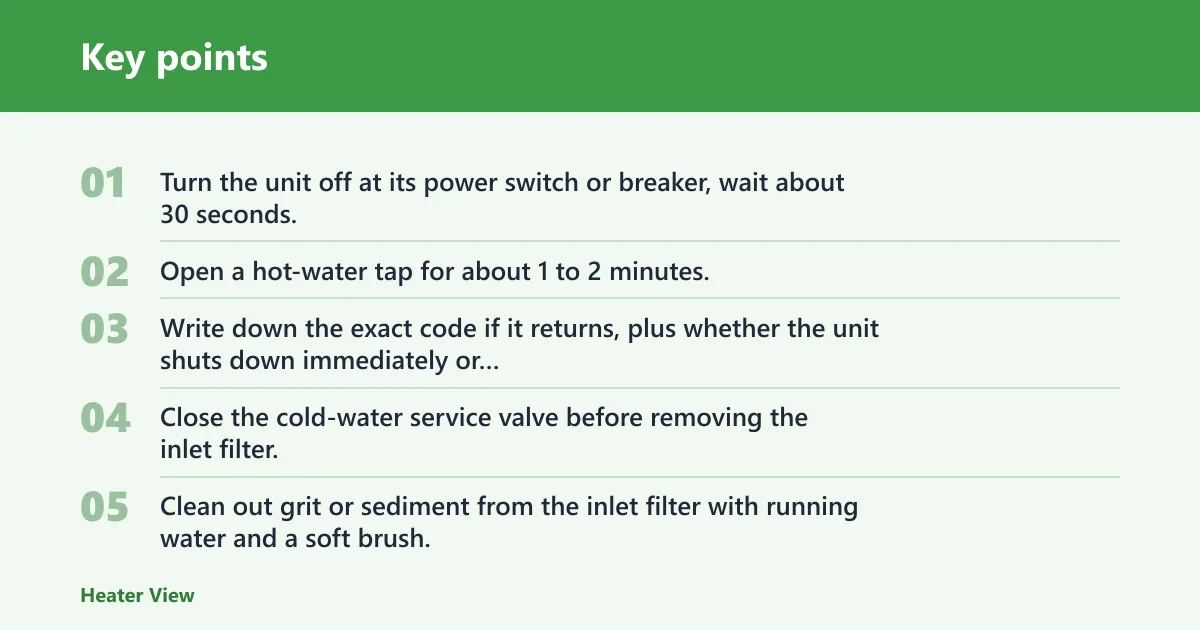
- Turn the unit off at its power switch or breaker, wait about 30 seconds, then restore power.
- Open a hot-water tap for about 1 to 2 minutes.
- Write down the exact code if it returns, plus whether the unit shuts down immediately or after a short run.
If the same fault comes back right away, repeated resets are not a fix. They only confirm the heater is seeing the same problem again.
Step 2: check water flow and the inlet filter
- Close the cold-water service valve before removing the inlet filter.
- Clean out grit or sediment from the inlet filter with running water and a soft brush.
- Reinstall the filter, reopen the valve, and run a hot tap at full open.
The inlet water filter is a common first check because grit or sediment can choke flow. A flow sensor can also be contaminated by sediment or scale, and that can stop the heater from starting a heating cycle.
Suppose a shower runs lukewarm for a minute, then the unit throws a flow-related code. That pattern often points to restriction at the filter or sensor, not a full loss of power.
Step 3: inspect venting, scale, sensors, and electrical inputs
- Check intake screens, flues, chimneys, and vent sections for blockage or damage.
- Look for white scale deposits around the heat exchanger, fittings, or drain path.
- Confirm the display has stable power and the wiring connections are intact before assuming a board failure.
Combustion air and exhaust venting are safety-critical on gas models. Blocked venting can trigger shutdown. Hard-water scale buildup can also drive overheating or thermal faults, especially where water hardness is above common scaling thresholds used by utilities and manufacturers to flag increasing risk, and where degradation accelerates as hardness rises.
Why is the code different by brand?
Match the code to the manufacturer table, not to a generic list. Compare code families, not just the number, because the same code can mean ignition trouble in one brand and a ventilation fault in another. Treat similar-looking codes as brand-specific faults.
Bosch error code EA indicates ignition failure. Bosch error code C2 indicates excessive flue blockage. Those examples show why the brand name and model number matter before you act.
Brand lookup rule
- Use the exact model number from the rating plate.
- Open the brand’s code chart or service manual.
- Map the code family before touching components.
Brand/model lookup by manufacturer and code family
Use this quick lookup flow before you troubleshoot by symptom. Manufacturer-specific manuals matter because the same number can point to different faults depending on brand, model year, and controller type.
- Bosch: start with Bosch error code EA for ignition-related faults and Bosch code charts for flue/airflow faults such as C2.
- Rinnai: use the exact model chart for ignition, airflow, temperature, or flame issues before you decide whether the fault is homeowner-safe.
- Rheem: use the code family and display behavior to separate blank-display power issues from temperature, airflow, or lockout conditions.
- No display / no code: check power supply, breaker, plug, controller wiring, and display connections first, because the problem may not be a fault code at all.
- Code 10: use the brand chart and then follow the flow, vent, and ignition path that matches the model.
- Code 12: use the brand chart and confirm whether the code family points to airflow, flame, or sensor trouble on that specific unit.
Error code troubleshooting matrix
| Code family | Likely root causes | Homeowner-safe checks | Technician-only checks | Urgency | Stop / call-a-pro note |
|---|---|---|---|---|---|
| No ignition | Gas supply issue, dirty ignition components, flame rod / ignition system fault | Reset once, confirm gas service to other appliances, inspect for obvious shutoff or display issues | Gas pressure verified in inches water column, ignition sequence testing, flame signal checks | High if the code repeats | Stop if the fault returns after one reset or if gas service, ignition, or flame sensing must be tested. |
| Flame failure | Weak flame signal, flame rod contamination, gas pressure out of range | Reset, check for gas odor, confirm the unit has not just been serviced or shut off | Instrumented gas pressure check, combustion analysis, component replacement | High | Stop immediately if you smell gas or if the heater repeatedly ignites and then drops out. |
| Airflow blockage | Blocked intake, blocked exhaust, pressure switch problem on sealed-combustion gas units | Inspect intake screens and visible vent sections, clear obvious debris | Pressure switch test, vent diagnostics, draft verification | High | Stop and call a pro if venting is blocked, damaged, disconnected, or the unit keeps locking out. |
| Flow-sensor fault | Sediment, scale, failed sensor, low draw flow | Clean inlet filter, increase hot-water draw, check for fixture restriction | Sensor inspection, wiring checks, control-board input test | Medium to high | Stop if cleaning the filter does not change the fault or if the sensor wiring must be tested. |
| Overheating or thermal fault | Heat exchanger scale buildup, low flow, circulation restriction | Check filter, flush if the manual allows a homeowner flush, confirm hot-water flow is adequate | Descaling, exchanger inspection, temperature-sensor checks | Medium | Stop if the heater overheats again after flow checks or if scale removal requires service tools. |
| Blank display | Power loss, wiring fault, control board / PCB failure | Check breaker, plug, service switch, and any visible loose connection | Power supply testing, PCB diagnosis, internal wiring inspection | High if the unit is dead | Stop if the display stays blank after power checks or the controller will not wake up. |
Stop here if the fault keeps returning after reset, if the heater is gas-fired and you smell gas, or if the problem needs gas-pressure testing, vent diagnostics, or PCB diagnosis. That is the line between a safe check and a service call.
When should you stop troubleshooting?
Stop if the code returns after reset, if you smell gas, or if the heater shuts down during ignition again and again. Stop as well if the display is blank and the unit will not respond, because that can point to power, wiring, or control-board failure.
A common first-timer mistake is clearing the code three or four times in a row and assuming the problem is gone. That can hide a venting fault, a gas-pressure issue, or a sensor problem that only comes back under load.
Escalation ladder
- Check the model number and exact code again.
- Clean the inlet filter and verify water flow.
- Inspect venting and intake screens.
- Stop and call for service if the fault repeats.
How do I reset a tankless water heater safely?
Use a single reset after you have written down the code and checked the model number. If the fault is a one-time lockout from a brief interruption, a reset may clear it. If the code comes back, do not keep cycling power.
- Turn off power at the switch or breaker.
- Wait 30 seconds.
- Restore power and open a hot-water tap.
- Watch for the same code to return within about 1 to 2 minutes.
Common mistakes
- Using a generic code list before checking the model number.
- Cleaning the inlet filter without closing the cold-water service valve first.
- Ignoring venting on gas units because the code appears to be “just a sensor fault.”
- Resetting the heater repeatedly after the same code returns.
- Assuming a blank display means a simple lockout instead of a power or PCB problem.
- Treating gas pressure checks as a homeowner task. Gas pressure is typically verified in inches water column.
Frequently asked questions
Why did my tankless water heater stop working?
The most common path is a lockout from ignition, airflow, flow, overheating, or power trouble. Start with the exact code, then check the brand table and the model number. If there is no code at all, look at power, wiring, and the display before assuming a major failure.
What does my tankless water heater error code mean?
It points to a fault family, not a universal fix. The meaning depends on the brand and model number, and major brands use proprietary code systems. Read the code chart for that exact unit before deciding whether the issue is flow, ignition, airflow, temperature, or electronics.
Why is my tankless water heater showing code 11?
Code 11 is not universal, so the brand should be checked first. On some gas units, similar numbers point to ignition or flame-sensing trouble, while other brands assign different faults. Check the manual for the exact model, then decide whether the issue is safe to clear or needs service.
Why is my tankless water heater showing code 10?
Code 10 can mean different things by brand, so do not assume one fix. Look up the exact model number and the manufacturer’s chart, then inspect the basics first: filter, flow, venting, and display behavior. If the code returns after reset, call a technician.
Why is my tankless water heater showing code 12?
Code 12 is also brand-specific. In many systems, codes in this range can point to airflow, flame, or sensor faults, but the exact meaning depends on the manufacturer. Use the model number and code table, then stop if the problem involves gas, venting, or repeated lockout.
When should I call a plumber for a tankless water heater error code?
Call when the code returns after a reset, when you smell gas, or when the fault appears tied to gas pressure, venting, or the control board. Also call if the heater is blank, locked out, or shuts down during ignition. Those are not reliable homeowner fixes.