Heat Pump Water Heater vs Electric Tank: Which Is Better?
A heat pump water heater is usually the better retrofit if you can pay a higher install price and have enough room for air flow, because it can cut water-heating electricity use by about 50% to 60% versus a standard electric tank. Pick the wrong unit and you can face cold-water complaints, installation surprises, or savings too small to cover the upgrade.
| Decision factor | Heat pump water heater | Electric tank | Winner |
|---|---|---|---|
| Upfront cost | Higher equipment and retrofit cost | Lower purchase and install cost | Electric tank |
| Operating cost | Lower electricity use; top models can exceed a UEF of 4.0 | Higher electricity use; resistance heat is direct | Heat pump water heater |
| Hot-water recovery | Slower recovery after big draws | Faster recovery than a heat pump unit | Electric tank |
| Space and air needs | Needs more room and warm surrounding air | Fits more easily in tight spaces | Electric tank |
| Service life potential | Often cited around 14 to 15 years | Commonly about 8 to 12 years | Heat pump water heater |
How each system heats water
Heat pump water heater
A heat pump water heater moves heat from the surrounding air into stored water with a refrigerant cycle. It uses the same basic technology as a refrigerator, but in reverse. Because it moves heat instead of making it directly, it can use far less electricity than a resistance tank.
Electric tank
An electric tank water heater uses internal resistance elements immersed in the tank. That makes the design simpler, cheaper, and easier to replace in many homes. It also means every gallon of hot water is produced by direct electric heat, which costs more to run.
Which one costs less to run?
A heat pump water heater usually costs less to operate, especially in homes that use a lot of hot water. The best units can exceed a UEF of 4.0, while standard electric resistance tanks are far lower. But the size of the bill drop depends on your usage, local electric rate, and whether the unit can run in suitable air.
Why UEF matters
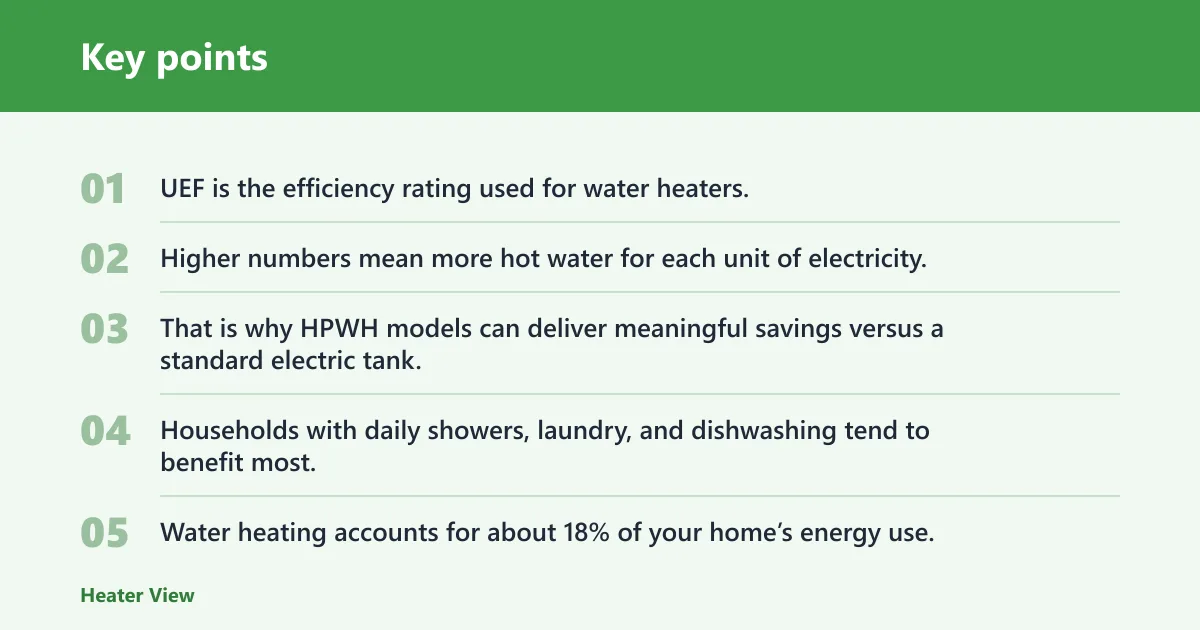
UEF is the efficiency rating used for water heaters. Higher numbers mean more hot water for each unit of electricity. That is why HPWH models can deliver meaningful savings versus a standard electric tank, and why the operating gap is much smaller when a home has low hot-water use.
Where savings are usually biggest
Households with daily showers, laundry, and dishwashing tend to benefit most. Water heating accounts for about 18% of your home’s energy use, so cutting that load can matter. The gain is smaller for a low-use household that already uses little hot water or pays a low electric rate.
Simple bill-impact frame
Compare three numbers before choosing: your current hot-water use, your electricity price, and the installed cost gap between the two units. If the upgraded unit costs far more but your tank replacement is already due, the operating savings may still justify it. If usage is light, the payback can stretch out.
Can it keep up with your hot water use?
An electric tank usually wins on immediate hot-water delivery because it recovers faster after a draw. A heat pump water heater can still serve a normal household well, but its slower recovery can matter during back-to-back showers, large laundry loads, or simultaneous demand from multiple fixtures. First hour rating matters more here than efficiency alone.
First hour rating and recovery time
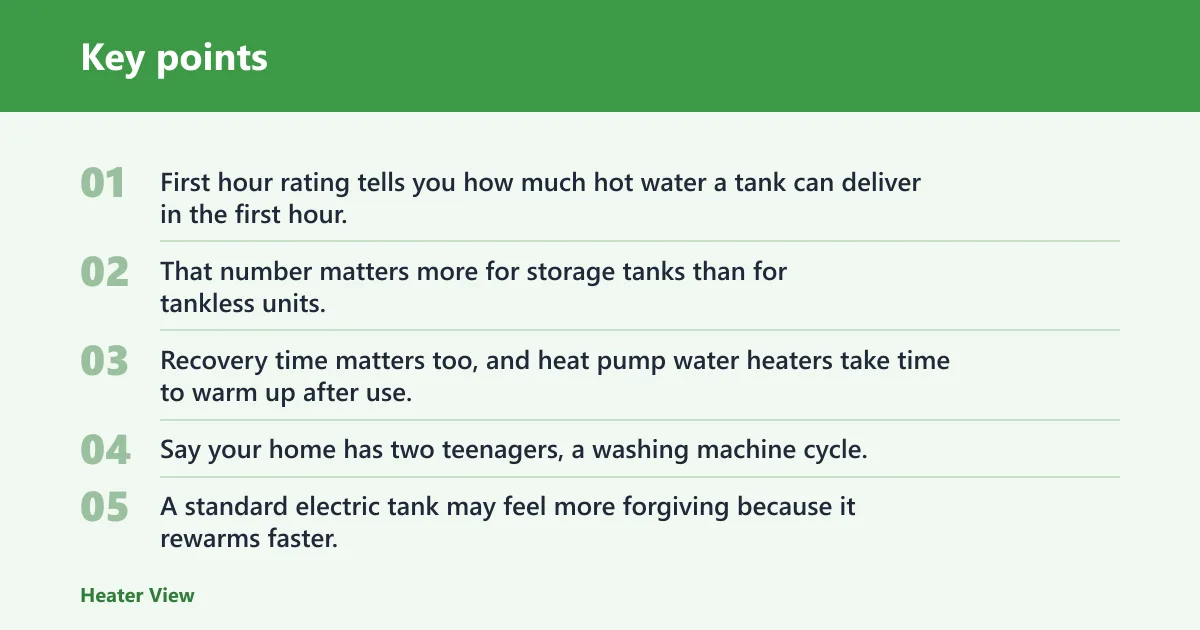
First hour rating tells you how much hot water a tank can deliver in the first hour. That number matters more for storage tanks than for tankless units. Recovery time matters too, and heat pump water heaters take time to warm up after use, so they can lag when demand stacks up.
Say your home has two teenagers, a washing machine cycle, and a shower running before breakfast. A standard electric tank may feel more forgiving because it rewarms faster. The heat pump unit can still work, but the recovery delay raises the risk of a cold-water complaint if the tank is undersized.
Why demand changes the winner
A household with one or two people and spread-out usage is a better match for a heat pump water heater. A draw-heavy home is more likely to value the faster response of an electric tank, even if that choice raises monthly operating cost. Simultaneous demand changes the decision more than many shoppers expect.
Does it fit your space?
Space is one of the biggest retrofit filters. A heat pump water heater needs a reasonable amount of room to harvest air, and it works best in a furnace room, basement mechanical area, or similar space with enough volume. Tight closets and cold garages are common problem spots.
Warm-air and room-volume needs
HPWHs pull heat from the air around them, so they need warm enough surrounding air and room to move it. Some heat pump water heaters may not work below 40°F. In a cold or cramped space, efficiency falls and recovery slows, which can wipe out much of the expected benefit.
Retrofit checks that matter
Before choosing a heat pump water heater, check four things: room volume, ambient temperature, drain access for condensate, and electrical capacity. A condensate line is often needed because the unit removes moisture from the air. Panel space and circuit sizing also matter, even when the heater itself is a replacement for an existing electric tank.
Picture a furnace room with enough open air, a floor drain nearby, and an existing 240-volt connection. That is a strong HPWH location. By contrast, a small insulated closet with no drain is a poor fit, even if the old tank is already in place.
Water heater decision table
| Household scenario | Likely winner | Key reason | Main hidden cost or risk |
|---|---|---|---|
| Baseline electric tank replacement | Heat pump water heater | Best chance to cut operating cost when the old tank is already due for replacement | Higher upfront price and a longer simple payback if usage is light |
| Basement or furnace room | Heat pump water heater | Usually has enough air volume and a warmer environment for efficient operation | Condensate drain and room cooling can still require planning |
| Cold garage | Electric tank | Cold ambient air can cut performance and lengthen recovery | Comfort complaints and lower efficiency if the unit operates near or below 40°F |
| High hot-water demand | Electric tank | Faster recovery better handles back-to-back showers and simultaneous draws | Higher monthly operating cost over time |
| Hard-water home | Electric tank | Simpler maintenance if the household is not ready for more upkeep | Both types suffer from scale, but HPWH service and parts access can matter more in practice |
Baseline replacement
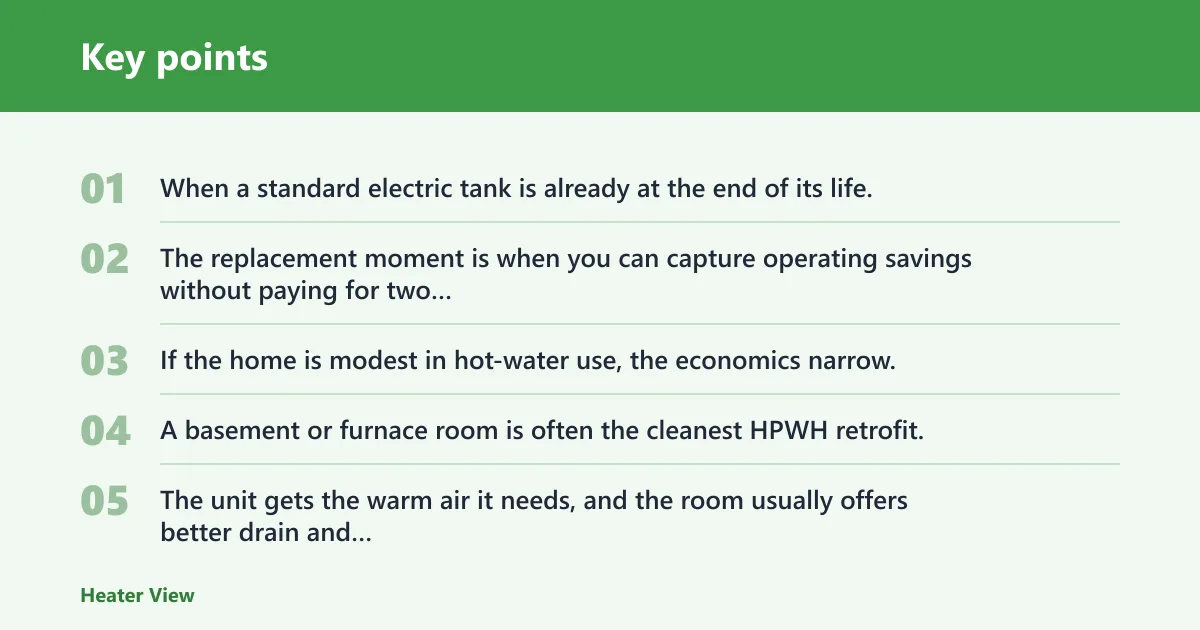
When a standard electric tank is already at the end of its life, a heat pump upgrade often makes the most sense if the space and electrical setup are ready. The replacement moment is when you can capture operating savings without paying for two separate installs. If the home is modest in hot-water use, the economics narrow.
Basement or furnace room
A basement or furnace room is often the cleanest HPWH retrofit. The unit gets the warm air it needs, and the room usually offers better drain and service access than a cramped closet. That lower installation risk is often worth more than the raw efficiency difference alone.
Cold garage
A cold garage pushes the decision the other way. Some heat pump water heaters may not work below 40°F, and even above that point the unit can lose efficiency and slow recovery. A standard electric tank is usually the safer buy where winter temperatures stay low.
High hot-water demand
High-demand homes place more value on recovery time than on maximum efficiency. If several showers, laundry, and dishwashing can overlap, a standard electric tank is less likely to run short. The heat pump option may still work if the tank is large enough, but the margin gets thinner.
Hard-water home
Hard water adds maintenance pressure to either system. Sediment flushing matters for tanks, and scale control matters for both tank elements and heat pump components. In a hard-water home where maintenance tends to get delayed, the simpler electric tank can be the safer choice.
How much maintenance and lifespan should you expect?
Expect a heat pump water heater to need a little more attention than a plain electric tank. Filter cleaning is part of normal ownership, and annual professional service is often recommended. Electric tanks need sediment flushing and scale control too, especially where water hardness is high.
What actually gets maintained
For HPWHs, the air filter needs cleaning so airflow stays adequate. The unit also needs enough clear space around it, and the condensate path should remain open. For standard tanks, sediment buildup can reduce performance and life, so flushing the tank periodically helps.
Lifespan in practical terms
Tank water heaters are often cited around 8 to 12 years, while many heat pump systems are often cited around 14 to 15 years. That longer life is not automatic. Water quality, maintenance, and installation conditions can shorten either one.
A common mistake is buying a heat pump water heater for a remote utility room without checking whether a qualified installer and repair tech are available nearby. If the unit will be hard to reach for filter cleaning or flush work, the expected lifespan advantage can shrink quickly. A slightly less efficient unit that gets maintained on time can outperform a neglected upgrade.
Choose heat pump water heater if… / Choose electric tank if…
Choose a heat pump water heater if you have a basement, furnace room, or other space with enough warm air; your current electric tank is already due for replacement; your hot-water demand is moderate; and you want lower operating cost over a longer service life.
Choose an electric tank if your install space is tight or cold, such as a closet or garage; your household has high simultaneous hot-water use; you want the lowest upfront price; or you want the simpler retrofit with fewer space and drain requirements.

Frequently asked questions
Is a heat pump water heater worth it over a standard electric tank?
It is usually worth it when your replacement location has enough space, the air around the unit is warm enough, and your hot-water use is average to high. If the install is easy and the old tank is already failing, the operating savings can outweigh the higher upfront price. Cold rooms change that math quickly.
How much does a heat pump water heater save compared with an electric tank?
The comparison is often strongest when the heat pump unit replaces a standard electric resistance tank. Compared with electric resistance heating, heat pumps can save up to 50% on heating costs. Actual savings depend on your rate, usage pattern, and the installation environment, so the bill reduction is never a fixed number.
Does a heat pump water heater work in a cold basement or garage?
Sometimes, but cold spaces are a real limit. Some heat pump water heaters may not work below 40°F, and even warmer-but-unconditioned spaces can reduce efficiency and slow recovery. A basement mechanical room is often a better fit than a cold garage because it usually offers more stable air temperature and room volume.
How long does a heat pump water heater take to recover hot water?
Longer than a standard electric tank in many real homes. Heat pump water heaters take time to warm up after use, so they can lag during back-to-back showers or when laundry overlaps with bathing. A larger tank helps, but recovery speed remains part of the tradeoff.
What size electrical or space requirements does a heat pump water heater need?
You need enough room for the unit to harvest air, plus practical access for service and condensate drainage. Electrical requirements vary by model, but a retrofit should check breaker capacity, wiring, and whether the existing circuit can support the replacement safely. Tight closets and low-clearance rooms are common problems.
Which lasts longer: a heat pump water heater or an electric tank?
Heat pump systems are often cited around 14 to 15 years, while tank water heaters are often cited around 8 to 12 years. That gap can narrow if water is hard or maintenance is delayed. Lifespan should be treated as a range, not a promise.