Wall Heater Troubleshooting for No Heat
For wall heater troubleshooting with no heat, start with power, then airflow, then fuel or ignition. If the fan runs but no warm air comes out, the usual causes are a tripped safety, blocked airflow, or a failed ignitor. Ignoring the fault can lead to repeated breaker trips, wasted energy, or a service call that costs more than the repair. This guide gives you a fast wall-heater decision tree so you can isolate the failure point and decide what to fix first.
Why a wall heater blows cold air
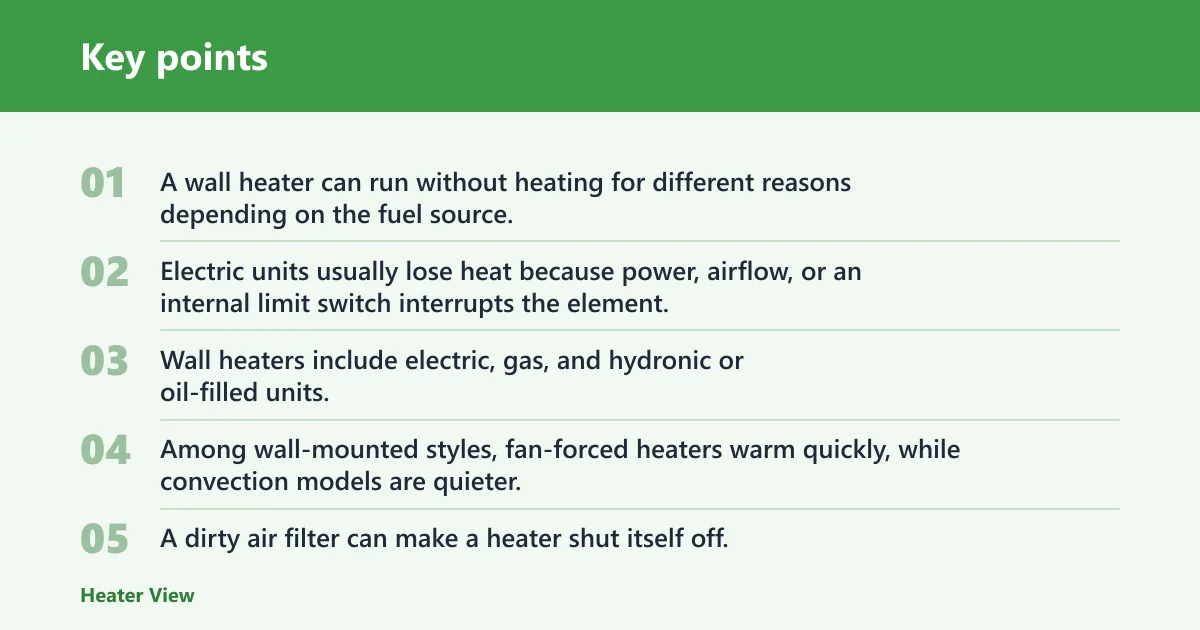


A wall heater can run without heating for different reasons depending on the fuel source. Electric units usually lose heat because power, airflow, or an internal limit switch interrupts the element. Gas units can run through a full startup cycle but stop before flame, which points to supply, pilot, ignitor, or flame sensor problems.
Wall heaters include electric, gas, and hydronic or oil-filled units. Among wall-mounted styles, fan-forced heaters warm quickly, while convection models are quieter. Radiant and infrared units heat people and objects more directly, so a cold-room complaint can feel different from a fan that blows air without warmth.
Electric wall heater no-heat path
On an electric wall heater, a working fan with cold air usually means the unit has some power but the heating element is not energizing, or a safety switch is opening the circuit. A dirty air filter can make a heater shut itself off. If the breaker trips again after a reset, leave it off and call a professional.
Gas wall heater no-heat path
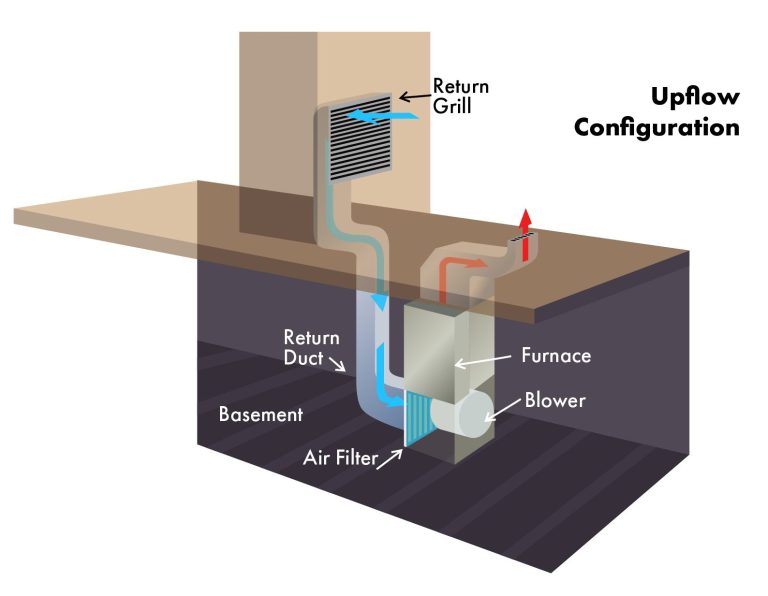
On a gas wall heater, the sequence matters. A normal gas furnace cycle starts with inducer fan, then ignitor, then burners, then blower. If you hear startup but no flame appears, the fault usually sits in gas supply, pilot light systems, ignitor operation, or flame sensing, not in the thermostat alone.
What a no-heat symptom usually means
The symptom pattern points to the fault class. Power present but no warmth usually means the control path or heating element is interrupted. Ignition tries but no flame points to gas-side failure. Fan runs but output stays cold often means airflow, safety interlock, or element trouble instead of a dead thermostat.
Picture a bedroom with a wall heater set to about 72 degrees and the fan running continuously. If the supply air stays cool while the breaker holds, that points away from a simple power outage and toward a limit switch, blocked filter, or failed heat source.
Power present but no warmth
This is common on electric heaters with a tripped internal safety or open door switch, and on gas heaters where the control board allows startup but the burner never lights. The heater may look alive while delivering no useful heat. That difference helps you stop chasing the wrong part.
Ignition tries but no flame
If a gas wall heater clicks, glows, or cycles but never lights the burner, the issue is often gas delivery, a pilot problem, an ignitor, or a flame sensor. Those parts are usually technician-level repairs. Do not keep cycling the unit if startup keeps failing.
Fan runs but output stays cold
A fan that runs with cold discharge is a strong sign to check airflow restrictions first on electric fan-forced heaters. Dirty filters, blocked vents, or a closed panel can trigger the safety devices that stop heat output. On some models, the fan can keep moving air after the heater has already shut the element down.
Check the thermostat first
Thermostat setup is the fastest first check because a wrong setting can mimic a failed heater. Set the system to Heat, put the fan on Auto, and raise the setpoint 3 to 5 degrees above room temperature. On smart thermostats, check battery or WiFi status first.
Heat mode and fan auto
-
Set Heat mode.
Switch the thermostat from Cool or Off to Heat. If the fan stays on On instead of Auto, it may blow unheated air between cycles and make the heater seem broken. -
Raise the setpoint.
Set the target temperature 3 to 5 degrees above the room temperature. That creates a clear call for heat without forcing a large overshoot that could confuse the test.
Smart thermostat status
If the thermostat is battery powered, low batteries can stop a heat call or create erratic control. If it is WiFi-connected, check whether the display is offline or showing a loss of connection. A disconnected smart thermostat can look normal while failing to send a heat request.
Check power to the heater
Wall heaters depend on a clean power path. That includes the wall switch or furnace-style switch, the breaker, and sometimes a door safety switch that must read closed before heat can start. Some wall heaters need a dedicated circuit sized as a continuous load, so an overloaded shared circuit can create repeat shutdowns.
Wall switch and door safety switch
-
Confirm the power switch.
Verify the wall switch is on and the heater panel is fully closed. A safety interlock can cut power when the door or access panel is not seated correctly. -
Check the access panel.
Close the panel firmly and listen for the latch to engage. If the unit has a furnace-style service switch nearby, confirm it was not turned off during cleaning or painting.
Breaker reset and dedicated circuit
-
Inspect the breaker.
If the breaker is tripped, reset it once only. If it trips again, leave it off and call a professional. -
Look for circuit limits.
Wall heaters may require a dedicated circuit sized as a continuous load. If other loads share the same circuit, the heater can lose power when demand rises.
Could airflow be blocking heat?
Yes. Airflow problems are one of the most common no-heat causes on fan-forced wall heaters. A dirty air filter can make a heater shut itself off, and blocked vents or poor clearance can prevent enough air from crossing the heat source. That can trigger limit protection even when the electrical supply is fine.
Dirty air filter
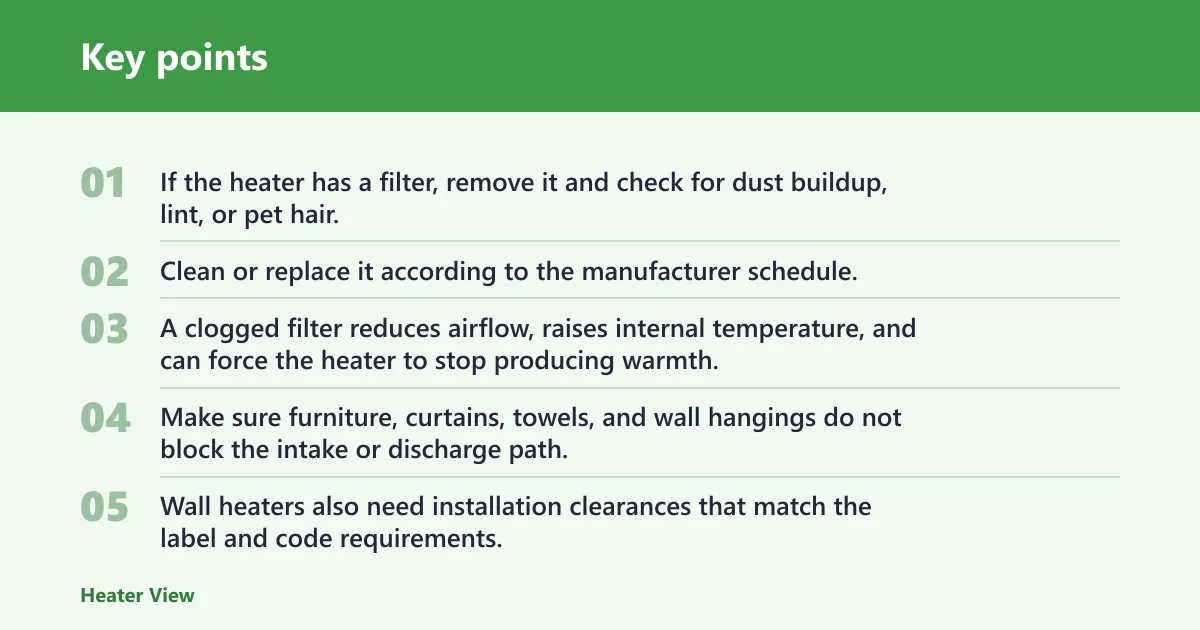
If the heater has a filter, remove it and check for dust buildup, lint, or pet hair. Clean or replace it according to the manufacturer schedule. A clogged filter reduces airflow, raises internal temperature, and can force the heater to stop producing warmth.
Blocked vents or clearance issues
Make sure furniture, curtains, towels, and wall hangings do not block the intake or discharge path. Wall heaters also need installation clearances that match the label and code requirements. Bathroom wall heaters should have at least IP24 protection, and IP25 or more is better near shower or tub zones.
Suppose a bathroom wall heater warms normally for five minutes, then shuts down while the filter is packed with lint. That pattern points to airflow restriction, not a failed thermostat. Clean the filter and keep the surrounding space clear before assuming the heater is dead.
Could a gas supply issue be the cause?
For gas wall heaters, confirm the gas supply valve is open before testing ignition. Other gas appliances can help confirm supply if they are working normally. If you smell gas, do not turn switches on or off, do not relight anything, and leave the area until it is safe.
Gas valve position
-
Check the supply valve.
Confirm the gas valve serving the heater is open. If other gas appliances are also out, the supply issue may be upstream of the heater itself. -
Watch for odor.
If you smell gas, stop troubleshooting immediately. Do not relight the heater or flip electrical switches.
Pilot light and relight limits
Some gas wall heaters use a pilot light, while others use electronic ignition. If the model uses a pilot, follow the manufacturer instructions exactly and attempt relighting only when there is no gas smell. If the pilot will not stay lit, or keeps going out, the fault may be in the pilot assembly, thermocouple, or gas control.
Ignitor and flame sensor faults
An ignitor that fails to light the burner, or a flame sensor that does not confirm flame, can stop heat production even when gas is present. Cleaning or testing may be required, but persistent faults usually need a technician. Do not keep pressing reset or repeat startup cycles when ignition fails.
Wall heater decision table
| Symptom | Likely cause | Next safe check |
|---|---|---|
| Electric heater runs, fan blows cold air | Thermostat set wrong, dirty filter, open safety switch, or failed element | Set Heat, fan Auto, and raise the setpoint 3 to 5 degrees; then check the filter and panel closure |
| Electric heater will not start at all | Wall switch off, breaker tripped, or circuit overload | Confirm the switch and breaker once; if the breaker trips again, leave it off and call a professional |
| Gas heater clicks or cycles but no flame | Gas valve closed, pilot outage, ignitor failure, or flame sensor fault | Confirm the gas valve is open and stop if there is any gas odor |
| Gas heater lights briefly, then shuts down | Flame sensor dirty or faulty, or burner control problem | Stop repeated restarts and schedule service |
| Heater stops after a short run | Blocked vent, dirty filter, clearance issue, or overheat protection | Clear the intake and discharge area and inspect the filter |
| Bathroom heater seems weak or unsafe near fixtures | Wrong unit for the location or inadequate protection rating | Confirm the installation meets room-size limits, clearances, and at least IP24 protection, with IP25 or more near shower or tub zones |
When to stop and call a technician
Stop troubleshooting when the breaker trips again, the heater keeps resetting, or a gas unit will not light after a normal supply check. Persistent ignition faults and flame sensor problems usually need service tools and parts access. Any gas odor is an immediate stop point.
-
Leave repeated trips off.
If the breaker trips again after one reset, do not keep trying it. A recurring trip can mean a wiring fault, short, or overloaded circuit. -
Stop ignition retries.
If a gas heater keeps clicking, glowing, or failing to light, stop cycling it. Repeated restarts can mask the real fault and add risk. -
Exit on gas odor.
If you smell gas at any point, do not relight and do not switch anything on or off. Leave the space and follow local safety guidance. -
Call for code issues.
If the heater is too close to combustible materials, lacks the right bathroom rating, or does not fit the room-size limits, have the installation checked before use.
Frequently asked questions
Why is my wall heater not heating?
The most common reasons are wrong thermostat settings, lost power, blocked airflow, or a gas-side ignition problem. Start by separating electric from gas, then check Heat mode, fan Auto, the setpoint, the breaker, and the filter before moving to fuel or ignition checks.
How do I troubleshoot a wall heater with no heat?
Use this order: identify the heater type, check the thermostat, confirm power, inspect airflow, then confirm gas supply or ignition on gas models. That sequence prevents wasted time and helps you stop at the right fault instead of testing parts that are not involved.
Why my heater is not working
If the heater runs but gives no warmth, the fault often sits in the control path or the heat source itself. Electric models usually point to power, safety switches, or airflow. Gas models usually point to gas supply, pilot, ignitor, or flame sensing.
Why is my electric heater not working?
An electric wall heater that will not warm up often has a thermostat set wrong, a tripped breaker, a closed safety interlock, or a dirty filter that forced shutdown. If the breaker trips again after one reset, leave it off and call a professional.
How to fix heater not working
Start with the safe homeowner checks only: set Heat, fan Auto, raise the setpoint 3 to 5 degrees, confirm the power switch, check the filter, and verify gas supply on gas models. Stop before component repair if the fault points to ignitor, flame sensor, repeated trips, or gas odor.
Are wall heaters safe?
Wall heaters are safe when installed to the label instructions, kept clear of combustibles, and used within the room-size and bathroom protection requirements. Trouble starts when clearances are ignored, filters clog, or gas startup faults are pushed through instead of stopped and inspected.