Heater Not Turning On: Quick Homeowner Checks and Fixes
If your heater will not turn on, start with three checks: verify power at the HVAC breaker and the local furnace switch, confirm the thermostat is set to Heat with a temperature above the room reading, then look for a safety lockout or error code. Skipping those checks can lead to service calls you do not need, blown fuses, or repeated restarts that make the fault worse. This guide follows the symptom in front of you, so you can separate total power loss, thermostat communication problems, and safety lockouts before you call for repair.
Why is my heater not turning on at all?
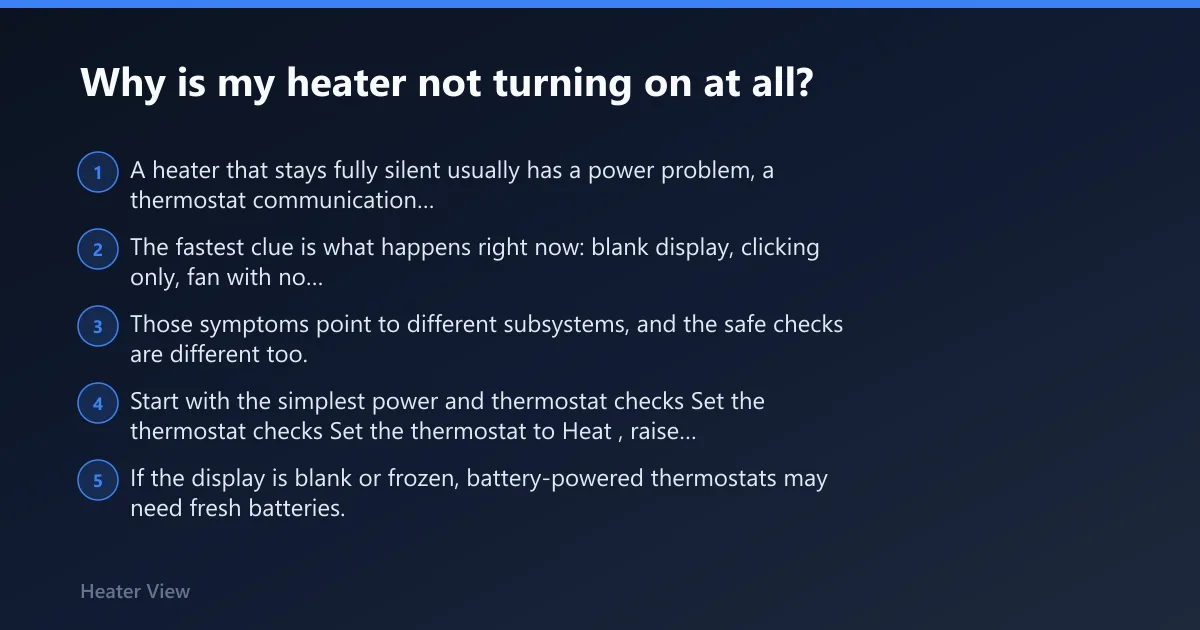
A heater that stays fully silent usually has a power problem, a thermostat communication problem, or a safety shutdown. The fastest clue is what happens right now: blank display, clicking only, fan with no heat, or complete silence. Those symptoms point to different subsystems, and the safe checks are different too.
Start with the simplest power and thermostat checks
Set the thermostat to Heat, raise the set temperature above room temperature, and wait a minute for the system to respond. If the display is blank or frozen, battery-powered thermostats may need fresh batteries. Hardwired thermostats can lose power from a breaker trip, a furnace switch that is off, or a communication fault.
Find the wall switch near the furnace or air handler. It often looks like an ordinary light switch, and it must be ON. Also check the emergency shut-off switch near the equipment. I have seen those switched off during storage, painting, and routine cleaning, and that cuts power before the heater can start.
Use sound and fan behavior to narrow the fault
Total silence after a proper thermostat call usually means power is missing somewhere in the control path. Clicking without ignition suggests the heater is trying to start but failing during sequence. A fan that runs without heat points toward partial power, a failed ignition path, or a safety lockout that lets airflow continue but blocks heat.
Portable electric heaters use a different startup path than central systems. They are sold in 1000+ listings, and one Walmart space heater is rated at 1500W. That matters because a space heater can fail at the plug or an internal protection device, while a central furnace can fail at the thermostat, breaker, ignition system, or control board.
According to Portable and Electric Space Heaters – Walmart.com — Portable electric heaters are sold in 1000+ listings. (source)
What should I check first if my heater won’t start?
Check the thermostat mode and power first, then confirm the heater has power at the breaker and local switch. Those steps catch the most common homeowner-side issues fast. If the display is dead, the system never gets the call to heat. If the display is live but nothing happens, the fault may be downstream.
- Set the thermostat to Heat.
- Raise the set temperature above the room temperature.
- Check whether the thermostat display is blank, frozen, or responsive.
- Replace batteries if the thermostat is battery-powered.
- Confirm the furnace switch and emergency shut-off switch are on.
- Check the HVAC-specific breaker once.
A battery-powered thermostat can go dead while the heater is otherwise fine. A hardwired thermostat can light up but still fail to send or receive the right signal. That difference matters, because a lit screen does not prove the heater can start. It only proves the screen has some power.
Can a tripped breaker stop a heater from turning on?
Yes. A tripped breaker can stop a heater completely, and an HVAC-specific breaker is one of the first places to look after the thermostat. If the breaker trips again right away after a reset, that often points to an electrical fault rather than a simple nuisance trip. Stop there and call for service.
Check the right breaker once
Look for the breaker labeled for heat, furnace, air handler, or HVAC. A tripped breaker often sits between ON and OFF, or it may rest in the OFF position after tripping. Reset it once only. Do not keep cycling it, because repeated resets can stress components and do not solve the cause.
Immediate re-trip is a fault signal. A blower motor can pull excess current, a control board can short internally, or another component can be failing under load. Those are not homeowner fixes. They are service calls, especially if the breaker trips the moment the heater tries to start.
Could airflow problems be shutting the heater down?
Yes. A dirty air filter or blocked vents can reduce airflow enough to overheat the system, and some heaters shut themselves down before damage spreads. This is common with furnaces and other forced-air systems. It is less common as a first cause on a space heater, where tip-over and overheat protection are more typical.
Check the filter and vents
Pull the air filter and look for heavy dust, collapse, or obvious blockage. A dirty filter can trigger overheating shutdowns, and some heating guides note that dirty filters can stop systems from starting. Replace filters on the regular schedule for the equipment, and do not keep running the heater with a filter that is packed solid.
Also check return and supply vents for closed registers, furniture, boxes, or rugs. Restricted airflow can push the blower and heat exchanger into a safety shutdown. That shutoff is a protection event, not a thermostat problem. If the heater starts again only briefly, airflow may be part of the cause.
What do the startup symptoms usually mean?
Startup symptoms usually point to one of four buckets: dead thermostat, total power loss, partial power with blower trouble, or safety lockout. Blank display and silence are different from clicking only, and both are different from fan-only operation. Reading the symptom correctly saves time and avoids blind resets.
Blank thermostat display and complete silence
A blank or frozen thermostat display is a strong clue that the thermostat has no power or has lost communication. Energy Smart Heating says a blank or frozen thermostat display is a symptom of a dead heater. On a hardwired setup, that can mean breaker, transformer, furnace switch, or control board trouble.
Thermostat lights up, but the heater does nothing
If the thermostat is lit and set to Heat, but the heater gives no sound, the call for heat may not be reaching the equipment. That points toward a communication failure, a control board issue, or a local power interruption at the furnace switch or emergency shut-off switch. The display alone does not clear the system.
Clicking only, fan runs, or no ignition
Clicking only usually means the heater is trying to begin its ignition or start sequence. In a gas furnace, the igniter is part of that sequence. If there is clicking but no flame, the problem may be ignition, gas supply, sensor, or control board related. A fan that runs without heat can also mean the unit is in partial fault or lockout.
Some heaters include shutoff features by design. Costco notes overheat safety shutoff and tip-over protection as common features, and many heaters have adjustable thermostats. That is normal protection on many portable units, while a central system may shut down because of heat, airflow, or a control fault.
Use the symptom-to-cause decision table
This table maps the symptom to the likely subsystem, the safest homeowner check, and the point where troubleshooting should stop. It is meant to separate dead thermostat, tripped breaker, partial power, and safety lockout cases without opening equipment or bypassing safety parts.
| Symptom | Likely subsystem | Safe homeowner check | Stop and call a pro trigger |
|---|---|---|---|
| Blank or frozen thermostat display | Thermostat power or communication failure | Check Heat mode, raise setpoint, replace batteries if battery-powered, confirm furnace switch and emergency shut-off switch are ON | Display stays blank after batteries and switches are checked, or a hardwired thermostat has no response |
| Breaker tripped | Power interruption, blower motor overload, control fault | Reset the HVAC breaker once only and watch for immediate re-trip | Breaker trips again right away or there is a burning smell |
| Thermostat lights up, heater stays off | Communication failure, control board fault, local switch off | Confirm Heat mode, setpoint, furnace switch, and emergency shut-off switch | No response after basic checks or repeated error code |
| Clicking only, no ignition | Igniter, gas valve, control board, or safety lockout | Check for airflow restriction and confirm the thermostat call is present | Repeated clicking, gas smell, or no ignition after one attempt |
| Fan runs but no heat | Partial power, blower motor, igniter, or lockout | Check filter condition and vents; confirm the system is not in a safety shutdown | Fan keeps running without heat, or the unit cycles off and on repeatedly |
When should I stop troubleshooting and call a technician?
Stop troubleshooting if the breaker re-trips immediately, there is a burning smell or visible damage, or the heater keeps locking out after the basic checks. Those are signs of an electrical fault, overheating problem, or gas-side issue. Past that point, a homeowner check adds risk without adding useful information.
Clear stop points
Repeated lockout is a warning. So is a breaker that will not stay set. Do not open sealed electrical compartments, bypass a safety switch, or keep resetting the unit after it has failed the same way twice. A blower motor overload, igniter fault, or control board failure belongs on a service call.
Space heaters have their own safety triggers. Costco notes overheat safety shutoff and tip-over protection as common features, and those features are supposed to interrupt power when conditions are unsafe. If a portable heater keeps shutting down, stop using it until it is inspected or replaced.
Could a safety shutdown be why my heater won’t turn on?
Yes. A safety shutdown is a common reason a heater will not start, especially after overheating, poor airflow, or a gas or electrical fault. Safety lockout protects the system from damage. If the heater tried to start, failed, and then went quiet, lockout is a real possibility.
What safety lockout looks like
A safety lockout often appears as repeated startup attempts, then silence, or a thermostat that calls for heat without any normal response. Overheating protection can follow a dirty filter or blocked vent. Gas and electrical faults can trigger the same effect. If lockout repeats after a basic filter and power check, call a technician.
Portable electric heaters are built for fast, targeted warmth, and Costco describes them that way for bedrooms, living rooms, offices, and apartments. But the same category often includes adjustable thermostats, overheat shutoff, and tip-over protection. Those features are there to stop unsafe operation, not to be overridden.
Frequently asked questions
Will dead thermostat batteries keep my heater off?
Yes. Dead batteries can leave a thermostat blank, frozen, or unable to send a heat call. That is common on battery-powered models. A hardwired thermostat can still go silent if the circuit loses power, so a lit display does not rule out a power or communication issue farther upstream.
Can a dirty filter make my heater stop turning on?
Yes. A dirty filter can restrict airflow, raise internal temperature, and trigger an overheating shutdown. Energy Smart Heating says dirty filters can trigger overheating shutdowns. If the filter is packed with dust or airflow is weak at the vents, replace the filter and check for blocked returns or supply registers.
Why does my thermostat light up but the heater stays off?
That usually points to a communication failure, local power interruption, or control board problem. The thermostat may have power but still fail to send the correct signal. Check Heat mode, the setpoint, the furnace switch, the emergency shut-off switch, and the HVAC breaker. If nothing changes, the fault is deeper.