How to Check Water Pressure for Water Heater Health
A common way to check water pressure is with a gauge at an outdoor spigot or washer tap; 40 to 80 psi is often considered typical, and readings outside that range can point to supply, pressure-regulator, or fixture issues rather than the heater alone. If you ignore it, weak hot water, noisy pipes, leaks, or a water heater that short-cycles, overheats, or fails sooner can follow. This guide shows how to separate plumbing pressure, fixture flow, and water-heater symptoms with a simple decision path.
Is the problem the heater or the plumbing?

- Reads 0-200 PSI with a max pointer
- Fits standard 3/4-inch hose-thread outlets
- Large dial is easy to read
Start by asking where the symptom shows up. If cold water is strong at one fixture but hot water is weak there, the issue is usually local to that fixture, the hot branch, or the heater connection. If every faucet is weak on both hot and cold, the issue is more likely the home supply, a partially closed valve, or a pressure regulator.
Compare cold and hot at the same fixture
Use the same sink or shower for both checks. A strong cold stream with a weak hot stream points away from the municipal supply and toward the hot side, the heater, or a restriction near the heater. Weak flow on both sides points toward the main supply, a PRV, or a closed valve.
Say your kitchen faucet delivers a strong cold stream, but the hot side trickles after the valve has been fully opened. That pattern points first to the hot branch, a kinked flexible line, or a partially closed stop valve, not to pressure inside the tank alone.
Separate pressure from flow
Pressure is the force in the pipe. Flow is how much water actually comes out. A house can read normal static pressure and still have poor flow at a single fixture if the aerator, showerhead, stop valve, or supply line is restricted.
How do you measure water pressure at home?
Use a water pressure gauge on a hose bib or laundry faucet and read it in psi. Common residential static pressure is often around 40 to 60 psi, which is a common target for many homes. A reading far below that range can mean weak supply or a regulator problem; a reading far above it can stress fixtures, valves, and the water heater.
Use a gauge the right way
-
Choose a test point. Screw the gauge onto an outdoor spigot or a laundry faucet with a hose-thread outlet. Pick a point close to the house supply so the reading reflects home pressure, not one bad fixture.
-
Shut off water use. Close showers, dishwashers, and washing machines before reading the gauge. That gives you static pressure, which is the clearest number for judging the supply system.
-
Read the psi value. Most gauges show pressure in psi. Write down the number and compare it with the common 40 to 60 psi range; that is the simplest way to judge whether the house supply is normal.
-
Check again while water runs. Open a nearby faucet and watch the needle. A large drop under use can point to a restriction, a failing PRV, or undersized or damaged piping.
When a high reading matters
Pressure above about 80 psi is often considered too high for a home. A pressure reducing valve, or PRV, is often installed near the main shutoff to trim incoming municipal pressure. If that valve is misadjusted or failing, the home may see pressure spikes, hammer, or inconsistent flow.
Picture a laundry faucet that reads 85 psi at rest, then sends a sharp bang through the pipes when a hot tap closes. That combination points first to high supply pressure and a system that may need PRV adjustment, an expansion tank check, or both.
Check valves, lines, and fixtures first
Before you blame the heater, inspect the main shutoff, the heater cold inlet, and the hot outlet. A valve that is partly closed can mimic low pressure. Corroded or kinked flexible lines can also choke flow enough to make a heater look weak when the restriction is really in the piping.
Inspect visible restrictions
-
Confirm every shutoff is open. Look at the main shutoff, the cold inlet to the heater, and the hot outlet valve if present. A handle that is not aligned with the pipe can mean the valve is partly closed.
-
Trace the supply lines. Check for kinks, crushed bends, corrosion, or mineral scaling on exposed flex lines and nearby fittings. Any narrow section can reduce flow enough to mimic a heater fault.
-
Remove fixture restrictions. Unscrew a showerhead or faucet aerator and run water briefly into a bucket. If flow improves a lot, the heater is less likely to be the cause.
Use fixture-level clues
Clogged aerators and showerheads are common single-fixture problems. Mixed faucets can also confuse the picture because a worn cartridge may restrict only the hot side. If one bathroom acts up and the rest of the home is normal, the heater is usually not the first suspect.
When does low flow point to the heater?
Low flow points to the heater when the rest of the home tests normal, the hot side is weaker than the cold side, or the heater shows maintenance-related symptoms. Tank water heaters can collect sediment. Tankless units can fail to fire if flow is below their minimum requirement or if the inlet screen is clogged.
Tank water heaters and sediment
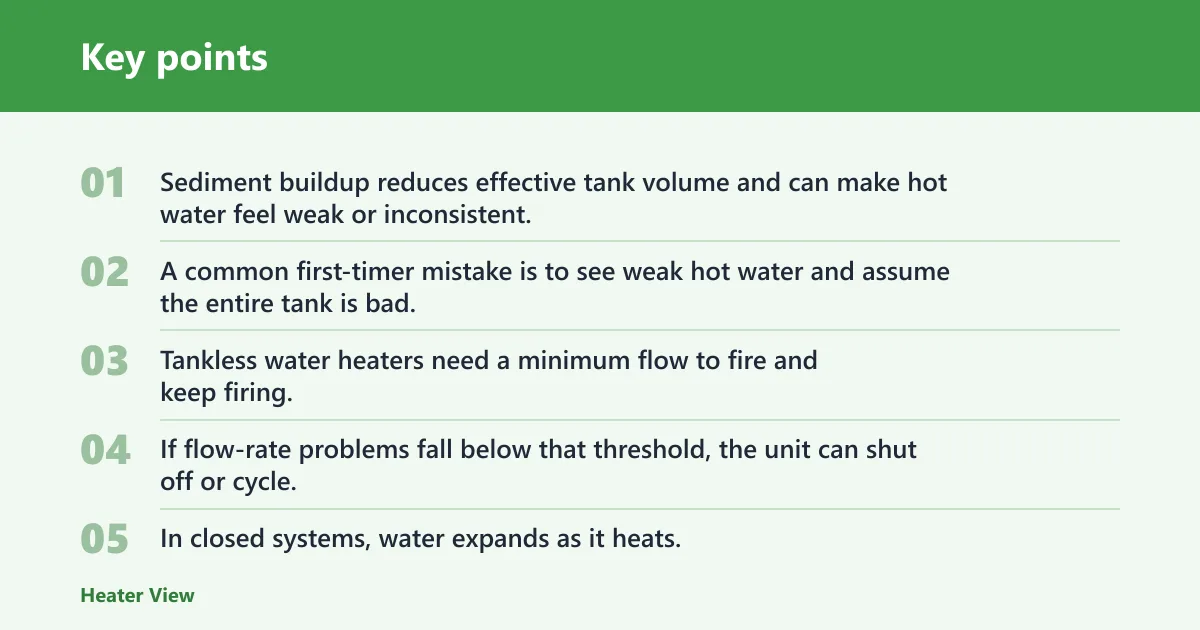
Sediment buildup reduces effective tank volume and can make hot water feel weak or inconsistent. It is more common in hard-water homes. It can also lead to delayed hot water, noisy operation, and fluctuating output because the heater has less usable space and the burner or elements work around a layer of mineral debris.
A common first-timer mistake is to see weak hot water and assume the entire tank is bad. If the cold pressure is normal, the tank may simply have sediment, a scaled dip tube, or a restricted outlet path that needs service.
Tankless units and minimum flow
Tankless water heaters need a minimum flow to fire and keep firing. If flow-rate problems fall below that threshold, the unit can shut off or cycle. A clogged inlet filter, scale in the heat exchanger, or a weak fixture stream can make the heater seem dead when the real issue is insufficient flow past the firing point.
Expansion tanks and pressure spikes
In closed systems, water expands as it heats. An expansion tank absorbs that extra volume and helps prevent pressure spikes. These tanks are commonly used with PRVs or backflow devices. If the tank is waterlogged or the wrong size, pressure can rise quickly after the heater runs, even when cold pressure looked normal earlier.
Pressure diagnosis table
| Symptom pattern | Likely cause | Next check |
|---|---|---|
| Normal cold water, weak hot water at one fixture | Clogged aerator, showerhead, mixed faucet cartridge, or a hot-side restriction near that fixture | Remove the aerator or showerhead, then compare hot and cold at the same faucet |
| Weak water everywhere, both hot and cold | Low house pressure, PRV misadjustment, main shutoff partly closed, or restricted supply lines | Read static pressure at a hose bib; common home pressure is about 40-60 psi |
| High pressure with hot-water hammer | Pressure above about 80 psi, failing PRV, or missing or failed expansion control | Check the PRV near the main shutoff and inspect the expansion tank if the system is closed |
| Tankless unit fails to fire at low flow | Flow below the heater’s minimum, clogged inlet filter, or scale in the unit | Confirm fixture flow, clean the inlet screen, and consider descaling if service history is unknown |
| T&P valve discharge | Overtemperature, overpressure, failed valve, or a closed system with no room for expansion | Do not cap or block the valve; check system pressure and call a plumber if discharge continues |
What pressure problems mean for heater safety
A T&P valve on a tank water heater is a safety valve. It opens if temperature or pressure gets too high. If it leaks or discharges, that is a warning sign, not a nuisance to ignore. The discharge pipe must never be capped, plugged, or blocked.
Watch for unsafe pressure swings
Very high pressure can damage valves, shorten appliance life, and make noisy hammer more likely. Pressure that jumps after heating often points to a closed system without enough expansion room. A plumber may need to check the PRV, expansion tank, and the heater’s own relief components.
Suppose the gauge reads 55 psi cold, but after a long heating cycle the system begins to drip from the relief pipe. That pattern suggests thermal expansion or a failing relief setup, even though the cold reading looked normal.
Do these safety checks before touching the heater?
-
Turn off power or gas. Shut off electric power at the breaker or gas supply at the control before opening panels or moving covers. This reduces the risk of shock, burns, or an ignition problem.
-
Let the unit cool. Wait until the tank or piping is safe to touch. Hot water and steam can cause serious burns during inspection.
-
Inspect only visible parts. Look for leaks, corrosion, loose joints, or discharge at the T&P valve and nearby piping. Do not block the valve or cap the discharge line.