How to Check the Thermostat During Water Heater Maintenance
To check an electric water heater thermostat, shut off the breaker, confirm the unit is dead with a non-contact voltage tester, remove the access panel, and probe the thermostat with a multimeter; replace it only if it fails cold-tank continuity or voltage tests after the element checks out. Skipping that sequence can lead you to buy the wrong part and leave the real fault in place. This article shows how to isolate thermostat problems from element and wiring issues before you replace anything.
What you’ll need before you open the panel
Start with the basics. A multimeter set for continuity and resistance checks is the main diagnostic tool, and a non-contact voltage tester gives you a quick safety check before you touch anything. A screwdriver, flashlight, and a place to set screws, insulation, and the cover keep the job organized.
- Multimeter with continuity and resistance modes
- Non-contact voltage tester
- Phillips or flat screwdriver for the access panel
- Flashlight
- Small tray or cup for screws
- Work gloves if you want extra handling protection
📊 Water heaters operate on 240 volts. Source: Plumbingguider.
How to check the thermostat during water heater maintenance
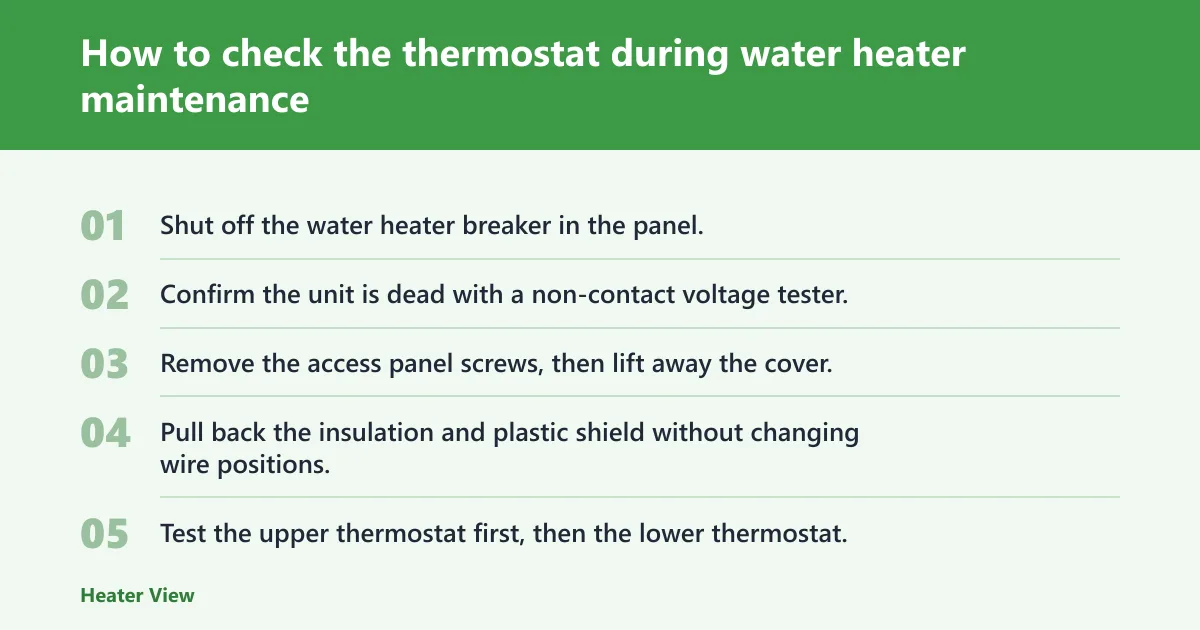
This check tells you whether the thermostat is actually failing or whether the symptom points to an element, a loose connection, or a reset problem. Electric water heaters operate on 240 volts, so the test starts with safety, then moves to simple continuity checks at the upper and lower thermostats. Electric heaters usually have one or two thermostats, with separate upper and lower controls in most units.
What this check can tell you
The upper thermostat controls the top heating element and turns on first when the tank is empty. The lower thermostat heats the bottom half after the top section is hot. That split matters because a complaint about no hot water may start in the upper section, while short hot-water runs often involve the lower section or the element it feeds.
- Shut off the water heater breaker in the panel.
- Confirm the unit is dead with a non-contact voltage tester.
- Remove the access panel screws, then lift away the cover.
- Pull back the insulation and plastic shield without changing wire positions.
- Test the upper thermostat first, then the lower thermostat.
- Reinstall the shield, insulation, and cover in the same order.
What is the safe order for checking a water heater thermostat?
Turn off the 240-volt breaker first, then confirm power is off with a non-contact voltage tester before removing any covers. After that, take off the access panel, move the insulation aside, and expose the thermostat without disturbing the wires. That order lowers shock risk and helps you put everything back correctly.
Why the order matters
A bad thermostat can trip the breaker frequently, but a tripped breaker does not prove the thermostat is the only problem. The high-voltage circuit can still hold dangerous energy if you skip the shutdown or test the wrong spot. Keep the wire layout unchanged so you can compare each terminal exactly as found.
How do you test the upper and lower thermostats?
Test the upper thermostat first because it controls the top heating element and usually decides whether the lower section gets power next. Use your multimeter on continuity or resistance, not guesswork. A closed thermostat path should show continuity or a low resistance reading; an open circuit on a thermostat that should be closed points to failure.
Upper thermostat check
Set the multimeter to continuity or the lowest ohms range. With the tank cool, touch the probes to the upper thermostat terminals and the linked high-limit circuit points as needed, then compare the reading to the expected closed path. If the upper thermostat reads open when it should be calling for heat, the upper control or its reset circuit is suspect.
Lower thermostat check
Check the lower thermostat after the upper section is verified. The lower thermostat should not be the first suspect if the top section never heats, because the lower unit often waits for the upper section to satisfy first. An open reading here can explain why the bottom half never warms or why hot water runs out quickly.
How to read the meter
Continuity means the circuit is closed. An open circuit means the path is broken. That open result can point to a failed thermostat, a tripped reset button, or wiring that is loose or disconnected. A reading that changes when you move wires usually points away from the thermostat body and toward a connection issue.
What reading means the thermostat is bad?
A bad thermostat usually shows an open circuit where you expect continuity, or it refuses to pass power when the tank is cool and a call for heat should be present. The reading becomes more useful when you compare it with the heating element and wiring. Do not replace the thermostat until the element and connections are checked.
Expected pass and fail results
On a cold tank, a thermostat that should be closed should usually show continuity or a very low ohm reading on the relevant circuit path. If the meter shows open, that typically means the part is not behaving as expected. If the thermostat passes but the element still does not heat, the element or its wiring becomes the more likely fault.
How to separate thermostat failure from a bad heating element
Suppose the upper section is cold, the lower section never runs, and the upper thermostat shows continuity. That points you toward the upper element, its wiring, or the high-limit reset rather than the thermostat itself. A thermostat that tests good on the meter but still leaves the tank cold is not the only part in play.
How loose wiring or a tripped reset can mimic thermostat symptoms
A loose spade connector can interrupt the circuit just like a failed thermostat. A tripped reset on the upper thermostat can also stop heat entirely. If the thermostat reads wrong only until the reset is pressed, the reset was the issue. If the meter changes when a wire is wiggled, the connection needs attention.
| Symptom | Most likely failed part | Exact test to run | Pass reading | Fail reading |
|---|---|---|---|---|
| No hot water at all | Upper thermostat, reset, or wiring | Continuity check at upper thermostat with tank cool | Closed circuit / continuity | Open circuit |
| Hot water runs out fast | Lower thermostat or lower element | Continuity check at lower thermostat after upper section checks out | Closed circuit / continuity | Open circuit |
| Lukewarm water | Heating element, thermostat, or loose wiring | Check thermostat continuity and then element resistance | Thermostat closes as expected | Open where closed is expected |
| Breaker trips frequently | Thermostat or element short | Inspect thermostat continuity plus element resistance and wire condition | Stable reading, no short to ground | Open/short anomaly or damaged wiring |
| Water heats on one side only | Upper or lower thermostat depending on symptom | Test the section controlling the dead heating stage | Correct switching and continuity | No continuity or wrong switching |
What temperature setting should a water heater thermostat be on?
Many manufacturers use about 120 degrees Fahrenheit as a common household setting, and some labels on electric units point to that range. Use the dial marks on the thermostat, not a guess. If the setting is much higher than needed, the water can feel too hot and increase risk at the tap.
When to change the setting
If the water is too cool after the thermostat tests pass, the dial may simply be set low. Adjust only after the unit is powered down and reassembled. If the heater has two thermostats, match both to the same target setting unless the manufacturer label says otherwise.
Common mistakes to avoid during thermostat testing
Testing live wiring is a major mistake. Another common one is mixing up upper and lower thermostat wires, which can turn a clear diagnosis into a false failure. Reassembly matters too, because insulation and the plastic shield help keep the unit operating as intended.
What goes wrong and how to avoid it
A common first-timer mistake is leaving the access cover off after the test, then forgetting the insulation and screw positions. Another is replacing the thermostat before checking the element, even though a bad element can produce the same symptom. Take photos of the wiring layout before moving anything.
- Turn the breaker back on only after the cover and insulation are in place.
- Restore each screw, shield, and insulation piece to its original position.
- Verify no wires are pinched under the cover.
- Run the heater and recheck for normal heating behavior.
Frequently asked questions
How do I know if my water heater thermostat is bad?
A thermostat is suspect when the tank is cool, the breaker is on, and a continuity test at the thermostat still shows an open circuit where the control should be closed. If the reading is correct but there is still no heat, the element, reset, or wiring is a better next target than the thermostat.
What tools do I need to test a water heater thermostat?
You need a multimeter, a non-contact voltage tester, and a screwdriver for the access panel. A flashlight helps you read terminal markings and keep wire placement straight. A small tray for screws keeps the reassembly parts from disappearing while the insulation and cover are off.
Should I turn off power before checking a water heater thermostat?
Yes. Shut off the 240-volt breaker first, then confirm the heater is de-energized with a non-contact voltage tester. Do not rely on the thermostat setting or the symptom itself, because a live circuit can still be present even when the water is cold.
Where is the thermostat located on an electric water heater?
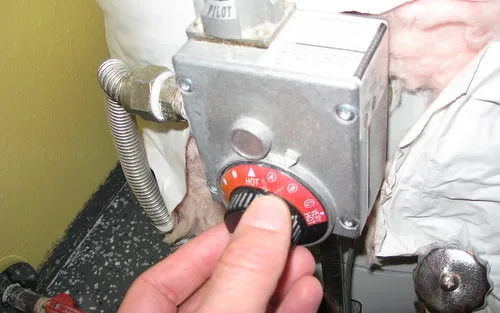
Many electric water heaters place the thermostat behind an access panel on the side of the tank. Remove the screws, lift the cover, and move the insulation aside to reach the thermostat and its terminals. Many units have an upper thermostat and a lower thermostat in separate positions.
Can a bad thermostat make hot water run out fast?
Yes. If the lower thermostat fails, the bottom section may not heat properly, so the tank can give you a short burst of hot water and then turn cool. A failed lower element can look similar, which is why the thermostat check should be paired with the element and wiring check.
Do gas water heaters have the same thermostat check as electric ones?
No. Gas water heaters use a different control system, so the electric thermostat continuity test does not apply in the same way. For a gas unit, the control valve, pilot system, and flame-sensing parts are the usual starting points, not the upper and lower electric thermostat arrangement.