
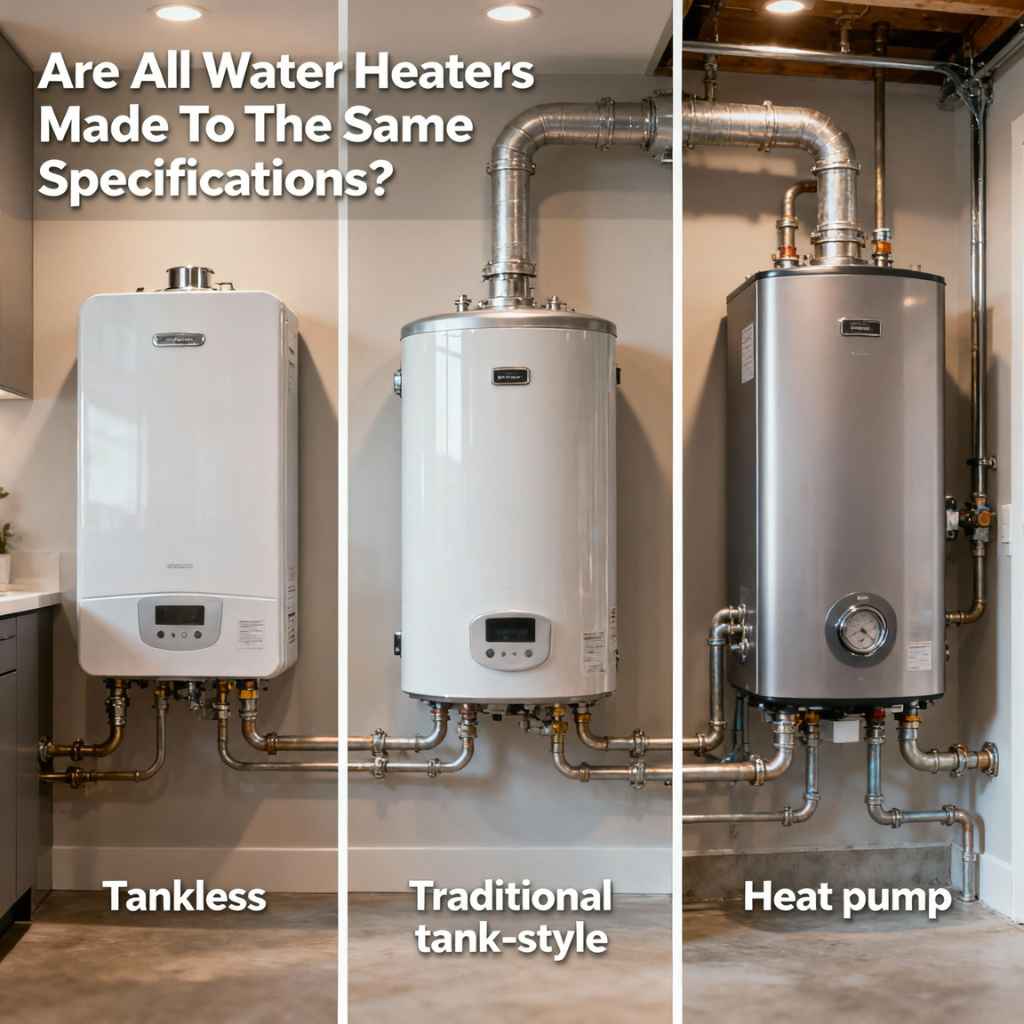
You might think all water heaters are the same, but they follow strict safety and performance rules. Different types exist, like gas and electric, each with its own way of working. What affects how well they work includes their size, how efficient they are, and the materials used. Understanding these differences helps you choose the best one for your home.
Understanding Water Heater Specifications
A water heater’s job is simple: give you hot water when you need it. But behind that simple task are many technical details. These details are often called specifications. They tell you how the heater works, how safe it is, and how well it will do its job.
Think of it like buying a car. All cars need to get you from point A to point B. But some are small and fuel-efficient, others are big and powerful. They all meet basic safety rules, but their features and performance vary a lot. Water heaters are quite similar.
What Exactly Are “Specifications”?
Specifications are like a water heater’s report card. They list its key features and performance metrics. For example, a spec might tell you:
How much hot water it can make at once (capacity).
How quickly it can heat water (recovery rate).
How much energy it uses (efficiency rating).
Its dimensions (size).
What kind of fuel it uses (gas, electric, propane).
These specs are important. They help you compare models. They also tell you if a heater is right for your home’s needs.
Why Do Specifications Matter So Much?
When you’re looking at water heaters, you’ll see numbers and terms you might not know. These specs aren’t just for show. They directly impact:
Your Comfort: A heater that’s too small won’t keep up with your family’s hot water use. You might run out of hot water during showers.
Your Energy Bills: Some heaters use a lot more power or gas than others. Better efficiency means lower bills.
Your Safety: All water heaters must meet safety codes. Specs confirm these important safety features.
How Long It Lasts: Materials and build quality, often hinted at by specs, affect durability.
It’s easy to feel overwhelmed by all the details. But understanding the basics can save you money and headaches.
The Backbone of Water Heaters: Safety and Building Codes
This is where the idea of “all water heaters being the same” starts to hold some truth. Safety is the absolute top priority. No matter the brand or price, every water heater sold in the U.S. must meet strict safety standards.
Mandatory Safety Standards
The main group overseeing this is the Department of Energy (DOE) and the Consumer Product Safety Commission (CPSC). They set rules that manufacturers must follow.
One key standard is ANSI (American National Standards Institute). Many water heaters also meet ASME (American Society of Mechanical Engineers) codes. These ensure things like:
Pressure Relief Valves: These are critical. They release excess pressure to prevent an explosion if the heater overheats.
Temperature Control: Thermostats must work correctly to keep water at a safe temperature.
Materials: Metal parts must be strong enough and resistant to corrosion.
Gas Safety: For gas models, there are rules for gas leaks and safe combustion.
When you see a water heater for sale, it has likely been tested and certified to meet these standards. This is a baseline that all reputable models share.
What About Energy Efficiency Standards?
The DOE also sets minimum energy efficiency standards. This means a water heater can’t be sold if it’s too wasteful with energy. Think of this as another universal requirement.
However, there’s a big difference between meeting the minimum and being highly efficient. Many models go far beyond the basic requirement. They use better insulation, smarter heating elements, or advanced controls. This is a major area where water heaters can differ.
Differences You’ll See: Types and Technologies
While safety and basic function are common, the way a water heater provides hot water can vary greatly. This is where most of the differences lie.
Tank vs. Tankless: The Big Divide
The most common difference is between tank and tankless water heaters.
Tank Water Heaters: These are the ones most people are familiar with. They have a large tank, usually holding 30 to 80 gallons of water. They heat this water and keep it hot, ready for use. When you use hot water, it’s * How they work: A burner (for gas) or heating elements (for electric) are inside or around the tank. They heat the water. An insulating jacket keeps the water warm.
Pros: Lower upfront cost, simple to install, good for high demand for short periods (like filling a bathtub).
Cons: Can run out of hot water if demand is high, tend to lose heat over time (standby heat loss), take up more space.
Tankless Water Heaters (On-Demand): These don’t have a storage tank. Instead, they heat water as it flows through the unit. When you turn on a hot water tap, cold water goes through the heater, gets heated by a powerful burner or element, and then goes to your faucet.
How they work: Water flows over a heat exchanger heated by a gas burner or electric element. This happens only when hot water is needed.
Pros: Endless hot water (as long as the unit can keep up), energy-efficient because they only heat water when used, save space.
Cons: Higher upfront cost, may have a slight delay in hot water delivery, can struggle with very high demand from multiple sources at once, require specific venting for gas models.
Tank vs. Tankless Quick Scan
Tank:
- Good for: Homes with average hot water needs, bathtubs, lower initial cost.
- Needs: Space for the tank, regular maintenance to prevent sediment buildup.
- Hot Water: Limited by tank size.
- Energy Use: Heats water constantly, leading to standby heat loss.
Tankless:
- Good for: Homes with high or continuous hot water demand, saving space, energy savings.
- Needs: Higher initial investment, specific installation requirements (gas venting, electrical power).
- Hot Water: Unlimited supply, but flow rate matters.
- Energy Use: Only heats when needed, very efficient.
Fuel Types: Gas vs. Electric vs. Propane
The energy source is another major difference.
Electric Water Heaters: Use electric resistance heating elements. They are generally less expensive to buy and install. However, electricity costs can make them more expensive to run, depending on your local rates.
Gas Water Heaters: Use natural gas or propane. They heat water faster than electric models and can often be cheaper to run if natural gas is affordable in your area. They require a vent to remove combustion gases.
Propane Water Heaters: Work just like natural gas heaters but use propane stored in a tank. They are common in areas without natural gas lines. Propane can be more expensive than natural gas.
Heat Pump Water Heaters (Hybrid): The Efficient Choice
These are a type of electric water heater that uses a heat pump to move heat from the surrounding air into the water. They are much more energy-efficient than traditional electric resistance heaters.
How they work: They pull heat from the air, like a refrigerator in reverse. This heat is used to warm the water in the tank. They also have backup electric resistance elements for times when more heat is needed.
Pros: Very energy efficient, can significantly lower electricity bills.
Cons: Higher upfront cost, need to be installed in a space with enough air volume (like a basement or garage), can make the surrounding air cooler.
Other Technologies
Solar Water Heaters: Use solar collectors on your roof to heat water. They are very eco-friendly but depend on sunshine and often have a backup system.
Condensing Gas Water Heaters: These capture extra heat from exhaust gases. They are more efficient than standard gas models, similar to how high-efficiency furnaces work.
Key Performance Metrics and What They Mean
Beyond the type and fuel, specific numbers on the label tell you a lot.
First Hour Rating (FHR)
This is crucial for tank water heaters. It tells you how much hot water the heater can supply in one hour, starting with a full tank of hot water.
Example: A heater with an FHR of 65 means it can deliver about 65 gallons of hot water in that first hour.
Why it matters: If your family uses a lot of hot water in a short period (like multiple showers back-to-back), you need a high FHR. If you have a smaller family with spaced-out needs, a lower FHR might be fine.
Uniform Energy Factor (UEF)
This is the current standard for measuring energy efficiency for most water heaters. It replaced the old Energy Factor (EF).
How it works: UEF considers all energy used by the heater, including standby losses (heat lost from the tank). A higher UEF means the heater is more efficient.
What the numbers mean: For example, a UEF of 0.80 is better than 0.60. This number is often used on the yellow EnergyGuide label.
Capacity (Gallons)
This is straightforward for tank heaters. It’s the size of the tank in gallons.
For tankless: Capacity is often described by its flow rate, measured in gallons per minute (GPM). This indicates how much hot water it can deliver at a certain temperature rise.
Matching size to needs: Choosing the right size is vital. Too small, and you run out of hot water. Too big, and you waste energy heating water you don’t use.
Recovery Rate
This tells you how quickly the heater can reheat the water in the tank after it’s been used.
For gas heaters: Recovery is usually faster.
For electric heaters: Recovery can be slower.
Why it matters: A fast recovery rate means the tank can be refilled with hot water sooner if you have a high demand.
Choosing the Right Size
For Tank Water Heaters:
- 1-2 people: 30-40 gallon tank
- 2-3 people: 40-50 gallon tank
- 3-4 people: 50-60 gallon tank
- 5+ people: 60-80 gallon tank or larger
For Tankless Water Heaters:
- Consider the number of hot water appliances and showers you use at once.
- Look at the GPM (gallons per minute) rating. A typical shower uses about 2.5 GPM.
Materials and Construction: What’s Inside Matters
Even with the same specs on paper, the actual build quality can differ. This affects how long the heater lasts and how well it performs over time.
Tank Linings: The First Line of Defense
The inside of a water heater tank is lined to prevent rust and corrosion.
*Glass Lining (Porcelain Enamel): Most modern tanks use this. It’s a thick coating of glass fused to the steel tank. It provides a good barrier against rust.
Anode Rod: Most tanks also have a metal rod (anode rod) inside. This rod is made of a softer metal (like magnesium or aluminum). It corrodes instead of the tank itself, sacrificing itself to protect the tank. This rod needs to be checked and replaced periodically.
Steel Quality: The thickness and quality of the steel used for the tank are also important for durability.
Insulation: Keeping the Heat In
Good insulation is key for efficiency. It reduces standby heat loss, meaning the water stays hot longer without the burner or elements needing to turn on as often.
Types of Insulation: Foam insulation (like polyurethane) is common. The thickness and density of the foam play a role.
Varying Levels: Some high-efficiency models have much thicker or better-quality insulation than basic models.
Burners and Elements
For gas heaters, the burner design can affect how evenly and efficiently it heats the water. For electric heaters, the wattage of the heating elements determines how quickly they can heat water. Higher wattage elements heat faster but use more electricity when active.
Outer Casing
While less critical for performance, the outer shell protects the inner workings and insulation. Some are more robust than others.
Brand Reputation and Warranties: Signs of Quality
When you look at different brands, you’ll notice some are much more well-known than others. Brand reputation often comes from years of consistent performance and customer satisfaction.
What to Look for in a Brand
Longevity: Brands that have been around for a long time often have a good understanding of water heater technology and reliability.
Customer Reviews: What do real homeowners say about their experience with a particular brand? Look for patterns in reviews.
Warranty: This is a big clue. A longer warranty, especially on the tank itself, often indicates the manufacturer has confidence in their product’s durability.
Tank Warranty: Typically ranges from 6 years to 10 years or even more for premium models.
Parts Warranty: Usually covers components for 1 to 6 years.
The Importance of a Good Warranty
A good warranty provides peace of mind. If something goes wrong within the warranty period, the manufacturer will repair or replace the unit. This can save you a lot of money on unexpected repairs. Always read the warranty details carefully. Some warranties only cover parts, while others include labor.
Real-World Scenarios: Where Differences Play Out
Let’s look at a few everyday situations where the differences in water heaters become clear.
Scenario 1: The Busy Morning Rush
Imagine a family of four. Mom and Dad take showers back-to-back. Then, the two kids jump in for their showers.
With a basic 40-gallon tank water heater: The first two showers might be fine. But by the third shower, the water is likely to be lukewarm or cold. The tank simply can’t heat water fast enough to keep up. The recovery rate and First Hour Rating are too low for this demand.
With a 60-gallon high-efficiency tank water heater: This family might get through all four showers with warm water, or at least the first three will be good. The larger tank and better insulation mean less heat loss and a higher FHR.
With a tankless water heater: If sized correctly, this family could theoretically have endless hot water, even if two showers ran at once (depending on the unit’s GPM rating). The system heats water as it’s used.
Scenario 2: The First-Time Homeowner’s Budget
Sarah just bought her first home. Her old water heater is leaking. She needs a replacement but has a tight budget.
The Cheapest Option: She might find a very basic electric 40-gallon tank heater for a few hundred dollars. It meets safety codes. It will provide hot water. But it will likely have the least efficient insulation and a shorter warranty (maybe 6 years on the tank). Her energy bills might be higher than with a better model.
A Mid-Range Choice: Sarah could spend a bit more and get a 50-gallon gas water heater with a 10-year warranty. It might have better insulation than the cheapest electric model and could be cheaper to run if natural gas is available.
The Efficient Investment: If she could stretch her budget further, she might consider a hybrid (heat pump) water heater. The upfront cost is higher, but she could save significantly on her electricity bills over the life of the heater. This is a longer-term investment.
Contrast Matrix: Water Heater Performance
| Feature | Basic Model (e.g., 6-yr warranty) | Standard Model (e.g., 10-yr warranty) | High-Efficiency/Hybrid Model |
|---|---|---|---|
| Upfront Cost | Low | Medium | High |
| Energy Efficiency | Lower (Higher UEF means less efficient) | Moderate | Very High |
| Hot Water Supply | Limited by tank size/recovery | Good | Excellent (tankless) or Very Good (hybrid) |
| Lifespan (Est.) | Shorter | Average | Longer |
| Long-Term Operating Cost | Higher | Moderate | Lower |
What This Means for You: Making the Right Choice
So, are all water heaters made to the same specifications? No, not exactly. They all meet minimum safety and energy standards. But the performance, efficiency, and longevity specifications vary a great deal.
When is “Good Enough” Okay?
For some situations, a basic, lower-cost model might be perfectly fine.
Rental Properties: If you own a rental, a reliable, code-compliant unit with a decent warranty is often the goal. You want something that won’t break down too often but don’t need the absolute highest efficiency.
Very Low Hot Water Use: A single person living alone who takes short showers and rarely uses a dishwasher might be okay with a smaller, less expensive tank model.
Short-Term Needs: If you plan to move or renovate very soon, you might opt for a less expensive unit.
When Should You Invest More?
Investing in a better water heater can pay off in many ways.
Your Primary Residence: For your own home, comfort and long-term savings are often worth the higher initial cost. A higher-efficiency unit means lower utility bills month after month.
Larger Households: If your family uses a lot of hot water, you need a system that can keep up without running out. This might mean a larger tank, a faster recovery rate, or a tankless system.
Environmental Concerns: Higher efficiency models use less energy, which is better for the environment.
Simple Checks Before You Buy
Check the UEF rating: Higher is better for efficiency.
Look at the First Hour Rating (FHR): Make sure it meets your household’s peak demand.
Read the warranty: A 10-year tank warranty is a good sign.
Consider the fuel type: Compare local natural gas vs. electricity rates.
Think about space: Do you have room for a tank, or is tankless a better fit?
Quick Fixes and Tips for Your Water Heater
While this article is about specifications, a few maintenance tips can help any water heater perform better and last longer.
Check the Anode Rod: Have it inspected every 1-2 years and replaced if heavily corroded. This is a cheap fix that can save your tank.
Flush the Tank: Once a year, drain a few gallons from the bottom of the tank. This removes sediment that can reduce efficiency and damage the tank.
Check for Leaks: Regularly inspect around the base and connections for any signs of water.
Set the Temperature Properly: Most manufacturers recommend 120°F (49°C). Higher temperatures waste energy and increase scalding risk. Lower temperatures can be a breeding ground for bacteria.
Insulate Hot Water Pipes: This reduces heat loss as hot water travels to your faucets.
Frequently Asked Questions
Are all water heater tanks made of the same material?
Most water heater tanks are made of steel, but they are lined with glass (porcelain enamel) to prevent rust. The quality and thickness of the steel and the lining can vary between models and brands.
Do I need a specific size water heater for my house?
Yes, the size is very important. For tank heaters, it’s measured in gallons and should match your household’s hot water usage. For tankless heaters, you look at the flow rate (GPM) to ensure it can meet demand.
What does “Uniform Energy Factor” (UEF) mean?
The UEF is a number that shows how efficient a water heater is. A higher UEF means the heater uses less energy to heat the same amount of water. It accounts for energy used and energy lost.
Are tankless water heaters really more efficient than tank models?
Generally, yes. Tankless heaters only heat water when you need it, so they don’t lose energy keeping a large tank of water hot all the time (standby heat loss). However, their upfront cost is higher.
What is the most common type of water heater in American homes?
Traditional tank water heaters, especially gas-powered ones, have been the most common. However, tankless and hybrid (heat pump) models are gaining popularity due to their efficiency.
How long should a water heater last?
A standard tank water heater typically lasts 10-15 years. High-quality models with good maintenance can last longer. Tankless heaters can often last 20 years or more.
Further Reading: DOE water heater standards | ENERGY STAR efficiency
Conclusion
While safety and fundamental operation principles are shared across most water heaters, they are far from being made to identical specifications. The differences in capacity, efficiency ratings, fuel types, technologies, materials, and warranties significantly impact their performance, cost, and longevity. Understanding these variations empowers you to choose a water heater that truly fits your home’s needs and your budget, ensuring you have reliable hot water for years to come.