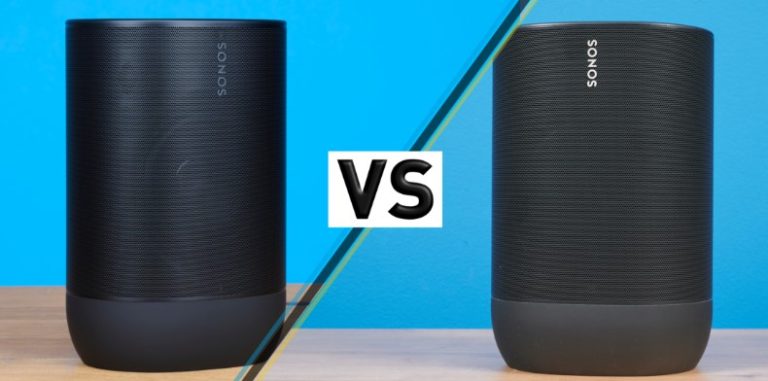
Bose Home Theater vs Sonos: Essential Buying Guide
Selecting between Bose and Sonos for your home theater setup can be a tough choice. Both offer fantastic sound, but they cater to slightly different needs. This guide breaks down everything you need to know to pick the system that’s perfect for your home, ensuring you get the best audio experience without the confusion.
Picking out a home theater system can feel a bit overwhelming, right? You want that theater-quality sound at home, but the options can seem endless. Two names that pop up a lot are Bose and Sonos. They both make amazing sound systems, and it’s easy to wonder which one is the better fit for you. Don’t worry! We’ll walk through everything, making it super simple to understand. Think of this as your friendly guide to choosing the perfect sound for your living room, helping you get that immersive audio experience you’ve been dreaming of. Let’s dive in and clear up the confusion so you can enjoy incredible sound soon!
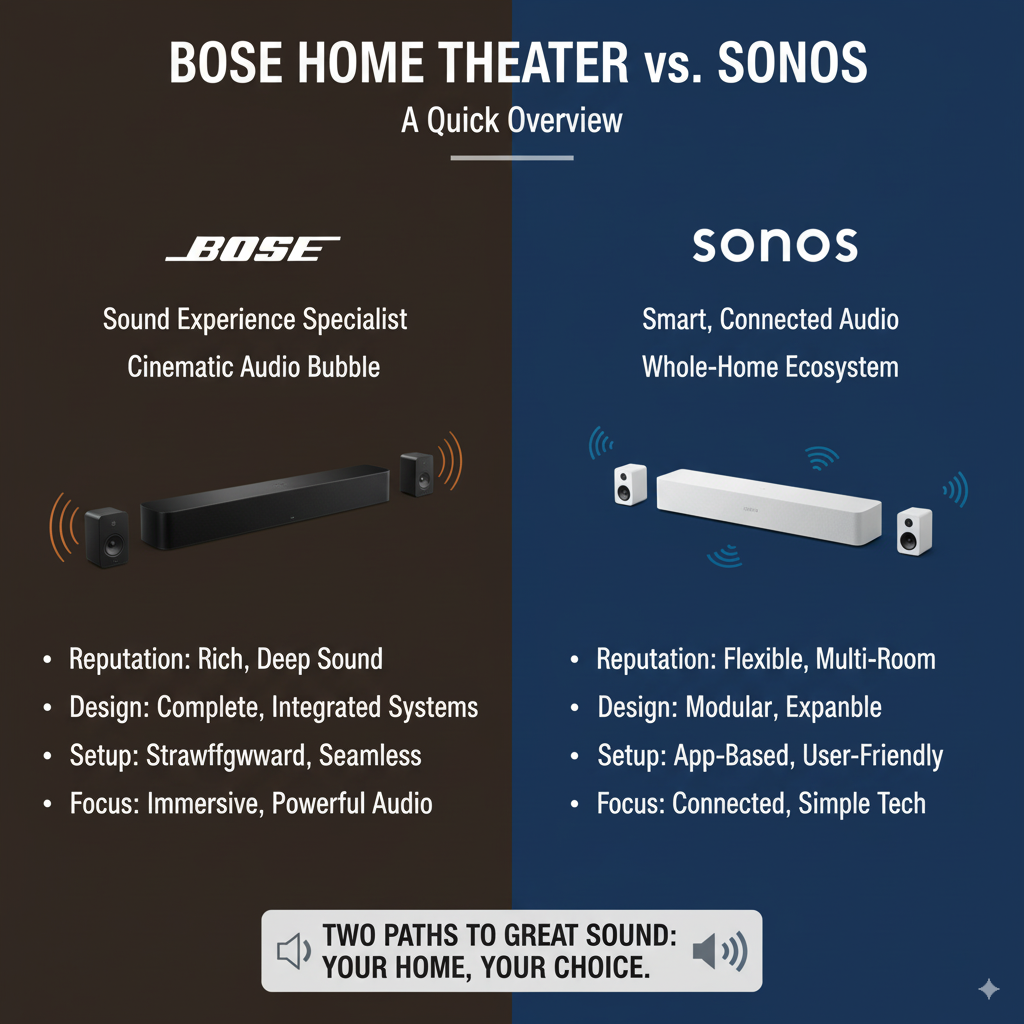
Bose Home Theater vs Sonos: A Quick Overview
When you’re looking for a way to bring that immersive movie or music experience into your home, both Bose and Sonos are top contenders. They’re known for great sound quality, but they go about it in different ways.
Bose: The Sound Experience Specialist
Bose has a long-standing reputation for delivering incredible audio. They’ve been in the sound business for decades, and they really focus on how sound makes you feel. When you think of Bose, think of rich, deep sound that can really fill a room. Their systems are often about creating that cinematic, powerful audio bubble, making movies more exciting and music more vibrant.
Bose home theater systems are generally designed as complete packages. You often buy them as a set, and they’re built to work together seamlessly. This makes setup straightforward, and you know you’re getting a system that’s engineered for a specific, high-quality performance. They aim for that instant wow factor when you first turn them on.
Sonos: The Smart, Connected Music Lover
Sonos, on the other hand, built its name on being a smart, connected audio system. They were early pioneers in multi-room wireless audio. Sonos is all about flexibility, ease of use, and integrating your music from many different sources, whether it’s streaming services, your own digital music library, or even your TV.
What really sets Sonos apart is its app-based control and its ability to expand your system over time. You can start with a soundbar and a speaker in one room and easily add more speakers to other rooms later, all controlled from your phone or tablet. They are known for their knack for making complex tech feel simple and user-friendly, focusing on building a cohesive audio ecosystem throughout your home.
Key Differences: Bose vs. Sonos
Let’s break down the main ways these two brands differ. This will help you see which approach better suits your home and your listening habits.
Sound Quality and Performance
This is where things get interesting, and it’s often very subjective. Both Bose and Sonos deliver excellent sound, but their signatures are a bit different:
- Bose: Often praised for its powerful bass, clear dialogue, and a more traditional, cinematic sound profile. Bose systems tend to be engineered for a powerful, front-heavy soundstage, making it feel like you’re right in the middle of the action. They excel at creating an immersive, “wow” factor with their sound.
- Sonos: While also producing excellent sound, Sonos often aims for a more balanced, room-filling audio experience. They are fantastic at clear mid-tones and crisp highs. Their strength lies in making sound feel natural and distributed throughout a space, perfect for both movies and background music. For those who love deep bass, some Sonos systems benefit from adding their wireless subwoofer.
Ecosystem and Expandability
How your system grows is a big consideration:
- Bose: Many Bose home theater systems are designed as integrated, all-in-one solutions. For example, you might buy a soundbar with a specific subwoofer and satellite speakers. While some Bose products can connect wirelessly, their expandability within home theater often means buying a specific companion product designed to go with your core system. It’s less about modularity and more about a curated experience. (For example, the Bose Smart Soundbar 900 is designed to work best with the Bose Bass Module 700 and Surround Speakers 700.)
- Sonos: This is where Sonos truly shines. Their ecosystem is built for seamless expansion. You can start with a Sonos Arc soundbar and add a Sonos Sub and two Sonos Era 100s as rear surrounds. The beauty is you can then take another Sonos speaker (like a Sonos One or a new Era 100) and place it in your bedroom, kitchen, or patio for synchronized music throughout your home. It’s a truly modular and scalable approach.
Setup and Ease of Use
Getting your system up and running should be a joy, not a headache:
- Bose: Bose systems are generally designed for straightforward setup. You often plug and play, and their remotes and interfaces are intuitive. They focus on getting you to great sound with minimal fuss. Specific advanced features might require using their companion app, but the core experience is usually very plug-and-chug.
- Sonos: Sonos is famous for its user-friendly app, which guides you through every step of setup. Connecting to Wi-Fi, adding speakers, and configuring your system happens via the Sonos app. While this requires Wi-Fi and a smartphone/tablet, it’s incredibly well-explained and makes managing a multi-room system a breeze.
Connectivity and Smart Features
How your system talks to your other devices and accesses content is vital:
- Bose: Bose systems typically offer essential connectivity like HDMI ARC/eARC for easy TV hookup, optical audio, and Bluetooth. Newer Bose soundbars come with voice assistant integration (like Amazon Alexa). Their focus is strong, reliable audio connections.
- Sonos: Sonos systems are heavily reliant on Wi-Fi. They integrate with a vast array of streaming services directly within the Sonos app, often surpassing the need to cast from other devices. Most Sonos soundbars also have voice assistant options built-in. They champion a connected, streaming-first audiophile experience. For TV audio input, they primarily rely on HDMI ARC/eARC or optical.
Price
Both brands are premium, but pricing can vary significantly depending on the specific product:
- Bose: Bose tends to be in the mid-to-high price range. Their complete systems can be a significant investment, but you’re often paying for established brand prestige and finely tuned audio engineering.
- Sonos: Sonos also occupies a similar price bracket. Their entry-level speakers are more affordable, allowing you to start smaller. However, building a comprehensive home theater setup with multiple components can quickly become as expensive as a Bose system, sometimes more so, if you opt for their higher-end soundbars and subwoofers.
Popular Bose Home Theater Systems
Bose offers several excellent options for serious home entertainment. Here are a couple of their flagships:
1. Bose Smart Soundbar 900
This is Bose’s premium soundbar, designed to deliver incredible, expansive sound with Dolby Atmos. It’s a sleek unit that can handle everything on its own or be expanded upon.
- Key Features:
- Dolby Atmos support for immersive, overhead sound
- Wide, spacious soundstage
- Built-in voice assistants (Amazon Alexa, Google Assistant)
- Wi-Fi and Bluetooth connectivity
- Can be expanded with Bose Bass Module 700 and Bose Surround Speakers 700
- Who is it for?
- Someone who wants a powerful, room-filling sound from a single, elegant soundbar that can be upgraded later. Ideal for movie buffs and those who appreciate clear, impactful audio.
2. Bose Lifestyle 650 Home Entertainment System
This is a more traditional, complete home theater package. It includes a sleek A/V receiver/console and four small, satellite speakers, plus a wireless bass module. It’s designed for a full surround sound experience with minimal visual clutter.
- Key Features:
- Four discreet satellite speakers for true surround sound
- Powerful wireless bass module
- Elegant A/V console with simplified controls
- Easy setup with step-by-step instructions
- Designed to work as a complete system
- Who is it for?
- Those looking for a premium, hassle-free, wired-equivalent surround sound experience without the complexity of AV receivers and multiple components. It’s for a dedicated home theater feel.
Popular Sonos Home Theater Systems
Sonos offers a more modular approach, allowing you to build and evolve your system.
1. Sonos Arc
The Sonos Arc is their flagship Dolby Atmos soundbar. It’s designed to deliver super-smart cinematic sound with the clarity and depth you’d expect. It works beautifully on its own and is the heart of a scalable Sonos home theater.
- Key Features:
- Dolby Atmos support with upward-firing speakers
- Smart sound tuning that adapts to your room (Sonos Trueplay)
- Voice control built-in (Amazon Alexa, Google Assistant)
- Wi-Fi connectivity for streaming services
- Can be paired with Sonos Sub (Gen 3) and Sonos Era 100s or Ones for a fuller surround system
- Who is it for?
- Individuals who want a top-tier soundbar that excels in Dolby Atmos playback, integrated smart features, and the ability to add more Sonos speakers for a complete surround setup or multi-room audio.
2. Sonos Beam (Gen 2)
The Sonos Beam is a more compact and affordable Dolby Atmos soundbar. It offers a big sound for its size and is perfect for smaller to medium-sized rooms.
- Key Features:
- Dolby Atmos support in a compact design
- Clear dialogue emphasis and a surprisingly wide soundstage
- Voice control built-in
- Wi-Fi connectivity
- Can be expanded with Sonos Sub Mini or Sonos Sub (Gen 3) and Sonos Era 100s or Ones as rear surrounds.
- Who is it for?
- Smart consumers looking for excellent Dolby Atmos sound at a more accessible price point. It’s a great starter for a Sonos home theater, especially in apartments, dens, or smaller living rooms.
Comparing Soundbars: Bose vs. Sonos
Soundbars are often the first step into improving your TV’s audio. Here’s how the top contenders stack up:
| Feature | Bose Smart Soundbar 900 | Sonos Arc | Sonos Beam (Gen 2) |
|---|---|---|---|
| Dolby Atmos | Yes | Yes | Yes |
| Sound Profile | Cinema-like, expansive, powerful | Balanced, room-filling, detailed | Clear, punchy for its size, good dialogue |
| Expandable for Surround | Yes (Bass Module & Surround Speakers) | Yes (Sub & Era 100/One) | Yes (Sub/Sub Mini & Era 100/One) |
| Connectivity | HDMI eARC, Optical, Wi-Fi, Bluetooth | HDMI eARC, Optical (adapter), Wi-Fi | HDMI eARC, Optical (adapter), Wi-Fi |
| Voice Assistants | Alexa, Google Assistant | Alexa, Google Assistant | Alexa, Google Assistant |
| Price Range | High | High | Mid-High |
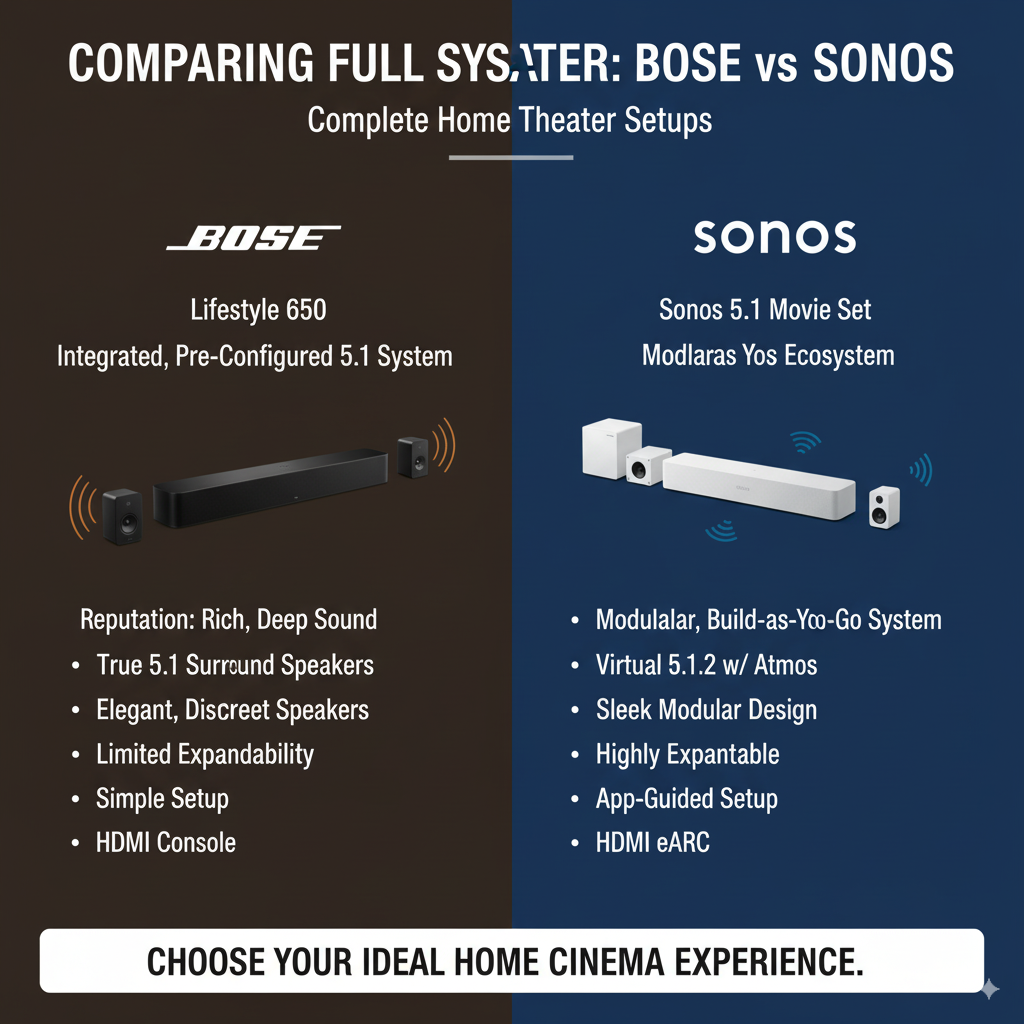
Comparing Full Systems: Bose vs. Sonos
For those who want a complete, immersive surround sound experience, comparing full systems is key.
| Feature | Bose Lifestyle 650 | Sonos 5.1 Movie Set (e.g., Arc + Sub + Era 100s) | Sonos 3.1 Movie Set (e.g., Arc + Sub) |
|---|---|---|---|
| Overall Approach | Integrated, pre-configured system | Modular, build-as-you-go | Modular, build-as-you-go |
| Surround Sound Channels | True 5.1 discrete channels | Virtual 5.1.2 with Atmos (configurable 5.1 with surrounds) | Virtual 3.1 with Atmos |
| Aesthetics | Elegant, discreet satellite speakers | Sleek soundbar, wireless sub, compact surrounds | Sleek soundbar, wireless sub |
| Expandability | Limited beyond the core system | Highly expandable for multi-room audio | Highly expandable for multi-room audio |
| Setup Complexity | Designed for simplicity | App-guided; generally easy | App-guided; generally easy |
| Primary Input | HDMI ports on console | HDMI eARC on soundbar | HDMI eARC on soundbar |
Tips for Choosing the Right System
To help you make the best decision, consider these practical tips:
1. Think About Your Room
Room Size: A large room might benefit from Bose’s powerful, expansive sound or a full Sonos surround setup. For smaller rooms or apartments, a Sonos Beam or a Bose soundbar solo might be plenty. The acoustics of your room, like hard floors or lots of furniture, can affect sound. Companies like The National Council of Acoustical Consultants offer general guidance on how room characteristics impact sound quality.
Layout: Do you have space for rear speakers? A dedicated home theater room can accommodate a fuller setup, while a living room might favor a cleaner soundbar solution.
2. How Will You Listen?
Movies and TV: If your primary goal is an immersive movie experience with deep bass and clear dialogue, both brands excel. Bose often leans into the cinematic punch, while Sonos provides a very balanced and detailed surround sound.
Music: Both are excellent for music. Sonos, with its multi-room capabilities and direct streaming integration, is often favored by music lovers who want to fill their entire home with sound from various sources.
Gaming: Low latency is crucial for gaming. Both brands have improved, but you’ll want to ensure the specific model you choose supports low-latency connections (often via HDMI eARC). Check reviews for gaming performance. If latency is your absolute top priority, a wired system might still be the gold standard, but modern wireless systems are remarkably good.
3. Consider Future Upgrades
This is where Sonos has a distinct advantage for many. If you envision starting simple and adding to your system later – perhaps adding surround speakers or more music in other rooms – Sonos’s modular design is unparalleled. Bose systems are more about buying an integrated package, and while they have upgrade paths (like adding their sub or surrounds), it’s less about building an entire home audio network.
4. Ease of Use vs. Ultimate Control
Both are designed to be user-friendly. Bose offers a more traditional, sometimes more direct, setup. Sonos relies heavily on its superb app, which offers incredible control over your entire audio setup and streaming services. The Sonos app is powerful but requires a stable Wi-Fi network and a smartphone.
5. Budget
Be realistic about what you want to spend. A basic soundbar from either brand is a significant upgrade from TV speakers. A full surround system with subwoofers and rear speakers will cost considerably more. Sonos can be a good entry point if you’re on a tighter budget, as you can buy one component and add more later. Bose often requires a larger upfront investment for a complete system.
Bose Home Theater vs Sonos: Frequently Asked Questions (FAQ)
Here are some common questions beginners have when choosing between Bose and Sonos:
Q1: Which brand offers better bass?
A1: Bose systems are often noted for their powerful and deep bass responses, which can provide a more impactful cinematic feel.