Garage Heater Guide
Size a garage heater by condition first: an insulated, reasonably air-sealed garage often lands around 30–50 BTU per square foot for comfort heat, while a drafty garage with little insulation often needs about 60–80 BTU per square foot, with electric often better for occasional use and gas often cheaper for frequent heating. Get it wrong and you can end up with slow warm-ups, cold tools, tripped circuits, moisture problems, or venting that is unsafe. This guide matches garage type, use pattern, and local energy prices to the right heater, size, and installer boundary.
Start with the heating job


Before size or fuel, decide what the heater must do. There are three different jobs: quick warm-up when you step in, steady comfort heat for hours, and above-freezing protection to keep pipes, finishes, batteries, or stored items from dipping too low.
Those jobs push you toward different heater types and different outputs. Quick warm-up favors higher output and fast air recovery. Steady comfort rewards better controls and an insulated shell. Freeze protection usually needs less capacity than full comfort heating, but it often needs longer runtime.
Quick warm-up, steady heat, or freeze protection
If the garage sits cold most of the week and you only work there on weekends, warm-up speed matters more than fine temperature control. A forced-air unit heater or a high-output electric unit heater can make sense if the wiring or fuel supply supports it.
If the garage is used daily, a lower, steady background temperature with thermostat control usually feels better and wastes less energy than repeated full-blast recovery. In an insulated attached garage, a ductless mini split heat pump or a vented gas unit heater can fit that pattern well.
Freeze protection is its own category. Keeping the space above freezing is a smaller job than holding shirt-sleeve comfort in January, so oversizing can be a mistake if the heater short-cycles and the room swings hot and cold.
Whole-garage heat or spot heat
Whole-room heat works best when the shell can hold it. Insulated walls, a better garage door, and fewer air leaks matter as much as heater output. Spot heat works when the room is leaky or the user stays in one area.
Radiant and infrared heaters are useful when the person, bench, or vehicle bay matters more than the far wall. Forced-air is better when tools, slab, and room air all need recovery after the overhead door opens.
Door openings change the answer
A garage with one quick entry per day heats very differently from a workshop with repeated in-and-out traffic. Every large door opening dumps stored heat and replaces it with outdoor air.
Say your 2-car garage is insulated, has an 8-foot ceiling, and feels fine once warmed. If the overhead door opens every 15 minutes for deliveries or project work, a heater sized only from square footage will feel weak because recovery, not steady-state loss, is now the real job.
What size garage heater do you need?
Start with floor area, then correct for insulation, ceiling height, and how much outside air enters. A 1-car garage can need 6,300–25,000 BTUs, a 2-car garage 12,000–46,000 BTUs, and a 3-car garage 17,000–62,000 BTUs, depending on climate and insulation.
Garage sizes and rough starting points
Square footage is only a starting point, but it is still useful. Common residential ranges look like this:
- Single-car: about 180 to 300 square feet
- 1.5-car: about 250 to 375 square feet
- 2-car: about 350 to 550 square feet
- 2.5-car: about 500 to 700 square feet
- 3-car: about 550 to 900 square feet
- 4-car: about 800 to 1,200 square feet
Those ranges overlap because width, depth, storage alcoves, and workshop extensions vary a lot. Use the actual floor area if available, then apply the condition adjustments below.
For a rough comfort-heating check, many insulated attached garages with 8-foot ceilings land near 30–50 BTU per square foot, while garages with bare walls, leaky doors, or detached construction often land closer to 60–80 BTU per square foot. That broad rule should not override the garage condition.
Insulation and attachment matter first
An attached garage often has one or two shared house walls, which reduces heat loss. A detached garage loses heat from every side and often has more air leakage around framing, service penetrations, and older doors.
Uninsulated walls, an uninsulated steel door, and a cold slab all push load upward. Air sealing around the perimeter of the overhead door and side-entry door can change heater performance more than moving up one model size.
Suppose a 1.5-car detached garage and a 1.5-car attached garage have the same floor area and ceiling height. The detached one usually needs more output because all surfaces face outdoor conditions and the structure often sees more wind exposure.
Ceiling height changes the load
Heater ratings by square foot often assume an 8- to 10-ft ceiling. Once ceiling height climbs above that, the same floor area contains more air volume, and warm air also tends to stratify higher above the occupied zone.
Workshop-style garages with 10- to 14-foot ceilings usually need either more output, destratification from air movement, or a heater type that warms people and work areas more directly. That is why a 2-car garage with a 12-foot ceiling can behave more like a larger room than its floor area suggests.
How do BTUs and watts translate to garage heat?
BTUs per hour and watts both describe heater output. Princess Auto states 1 Watt equals 3.412 BTU, so a 1,500-watt heater produces about 5,118 BTU per hour. Use that conversion to compare a 120V or 240V electric heater‘s true heat output against a gas unit heater labeled directly in BTU per hour.
BTU-to-watt conversion
The quick conversion is simple: watts multiplied by 3.412 gives BTU per hour. A 5,000-watt electric heater is about 17,060 BTU per hour. A 7,500-watt heater is roughly 25,600 BTU per hour.
That matters because electric resistance heaters top out sooner in normal residential circuits than gas-fired unit heaters do. A gas ceiling unit rated in the tens of thousands of BTUs can cover loads that would require a large 240V electric circuit.
Garagetransformed notes that a 1500-watt heater has the same heat output as any other 1500-watt heater. Differences between two 1500-watt models come from controls, airflow, noise, safety devices, and form factor, not from extra hidden heat.
Watts per square foot and BTUs per square foot
PickHVAC says garage needs can range from 8 watts to 20+ watts per square foot. The same source says this equals roughly 25 to 85 BTUs per square foot. Those ranges line up with the real-world spread between a tight attached garage in a mild climate and a drafty detached garage in a cold one.
Use the low end only when the garage is insulated, reasonably air sealed, and used for lighter heating goals. Move toward the high end when the shell leaks badly, the ceiling is tall, or the door opens often.
Capacity by climate and insulation
Mild climates let a tight garage get by with much less output than a cold-climate detached shop.
For larger spaces, the spread stays wide. If the garage is a 4-car layout, the best estimate usually comes from actual area, ceiling height, and the heating goal rather than from a flat chart alone.
Princess Auto also gives a formula using cubic space and temperature rise for BTU sizing. That volume-based approach is useful when ceilings are high because cubic feet captures what floor area misses.
Which heater type fits your garage?
Choose heater type by how the garage is used, not by product category alone. Forced-air heaters recover fastest after door openings, radiant and infrared heaters favor people and work zones, convection heaters suit quieter background heating, and mini splits work best in insulated garages used often.
Forced-air for quick recovery
The same source says forced-air heaters are ideal for large spaces. In a garage, their strength is moving heat into the room quickly after a cold start or a door opening.
The tradeoff is air movement. They can stir dust, dry finishes too fast, and feel less pleasant for bench work if the blower points directly at the occupied area. They are usually the first choice when vehicles come and go and the whole room must recover fast.
Radiant and infrared for people and zones
Radiant and infrared heaters make more sense when the user stands in one area and does not need the whole garage equally warm. They can feel faster because the energy is aimed at surfaces and occupants rather than trying to heat all room air first.
That makes them useful in leaky garages where comfort at a workbench matters more than uniform wall-to-wall temperature. They are less helpful if stored items across the room also need protection.
Convection for quieter background heat
Convection heaters are usually better for steady use than for rapid recovery. They work best where the garage stays closed for longer periods and dust disturbance should stay low.
They also pair well with a thermostat strategy that maintains a moderate baseline temperature instead of repeated cold starts.
Mini split heat pumps for conditioned garages
Ductless mini split heat pumps fit garages that already have a decent envelope. If walls and door are insulated and air leakage is under control, they can hold comfort temperature efficiently and add cooling in summer.
They are a weaker answer for a very drafty shop with frequent large door openings. In that job, recovery demand often outruns the benefits of a lower steady-state operating cost.
Which fuel makes sense: electric, gas, propane, kerosene, or heat pump?
Pick fuel by runtime, utility access, ventilation limits, and local rates. Electric resistance heat is simplest to add for occasional use, natural gas is often cheaper to run for frequent heating, propane suits sites without gas service, kerosene is niche, and heat pumps need a good envelope.
Electric resistance heaters
Electric heat is clean at the point of use and simple to control. Small portable units work for spot heating and occasional tasks. Larger wall- or ceiling-mounted electric unit heaters often need a dedicated 240V circuit.
The operating-cost caution is straightforward: if local electricity rates are high and the garage is used for long stretches, runtime cost can climb fast. Electric still makes sense when installation simplicity matters more than fuel cost.
Natural gas unit heaters
The same source says natural gas costs less than propane and electricity heating. Where gas service already exists, that usually makes natural gas the strongest fit for frequent whole-garage heating.
The same source says propane and natural gas heaters are meant for permanent installation. That points to the real scope: gas piping, venting, combustion air, mounting, and code compliance, not a casual DIY plug-in project.
Propane and kerosene
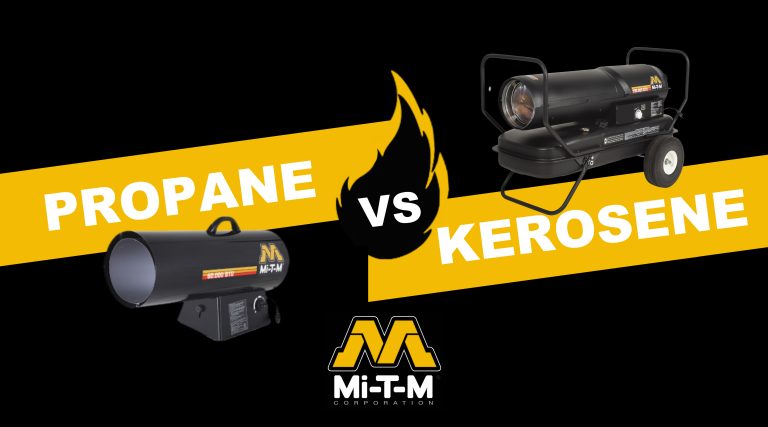
Propane helps when no natural gas service is available. Portable propane and kerosene heaters can deliver a lot of heat quickly, but enclosed-garage use brings ventilation and storage concerns that many buyers underestimate.
Fuel-burning heaters consume oxygen and produce carbon monoxide, water vapor, and other combustion byproducts, so enclosed garages need outdoor air, a proper vented appliance for permanent use, and a working carbon monoxide detector. That makes many ventless options a poor fit for an enclosed garage that stays shut in cold weather, especially if gasoline, solvents, or finishing fumes are present.
Heat pumps
A mini split heat pump is best when the garage is insulated, used often, and expected to stay comfortable for extended periods. It also brings the best control range of the common options.
It is not automatically the cheapest answer. Compare local electricity rates, winter temperatures, and installation cost before deciding.
Garage heat matrix
Decision matrix
| Garage size | Insulation level | Ceiling height | Use case | Fuel type | Recommended BTU/watt range |
|---|---|---|---|---|---|
| Single-car, 180-300 sq ft | Insulated walls and door, attached | 8 ft | Occasional work, quick warm-up | Electric resistance | 6,300-12,000 BTU or about 1,850-3,520 W |
| Single-car, 180-300 sq ft | Drafty or uninsulated | 8-10 ft | Steady comfort heat | Natural gas or propane | 12,000-25,000 BTU |
| 1.5-car, 250-375 sq ft | Insulated, attached | 8 ft | Freeze protection | Electric or mini split heat pump | 7,500-15,000 BTU or about 2,200-4,400 W |
| 2-car, 350-550 sq ft | Insulated walls and door | 8-10 ft | Regular comfort heating | Natural gas, electric unit heater, or mini split heat pump | 12,000-30,000 BTU or about 3,520-8,790 W |
| 2-car, 350-550 sq ft | Drafty, detached, frequent door opening | 8-10 ft | Quick recovery | Natural gas or propane forced-air | 30,000-46,000 BTU |
| 2.5-car, 500-700 sq ft | Moderately insulated | 10 ft | Workshop with bench area | Gas forced-air plus radiant zone heat, or larger electric if service allows | 25,000-45,000 BTU or about 7,330-13,190 W |
| 3-car, 550-900 sq ft | Insulated, attached or tight detached | 8-10 ft | Frequent use, steady comfort | Natural gas or mini split heat pump | 17,000-40,000 BTU |
| 3-car, 550-900 sq ft | Uninsulated or high air leakage | 10-12 ft | Cold-climate workshop | Natural gas or propane forced-air | 40,000-62,000 BTU |
| 4-car, 800-1,200 sq ft | Well insulated | 10-12 ft | Steady comfort heating | Natural gas or multiple-zone mini split heat pump | 30,000-60,000 BTU |
| 4-car, 800-1,200 sq ft | Drafty, detached, high ceiling | 12-14 ft | Vehicle and workshop use | Natural gas or propane unit heater | 60,000-85,000 BTU |
When this advice fails
Detached garages often need more capacity than area-based charts suggest because every wall is exposed and infiltration is higher. If the shell is loose, spending part of the budget on weatherstripping and door sealing can beat stepping up one heater size.
Frequent door opening can break an otherwise sensible sizing plan. The issue is not room size. It is repeated heat loss and recovery time, which pushes the answer toward forced-air output rather than a quieter low-output heater.
High-ceiling workshops are another failure point. Once the ceiling is well above 8 to 10 feet, floor-area assumptions weaken. Use cubic volume, temperature rise, and heater placement, then expect stratification to reduce comfort unless airflow or radiant coverage addresses it.
Picture a 700-square-foot garage with a 14-foot ceiling used for woodworking. A wall heater sized from floor area alone may keep the thermostat happy near the unit while the bench stays cold because the heat stacks overhead and the door leaks at the bottom seal.
What safety checks matter before you buy or install?
Check ventilation, carbon monoxide risk, combustibles, mounting clearances, and the garage contents before choosing any heater. Fuel-burning units need combustion-air planning and a carbon monoxide detector, while electric models still need safe placement, overheat protection, and distance from dust, solvents, and stored fuel.
Ventilation and vented versus ventless
The same source says fuel-burning heaters should only be used in well-ventilated areas. That one sentence rules out many casual enclosed-garage setups where doors and windows stay shut for winter comfort.
Ventless heaters are often the most problematic choice in a garage because they add combustion byproducts and moisture to a space that may already contain vehicle exhaust, paints, gasoline, or cleaners. For enclosed garages, the safer path is a vented heater installed to code, with a clear combustion-air plan and a carbon monoxide detector nearby.
Safety devices and detection
The same source recommends a carbon monoxide detector for fuel-burning heaters. That is baseline protection, not an accessory. If a heater burns gas, propane, or kerosene, add a detector and test it on schedule.
- Low oxygen sensor for fuel-burning portable units
- Overheat shut-off on electric and fuel-burning heaters
- Tip-over protection on portable floor units
- Thermostat control to avoid runaway overheating
Clearance, dust, fumes, and storage hazards
Most manufacturers list minimum distances from combustibles on the heater nameplate and in the manual, and those numbers control placement. Keep service access clear too, especially around ceiling-mounted unit heaters and wall-mounted infrared units.
Garages add hazards that living rooms do not. Gasoline cans, oil-soaked rags, cardboard, sawdust, paint, and solvent fumes all change heater placement. Forced-air heaters can stir dust into the airstream, and open-flame or very hot-surface heaters should stay away from flammable vapor sources.
Floor placement needs extra caution. A portable heater near the vehicle path, the walk door, or stacked storage gets blocked easily and can be knocked over even if it has a tip switch.
What can you install yourself and what needs a licensed installer?
A homeowner can usually handle plug-in electric heaters and some simple mounting tasks, but dedicated 240V circuits, gas piping, venting, and mini split refrigerant work change the job. The practical boundary is whether the project touches fixed wiring, combustion systems, or sealed refrigeration components.
Portable and plug-in electric heaters
- Check circuit load. Confirm the heater voltage and amperage against the branch circuit before first use. A plug-in heater that shares a busy garage receptacle can trip breakers or overheat cords if the circuit is already carrying tools or a freezer.
- Place on clear floor. Keep the unit on a stable, dry surface with open air around intake and discharge areas. Do not tuck it under shelves, behind tires, or beside fuel containers where heat and blocked airflow raise risk.
- Use the thermostat. Start with the built-in manual or analog thermostat at a moderate setting and adjust after the room stabilizes. Constant full-power operation often points to an undersized heater or a garage that leaks too much heat.
240V electric unit heaters
- Confirm heater draw. Match the heater’s voltage and current requirements to a properly sized dedicated circuit. A common first-timer mistake is buying a higher-watt unit first and discovering the panel or garage wiring cannot support it.
- Mount to instructions. Follow the manufacturer layout for wall or ceiling mounting, floor clearance, and service space. Placement affects safety and how well the fan throws warm air into the occupied zone.
- Add controls correctly. Use only supported line-voltage thermostats or manufacturer-approved controls. Some units accept external thermostats, and some can work with Wi-Fi thermostat setups through compatible control hardware.
Gas unit heaters and mini splits
- Stop at rough planning. Homeowners can measure the room, identify mounting spots, and compare vent runs or line routes. Once gas piping, vent termination, combustion air, or refrigerant lines enter the picture, the installation scope changes.
- Use licensed trades. Gas unit heaters and mini split systems usually need licensed installation for piping, venting, electrical connection, pressure testing, evacuation, and startup. This is the point where code, warranty terms, and safety all matter.
- Schedule final checks. After installation, verify thermostat operation, airflow direction, clearance, and detector placement. A heater that is technically installed but poorly aimed or badly controlled can still perform poorly.
How should you compare operating cost and controls?
Compare local energy prices before picking a fuel, then match controls to the way the garage is actually used. Frequent use favors lower running cost and better thermostats, while occasional use often favors simple electric heat with lower installation cost and straightforward on-off control.
Compare runtime cost with local rates
The same source says natural gas costs less than propane and electricity heating, but local utility rates and runtime still decide the bill. A rarely used garage can cost less overall with electric heat because the installation is simpler, even if the cost per hour is higher.
Use the heater output to estimate runtime cost. Electric is easiest to compare because watts are direct input. For gas or propane, compare delivered fuel price, heater efficiency, and expected hours of use.
Say your garage only needs heat for two hours on Saturday and two hours on Sunday. The best value may be a modest electric unit with no gas line or vent work, even if a gas heater would be cheaper per hour once running.
Thermostat choices
Manual thermostats are common on portable heaters and basic unit heaters. Analog wall thermostats are still common on hardwired electric and gas units because they are simple and durable.
Wi-Fi thermostat compatibility depends on the heater controls. Some electric unit heaters support external line-voltage controls. Gas unit heaters and mini splits may offer better compatibility, but only when the control logic and voltage match the thermostat system.
Control strategy affects comfort
A garage used daily usually feels better with a lower maintained setpoint than with repeated deep setbacks and cold starts. A garage used once a week usually does better with a heater chosen for fast response.
That is why control choice matters almost as much as fuel choice. The right thermostat can reduce overshoot, improve comfort at bench height, and keep operating cost closer to the intended use pattern.
Frequently asked questions
What size heater for my garage
Use floor area only as a starting point, then adjust for insulation, air leakage, ceiling height, and how often the big door opens. A tight garage may land near 30–50 BTU per square foot, while a drafty one may need 60–80 or more for decent recovery.
What is a good garage heater?
A good garage heater fits the job. For occasional use, a plug-in or 240V electric heater is often the simplest answer. For frequent whole-room heating, a vented natural gas unit heater is often the stronger value. For insulated daily-use spaces, a mini split heat pump can make sense.
Electric vs gas garage heater
Electric is easier to add and simpler to control, but operating cost is more sensitive to local power rates. Gas usually delivers more output and lower running cost where service exists, but it adds venting, piping, combustion-air planning, and a tighter installer boundary.