Heater Efficiency Guide
Use the efficiency metric tied to the heater type: AFUE for furnaces and boilers, HSPF2 or COP for heat pumps, UEF for water heaters, and watt-for-watt electric resistance heat is generally treated as effectively 100% at the point of use. Mixing those ratings can make an expensive system look cheaper to run, or hide large differences in seasonal fuel use. This guide shows which label matters for each product family and how to compare operating cost without crossing metrics.
What makes one heater more efficient than another?
One heater is more efficient than another when it turns more of its energy input into useful heat delivered to the room, duct system, or hot water line for the same job. The catch is simple: fuel conversion, heat delivery, standby loss, and cycling loss are different issues, so one rating cannot compare every heater fairly.
Fuel efficiency and heat delivery are not the same thing
Start with a basic split. Fuel-conversion efficiency asks how well the appliance turns gas or electricity into heat. Heat-delivery efficiency asks how much of that heat actually reaches the space or water fixture where you need it.
A gas furnace can post a high AFUE and still lose part of the benefit through duct leakage, filter restriction, or short cycling. An electric space heater may convert nearly all electric input into heat at the point of use, yet still cost more to run if it heats the wrong room for too long.
That gap is why buyers get tripped up by AFUE, UEF, BTU, and wattage. They are not competing labels for the same thing. They answer different questions.
Why one rating does not work across all heater types
AFUE is built for annual fuel use in furnaces and boilers. UEF is built for water heaters and includes standby losses and recovery efficiency. BTU is output capacity. Watts are electrical input. COP and HSPF2 describe heat pump performance. Put those into one bucket, and the comparison stops being useful.
Water heating makes this plain. Water heaters can account for 12-30% of a household’s energy costs, so the wrong comparison method can distort a meaningful share of the utility bill. A tank unit, a tankless unit, and a heat pump water heater may all meet the same household need, but the label that matters is not the same across categories.
Where operating cost parts ways with rated efficiency
A good rating still does not equal your bill. Operating cost changes with heater size versus the actual load, how many hours it runs, outdoor temperature, insulation levels, duct or pipe losses, venting setup, airflow, and the way your household uses heat or hot water. Within the same heater category, a higher rating usually cuts energy use for the same output, but installed performance can still differ a lot from the lab number.
Suppose a high-AFUE furnace is oversized for a tight, small house. It may start and stop so often that comfort drops and fuel use climbs. The nameplate number did not change. The installed result did.
Which efficiency metric matters for each heater type?
The metric that matters is the one designed for that heater family: AFUE for furnaces and boilers, UEF for water heaters, COP or HSPF2 for heat pumps, and watts paired with run time for electric resistance heaters. BTU matters because it tells you how much heat the unit can deliver, which is key for sizing, but BTU by itself does not show how much fuel or electricity the unit uses to produce that output.
AFUE for furnaces and boilers
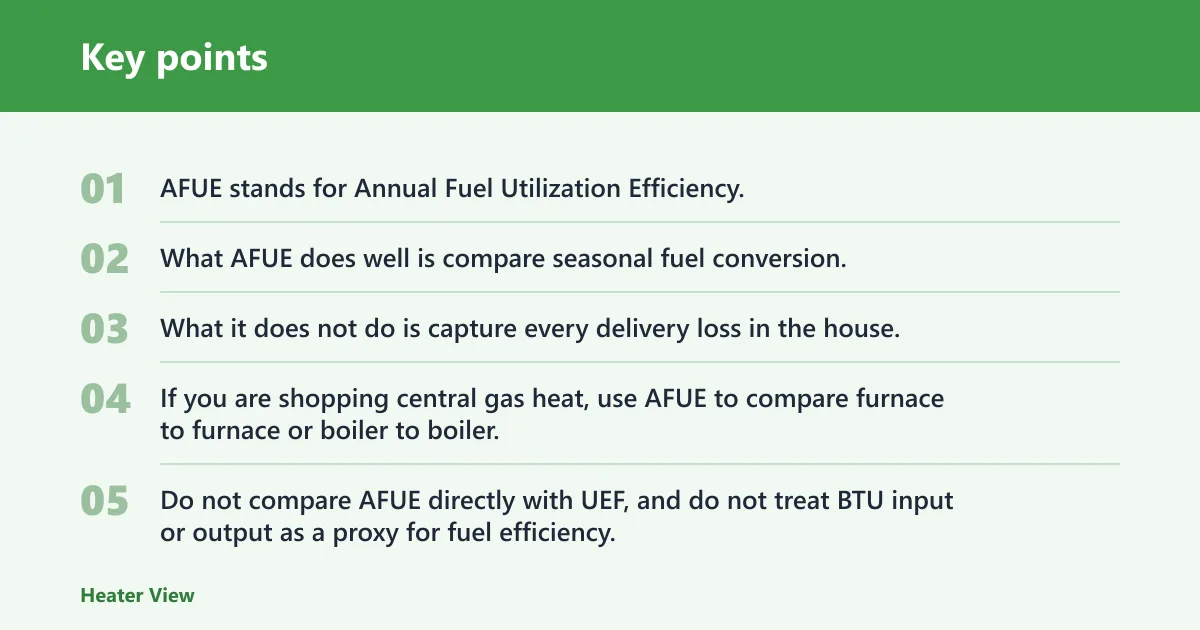
AFUE stands for Annual Fuel Utilization Efficiency. It is a percent-based annual metric used for furnaces and boilers, and it is the right place to compare gas-fired central heating equipment within that class.
What AFUE does well is compare seasonal fuel conversion. What it does not do is capture every delivery loss in the house. Duct leakage, poor airflow, dirty filters, or bad control settings can raise real operating cost even when AFUE looks strong on paper.
If you are shopping central gas heat, use AFUE to compare furnace to furnace or boiler to boiler. Do not compare AFUE directly with UEF, and do not treat BTU input or output as a proxy for fuel efficiency.
UEF for water heaters
UEF is the rating that matters for residential water heaters. Higher is better, and UEF includes standby losses and recovery efficiency, which makes it more useful than a bare burner size or element wattage when you are comparing water heater operating cost.
The categories beneath that label still differ. Tank water heaters store 30-80 gallons of hot water, so standby heat loss is part of the ownership picture. Tank water heaters typically last 8-12 years. Tankless water heaters heat water only when needed, and tankless water heaters typically last 15-20+ years. Heat pump water heaters use electricity to transfer heat rather than create it directly, can be three times more efficient than conventional electric water heaters, often post the highest UEF values, and typically last 10-15 years.
Watts, BTU, COP, and HSPF2
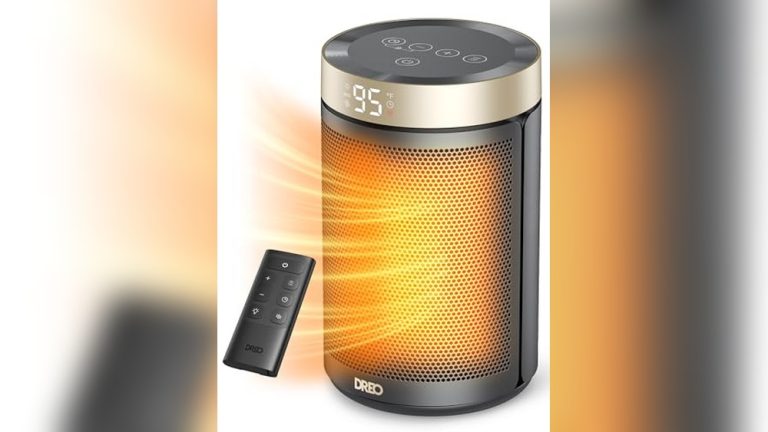
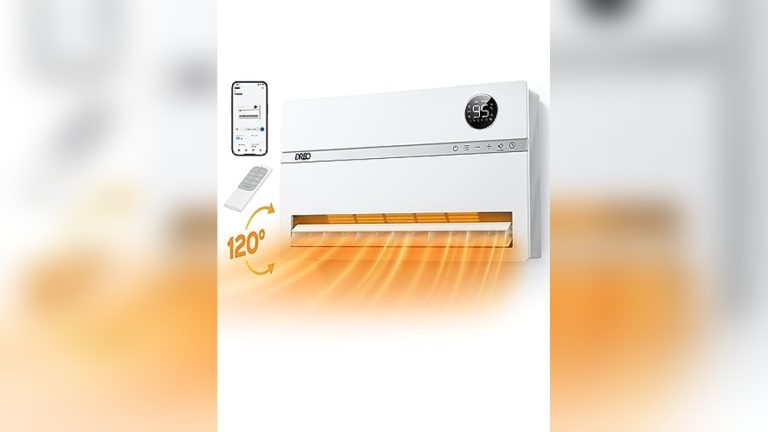
For electric resistance heaters, wattage is the main input figure. A 1,500-watt portable heater generally draws more power than a 750-watt model when both run continuously. That does not make the bigger one less efficient; it means it uses more electricity because it delivers more heat.
BTU is heat output, not efficiency by itself. Use BTU to judge whether the heater can meet the load. Then pair that with runtime, fuel type, and building load to estimate energy use.
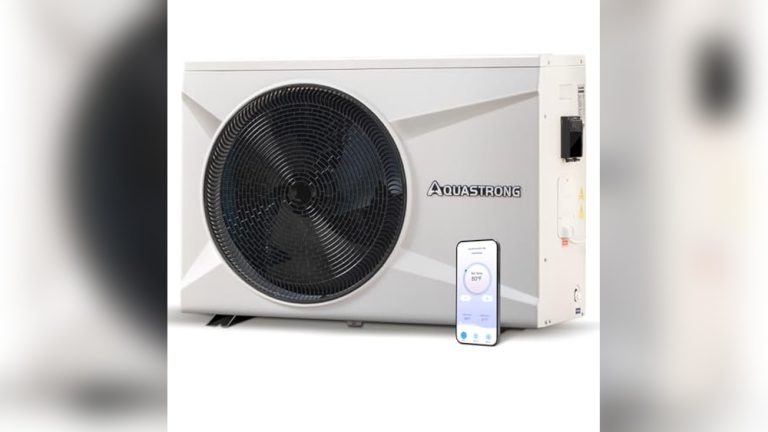
For heat pumps, COP and HSPF2 are the performance metrics that matter. A heat pump moves heat instead of making all of it through resistance, so its delivered heat per unit of electricity can exceed electric resistance heat in many conditions. That is why a heat pump can beat a baseboard or portable resistance heater on seasonal operating cost even when both use electricity.
Heater metrics decision matrix
| Heater type | Correct metric | Misleading metric to ignore | Real-world cost inflator | What to check first |
|---|---|---|---|---|
| Gas furnace | AFUE for seasonal fuel efficiency | BTU alone | Duct leakage, dirty filters, oversizing, short cycling | Match furnace output to heating load and verify duct condition |
| Electric resistance heater | Watts plus runtime | BTU marketing claims without watt draw | Heating too large an area, long run time, thermostat overshoot | Confirm circuit capacity and the size of the area being heated |
| Heat pump | COP or HSPF2 | Resistance backup wattage by itself | Low outdoor temperature operation, airflow issues, backup heat use | Check climate fit, seasonal rating, and duct or air-handler setup |
| Tankless water heater | UEF plus required GPM at your temperature rise | BTU input alone | Long pipe runs, low flow activation issues, undersized GPM | Size for simultaneous fixtures, not only the burner size |
| Tank water heater | UEF | Tank size alone | Standby heat loss, recirculation losses, scale buildup | Check UEF, insulation quality, and whether stored volume fits demand |
| Portable space heater | Watts plus duty cycle in the room used | Room-size claims without wattage | Door drafts, cycling in an open floor plan, running all day | Measure the room and decide whether spot heating is realistic |
How do you read heater labels and spec sheets?
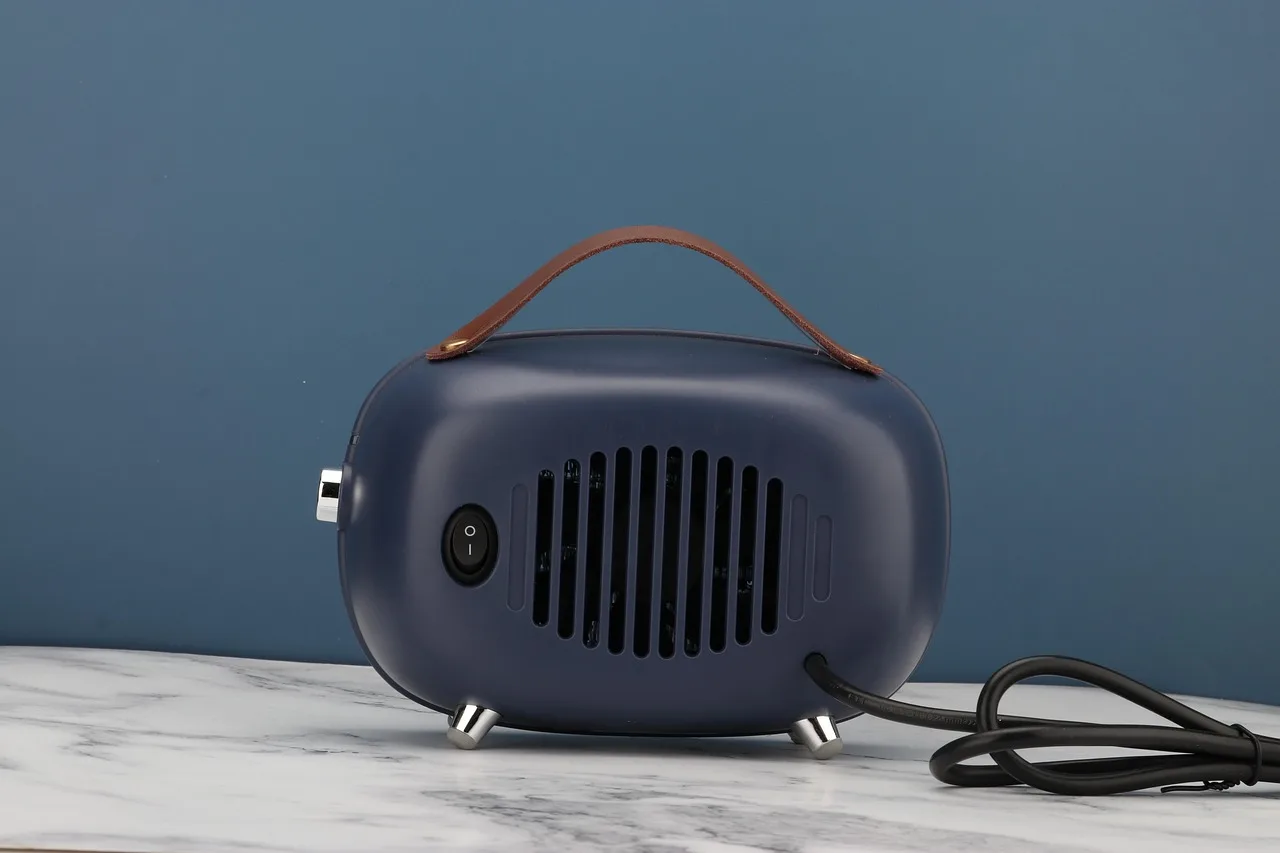
Read labels by finding the rating that belongs to that product family first, then use the standardized comparison tools on the same category of appliance. The Energy Guide label helps consumers compare energy efficiency and estimate operating costs, but it is meant for side-by-side comparison rather than an exact prediction of your bill.
What the Energy Guide label tells you
The Energy Guide label is standardized across models for easier comparison. That matters because different brands present marketing claims in different ways, while the label gives you a common basis for estimated energy use and operating cost.
You will often see it on water heater shopping pages and showroom tags. Use it to compare one tank unit to another, one tankless unit to another, or one heat pump water heater to another. Use care when comparing very different product types with different usage assumptions.
Where to find the numbers that matter
- Identify the heater family. Before you compare any numbers, confirm whether the product is a furnace, boiler, heat pump, tank water heater, tankless water heater, or portable electric heater. This keeps you from comparing AFUE to UEF or wattage to GPM.
- Find the primary efficiency rating. Look for AFUE on furnaces and boilers, UEF on water heaters, and COP or HSPF2 on heat pumps. For electric resistance heaters, note the wattage and any thermostat or duty-cycle controls because power draw is the starting point.
- Check the capacity figure. Find BTU output for heating equipment, tank size for storage water heaters, and GPM for tankless units. Capacity tells you whether the unit can meet demand; it does not tell you by itself how efficiently it will do that job.
- Scan the operating-cost estimate. Use the Energy Guide estimate as a standardized comparison figure across similar models. Treat it as a shopping tool, not a promise, because climate, hot water use, and utility rates shift the real bill.
- Read the installation notes. Review venting requirements, electrical circuit needs, duct or airflow needs, and recovery or temperature-rise assumptions. These notes often explain why two units with similar ratings can produce very different results after installation.
Specs that often mislead buyers
Big BTU numbers can distract from poor fit. A larger burner or larger element may simply mean more output, not lower cost per delivered unit of heat. For tankless water heaters, GPM without the expected temperature rise can mislead. A 9-11 GPM tankless unit typically covers two showers plus an appliance in Central Texas, but the same headline figure means less in colder incoming-water conditions.
For portable heaters, room-size claims are loose marketing shorthand. Wattage is the harder number. For central systems, blower features and staging matter, but they do not replace the need to check load matching and duct condition.
How do major heater categories compare?
Major heater categories compare best when you hold the job constant and then use the right metric for each type. Gas furnaces are judged by AFUE, water heaters by UEF, heat pumps by COP or HSPF2, and electric resistance heaters by watts and runtime. Once the metric matches the category, operating-cost tradeoffs become clearer.
Gas furnaces and boilers
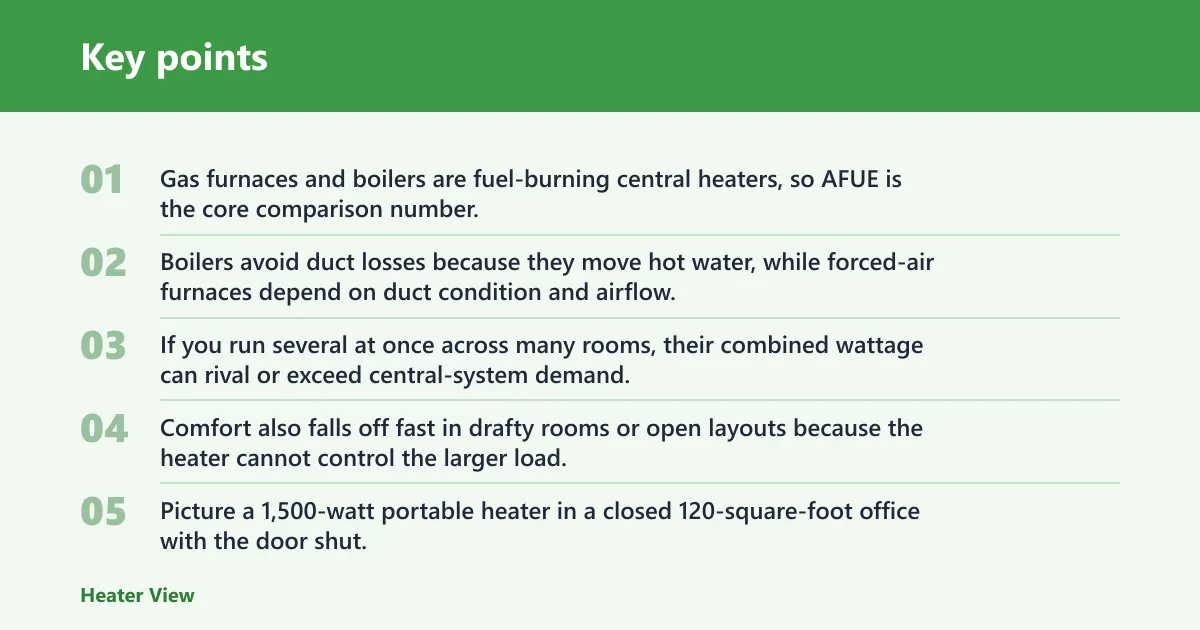
Gas furnaces and boilers are fuel-burning central heaters, so AFUE is the core comparison number. They can deliver strong whole-home heating performance, but real cost also depends on venting setup, combustion adjustment, and distribution losses.
Boilers avoid duct losses because they move hot water, while forced-air furnaces depend on duct condition and airflow. A clean filter and sealed ducts can matter as much as a modest jump in AFUE when the existing air-distribution system is poor.
Electric resistance heaters and portable space heaters
Electric resistance heaters, including baseboards and many portable space heaters, are simple to compare at the point of use. Watt-for-watt electric resistance heat is effectively 100% at the point of use because the electrical input becomes heat in the room. That does not mean every electric heating setup is equally economical across a whole house.
Portable units work best as spot heat. If you run several at once across many rooms, their combined wattage can rival or exceed central-system demand. Comfort also falls off fast in drafty rooms or open layouts because the heater cannot control the larger load.
Picture a 1,500-watt portable heater in a closed 120-square-foot office with the door shut. It may cut the need to heat the rest of the house during work hours. Move the same heater into an open great room, and runtime climbs because the load changed, not because the heater became less efficient.
Heat pumps for space heating and water heating
Heat pumps sit apart because they transfer heat. For space heating, that gives them an efficiency path resistance heat cannot match on a seasonal basis in many climates. For water heating, the same transfer principle is why heat pump water heaters can be three times more efficient than conventional electric water heaters.
That efficiency edge depends on conditions. Cold weather, backup resistance operation, and poor airflow can reduce the advantage for space-heating heat pumps. For water-heating heat pumps, installation location and ambient air conditions affect performance, noise, and dehumidification side effects.
Tank, tankless, and heat pump water heaters
Storage tank water heaters are straightforward, but they carry standby heat loss because hot water sits waiting in the tank. They store 30-80 gallons, and that stored volume should fit the household’s draw pattern.
Tankless units heat water only when needed, which avoids standby loss from stored hot water. Their weak point is sizing for simultaneous flow. Long pipe runs can also delay hot water arrival and inflate waste at the tap.
Heat pump water heaters usually post the highest UEF values in residential water heating. They often cost more upfront, but category-to-category operating cost can be lower when the installation site fits the equipment well.
Do bigger heaters use more energy than smaller ones?
Bigger heaters do not always use more energy than smaller ones, because energy use depends on load, runtime, control behavior, and delivery losses. A properly sized larger unit can finish the job efficiently, while an oversized unit may cycle too often and waste energy, and an undersized unit may run nonstop without meeting demand.
Capacity, runtime, and building load
Capacity tells you how much heat a unit can deliver at one time. Energy use comes from how long it runs to satisfy the space or water-heating load. That is why BTU alone is not an efficiency rating.
A small heater can be cheap to buy and still expensive to live with if it runs almost continuously. A larger unit can use less total energy in some situations if it meets the load cleanly and avoids long recovery periods.
Why oversizing raises cost
Oversized furnaces and boilers can short cycle. Each start-up and shutdown adds loss, and room temperatures can swing more than they should. Oversized water heaters can add standby loss if you pay to keep more hot water ready than the household uses.
Say your home has a modest heating load, but the installed furnace is selected mainly by the old unit’s size. The new furnace reaches thermostat setpoint quickly, shuts off, and restarts often. Comfort feels uneven, and fuel use can disappoint even though the AFUE on the brochure looked better.
When a smaller unit costs more to run
Undersized equipment has its own penalty. A tankless water heater that cannot meet simultaneous demand may force users to stagger showers and appliances or raise setpoints. A small space heater in a drafty large room may run flat-out for hours.
The right comparison is not big versus small. It is matched versus mismatched.
What real-world factors erase rated efficiency?
Rated efficiency gets erased by delivery losses, setup faults, and usage patterns that force the heater to work harder than the label assumes. Dirty filters, duct leakage, poor venting, scale buildup, long pipe runs, standby loss, and short cycling often matter more to the monthly bill than small rating differences between similar models.
Airflow, duct leakage, and filter restriction
Forced-air equipment needs enough airflow across the heat exchanger or coil. A clogged filter cuts airflow, which can reduce heat transfer and increase cycling stress. Leaky ducts lose heated air before it reaches the rooms that need it.
These are delivery losses, not rating losses. The AFUE on the furnace stays the same, but the useful heat reaching the house drops.
Standby losses, pipe runs, and draw patterns
Storage water heaters lose heat while they wait. UEF captures that better than older simple efficiency claims because it includes standby losses and recovery efficiency. Real use still matters. Long hot-water pipe runs waste time, water, and heat before the tap gets hot.
Tankless units avoid standby storage loss, yet they can still cost more to operate than expected when pipe runs are long or the chosen flow rate is too small for the way the household actually uses hot water.
Venting, combustion setup, and room cycling
Combustion appliances depend on proper venting and burner setup. Ventless heaters may appear more efficient in a narrow combustion sense because there is no flue carrying heat outdoors, but that is not the whole decision. Indoor air quality and added moisture matter, and those side effects can outweigh the apparent gain.
For room heaters, cycling matters too. A portable heater in a small sealed room may cycle gently and stay comfortable. In a room with drafts and frequent door opening, the same heater may run nearly nonstop.
Maintenance faults that change operating cost
Maintenance advice only helps if it is tied to a failure mode. Dirty air filters raise blower effort and reduce airflow. Scale buildup in water heaters lowers heat transfer. Badly set dampers, blocked vents, or neglected burner service can reduce delivered heat and raise fuel use.
Watt density and band heaters
Watt density is an element-loading spec, not a homeowner efficiency label, and it matters most when you are selecting industrial-style band heaters for heat transfer and element life. Higher watt density can raise surface temperature and failure risk if the application cannot carry heat away fast enough.
Why watt density affects selection and failure risk
Watt density is power per unit area of the heater surface. It tells you how hard the element is being driven. That affects sheath temperature, heat transfer, and service life more directly than it affects a household utility-bill comparison.
In practical terms, watt density belongs in equipment design and replacement matching. It does not replace AFUE, UEF, COP, or wattage when you are comparing home heating categories.
Ceramic versus mica band heater limits
Ceramic band heaters use insulating ceramic knuckles and are built for higher-temperature duty. Ceramic band heaters have a maximum operating temperature of 600°C, and ceramic band heaters have a max watt density of 6 W/cm².
Mica band heaters are a common economy option for many lower-temperature applications. Mica band heaters have a maximum operating temperature of 340°C, and mica band heaters have a max watt density of 3 W/cm².
Those figures help you match the band heater to the barrel, nozzle, or process conditions. They do not tell you whether one whole-home heating system is cheaper to run than another.
Frequently asked questions
Are all heaters 100 percent efficient?
No. Electric resistance heaters are effectively 100% efficient at the point of use because their electrical input becomes heat in the room, but whole-system and source-energy comparisons are broader than that. Gas systems have combustion losses, and even efficient heaters can lose performance through ducts, venting, standby loss, or cycling.
How do I compare heater efficiency before I buy?
First match the metric to the heater type: AFUE for furnaces and boilers, UEF for water heaters, COP or HSPF2 for heat pumps, and watts plus runtime for electric resistance heat. Then check capacity, installation needs, and Energy Guide estimates so you compare similar products doing the same job.
How do I read heater efficiency labels and spec sheets?
Read the product family first, then find the category-specific rating. Use Energy Guide labels as standardized comparison tools for estimated energy use and operating cost, not exact bills. After that, verify capacity figures such as BTU, GPM, tank size, or wattage so the heater is large enough without being oversized.
Is gas or electric heater efficiency better for home heating?
It depends on the heater type, not only the fuel. Electric resistance heat is very efficient at the point of use, heat pumps can deliver more heat per unit of electricity than resistance heaters, and gas furnaces are compared by AFUE. The better choice turns on climate, distribution losses, and how the home is heated room to room.
What does AFUE mean on a heater?
AFUE means Annual Fuel Utilization Efficiency, the seasonal fuel-efficiency rating used for furnaces and boilers. It helps compare one central combustion heater with another in the same class. It does not include every real-world delivery loss, so duct leakage, airflow problems, and oversizing can still raise operating cost.
Are ventless heaters more efficient than vented models?
In a narrow combustion sense, ventless heaters can avoid flue losses, but that does not make them the best choice by default. Indoor moisture and air-quality effects matter, and those issues are separate from the raw fuel-conversion picture. Efficiency should be judged with the safety and room conditions kept in view.