Garage Heater Maintenance Checklist for Homeowners
Garage heaters should be checked about monthly, cleaned each season, and taken out of service right away if there is a gas smell, scorch marks, or repeated breaker trips. Skipping maintenance raises fire, carbon monoxide, shock, and breakdown risks, and small faults turn into larger repairs. This guide covers routine, seasonal, and safety checks for gas, electric, and infrared garage heaters, plus the warning signs that mean call a pro.
How to use this garage heater checklist


Use the monthly items for quick condition checks, seasonal items before heavy use, and annual items for a full inspection. Give the heater extra attention after dusty projects, water leaks, or storage changes that crowd the area around the unit.
Keep the heater’s manual nearby. It may set tighter limits for clearance, filter type, ignition checks, or service intervals than a general checklist can cover.
What you’ll need
- Flashlight
- Vacuum with brush attachment
- Soft brush or microfiber cloth
- Replacement air filter, if your unit uses one
- Fresh batteries for the carbon monoxide detector
- Phillips and flathead screwdriver
- Noncontact voltage tester for electric units
- Bubble solution or soapy water for leak spotting around accessible gas fittings, if your manual allows homeowner checks
- Step stool, if needed for safe access
Garage heater maintenance matrix
| Task | Heater type | DIY or pro | Frequency | Warning signs | Stop-use triggers |
|---|---|---|---|---|---|
| Vacuum dust from cabinet, louvers, and intake areas | Gas, electric, infrared | DIY | Monthly and after dusty projects | Dust buildup, weak airflow, uneven heat | Burning smell that does not clear, scorch marks, repeated shutdowns |
| Check air filter and clean or replace it | Gas and some electric units | DIY | Monthly or seasonal | Poor airflow, hotter cabinet, short-cycling | Filter is damaged, wet, collapsed, or missing |
| Test carbon monoxide detector and battery | Gas | DIY | Monthly; battery check seasonal | Low-battery chirp, failed test, expired unit | Alarm sounds or detector will not test properly |
| Inspect venting for blockage and visible damage | Gas | Pro for internal vent service; DIY only for visual check if accessible | Seasonal and after storms | Soot, rust, loose joints, bird nest, backdraft smell | Exhaust smell indoors, soot, flue damage, moisture at vent |
| Check thermostat setpoint and heat consistency | Gas, electric, infrared | DIY | Monthly | Short-cycling, uneven heat, wide room swings | Controls do not respond or heater runs without stopping |
| Inspect electrical connections, breaker, and switch | Electric and powered ignition parts on gas units | DIY visual only; pro for wiring repairs | Seasonal | Corrosion, heat discoloration, tripped breaker, loose cover | Burn marks, melted insulation, repeated breaker trips |
| Check gas line and shutoff access | Gas | Pro | Annual | Gas odor, damaged valve, hard-to-reach shutoff | Any gas smell, hissing, or wet-looking leak area |
| Confirm mounting hardware and clearances | Mounted gas, electric, infrared | DIY for visual check; pro if hardware is loose | Monthly and after storage changes | Loose anchors, vibration, moved storage, blocked clearance | Unit shifts, sags, or has combustibles too close |
| Full inspection and burner or internal electrical service | Gas, electric, infrared | Pro | Annual | Persistent odor, rough start, noise, repeated shutdowns | Any unresolved fault that returns after cleaning or reset |
What should you check each month?
Each month, check for dust, moisture, loose hardware, airflow problems, and early warning signs such as soot, tripped breakers, or uneven heat. For gas units, test the carbon monoxide detector and confirm the vent path stays open. Monthly checks catch issues before they turn into shutdowns.
- Clear the area. Move boxes, rags, paint cans, and long-handled tools away from the heater. Keep the clear space the manual requires, because stored clutter traps heat and can block air movement.
- Vacuum dust buildup. Clean louvers, intake slots, fan covers, and nearby surfaces with a brush attachment. Dust can restrict airflow and add odor when the unit starts.
- Check for moisture. Look for rust, condensation, drips, or damp insulation around the unit and vent path. Garage humidity can corrode fasteners and electrical parts faster than a dry indoor room.
- Test controls and heat. Raise the thermostat a few degrees and confirm the heater starts and shuts off normally. Uneven heat, short-cycling, or delayed starts point to a control or airflow problem.
- Inspect safety devices. Press the carbon monoxide detector test button and replace weak batteries. A detector near a combustion appliance should always be working, and many homeowners replace the alarm at the age listed by the manufacturer.
How do you prep a garage heater for winter?
Before winter, do a fuller check than the monthly routine. Check heating systems regularly through winter, and give garage heaters extra attention because cold starts, road salt, and tighter storage often expose weak parts quickly.
- Replace or clean filters. If your heater uses an air filter, clean or replace it before regular cold-weather use. A dirty filter reduces airflow and can make the unit run hotter or cycle more often.
- Inspect venting. On gas heaters, confirm the vent is open, straight, and free of visible damage. Look for soot, rust, loose joints, nests, or signs of exhaust backing up into the garage.
- Check wiring and hardware. Look for loose covers, corrosion at connections, and tight mounting anchors. Tighten accessible fasteners only if the manual allows it; if hardware is bent, cracked, or pulling from the wall or ceiling, stop there.
- Verify shutoff access. Make sure the gas shutoff is visible and easy to reach, and that nothing blocks it. A technician should handle any leak check beyond simple smell-and-visual screening.
Say your ceiling-mounted gas heater runs fine in October, but by December it starts shutting off after five minutes and the garage still feels cold. That pattern points to airflow, venting, or a control problem, not a need to keep resetting it and hoping it settles down.
When should you stop and call a pro?
Stop using the heater if there is a gas odor, soot, scorch marks, repeated breaker trips, water intrusion, or if it shuts down again after cleaning. Call a qualified technician for gas line work, burner service, sealed combustion parts, internal wiring repairs, or vent damage. Those are not homeowner jobs.
Gas heater warning signs
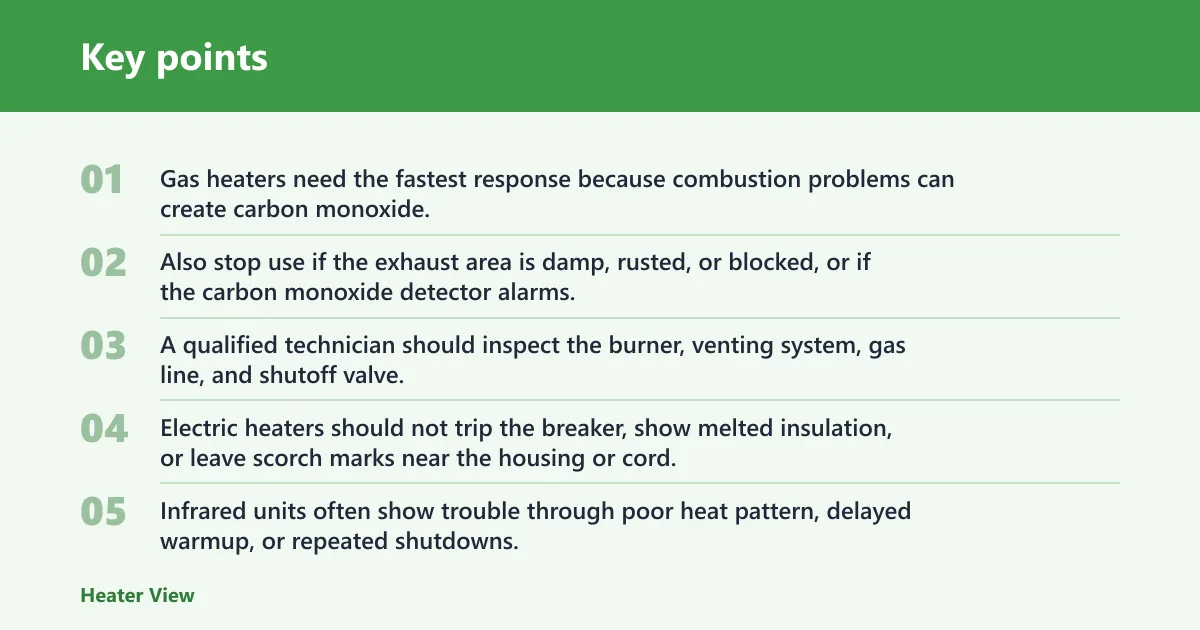
Gas heaters need the fastest response because combustion problems can create carbon monoxide. If you smell gas, see a yellow or lazy flame where the manual expects a steady flame, notice soot, or hear hissing at a fitting, shut the unit off and call a pro.
Also stop use if the exhaust area is damp, rusted, or blocked, or if the carbon monoxide detector alarms. A qualified technician should inspect the burner, venting system, gas line, and shutoff valve.
Electric heater warning signs
Electric heaters should not trip the breaker, show melted insulation, or leave scorch marks near the housing or cord. Repeated breaker trips, warm outlets, and corrosion at terminals point to a wiring problem that needs professional repair.
Suppose a wall-mounted electric heater starts fine in the morning but shuts off every time the garage door opens and cold air rushes in. That can be a ventilation or setpoint issue, but if the breaker also trips, stop using the unit until an electrician checks it.
Infrared heater warning signs
Infrared units often show trouble through poor heat pattern, delayed warmup, or repeated shutdowns. If the emitter area is dusty, the mounting hardware shifts, or nearby stored items have crept into the clearance zone, stop use and correct the setup before restarting.
Any visible damage to the emitter, reflector, or electrical feed also belongs in the pro column. Infrared units depend on correct spacing and stable mounting more than many homeowners expect.
Common mistakes
Most failures start with the same avoidable errors: letting dust pile up, storing boxes too close to the heater, ignoring weak airflow, and skipping seasonal checks. A garage adds road salt, damp air, and clutter, so generic home maintenance habits are often not enough.
- Cleaning the outside but not checking intake and vent openings.
- Replacing batteries in the detector without pressing the test button.
- Assuming a tripped breaker is a one-time event.
- Using the heater with blocked clearance around stored items.
- Trying to fix burners, gas valves, or internal wiring without training.
How often should I service a garage heater?
Use a monthly visual check, seasonal cleaning before heavy winter use, and an annual professional inspection. A routine that includes monthly, quarterly, and annual tasks is more reliable than waiting for a failure, and preventive maintenance is usually far cheaper than reactive repair.
What garage heater maintenance can I do myself?
You can vacuum dust, check filters, test the carbon monoxide detector, verify thermostat response, look for loose hardware, and confirm the area is clear of combustibles. For gas units, keep your role to visual checks unless the manual specifically allows a homeowner step.
What maintenance items are specific to gas versus electric garage heaters?
Gas heaters need vent checks, gas shutoff access, flame and soot inspection, and carbon monoxide protection. Electric heaters focus more on wiring, breaker behavior, corrosion, and cord or terminal condition. Infrared units add extra attention to emitter condition, reflector cleanliness, and mounting stability.
Frequently asked questions
What should be on a garage heater maintenance checklist
Include dust removal, air filter cleaning or replacement, thermostat checks, fastener and clearance checks, carbon monoxide detector testing for gas units, and a visual inspection for corrosion, soot, moisture, and damaged wiring. Add a seasonal and annual task schedule so the same items do not get missed.
When should a professional inspect my garage heater?
Call a pro if you smell gas, see soot or scorch marks, have repeated breaker trips, notice rusted or damaged venting, or hear unusual cycling and shutdowns. Annual service is a good baseline even when the heater seems to work normally.
What safety checks should I do before winter for my garage heater?
Clean dust, check filters, test the carbon monoxide detector, verify the thermostat response, inspect vents, and confirm clearances around the unit. Also make sure the gas shutoff is reachable and that storage has not crept into the heater’s clearance zone.
How do I know if my garage heater is wasting energy or failing?
Watch for short-cycling, uneven heat, long run times, weak airflow, and frequent resets. A heater that runs longer than usual, turns off early, or leaves cold spots is often dealing with a filter, thermostat, venting, or wiring problem that needs attention.