Garage Heater Troubleshooting for Cold Air
If your garage heater blows cold air, start with the heater type, then check thermostat setting, power or fuel supply, airflow, and finally ignition or flame safety. Many units move air before they produce heat. Ignoring the problem can waste energy, trip safety limits, and leave carbon-monoxide or gas faults unresolved. This guide covers garage heater troubleshooting for cold air with a step-by-step decision tree, safe DIY checks, and clear stop points for a pro.
How to tell what kind of heater problem it


“Cold air” in a garage is not one problem. It can mean the blower is running before ignition, the burner lit and then shut off, or a heat pump is in a normal defrost cycle. The heater type matters first, because electric unit heaters, gas or vented units, infrared heaters, and heat pump-based systems fail in different ways.
Cold air vs. lukewarm air vs. blower-only
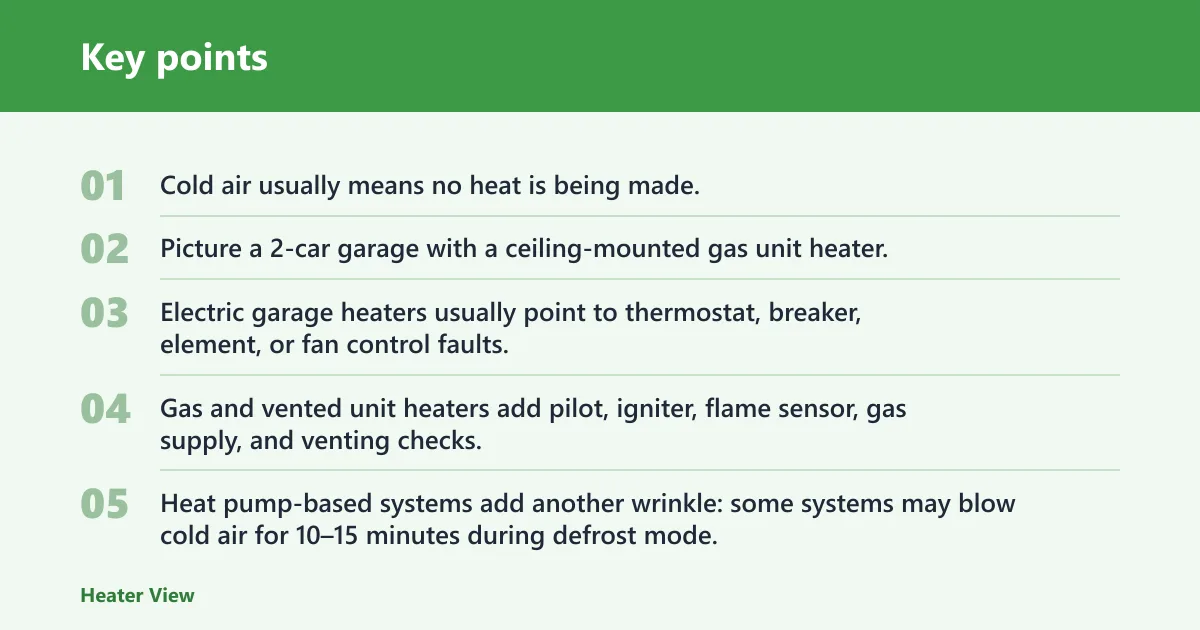
Cold air usually means no heat is being made. Lukewarm air often means the heater is producing some heat, but airflow, short cycling, or garage heat loss is flattening the temperature rise. Blower-only means the fan runs while burners or heating elements stay off, which narrows the fault to control, ignition, safety, or power issues.
Picture a 2-car garage with a ceiling-mounted gas unit heater. If the fan starts, the burners never light, and the air stays room temperature, that is a different path from a unit that lights for a minute, then shuts the flame off while the blower keeps running.
How heater type changes the likely cause
Electric garage heaters usually point to thermostat, breaker, element, or fan control faults. Gas and vented unit heaters add pilot, igniter, flame sensor, gas supply, and venting checks. Infrared heaters may produce little or no moving air, so “cold air” complaints there often mean the room never warmed, rather than the heater blowing cold.
Heat pump-based systems add another wrinkle: some systems may blow cold air for 10–15 minutes during defrost mode. That is normal if it ends on its own, but not if the unit stays in that state or repeats it too often.
Garage heater troubleshooting matrix
| Heater type | Symptom | Likely cause | Safe homeowner check | Pro-only escalation trigger |
|---|---|---|---|---|
| Electric | Cold air | Thermostat not calling for heat, breaker off, failed element, weak blower output | Set Heat mode, fan AUTO, and raise setpoint 5°F above room temperature; check breaker and filters | Burned wiring, tripped limit that returns, weak amp draw, or element replacement |
| Gas or vented | Cold air | Pilot out, igniter failure, flame sensor fault, gas supply issue, safety lockout | Look for a blue flame, check for gas odor, confirm thermostat call, and inspect the air filter | Repeated ignition failure, soot, flame rollout, gas valve, vent, or heat exchanger concerns |
| Infrared | Lukewarm air or no warm feel | Unit not firing, poor placement, or garage heat loss overwhelming radiant output | Confirm power, thermostat call, and clear line of sight to the heated area | Burner, gas train, reflector, or combustion fault |
| Any forced-air unit | Blower-only | Limit switch trip, ignition failure, control signal loss, or fan delay issue | Check thermostat, filter, and whether the blower keeps running after heat stops | Repeated lockouts, overheating, or electrical control diagnosis |
| Heat pump-based system | Short cycling or cold air | Defrost mode, reversing valve issue, refrigerant or control fault | Wait 10–15 minutes to see whether heat returns after defrost | Persistent cold discharge, ice buildup, or valve/control diagnosis |
Is the thermostat telling the heater to run?
A bad setting is one of the fastest explanations for a garage heater blowing cold air. Set the thermostat to Heat mode, set the fan to AUTO, and raise the setpoint by about 5°F above room temperature. If the fan is left on ON, it can move unheated air and make the heater seem broken.
Heat mode, fan auto vs. on, and setpoint checks
The fan setting should be changed to AUTO so it only runs when heat is produced. On many systems, ON means the blower runs continuously, even when the heater is not making heat yet. That is why a garage can feel cold even though the unit is powered.
- Set Heat mode. Confirm the thermostat is not in Cool or Fan Only. If the system is not being told to heat, the blower may still run on some controls.
- Change the fan to AUTO. This keeps air moving only when the heater is producing warmth. It also helps separate a true heating fault from a blower-only condition.
- Raise the setpoint. Set the temperature at least 5°F above room temperature. If the thermostat is too close to room temp, some systems will not call for heat reliably.
The heater may not start if the thermostat is set too close to room temperature. The heater may never start. Set it to 55°F or higher, then wait for a call for heat before moving to ignition or airflow checks.
Battery, control power, and signal failure signs
Battery-powered or smart thermostats can fail at the control level even when the display still lights up. Check batteries first if the thermostat uses them. Signal or control failure signs include no response to setpoint changes, no call-for-heat indicator, or a heater that never starts even though power and fuel are present.
- Replace weak batteries. Use fresh batteries if the thermostat depends on them. Weak battery voltage can break the heat call without fully blanking the screen.
- Watch for call response. Change the setpoint and listen for relay clicks or heater startup. No response can point to a control wiring or thermostat fault.
- Check the power source. Confirm the breaker, switch, or service disconnect is on. A thermostat can be correct while the heater still lacks power.
Could ignition or a pilot fault be the cause?
Yes. On gas garage heaters, a cold-air complaint often comes from ignition failure, pilot failure, or flame detection trouble. If the blower starts but there is no flame, the heater may circulate air without heat until it locks out. Any gas odor changes the response immediately: shut the heater down and get help.
Pilot light and blue flame checks
For pilot-based systems, look for a steady blue flame if the manufacturer’s design uses a standing pilot. A weak, yellow, or absent pilot can keep the main burner from lighting. Follow the manufacturer’s relighting instructions exactly; do not improvise. If gas odor is present, stop and do not relight.
Igniter and flame sensor failure signs
Electronic ignition systems can click without lighting. Hot surface igniters can crack or lose output, and flame sensors can fail from carbon residue or oxidation. A dirty flame sensor is a common first-line maintenance item because it can misread flame presence and shut the burner off while the blower keeps running.
- Listen for ignition attempts. Clicking without ignition points to an igniter, gas supply, or control issue. Repeated click-no-light cycles usually mean the heater is locking out for safety.
- Inspect the flame signal path. If the burner lights and then drops out quickly, the flame sensor may be dirty or failing. Carbon residue and oxidation can interrupt flame detection.
- Follow relight instructions. Only relight a pilot using the manufacturer’s procedure. Do not keep cycling the system if gas odor, soot, or rollout marks appear.
A common first-timer mistake is assuming “the fan works, so the heater works.” On a gas unit, the fan can run perfectly while the igniter, flame sensor, or pilot path is preventing heat.
Can airflow or overheating make it feel cold?
Yes. Dirty filters, blocked return air, weak blower performance, and overheated components can all turn a heating call into a cold-air complaint. If the heater cannot move enough air across the heat source, the safety controls may shut the burners off before useful warmth reaches the garage.
Air filter restriction and weak airflow
Dirty filters are recommended to be replaced every 1–3 months, depending on dust load and run time. A clogged filter cuts airflow, and reduced airflow can trigger overheating or a limit-switch trip. In a garage, dust from vehicles, tools, and stored items often loads filters faster than in a house.
- Inspect the filter first. Replace a dirty filter instead of trying to wash out a disposable one. Restricted airflow can make the air feel cool even when the burner is firing.
- Check intake and return paths. Make sure cardboard, storage bins, or dust are not blocking the return. Garage heaters need clear breathing room to deliver full output.
- Listen for weak airflow. A blower that runs but moves little air may have a motor, capacitor, or wheel problem. Weak air movement lowers temperature rise and can mimic a heat failure.
Limit switch trips and blower-only operation
The limit switch is a safety shutoff for overheating. If the unit overheats, the burners can shut off while the blower keeps running to cool the cabinet. That makes the heater feel like it is “blowing cold air,” but the blower is doing exactly what the safety design calls for.
Repeated limit trips are generally not normal. They usually point to a dirty filter, blocked airflow, failing blower, or duct restriction that should be corrected before the heater is used again.
Does your garage heater need venting and ventilation?
Some do, some do not. Vented gas units must move combustion products outdoors, and propane heaters in garages require proper ventilation. A closed garage is not automatically safe for every heater, especially where exhaust, carbon monoxide, or oxygen depletion are possible. Venting and ventilation are safety issues, not optional extras.
Vented gas units, direct-fired heaters, and propane safety
Garage heater selection depends on garage size, ceiling height, attachment, and ventilation. That matters because a unit sized for a detached, semi-open space may be a poor fit for an enclosed garage. Propane heaters in garages require proper ventilation, and direct-fired systems need the right combustion air and exhaust path.
- Identify the heater type. Check whether it is vented, direct-fired, infrared, electric, or portable. The safe answer changes with the design.
- Confirm ventilation needs. Do not assume a closed garage is acceptable. Combustion heaters need the right exhaust or ventilation arrangement.
- Stop for gas odor. If you smell gas, shut the unit off and leave the area. Do not keep testing the heater.
Garage door infiltration, duct leaks, and heat loss
Garage-specific heat loss can make a working heater feel weak. Door cycling dumps warm air every time the door opens. Uninsulated walls, ceiling losses, and infiltration around the door can overwhelm a small or undersized unit. Duct leaks and disconnected joints can also dump warm air into an attic, basement, or crawlspace instead of the garage.
Small gaps in ducts can be sealed using HVAC foil tape or mastic sealant. That is a valid homeowner check for small openings, but damaged duct runs, loose connections, or heat exchanger concerns belong with a technician.
What else can mimic a cold-air fault?
Heat pump systems and high-efficiency condensating furnaces can act like they are failing when they are doing a different normal or specialized sequence. Heat pumps may blow cool air during defrost. Condensate issues apply only to high-efficiency furnaces or similar condensating systems, not to every garage heater.
Heat pump defrost mode and reversing valve issues
Some systems may blow cold air for 10–15 minutes during heat pump defrost mode. If the cold discharge ends on its own, that may be normal. If it stays cold or repeats often, a reversing valve issue or other control fault can mimic a heating failure and needs service.
Condensate drain problems on high-efficiency systems
High-efficiency furnaces can use a small white PVC condensate drain line. If that line plugs, the unit may shut down or behave oddly. A homeowner can check for visible blockage and flush the line with warm water or vinegar if the manufacturer allows it. A failed condensate pump needs professional attention.
What checks should I do before replacing a garage heater?
Before replacing anything, confirm the problem is really the heater and not the control, airflow, gas supply, venting, or garage heat loss. Many “dead” heaters turn out to be thermostat mistakes, dirty filters, ignition faults, or short-cycling from poor airflow. Replacement should come after the basic checks, not before them.
- Verify the thermostat call. Heat mode, fan AUTO, and a setpoint 5°F above room temperature should create a clear call for heat.
- Check power and fuel. Confirm breaker position, service disconnect, and gas supply where applicable. No power or no fuel is not a heater failure.
- Inspect airflow parts. Replace the filter, clear returns, and look for weak blower performance. Airflow restrictions can cause shutdowns that look like heating failure.
- Separate symptom type. Decide whether the unit is blowing cold air, lukewarm air, blower-only air, or short cycling. That narrows the fault path fast.
- Call for service if needed. Repeated ignition failure, venting trouble, soot, flame rollout, gas odor, or repeated limit trips should not be treated as a DIY replacement trigger.
Frequently asked questions
Why is my garage heater blowing cold air?
Start with heater type, thermostat settings, and airflow. A garage heater can blow cold air when the fan is on AUTO or ON at the wrong time, the setpoint is too low, the filter is clogged, ignition fails, or a safety limit shuts the burners off while the blower keeps running.
Is it safe to use a garage heater in a closed garage?
Not always. Electric heaters can be acceptable if installed correctly, but gas, propane, and direct-fired units bring combustion and ventilation requirements. If the heater uses fuel, treat a closed garage as a safety issue until the manufacturer’s venting and ventilation rules are confirmed.
Should I choose a gas or electric garage heater?
Choose based on garage size, ceiling height, attachment, and ventilation. Gas units often heat larger spaces faster, but they require combustion safety checks and venting. Electric units are simpler to use and avoid combustion exhaust, but they depend on available electrical capacity and may heat more slowly.
Why does my heater run but only blow cold air?
That usually means the blower is working but heat production is not. Common causes include thermostat missettings, dirty filters, ignition or pilot failure, flame sensor trouble, or a limit switch trip. On heat pump systems, defrost mode can also send cool air for 10–15 minutes.
Can a dirty filter make a garage heater blow cold air?
Yes. A clogged filter can restrict airflow enough to cause overheating and a limit-switch shutdown. The blower may keep running while the burners shut off, which feels like cold air. Dirty filters are recommended to be replaced every 1–3 months.
When should I call a technician for a garage heater blowing cold air?
Call for service if you smell gas, see soot or flame rollout, get repeated ignition failures, or see repeated limit-switch trips. Also call if venting seems wrong, a heat exchanger is suspected, or the heater still blows cold air after thermostat, power, filter, and pilot or ignition checks.