Heater Carbon Monoxide Warning Signs
Treat a CO alarm, a severe headache with nausea, or similar symptoms in several people as an emergency: get everyone and every pet outside right away, then call 911 or your gas utility from outside. Carbon monoxide is invisible, odorless, and tasteless, so waiting for a smell or a visible clue can let it build to deadly levels. This guide separates furnace warning signs from other fuel-burning appliance clues and shows when to evacuate versus arrange an immediate inspection.
CO warning signs table
This table helps you sort what you can see or feel into a likely source, urgency, and the safest next move. Carbon monoxide cannot be seen, smelled, or tasted, so the point is not to identify the gas itself; it is to combine symptoms, appliance clues, and alarm status.
| Symptom or appliance clue | Likely source | Urgency level | Safest next step |
|---|---|---|---|
| Headache, dizziness, nausea, sleepiness, confusion, or vomiting in one or more people | None confirmed yet; could be furnace, water heater, stove, fireplace, or another fuel-burning appliance | Emergency if several people or pets are affected, or if symptoms improve after leaving | Leave the home and call 911 from outside |
| CO alarm sounds | Any fuel-burning source in the home | Emergency | Get everyone outside immediately and call 911 from outside |
| Yellow or flickering flame | Furnace, water heater, stove, or fireplace | Urgent inspection | Shut the appliance down if the manufacturer allows it and arrange a qualified inspection |
| Soot or scorch marks near the appliance | Furnace, water heater, stove, or fireplace | Urgent inspection | Stop using the appliance and have it checked before restart |
| Rust or water streaks on the vent pipe | Furnace or water heater | Urgent inspection | Schedule vent and draft inspection right away |
| Furnace shuts itself off often | Furnace | Urgent inspection | Arrange service; do not keep resetting it |
| No symptoms, no alarm, and no appliance clues | None identified | Routine if the system is maintained | Keep CO alarms installed and test them monthly |
What are the first signs of carbon monoxide exposure?
Early CO exposure often looks like the flu or a bad headache: headache, dizziness, weakness, nausea, vomiting, sleepiness, and confusion. The warning becomes more serious when several people or pets feel ill at the same time, or when symptoms ease after leaving the house.
Possible CO symptoms in people and pets
Pets can act off before people do. A dog, cat, or other animal may seem weak, unusually sleepy, unsteady, or sick to the stomach while people in the home think they have a virus or a migraine. That pattern deserves immediate caution.
Symptoms alone do not prove carbon monoxide. A headache can come from many things. The safer rule is to treat a sudden cluster of flu-like symptoms, especially in winter or around fuel-burning appliances, as a warning until an alarm, inspection, or outside air clears the question.
When symptoms are more likely to be CO than a virus or headache
CO becomes more likely when symptoms start in more than one person, appear after the furnace or fireplace has run, or improve after everyone gets outside. That pattern is more concerning than a single isolated headache.
Suppose two adults and a child feel sleepy and nauseated after a cold night with the furnace running. That combination should be treated as possible CO, not as a simple cold. Leave first, then sort out the source from outside.
Can a heater cause carbon monoxide?
Yes, a fuel-burning heater can produce carbon monoxide if combustion is incomplete or exhaust leaves the appliance the wrong way. Gas furnaces, water heaters, stoves, and fireplaces can all be sources. Electric furnaces and heat pumps do not burn fuel, so they do not make CO.
Gas furnace risks
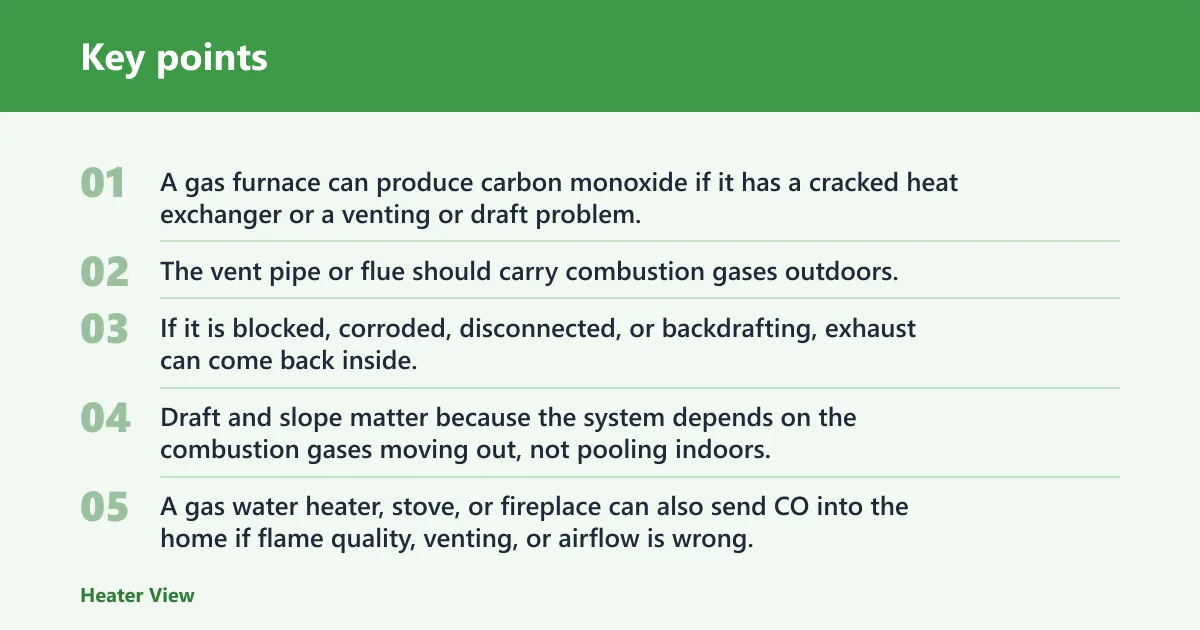
A gas furnace can produce carbon monoxide if it has a cracked heat exchanger or a venting or draft problem. A heat exchanger separates combustion gases from indoor air; if it cracks, exhaust can leak into the airstream or ductwork.
The vent pipe or flue should carry combustion gases outdoors. If it is blocked, corroded, disconnected, or backdrafting, exhaust can come back inside. Draft and slope matter because the system depends on the combustion gases moving out, not pooling indoors.
Water heater, stove, and fireplace risks
Do heaters emit carbon monoxide? Fuel-burning ones can. A gas water heater, stove, or fireplace can also send CO into the home if flame quality, venting, or airflow is wrong. That is why the source is not always the furnace.
Do not assume a gas smell means CO. Natural gas odor is a separate issue. A gas leak may smell strong, while carbon monoxide itself cannot be seen, smelled, or tasted. The response changes depending on which hazard is present.
Why electric furnaces and heat pumps are different
Can an electric heater cause carbon monoxide? No, not if it is truly electric and does not burn fuel. Heat pumps and electric furnaces do not produce CO. If someone in an all-electric home has CO symptoms, another fuel-burning appliance may be the source.
That is why all-electric homes still need CO alarms if they have a gas water heater, fireplace, attached garage, or another fuel-burning appliance nearby. The heating system may be electric while another device in the house is not.
How do I know if my furnace is leaking carbon monoxide?
You cannot confirm a leak from one clue alone, but a furnace with a cracked heat exchanger, blocked flue, or draft problem can release CO. Safe visual checks can point to trouble. Combustion analysis and draft checks are what confirm the condition.
Heat exchanger problems
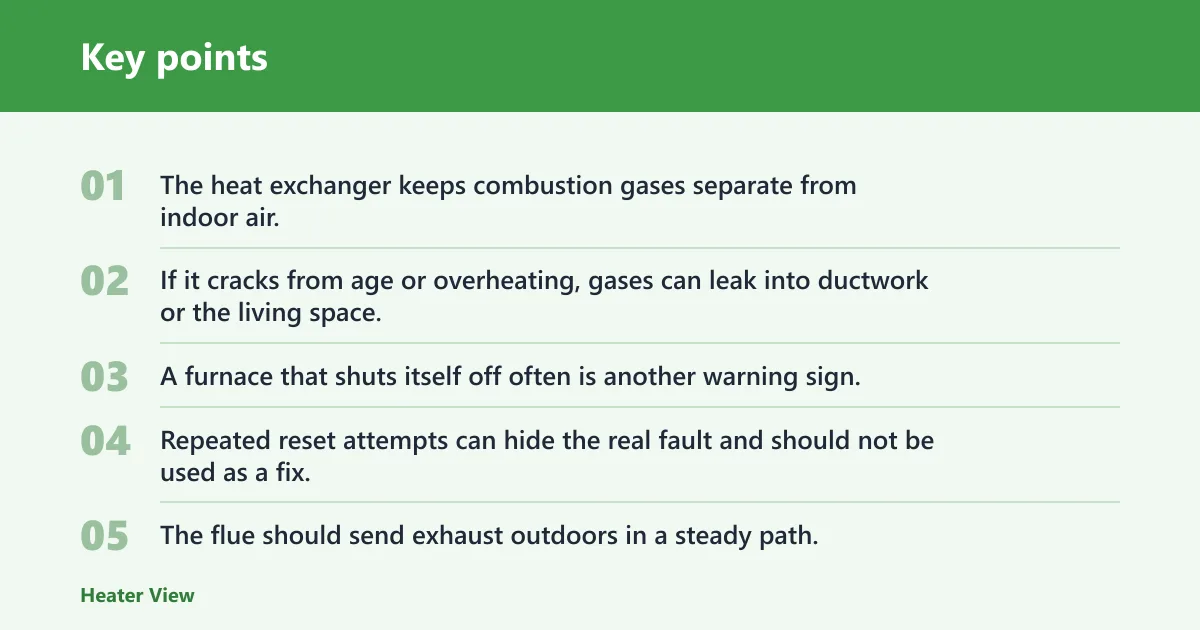
The heat exchanger keeps combustion gases separate from indoor air. If it cracks from age or overheating, gases can leak into ductwork or the living space. That is a furnace failure, not a normal operating condition.
A furnace that shuts itself off often is another warning sign. It may be protecting itself from a combustion or venting problem. Repeated reset attempts can hide the real fault and should not be used as a fix.
Flue and draft problems
The flue should send exhaust outdoors in a steady path. Blockage, corrosion, disconnection, or backdraft can interrupt that path and move combustion gases where they do not belong. If the vent pipe looks damaged, the furnace should not be ignored.
Rust or water streaks on the vent pipe can signal a problem. Moisture can mean exhaust is cooling or condensing in the wrong place, and that can go along with poor draft. Those are inspection clues, not signs to keep the system running and hope for the best.
Visible appliance clues you can spot safely
Yellow or flickering flame is a warning sign. A normal gas flame should usually look steady and blue. Soot or scorch marks around the furnace also point to poor venting or combustion problems.
Picture a furnace with a mostly blue flame but a flickering yellow tip and black streaks near the burner compartment. That pattern does not prove CO on its own, but it is enough to stop treating the unit as normal and to arrange a qualified inspection.
What should you do if a CO alarm goes off?
If a CO alarm sounds, leave the house immediately and call 911 from outside. Do not stay to investigate, do not open every appliance to inspect it, and do not try to keep using the furnace while you sort it out. The alarm is the signal to exit first.
Immediate evacuation and 911
-
Get everyone outside. Move every person and pet out of the home at once. Leave doors as you pass through them; speed matters more than trying to turn off every appliance.
-
Call 911 from outside. Use a cell phone or neighbor’s phone after you are in fresh air. If your utility advises a second call to the gas company, make it from outside as well.
-
Wait for clearance. Do not re-enter until emergency responders or the gas utility say it is safe. A CO alarm can keep sounding if the source is still active.
What not to do after you leave
Do not open windows as a substitute for evacuation if the alarm is sounding. Do not assume the alarm is false because no one feels sick yet. No symptoms does not mean safe, and some exposures start low before they become obvious.
Do not relight appliances or restart breakers to “see what happens.” If the source is a furnace, water heater, stove, or fireplace, power-cycling the equipment can obscure the failure and add delay when the next step should be diagnosis.
When to call a qualified HVAC pro
After emergency responders clear the home, a qualified HVAC technician should inspect the furnace and venting before normal use resumes. A pro can check the heat exchanger, burner operation, vent pipe, and draft conditions that are not visible from the room.
Combustion analysis can matter here. It uses a probe in the flue to measure exhaust gases and draft pressure, which can help identify incomplete combustion and venting problems that a quick look cannot confirm.
CO alarm placement and maintenance
The CPSC recommends CO alarms on every level of the home and outside sleeping areas. Use battery-operated or battery-backup alarms so they still work during a power outage. Monthly testing and end-of-life replacement are part of normal upkeep.
Where alarms belong in the home
Place alarms on every level, including basements, and outside sleeping areas. If the home has multiple sleeping zones, each zone needs coverage close enough to wake people before exposure rises.
Do not put all the alarms in one hallway and call that enough. A furnace in the basement and bedrooms on an upper floor need coverage on both levels because CO can move through the house unevenly.
Testing, battery care, and replacement timing
-
Test the alarm monthly. Use the test button once a month to confirm the unit sounds. Monthly testing catches dead batteries, failed electronics, and silent alarms before they are needed.
-
Check the battery backup. Replace batteries as directed by the manufacturer, and do not remove them because of nuisance alarms. A backup is part of the device, not an optional extra.
-
Replace by end of life. Look for the end-of-life date printed on the alarm and replace the unit by that date. An expired alarm is not a reliable safety device.
Why a pro inspection matters after a warning sign
A furnace warning sign should lead to testing, not guesswork. A technician can use combustion analysis, draft checks, and vent inspection to see whether the appliance is producing incomplete combustion or failing to exhaust properly. That is how the source gets confirmed.
Combustion analysis
Combustion analysis measures what comes out of the furnace during operation. A probe in the flue can show exhaust gases and draft pressure, which helps identify whether the appliance is burning fuel the way it should. That is more useful than guessing from a flame color alone.
Draft checks and vent inspection
Draft checks tell whether the vent system is pulling exhaust the right direction. A pro can also look for corrosion, blockage, disconnection, or poor slope in the flue. Those problems can send combustion gases indoors without leaving an obvious room-level clue.
A common first-timer mistake is to see no soot and assume the furnace is fine. A clean exterior does not rule out a cracked heat exchanger or a vent problem. Testing has to happen at the appliance and in the vent path, not only on the outside panel.
Frequently asked questions
What are carbon monoxide symptoms?
Carbon monoxide symptoms often look like a flu without fever: headache, dizziness, weakness, nausea, vomiting, sleepiness, and confusion. If several people or pets feel sick at once, or if the symptoms ease after going outside, treat it as possible CO and leave the home before trying to find the source.
Can a heater cause carbon monoxide: yes, if the heater burns?
Yes, if the heater burns fuel. Gas furnaces, water heaters, stoves, and fireplaces can produce CO when combustion or venting fails. Electric furnaces and heat pumps do not burn fuel, so they do not make carbon monoxide.
Can a gas heater cause carbon monoxide?
Yes. A gas heater can make carbon monoxide if it has poor combustion, a cracked heat exchanger, blocked venting, or backdrafting. A yellow or flickering flame, soot, scorch marks, or rust on the vent pipe are warning signs that call for inspection.
What should I do if a carbon monoxide alarm goes off?
Leave the house immediately and call 911 from outside. Do not stay to investigate or keep using any fuel-burning appliance. Wait for emergency responders or the gas utility to say it is safe before going back in.
Can I stay in the house if I suspect carbon monoxide?
No, not if the alarm is sounding or if multiple people or pets are sick. Carbon monoxide can build without warning, and symptoms are not reliable enough to keep you in the home. Get outside first, then call for help and wait for clearance.
Which heaters can and cannot produce carbon monoxide?
Gas furnaces, gas water heaters, stoves, and fireplaces can produce carbon monoxide if they burn fuel. Heat pumps and electric furnaces cannot, because they do not burn fuel. If an all-electric home has CO symptoms, look for another fuel-burning appliance or an attached source.