How to Choose Between OEM and Aftermarket Block Heaters
Choose OEM if your engine has a factory-specified heater port and you want the safest fit; choose aftermarket if you need lower cost, wider availability, or a replacement for a hard-to-find unit. Pick wrong and you can waste money on leaks, weak heat transfer, or a heater you cannot service in winter. This guide compares fitment certainty, repairability, cold-weather performance, and total ownership cost across several vehicle and equipment types.
OEM vs aftermarket block heaters: what actually changes
An OEM block heater is built for a specific vehicle application, often with a part number tied to engine family, coolant passage design, and mounting location. I like that because it cuts guesswork at install time.
An aftermarket block heater may be universal or semi-universal. It can use different mounting styles, including coolant, magnetic, and oil-pan formats. That wider fit range helps, but it also pushes more checking onto the buyer for engine, access, and cord setup.
Factory-specified fitment and part-number matching
OEM units are the safer bet when the engine has a clearly defined heater port and the vehicle maker has already matched the heater to the cooling system. That matters on newer vehicles, on engines with tight packaging, and on jobs where the wrong part can create a leak or a bad contact surface.
The downside is simple. OEM parts can be harder to source, especially on older vehicles, out-of-production engines, or mixed fleets. If the original part disappears from the catalog, repair time can stretch into winter waiting time.
Universal and semi-universal fitment paths
Aftermarket heaters fill the gaps that OEM coverage leaves behind. I see them most often when a vehicle is missing the factory part, when the engine family has several mounting options, or when the owner wants a replacement without dealer pricing.
The tradeoff is fit certainty. Universal does not mean plug-and-play. It means the buyer must check the mounting style, heater type, cord routing, and whether the vehicle has room for the body and connector.
Where each option tends to fail
OEM units usually fail on availability, cost, or limited service parts. Aftermarket units usually fail on the basics: wrong fit, slow heating from poor contact, cord damage, and connector issues that show up after a few freeze-thaw cycles.
Those failure modes matter more than brand loyalty. A heater that fits badly is expensive even if the sticker price looks low.
According to Best Engine Block Heater: Reviews & Buying Guide 2025 — The article says some users report the heater takes 3 to 4 hours to cool it completely.
Which block heater fits your vehicle and engine?
Fit starts with the engine family, cylinder layout, and coolant passage design. Diesel and gas engines can use different heater locations, and the same vehicle model can have more than one engine option with different heater requirements.
Do not buy by vehicle name alone. Verify the exact engine code, the mounting style, and the plug style before ordering.
Diesel versus gas: why fitment checks differ
Diesel engines often spend more time in cold-start trouble, so they are more likely to have purpose-built heater ports or higher-wattage options. Gas engines may use smaller heaters or different mounting methods, especially on passenger cars and light SUVs.
That changes both installation and output. A universal heater may fit a diesel truck, but only if the coolant passage, plug access, and wattage suit the engine’s needs.
Cars, trucks, SUVs, tractors, generators, and boats
Vehicle category changes the decision. Trucks and buses often have more room and may accept larger coolant heaters. Cars and SUVs can be tighter around the block and wiring path. Tractors and generators often favor serviceable, repeatable setups. Boats add moisture exposure and cord routing concerns.
Hotstart is described as working for trucks, buses, cars, generators, and boats. That broad fit matters, but it still does not remove the need to confirm the exact application.
How heater type changes the decision
Heater type often matters more than brand. A magnetic heater, coolant heater, and oil-pan heater solve different problems, and each one brings its own fit and installation tradeoffs.
Coolant heaters and when they make sense
Coolant heaters warm the engine through the cooling system. They usually give the most even heat transfer when the engine has the right port and access. That makes them a strong choice for vehicles that sit through repeated cold starts.
They can be harder to install if the access point is tight or buried. If the connection is poor, performance drops fast.
Oil-pan heaters and cold-soak use cases
Oil-pan heaters work well where cold-soak is the main problem. They help keep oil moving better at startup, which matters on engines that sit outside overnight in deep cold.
They do not heat the whole engine the same way a coolant heater can. That makes them useful in some cases and incomplete in others.
Magnetic heaters and their practical limits
Magnetic heaters are the easiest to place, but they depend heavily on surface contact and safe mounting. Kat’s 1160 is a 300-watt magnetic heater, and it can cover up to 20 square inches. That gives a sense of the footprint and the limited heat zone.
Magnetic units are often best for temporary use, older equipment, or engines where a permanent installation would be awkward. They are not the first choice when the engine needs a more precise, sealed fit.
Is OEM better than aftermarket in extreme cold?
OEM is safer when the heater port is known, access is difficult, or the engine has little tolerance for fit error. In extreme cold, though, wattage, heater type, and contact quality can matter more than the logo on the box.
A well-chosen aftermarket heater can perform very well. A poorly matched OEM part can still heat slowly if the design does not suit the engine or the power draw is too low for the climate.
Wattage and warm-up speed
Wattage changes how quickly the heater can raise temperature and how much power it draws. Zerostart 3500043 is a 1000-watt block heater. That is a very different starting point from a 300-watt magnetic unit.
Higher wattage can help in severe cold, but it also means more current draw and more attention to cord quality and outlet capacity. A 1500W unit can be appropriate in harsher conditions, but only if the vehicle, cord, and electrical setup can handle it.
Cold-start performance versus fit certainty
Cold-start performance is worthless if the heater will not install cleanly or cannot be serviced later. For a daily driver in a mild winter, a universal heater may be enough. For an engine that must start every morning at deep subzero temperatures, fit certainty often matters more.
That is where OEM tends to win on safety of selection, not automatically on raw heat output.
When a universal unit is good enough
A universal heater is usually fine when the vehicle has easy access, the engine family is well documented, and the owner can confirm the mounting location before buying. It also makes sense for older engines and mixed fleets where part availability is the bigger problem.
On a diesel truck, universal can work, but only after verifying the plug style, heater type, and available space around the block or coolant passage.
What specs should you check before buying?
Check wattage, voltage, cord length, connector quality, heater type, and the exact application. CSA approval is useful as a safety signal, but it does not tell you whether the heater fits your engine or whether the cord routing will survive winter use.
Those checks prevent most bad purchases. They matter more than any marketing description.
Wattage, voltage, and power draw
Match wattage to climate severity and engine size. Lower wattage means slower heat-up and lower power draw. Higher wattage can improve performance in extreme cold, but it also raises the burden on the cord, connector, and outlet.
Voltage must match the vehicle setup and the local electrical supply. If the rating is wrong, stop there.
Power cord length, connector quality, and extension-cord compatibility
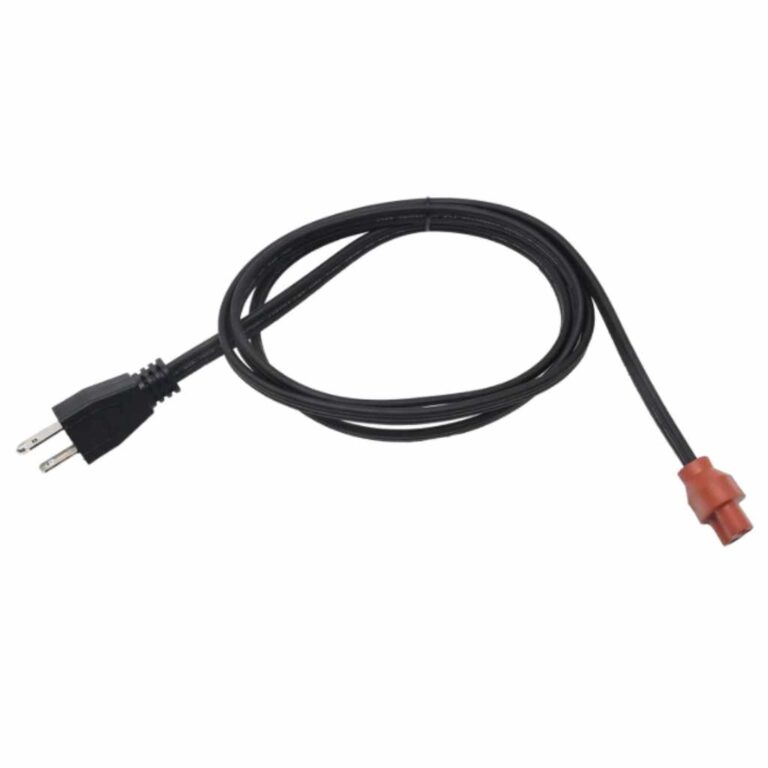
Hotstart includes a 4-foot power cord. That is short enough to make cord routing a real issue on some vehicles, especially where the outlet is not close to the mounting point.
Inspect connector quality, strain relief, and cold-weather flexibility. Extension cords add another failure point. In cold weather, a stiff cord or weak connector can fail long before the heater body does.
CSA approval and what it does and does not tell you
Zerostart is described as CSA approved. That signals a safety and compliance review, which can help buyer confidence. It does not prove the heater will fit your engine, heat fast enough for your climate, or survive a poor installation.
Think of approval as one filter, not the whole decision.
| Decision factor | OEM block heater | Aftermarket block heater |
|---|---|---|
| Fit certainty | 5 | 3 |
| Installation risk | 4 | 3 |
| Cold-start performance | 4 | 4 |
| Parts availability | 3 | 4 |
| Warranty support | 4 | 3 |
| Total cost of ownership | 3 | 4 |
On this matrix, OEM wins on fit certainty and usually on installation confidence. Aftermarket wins when availability, serviceability, and lower ownership cost matter more than factory matching. Neither side wins every category.
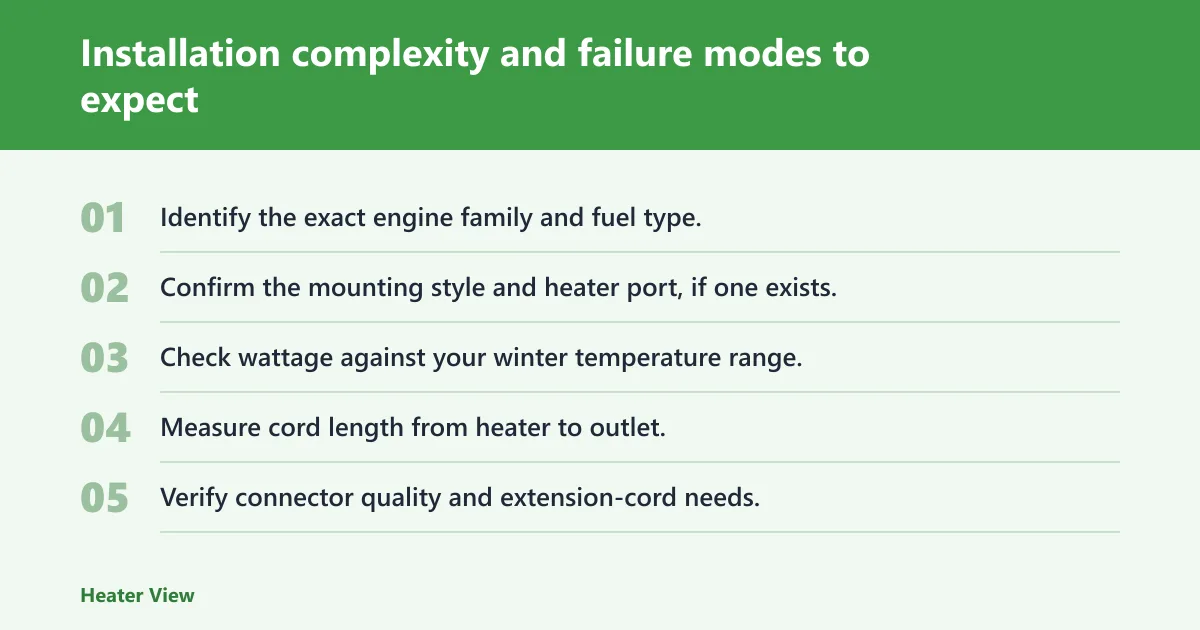
Installation complexity and failure modes to expect
Some installs are quick. Others need access around the block, undertrays removed, or careful routing near hot or moving parts. The hard part is often not inserting the heater. It is making sure the final location will stay dry, secure, and easy to service.
Hotstart has a one-year warranty, and the unit is described as vibration and shock tested. The heater uses an aluminum body. Those details point to durability expectations, but they do not erase the need for careful placement.
Quick installs versus jobs that need more access
Magnetic heaters can be quick to place. Coolant heaters often take longer because they depend on access to the correct port. Oil-pan heaters may be simple or awkward depending on pan shape and underbody clearance.
If the job requires removing splash shields or reaching blind behind accessories, the risk of installer error goes up.
Mounting location concerns
Do not mount a heater where road debris, heat, or vibration can damage it. Keep an eye on cord exit paths, clamp points, and anything that can rub through insulation over time.
That matters on trucks and commercial equipment, where vibration loads are higher and access is often tighter.
Common failures: poor fit, slow heating, cord damage, connector issues
Poor fit usually shows up as weak heat transfer or fluid seepage. Slow heating often traces back to wattage that is too low for the climate or a heater type that does not suit the engine. Cord damage and connector issues often come from routing mistakes or cheap accessory cords.
Some users report the heater takes 3 to 4 hours to cool it completely. That is a reminder that surface temperature and cool-down time should be considered when routing cords or choosing a mounting spot.
- Identify the exact engine family and fuel type.
- Confirm the mounting style and heater port, if one exists.
- Check wattage against your winter temperature range.
- Measure cord length from heater to outlet.
- Verify connector quality and extension-cord needs.
- Look for CSA approval and warranty terms.
- Compare part price, labor, and replacement risk.
Frequently asked questions
What is the difference between OEM and aftermarket block heaters?
OEM block heaters are made for a specific vehicle or engine application, often with a factory part number and matched mounting path. Aftermarket heaters are built for broader fitment and may use universal or semi-universal mounting. The main difference is fit certainty versus flexibility.
Is an OEM block heater better than an aftermarket one?
OEM is better when the engine has a factory-specified heater port and the goal is the safest fit. Aftermarket can be the better buy when the original part is unavailable, the engine is older, or total cost matters more than perfect factory matching.
Will an aftermarket block heater fit my engine?
It can, but only if the engine family, cylinder layout, coolant passage design, and mounting space match the heater’s design. Diesel engines often need extra attention because their fitment and cold-start demands can differ from gas engines. Check the exact application, not just the vehicle model.
Do OEM block heaters cost more to install?
Not always, but they can if the factory part is easier to fit and the aftermarket option needs extra adaptation. In some cases OEM saves labor because the intended port, cord path, and mounting location are already known. In others, part cost is the bigger difference.
Which block heater is more reliable in extreme cold?
Reliability in extreme cold depends on fit, wattage, and heater type. A correctly matched OEM unit can be very dependable, but a well-chosen aftermarket heater with the right wattage may perform just as well. Poor contact or weak cords matter more than brand preference.
Can I use a universal block heater on a diesel truck?
Yes, if the heater type, wattage, mounting space, and connector fit are right for the truck’s engine. Diesel applications often benefit from higher wattage and careful fit checks. Verify the exact engine family, access to the block or coolant passage, and cord routing before buying.