How Block Heaters Help with Cold Starts in Diesel Engines
Block heaters help diesel engines start by warming the block, coolant, and nearby metal before cranking. In practical winter use, they matter most once temperatures fall below freezing and especially in the single digits Fahrenheit and colder. They can reduce cranking strain, shorten time to first fire, and cut white smoke on startup. They do not fix weak batteries, failed glow plugs, gelled fuel, bad cables, or injector faults. Diesel OEM owner’s manuals, battery manufacturer cold-cranking guidance, and cold-weather diesel fuel guidance all point to the same split: use the heater for the temperature problem, then diagnose the rest of the starting system if symptoms remain.
For pickups, tractors, and standby generators, the result depends on engine size, heater wattage, how exposed the equipment is to wind, and how long it sat outside. A 400W to 1,000W heater may be enough for one engine in mild subfreezing weather, while larger blocks or colder outdoor parking often need longer preheat time. In other words: the heater is a strong winter-start aid, but it is only one part of the cold-start system.
Block heaters and diesel cold starts
Diesel engines rely on compression ignition, so cold weather works against them in several ways at once. Thick oil raises starter load, cold batteries deliver less current, and cold metal pulls heat away from the compressed air charge faster than the fuel can ignite it. A block heater changes that temperature problem. OEM cold-weather starting sections for diesel pickups and industrial engines generally describe the same basic benefit: preheating reduces the amount of cold the engine has to overcome during the first revolutions.
What the heater warms first
A block heater is an electric immersion or coolant-heating device that uses household AC power to raise engine block and coolant temperature before you crank the engine. It heats the metal around the cylinders and, in many designs, the coolant that moves through the block and head. That preheating cuts heat loss during the first compression strokes. This is why many OEM manuals and cold-weather operation guides recommend preheating before starts in freezing conditions, especially for vehicles and equipment parked outside overnight.
Coolant matters because it carries heat through the engine. When it is warmer, the block and head begin from a higher temperature, and the first combustion event is more likely to light off cleanly. Antifreeze mix still provides freeze protection; the heater changes temperature, not coolant chemistry. Transport and fleet cold-weather guidance commonly treats heater use as part of a broader winter-start routine, not a substitute for proper coolant freeze protection or winter-grade fuel.
Why warmer metal helps combustion
Diesel fuel needs enough heat from compression to ignite. In a cold engine, the compressed air loses heat to cold metal faster, so the first few injections may burn poorly or only partly. A warmer block, head, and coolant slow that heat loss, which helps the engine fire sooner and settle into a cleaner idle. SAE and OEM cold-start discussions consistently describe cold-soak heat loss as a major reason diesels become harder to start at low ambient temperature.
What changes during the first seconds of cranking
During cranking, the starter must turn a cold, high-compression engine while the oil is thick and the battery is already weakened by low temperature. The block heater does not reduce compression itself. It makes the engine easier to turn and quicker to light by shrinking the temperature gap the starter has to overcome. That distinction matters because a heater can improve start quality without masking a battery or cable problem that still needs attention.
Why diesel starts get harder in the cold
Cold weather can make diesel starting harder because the engine needs more cranking effort exactly when the battery may deliver less. The fuel, oil, battery, and combustion chamber all move in the wrong direction at once. That is why a start that seems marginal at 15°F can become a no-start near or below 0°F. Battery manufacturers commonly note that available cranking power drops as temperature falls, and OEM manuals often warn that battery performance and starting capacity are reduced in cold weather.
Compression ignition needs more cranking effort
Diesels use high compression ratios, so the starter must work harder than in many gasoline engines. Cold air and cold metal make the first combustion events less efficient, which means the starter may need to spin the engine longer before it fires. Every extra second of cranking draws more current from an already cold battery. That is why many diesel owners notice the difference between a “slow but starts” morning and a true winter no-start once the temperature falls further.
Cold oil increases starter load
Engine oil viscosity rises as temperature falls. Thicker oil moves more slowly through galleries and bearings, and it adds drag to the rotating assembly. That extra drag increases starter load at the exact moment the battery output is dropping, which is why winter starts can feel slow and labored even before the engine tries to fire. SAE cold-flow and viscosity guidance points to the same principle: low temperatures increase fluid resistance, which can affect both lubrication and cranking effort.
Cold batteries deliver less current
Battery cold-cranking performance commonly drops in low temperatures, so the same battery may deliver less usable amperage on a freezing morning than it does in mild weather. State of charge matters too. A weak or partly discharged battery may still power lights, but not enough starter current for repeated diesel cranking. CCA rating matters, but health matters just as much. Battery manufacturer specifications and OE service literature both emphasize that cold performance depends on both battery condition and ambient temperature.
Suppose a pickup sits outside at 5°F with a battery that is already aging. If the starter turns slowly before any smoke appears, the battery side deserves attention before fuel or glow plugs. A block heater may still help, but it will not restore lost cranking output. This is where a simple wear reduction explanation matters: the heater can lessen cold-start stress, but it cannot make up for weak electrical supply.
How a block heater helps cold starts
A block heater mainly helps by reducing the amount of cold the starter and combustion chamber have to fight. That usually means faster cranking, quicker firing, less white smoke on startup, and a shorter warm-up period. It can also reduce wear from repeated cold starts because the engine spends less time in a thick-oil, low-temperature condition. OEM manuals, fleet cold-weather guides, and diesel maintenance references generally frame the heater as a cold-start aid, not a cure-all.
Faster cranking and quicker firing
When the block and coolant start warmer, the engine usually reaches ignition sooner. The starter still has to do the same mechanical work, but the engine often needs fewer revolutions before the first cylinders fire. That can be the difference between a prompt start and a long crank that drains the battery.
Less white smoke and rough idle
White smoke on startup often means fuel is entering the cylinder before combustion is stable. A colder chamber makes that more likely, because the fuel can condense or burn incompletely. By warming the block and head, a heater can reduce that startup smoke and help the idle smooth out faster.
Shorter warm-up after startup
The heater does not fully warm the whole engine to operating temperature. It does, however, shorten the time needed for the coolant and metal to reach a useful starting point. That matters in short trips, where a diesel may otherwise spend a large part of the drive still warming up.
When should you plug in a block heater?
Start with ambient temperature, then adjust for heater wattage, wind exposure, and how long the vehicle sits outside. In many OEM recommendations, below-freezing weather is the point where preheating becomes useful, and single-digit Fahrenheit weather is where it often becomes strongly beneficial. A garage, windbreak, or insulated hood area can reduce the needed plug-in time. Cold-weather agencies and engine makers also note that exposed parking in wind can make a heater work much harder than sheltered parking.
Ambient temperature as a guide
There is no universal cutoff for every diesel. Engine design, battery health, and parking conditions change the answer. As a practical rule, many owners start using a block heater in below-freezing weather, and many rely on it heavily once temperatures fall into the single digits or lower. The colder and windier the setting, the more likely a heater will pay off.
How wattage and parking conditions change timing
Plug-in time depends on heater wattage and how much cold the vehicle loses before starting. A higher-wattage heater can raise temperature faster than a lower-wattage unit. Outside overnight parking, especially in wind, usually calls for longer preheat time than a vehicle parked in a sheltered space. Engine size matters too: a small pickup diesel may warm differently than a larger tractor engine or a standby generator set.
Overnight use versus a shorter preheat
Some engines are fine with a few hours of preheat; others may benefit from overnight use during severe cold. A common rule of thumb is to start with about 2 to 4 hours for mild subfreezing conditions and lengthen that window as temperatures drop. Check the engine maker’s guidance if it is available. Some OEM manuals specify minimum plug-in times, while others recommend longer preheat for severe cold or uncovered outdoor parking.
| Ambient band | Typical heater wattage | Realistic block/coolant temperature rise | Typical preheat time | Notes and caveats |
|---|---|---|---|---|
| 32°F to 15°F | 400W to 750W | Modest rise, often enough to take the edge off a cold soak | 2 to 4 hours | Better for sheltered parking, smaller pickup engines, and lighter-duty use; wind can reduce the benefit |
| 15°F to 0°F | 750W to 1,000W | Moderate rise, usually noticeable at startup | 4 to 8 hours | Common range for pickups, tractors, and some generators; larger blocks or exposed parking may need more time |
| 0°F to -20°F | 1,000W and up, or engine-specific OEM heater | More limited rise in deep cold, especially outdoors | 6 to 12+ hours | Best results depend on insulation, wind protection, battery condition, and engine design; some setups need overnight plug-in |
| Below -20°F | Engine-specific, often paired with battery maintainer or additional heater types | Highly variable | Overnight or per OEM guidance | Outcomes vary widely by engine size, coolant capacity, heater location, and whether the equipment is parked outside |
Caveat: The table above is a practical comparison, not a universal specification. The real temperature rise depends on engine displacement, heater placement, coolant circulation, insulation, wind, cord losses, and whether the vehicle or machine is parked inside or outside. Always defer to the engine or chassis manufacturer’s instructions when available, especially for heavier pickup diesels, farm tractors, and generator sets.
- Check the forecast and note the overnight low.
- Confirm the heater is rated for your engine.
- Use a longer plug-in time for colder, windier, or uncovered parking.
- If the engine still cranks slowly, look at battery health and oil grade next.
Cold-start matrix
This matrix separates the symptom from the likely cause and the next step. It also shows whether a block heater likely helps, is only part of the fix, or is not the main issue. That distinction matters because many winter no-start complaints come from batteries, glow plugs, or fuel waxing rather than the block itself. If you want a quick symptom-to-fix path, this is the most useful diagnostic section.
| Symptom set | Likely cause | Block heater likely helps? | Next step |
|---|---|---|---|
| Difficult cranking, slow starter, dim lights | Weak battery, thick oil, or both | Insufficient alone | Test battery state of charge and CCA, then check oil grade and cable condition |
| White smoke, rough idle, then gradual improvement | Cold combustion chamber or weak glow plug function | Likely helps, but may not be enough | Confirm glow plugs or intake air heater operation and verify plug-in time |
| No start, white smoke, and fuel line symptoms in deep cold | Fuel waxing or gelled fuel | Not the main issue | Move the vehicle to warmth if possible, use winterized fuel or approved anti-gel treatment, and inspect filters |
| Engine cranks normally after plugging in, but still misfires | Glow plug fault, injector issue, or air in fuel | Insufficient alone | Check preheat system and fuel delivery before blaming the block heater |
| No-block-heater response after long plug-in time | Failed heater, no power, or wrong diagnosis | Not the main issue | Verify outlet power, cord condition, and heater continuity; then inspect battery and preheat systems |
Difficult cranking
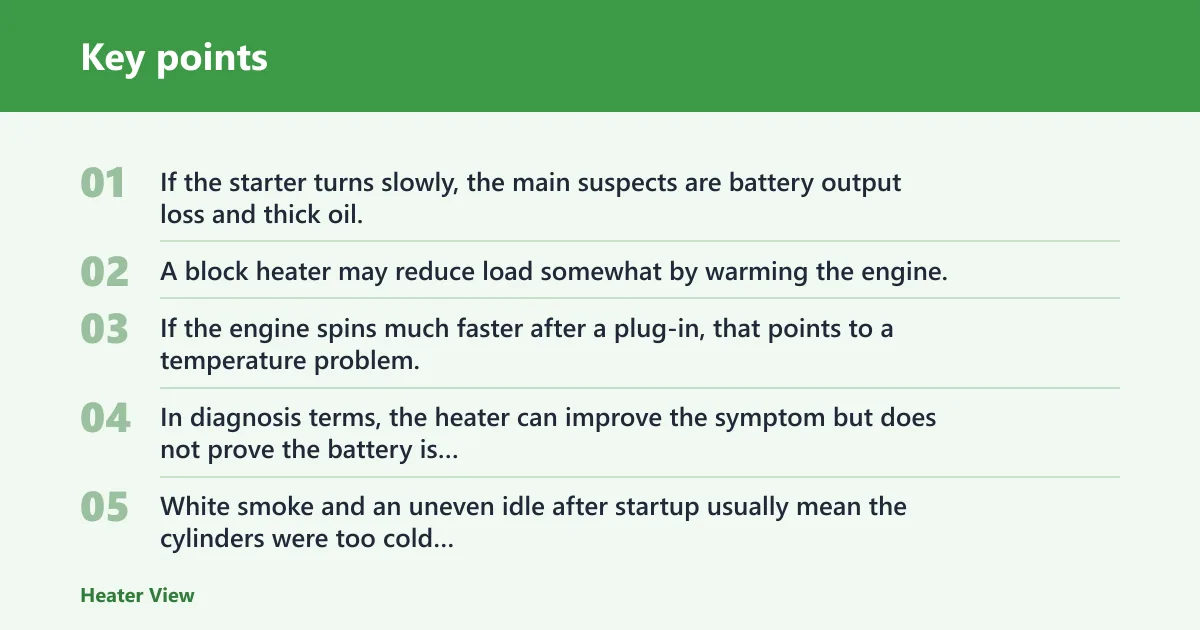
If the starter turns slowly, the main suspects are battery output loss and thick oil. A block heater may reduce load somewhat by warming the engine, but it will not repair a weak battery. If the engine spins much faster after a plug-in, that points to a temperature problem. If it still drags, look elsewhere first. In diagnosis terms, the heater can improve the symptom but does not prove the battery is healthy.
White smoke and rough idle
White smoke and an uneven idle after startup usually mean the cylinders were too cold for clean combustion. Here, a block heater often helps because it raises the starting temperature of the block and coolant. If the smoke remains heavy after proper preheating, suspect glow plugs, injectors, or low compression rather than the heater. This is where temperature can mask a real engine fault, so the diagnosis limit matters.
Fuel waxing
Fuel gelling is different from a cold block. Diesel wax crystallization happens in the fuel system, not in the engine metal, and a block heater does not solve it by itself. Winterized fuel, anti-gel treatment, and a clean fuel filter are the right tools when fuel flow is restricted by cold. Diesel fuel cold-flow guidance from transport agencies and fuel suppliers consistently recommends preventing waxing with proper seasonal fuel and additives rather than relying on engine heat alone.
Weak battery and glow plug faults
A weak battery reduces starter speed before the engine ever tries to fire. Failed glow plugs or an intake air heater can leave the combustion chamber too cold for stable ignition even if the block is warm. The heater may still help, but those faults can still stop the engine from starting cleanly.
Picture a tractor that sits outside at -10°F. The owner plugs in the block heater for a few hours, but the starter still labors and the dash lights dim. That points more strongly to battery or cable trouble than to the heater itself. A warmer block cannot make up for low amperage. The same pattern can show up on an older pickup or a standby generator after a cold soak: if electrical delivery is weak, the heater is only part of the solution.
Will a block heater fix every winter starting problem?
No. A block heater helps with the temperature side of cold starts, but it cannot fix every winter starting problem. It is useful for easier cranking, quicker firing, less smoke, and faster warm-up. It is not a cure for fuel waxing, weak batteries, failed glow plugs, bad cables, or contaminated fuel. OEM and battery-maker guidance are consistent on that boundary: preheat helps the engine; it does not replace electrical or fuel-system repair.
What it can fix
It can reduce cold metal losses, help the first combustion events happen sooner, and cut the time the engine spends running rough after startup. That is especially valuable in below-freezing weather, where the block, oil, and battery are all under stress. It can also reduce the strain of repeated cold cranking.
What it cannot fix
It cannot replace battery capacity, restore dead glow plugs, or thaw gelled fuel in the lines and filter. It also cannot correct injector faults, air leaks in the fuel system, or poor fuel quality. If the engine still behaves badly after preheating, the next step is diagnosis, not more plug-in time.
When to look beyond the heater
If the engine still starts poorly after a reasonable plug-in period, inspect the battery, charging system, glow plugs or intake heater, fuel filter, and fuel quality. A block heater is one part of the cold-start system. Treating it as the only winter tool often hides the real fault.
Can a block heater damage the engine if left on too long?
A block heater is generally meant for extended preheat in cold weather, but it should still be used with a sound cord, a proper outlet, and a heater that matches the engine. Leaving it on too long is less the issue than leaving damaged equipment powered. The real risks are electrical faults, not normal preheating. Most OEM and safety guidance focuses on cord condition, correct installation, and safe power supply rather than a hard maximum plug-in time.
What to check before plugging
Inspect the cord, plug, and heater connection for wear, corrosion, or damage. If the cord is frayed or the plug is loose, replace it before use. Check that the outlet is grounded and that any extension cord is rated for the load if one is unavoidable.
Cord, outlet, and heater condition
Use only a heater designed for the engine and installed correctly. A loose connection can overheat. A bad cord can fail under load. These are safety issues, not engine-warmth issues. If the heater or cord runs hot in normal use, stop and inspect the setup before the next cold night. Electrical safety agencies and workplace guidance generally treat damaged cords and overloaded connections as the real hazard.
Timer use and electrical safety
A timer can cut wasted power and helps match preheat time to the weather. It is especially useful when the vehicle sits outside overnight and does not need to be plugged in for many hours. A block heater should not be left running blindly forever without checking the cord, heater condition, and outlet safety.
Frequently asked questions
How do block heaters help with cold starts in diesel engines?
A block heater warms coolant and nearby metal before startup, which reduces heat loss during compression ignition. That makes the engine easier to crank, quicker to fire, and less likely to puff white smoke on the first start. It also shortens the time needed to reach a smoother idle after startup.
How long should I plug in a block heater before starting a diesel?
The answer depends on temperature, heater wattage, and parking conditions. A common rule of thumb is 2 to 4 hours in mild subfreezing weather, with longer times needed in deeper cold or windy outdoor parking. If the engine still cranks slowly, battery and oil checks matter too. For some equipment, OEM guidance may recommend longer plug-in times or overnight preheat in extreme cold.
Do block heaters improve fuel gelling or just starting?
They mainly help starting. Fuel gelling can happen in the fuel system when diesel wax crystallizes in extreme cold, and a block heater does not fix that on its own. If gelling is the problem, use winterized fuel, approved anti-gel treatment, and a clean fuel filter.
Will a block heater work on any diesel engine?
No single setup fits every diesel. Pickup trucks, tractors, generators, and passenger diesels can use different heater styles and wattages, and not every engine has the same plug-in arrangement. Check the engine or vehicle specification before buying or installing one, and verify that the heater matches the cooling system.
What temperature is cold enough to use a block heater?
Below freezing is a sensible point to begin using one, and single-digit Fahrenheit weather is where it often matters most. The exact threshold depends on engine design, battery health, oil grade, and whether the vehicle is parked outside. A sheltered vehicle may need less preheat than one exposed to wind.
Does a block heater reduce white smoke and rough idle on startup?
Usually, yes. By warming the block, head, and coolant before cranking, it helps the first injections burn more completely and stabilizes idle sooner. If white smoke or rough running persists after proper preheating, look at glow plugs, injectors, compression, or fuel delivery rather than the heater alone.