Are Extended Water Heater Warranties Worth It? Guide
Extended water heater warranties are often worth considering when they add labor coverage or cover parts you would otherwise pay for out of pocket, and the premium stays relatively modest compared with a replacement job. Skip them if the heater is near replacement age or the plan excludes labor. This guide compares coverage, exclusions, and when paying cash makes more sense.
Extended water heater warranties: what you are actually comparing
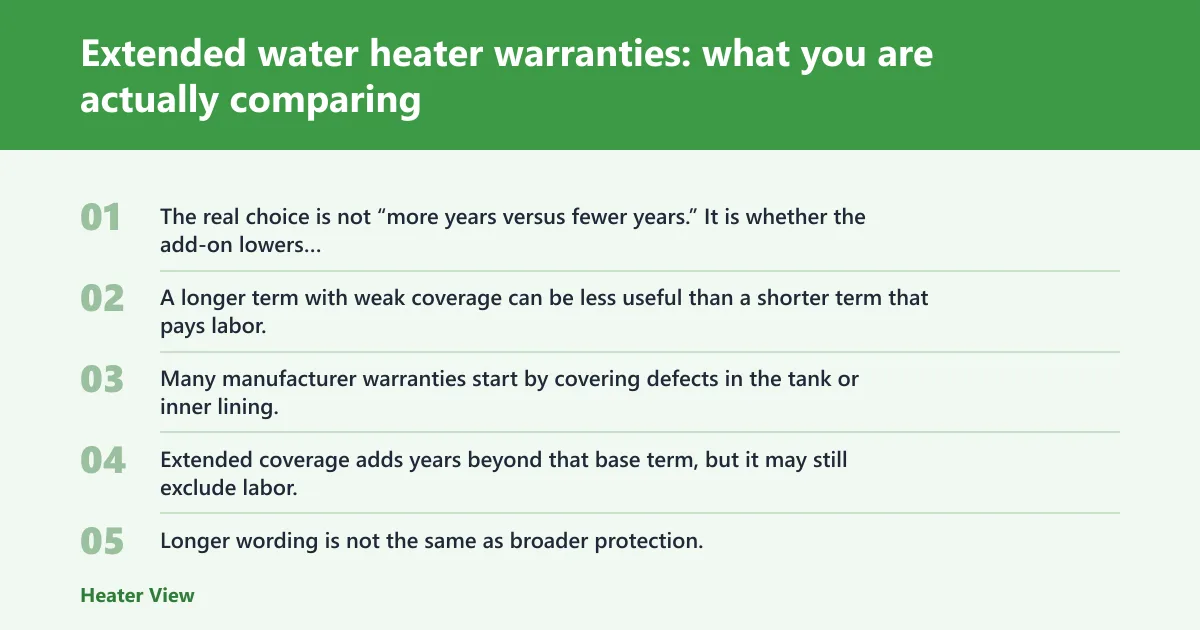
The real choice is not “more years versus fewer years.” It is whether the add-on lowers your likely out-of-pocket cost during the time you expect to keep the heater. A longer term with weak coverage can be less useful than a shorter term that pays labor, trip charges, and diagnosis.
Base warranty versus extended coverage
Many manufacturer warranties start by covering defects in the tank or inner lining, plus selected parts. Extended coverage adds years beyond that base term, but it may still exclude labor, may require registration, and may only apply to specific components. Longer wording is not the same as broader protection.
For example, American Water Heaters warranties can last six, eight, or ten years, but that length drops to one year outside a single-family home. American Standard offers a 6 or 12 year limited tank and parts warranty, and may let buyers upgrade to 12 years for an additional fee. Bosch tankless warranty terms can range from 3 to 15 years.
The three cost buckets: parts, labor, and replacement timing
Warranty value usually comes from three buckets: parts, labor, and timing. Parts coverage may pay for a failed control board, burner, valve, or tank defect. Labor coverage pays the technician. Timing matters because a heater near the end of its expected life may fail after the warranty has already lost much of its practical value.
Labor often decides the math. A warranty that only covers a part can still leave you paying for diagnosis, trip charges, drain-down, removal, and reinstallation. On storage tank units, those costs can change whether the add-on is worth buying.
Side-by-side comparison table: buy the add-on or self-insure
| Scenario | What the warranty actually pays for | What labor still costs | When self-insuring is cheaper |
|---|---|---|---|
| New build with a standard tank | Often parts and tank or lining defects, if registered on time and installed to spec | Usually diagnosis, trip charge, and installation labor unless labor is explicitly covered | Cheaper if the add-on costs more than a small share of likely labor-only exposure and you plan to sell before the base term ends |
| 7- to 10-year replacement horizon | Useful only if coverage extends past the base term and includes the failure types most likely in that period | Can erase the value of a parts-only claim because the labor bill remains yours | Cheaper if the unit is already several years old, the warranty is parts-only, or the premium approaches the cost of one repair visit |
| High-use family home | May pay for defects in the tank lining, control parts, or burner parts more often than a low-use home would need | Still matters a lot because hot-water outages tend to trigger immediate service calls | Cheaper if the plan excludes labor, requires expensive installation conditions, or the heater is already near replacement age |
A common first-timer mistake is buying years, not coverage. A 12-year label sounds strong, but if the plan only pays for a covered part and leaves labor untouched, the home can still face most of the repair bill.
What does an extended water heater warranty cover?
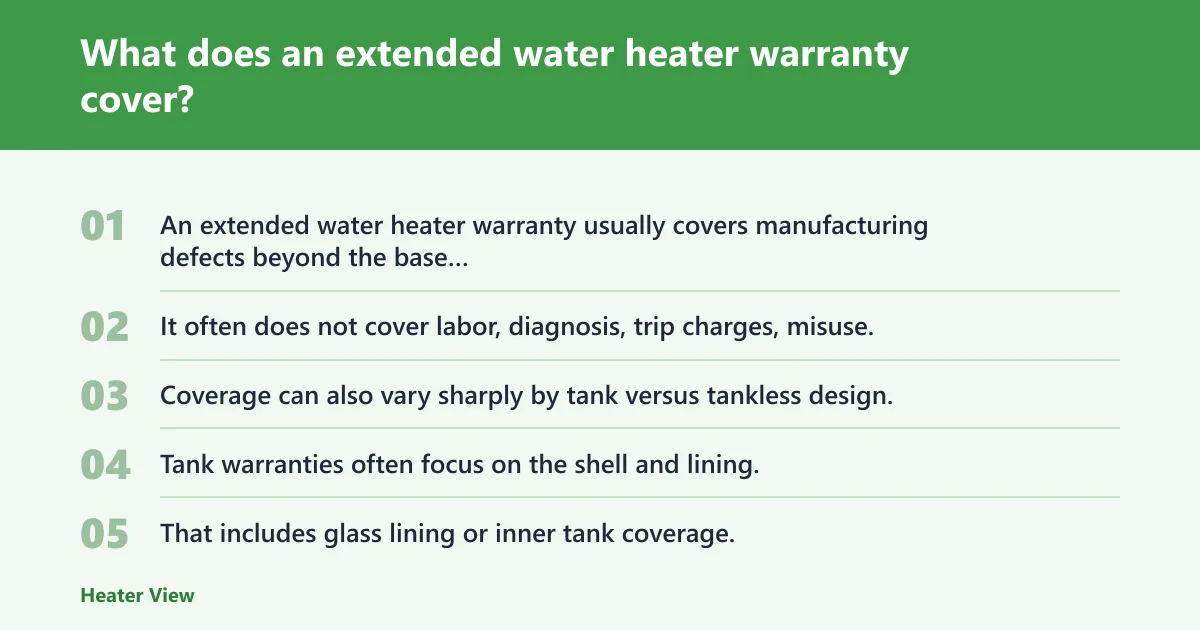
An extended water heater warranty usually covers manufacturing defects beyond the base term, especially the tank, inner lining, or selected parts. It often does not cover labor, diagnosis, trip charges, misuse, or problems caused by poor installation. Coverage can also vary sharply by tank versus tankless design.
Tank or glass lining coverage
Tank warranties often focus on the shell and lining. That includes glass lining or inner tank coverage, which matters because lining failure can lead to corrosion and leaks. American Standard’s 6 or 12 year limited tank and parts warranty is a good example of how a brand may bundle tank and parts language together.
Water heater manufacturer warranties commonly center on manufacturing defects, not wear from scaling, sediment, or abuse. For tankless units, Bosch tankless warranty terms can range from 3 to 15 years, while Bosch mini-tanks have a 6 year inner tank warranty. Those details matter because the failure mode differs by product type.
Parts covered beyond the base term
Extended plans may cover a thermostat, control board, heating element, gas valve, or other listed part after the standard term ends. A.O. Smith has some tankless warranties lasting 15 years, while most A.O. Smith models have six-, eight-, or ten-year warranties. The exact part list is always model-specific.
Do not assume “parts” means every part. Some plans cover only named components, and some only cover the tank itself. Others limit coverage to the original owner and to a single-family residence.
Common exclusions: labor, diagnosis, and trip charges
Many extended warranties exclude labor or cap it at a short period. Bosch provides five years of parts coverage and one year of reasonable labor on some products, which shows how quickly labor terms can shrink compared with the headline term. Diagnosis and trip charges may also remain yours.
That matters because a covered part is not a free repair. If a technician replaces a control board but charges for the diagnostic visit, travel, and installation, the claim value can fall quickly.
How much does an extended water heater warranty cost?
The price is best judged against the value of one likely claim, not against the warranty term alone. If the add-on is a small fraction of a replacement job and it includes labor, it can make sense. If it only adds years to a parts-only promise, self-insuring is often the cheaper route.
Up-front price versus likely claim value
Extended warranty pricing varies by brand, model, and seller, and many brands do not publish a single flat price. The right comparison is simple: compare the add-on cost against the likely value of one repair or replacement during your ownership window. If the heater is new and the plan covers labor, the odds improve.
For a homeowner keeping a heater past the base term, the add-on can be worthwhile when it meaningfully reduces a failure that would otherwise require both a part and a service call. If it only duplicates a long standard term, the value falls fast.
When labor charges erase the savings
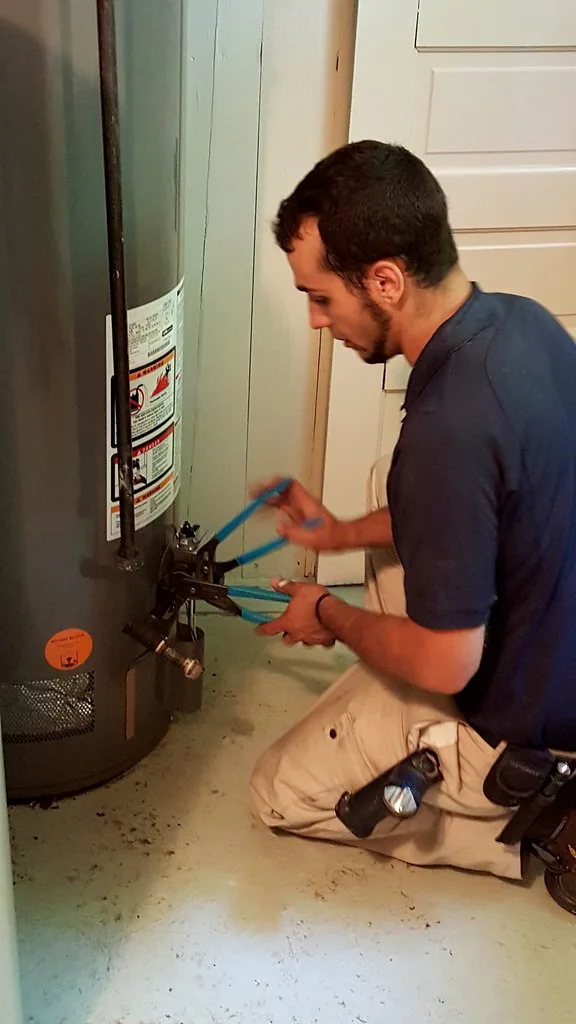
Labor can erase the savings even when the part is free. A technician may still charge for diagnosis, drain-down, removal, reconnection, and testing. That is why a parts-only warranty can be weak protection on a water heater, especially if replacement requires same-day service.
Suppose a storage tank leaks at year 7 and the warranty covers the tank but not labor. The owner may still pay for shutoff, removal, hauling, and a new installation. In that case, the claim may cover the failed shell while leaving much of the real bill untouched.
When paying out of pocket can be cheaper
Self-insuring is usually cheaper when the heater is already halfway through its life, the add-on does not include labor, or the house may be sold before the base coverage expires. It is also cheaper when the unit has strong factory coverage already, such as a 10-year tank term with limited added benefit from the extra years.
That decision often fits owners who can set aside the premium and a little extra for one repair visit. If the chance of filing a claim is low, keeping the cash can beat paying for a warranty rider that never gets used.
What can void or limit water heater warranty coverage?
Warranty claims often fail on paperwork or installation conditions, not on the part itself. Missing registration deadlines, using the wrong installer, relocating the unit, or using it in a non-residential setting can shorten coverage or void it entirely. Those terms matter as much as the year count.
Warranty registration timing and proof of purchase
Warranty registration may be required at installation, and deadlines can affect validity. Bosch warranties can begin on installation date or manufacture date, which means missing paperwork can change the start of coverage. Proof of installation or sales date may also be needed when you file a claim.
Keep the model number, serial number, invoice, and installation record together. If the manufacturer asks for dates and documents, a missing receipt can turn a valid defect into a denied claim.
Installation conditions, permits, and approved parts
Improper installation can void coverage. That can include incorrect venting, wrong gas sizing, unapproved electrical work, or failure to follow the installation manual. Some warranties also require approved parts or a qualified installer, so a DIY change can be expensive later.
Dealers often present the add-on as simple protection, but the fine print usually ties the warranty to the installation being done exactly as required.
Anode rod requirements and non-residential use limits
Some extended warranties may require a second anode, and some brand-specific warranty extensions can require one at registration. That is a direct deal-killer if the condition is missed. The same goes for non-residential use: American Water Heaters warranty length drops to one year outside a single-family home.
Rental, commercial, and other non-residential settings can shorten coverage sharply. If the home is used as a rental or the heater is moved, the warranty may be non-transferable or reduced. Bosch warranties are non-transferrable and require proper installation and usage.
Decision table: when the warranty is worth it

The best answer depends on ownership horizon, use intensity, and how much of the repair bill the plan actually absorbs. Base term length matters, but labor coverage and registration rules usually matter more. Here is the practical comparison.
| Homeowner scenario | Typical risk profile | Warranty value | Self-insure or buy? |
|---|---|---|---|
| New build | Low near-term failure risk, clean paperwork, easier registration | Good if the plan adds labor coverage and the home will be kept long enough to use it | Buy if the premium is modest and the term reaches beyond the base warranty |
| 7- to 10-year replacement horizon | Short remaining ownership window, higher chance you will not reach the payoff point | Limited unless the add-on is inexpensive and labor is included | Usually self-insure unless the heater has a known expensive failure profile and strong labor protection |
| High-use family home | More hot-water demand, more wear, more service calls | Best when the plan covers both parts and labor, and registration requirements are easy to satisfy | Buy if the unit is still early in life and the plan clearly outperforms one out-of-pocket repair |
Choose an extended warranty if… / choose self-insuring if…
Choose an extended warranty if you expect to keep the heater past the base term, the plan includes labor or at least meaningful labor reimbursement, and the registration or anode conditions can be met at installation. It also helps when the heater sits in a single-family home and the brand term is otherwise short.
Choose self-insuring if labor is excluded, the unit is already near replacement age, the home may be sold soon, or the coverage is non-transferable and tied to strict conditions. Self-insuring also makes sense when the base warranty is already strong enough that the add-on adds little practical value.
Scenario notes that make the difference
Say your 50-gallon tank is going into a new build and the dealer offers extra years for a modest fee. The add-on may be reasonable if it includes labor and registration is done at installation, because the owner has time to use the coverage.
Suppose a tankless unit in a high-use household needs recurring service after year 8. A parts-only plan may still leave the family paying for labor and visit fees, while a plan with labor reimbursement could materially change the bill. The fine print decides which outcome applies.
Are extended water heater warranties worth it?
They are worth it when the add-on covers the costs that actually hurt: labor, diagnosis, and the parts most likely to fail during your ownership window. They are usually not worth it when the plan only adds years to a parts-only promise, especially if the heater is already aging or the house may be sold soon.
How long do standard water heater warranties usually last?
Standard water heater warranties commonly run 6, 8, 10, 12, or 15 years, but the term depends on brand, model, and whether the unit is tank or tankless. American Water Heaters warranties can last six, eight, or ten years, while some A.O. Smith tankless warranties last 15 years. Non-residential use can shorten the term sharply.
What does an extended water heater warranty cover?
An extended warranty usually covers manufacturing defects in the tank or inner lining and selected parts after the base term ends. It may also add limited labor protection. It often does not cover diagnosis, trip charges, improper installation, misuse, or problems caused by moving the unit or using it in a non-residential setting.
Do extended warranties cover labor for water heater repairs?
Sometimes, but often only briefly or not at all. Bosch provides five years of parts coverage and one year of reasonable labor on some products, which shows how limited labor coverage can be. If labor is excluded, the owner can still pay for diagnosis, travel, removal, and reinstallation even when the part itself is covered.
Are water heater warranties transferable if I sell my house?
Often no. Many warranties are limited to the original owner, and some are explicitly non-transferable. Bosch warranties are non-transferrable, for example. Before relying on transfer value, check whether the policy follows the heater, the home, or neither, and whether the new owner must register the unit again.
What voids a water heater warranty?
Common warranty killers include missed registration deadlines, missing proof of purchase, improper installation, using unapproved parts, relocating the unit, and using the heater outside the covered residential setting. Some brands also require special conditions, such as a second anode at registration. If any of those terms are missed, the claim can fail.
Should I buy the dealer’s extended warranty on a water heater?
Buy it only after checking what it pays for, not just how long it lasts. If the dealer plan includes labor, matches your ownership horizon, and has manageable registration rules, it may be sensible. If it is parts-only, non-transferable, or tied to strict installation conditions, self-insuring is often the better bet.