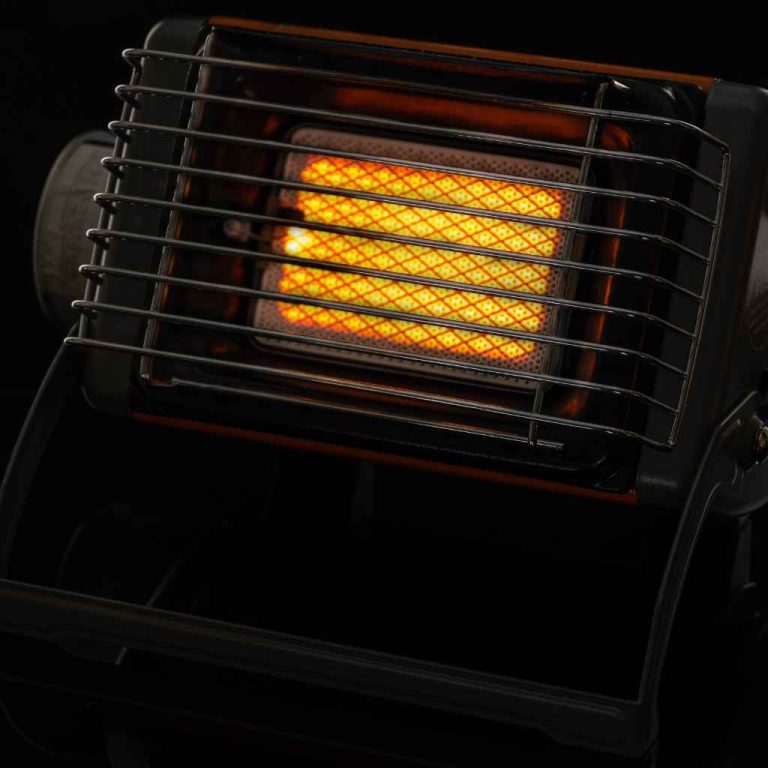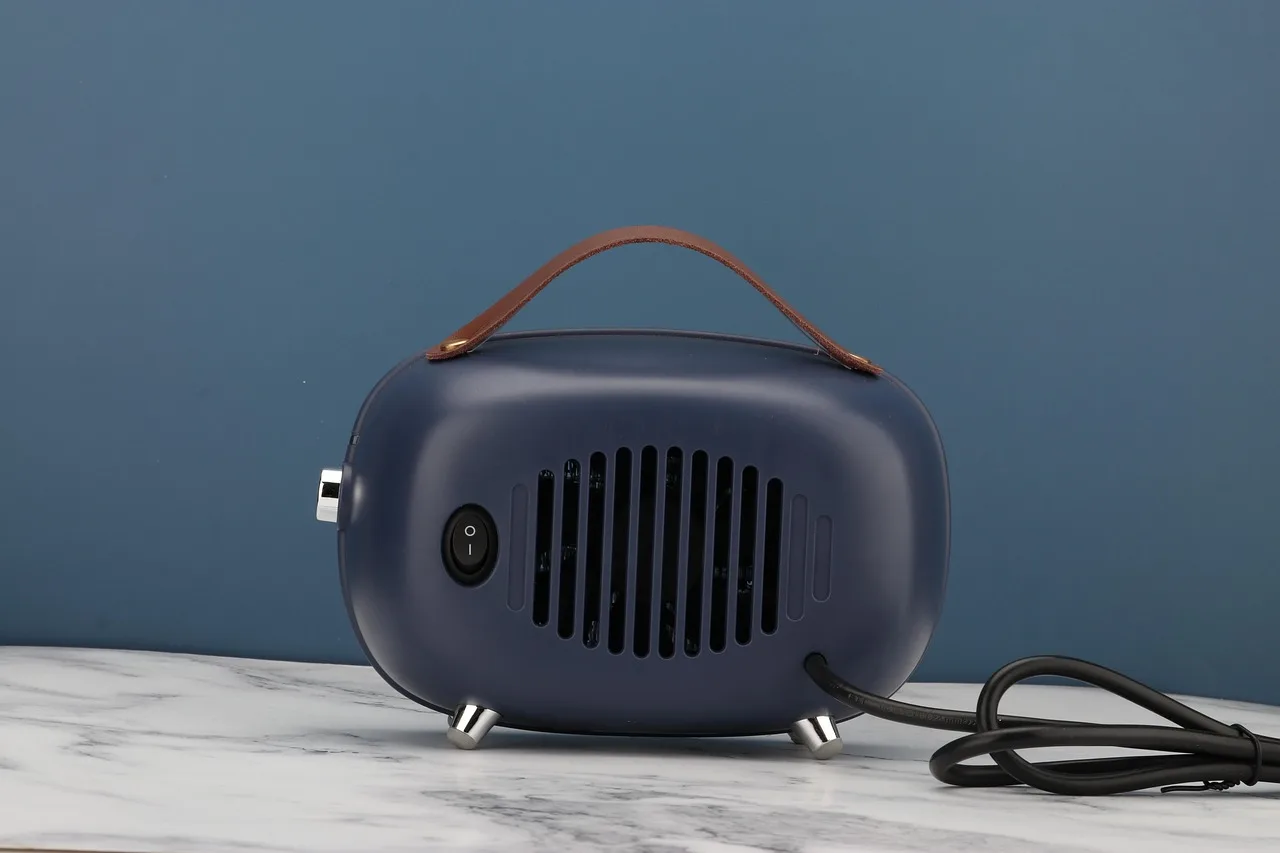
Portable heater fuel choices: electric, propane, diesel
Choose electric for enclosed rooms with dependable outlets, propane for outdoor or well-ventilated heat, diesel for longer runtimes in larger spaces, and battery for short, low-output backup. Safety, runtime, and power access matter more than BTU ratings. Pick the wrong fuel and you risk unsafe indoor combustion, dead batteries, fuel shortages, or a heater that cannot run when the power fails. This guide compares fuel types by indoor safety, runtime, electricity dependence, outage readiness, and typical use cases.
The right fuel type is a constraint match. A heater that makes more heat is not automatically the better choice if your circuit trips, your room needs no combustion products, or your runtime target is six hours during an outage.
Portable heater fuel choices: what changes the answer?
| Fuel type | Indoor safety | Typical output | Runtime driver | Setup effort | Noise | Maintenance | Outage readiness | Best fit |
|---|---|---|---|---|---|---|---|---|
| Electric | Best for enclosed rooms; no combustion gases | 750W to 1500W common for portable units | Continuous while power is available | Low; plug in and select a setting | Usually low to moderate fan noise | Low | Limited unless a generator or battery system is available | Bedrooms, small offices, apartments |
| Propane | Requires ventilation and CO precautions | Commonly several thousand BTU/h; radiant and forced-air types vary | Tank size and burn rate | Moderate; fuel, ignition, and clearances matter | Low to moderate | Low to moderate | Good for backup heat if fuel is on hand | Garages, patios, outage backup |
| Diesel | Requires exhaust management and ventilation | High heat output; common in air heaters and forced-air units | Fuel tank size and burn rate | Higher; pump, glow plug, exhaust routing | Moderate to high | Moderate to high | Strong for off-grid and long backup runs | Workshops, cabins, vans, larger spaces |
| Battery | Best from a combustion standpoint, but output is limited | Usually low-output personal heat | Battery capacity in Wh | Low | Usually low | Low | Only for brief, local heat unless paired with a large battery bank | Short spot heat, emergency personal use |
Which portable heater fuel type is safest indoors?
Electric heaters are often a safer indoor option for many enclosed rooms because they do not produce carbon monoxide, soot, or water vapor from fuel combustion. Propane and diesel heaters can be used safely only where the manufacturer allows it, with ventilation, clearances, and a working carbon monoxide alarm. Battery heaters avoid combustion, but they rarely provide whole-room heat.
Electric heaters for enclosed rooms
For a bedroom, nursery, or small office, electric is the default answer. Common portable models often draw roughly 750W to 1500W on 120V household power, and that output range can be enough for supplemental heat in modest rooms when the space is reasonably insulated.
Electric heaters still need basic clearance and tip-over protection. Keep them away from curtains, bedding, and paper, and check the nameplate for amperage. A 1500W heater draws about 12.5A at 120V, which can be close to the limit of a 15A circuit once other loads are present.
Why propane and diesel need extra precautions
Propane and diesel heaters burn fuel, so they consume oxygen and can create carbon monoxide. They also add moisture or exhaust byproducts, depending on design. That means ventilation is not optional, and sealed rooms are a poor match unless the unit is specifically designed as a vented appliance.
For combustion heaters, use a carbon monoxide alarm with battery backup. Place it per the alarm manufacturer’s instructions, often near sleeping areas and on each level of a home. Test it monthly and replace batteries on schedule.
Where battery heaters fit
Battery-powered heaters are safest from a combustion standpoint, but safety does not make them powerful. Most are meant for brief personal warming, glove warming, seat warming, or short emergency use. They are not a substitute for a room heater when the goal is raising the temperature of a whole bedroom or garage.

How much does each fuel type cost to run?
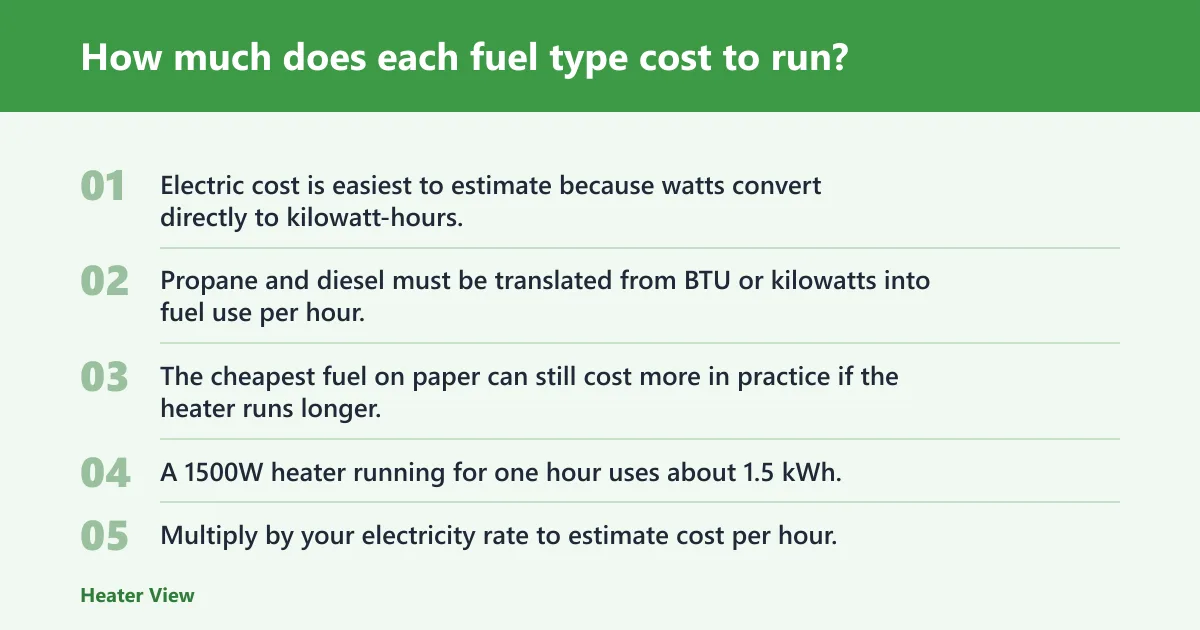
Electric cost is easiest to estimate because watts convert directly to kilowatt-hours. Propane and diesel must be translated from BTU or kilowatts into fuel use per hour. The cheapest fuel on paper can still cost more in practice if the heater runs longer, cycles poorly, or heats a space that is too large.
Electric: convert watts to kilowatt-hours
Use this rule: watts ÷ 1000 = kilowatts. A 1500W heater running for one hour uses about 1.5 kWh. Multiply by your electricity rate to estimate cost per hour. At $0.15 per kWh, that works out to about $0.23 per hour.
A 750W setting uses 0.75 kWh per hour. At the same rate, that is about $0.11 per hour. Thermostat cycling changes the real number, so a heater that only runs half the time costs roughly half as much.
Propane and diesel: convert BTU or kW to fuel use
Combustion heaters are usually rated in BTU/h or kW. A common conversion is 1 kW = 3412 BTU/h. Propane contains about 91,500 BTU per gallon, and diesel contains about 137,000 to 139,000 BTU per US gallon, though actual heater efficiency changes delivered heat.
Example: a heater burning 20,000 BTU/h at 100% efficiency would consume about 0.22 gallons of propane per hour. Real heaters are not perfect, so fuel use is often higher than the ideal math. For diesel, a 5 kW air heater may use only a fraction of a gallon per hour, but published consumption varies by model and heat setting.
Why seasonal cost changes
Seasonal cost depends on runtime, room size, insulation, and thermostat control. A small office may need short bursts. A leaky garage may force long runtimes that make any fuel type expensive. The same heater can look cheap in one room and costly in another.
Suppose a 1500W electric heater runs 4 hours per day for 30 days. That is 180 kWh for the month. At $0.15 per kWh, the monthly cost is $27. A propane unit with the same comfort level may cost less or more depending on burn rate and whether the room leaks heat.
How long will it run?
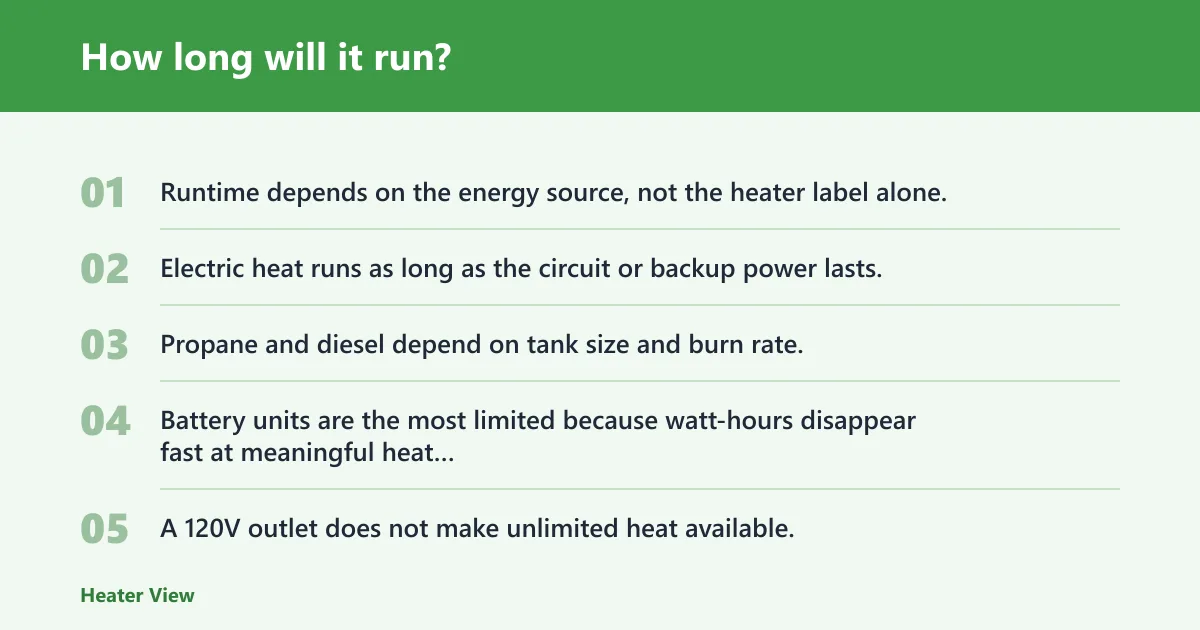
Runtime depends on the energy source, not the heater label alone. Electric heat runs as long as the circuit or backup power lasts. Propane and diesel depend on tank size and burn rate. Battery units are the most limited because watt-hours disappear fast at meaningful heat output.
Electric runtime and circuit limits
A 120V outlet does not make unlimited heat available. Continuous load planning matters. A common 15A circuit at 120V can provide roughly 1800W in theory, though many electricians use around 80% of that, or about 1440W, for continuous loads. That is why many portable heaters are capped at 1500W.
If you want a portable electric heater for steady use, check the circuit amperage, the breaker size, and what else is on that branch. Space heaters, hair dryers, and microwaves should not share the same circuit if tripping is a concern.
Propane runtime from tank size
Propane runtime is simple in principle: larger tank, longer run. A 20 lb cylinder holds about 4.7 gallons of propane. If a heater burns 0.4 gallons per hour, the cylinder lasts a little under 12 hours. Lower settings extend runtime, higher settings shorten it.
That makes propane useful when you need portable heat and can store fuel safely. It also means you must plan refills. A heater that is easy to carry can become useless if the tank is empty and no refill source is nearby.
Diesel runtime from fuel consumption
Diesel heaters often stretch runtime well because liquid fuel has high energy density and many units sip fuel at lower settings. But the exact number depends on the heater’s control range, pump rate, and whether it is running at startup or steady state. Start-up draws can also involve electrical power for the fan, glow plug, and controller.
For cabins, vans, and workshops, this matters more than headline output. A heater that can run overnight on one tank is more useful than a stronger unit that needs attention every few hours.
Battery runtime from watt-hours
Battery heaters are governed by watt-hours. A 100Wh battery can supply 100W for about one hour in ideal conditions, or 50W for about two hours. Real runtime is shorter because conversion losses and heat losses reduce usable output.
That is why battery heaters are best described as short-duration personal heat, not room heat. USB heaters are especially limited. Tool-battery heaters and integrated battery packs can help for brief use, but they are poor choices for a cold garage or an overnight outage.
What output and coverage can you expect?
Heater output should be read in watts or BTU/h, then matched to room size and insulation. Coverage claims are only rough estimates. Ceiling height, drafts, window area, and temperature rise all change the answer. A heater that works in one sealed room may fail in a leaky workshop.
Electric portable heaters
Most portable electric heaters are 750W to 1500W. That is enough for a small bedroom or office as supplemental heat, not always enough for a cold, open plan room. High output is limited by the branch circuit and by the heater’s own plug rating.
Propane and diesel heaters
Propane and diesel models can produce higher output, which is why they are common in garages, patios, and off-grid spaces. That higher output is useful when the goal is rapid warm-up or heating a partly open area. It also raises the importance of ventilation, clearances, and fuel handling.
Why space conditions matter
A well-insulated 120 sq ft room with a closed door can feel warm on 1000W. A drafty workshop can lose that same heat almost as fast as it is added. Do not compare heaters only by output. Compare output against the room’s heat loss.
Decision matrix: match fuel type to use case
The best fuel type changes with the setting. Bedrooms and small offices favor electric. Garages and outage backup often favor propane. Diesel fits larger, colder, or off-grid spaces. Battery fits brief spot heat or electronics-backed emergency use, not whole-room warming.
| Use case | Best fit | Why | Main caution |
|---|---|---|---|
| Bedroom | Electric | Quiet enough, no combustion gases, easy to control | Stay within circuit limits and clearance rules |
| Small office | Electric | Simple plug-in heat for enclosed indoor space | Avoid overloading the branch circuit |
| Garage | Propane or diesel | Higher output and less dependence on building power | Ventilation and CO alarm required |
| Patio | Propane | Portable outdoor heat with fuel storage | Wind reduces usefulness; keep clearances |
| Camping | Battery for brief spot heat; propane or diesel only if designed for the setup | Portability and runtime trade off differently in tents, vans, and RVs | Tent use needs strict ventilation and product-specific guidance |
| RV or camper | Diesel or electric at hookups | Diesel gives long runtime off-grid; electric is clean at shore power | Fuel exhaust must be managed correctly |
| Power outage | Propane, diesel, or battery depending on fuel storage and ventilation | Does not rely entirely on building electricity | Combustion heaters still need CO safety |
Picture a 10 by 12 bedroom with a single outlet and no ventilation issue. Electric is the practical choice. Now picture a detached garage with cold concrete, tool storage, and a door that opens often. Propane or diesel starts to make more sense because the setting is larger and less sealed.
A common mistake is choosing a propane heater for a small, poorly ventilated tent when a battery or electric model would be safer and easier to use. Another is choosing battery heat for a six-hour outage, then discovering that the battery rating sounded large but only supported a small pad or vest for a short time.
Choose electric if… / Choose propane, diesel, or battery if…
Choose electric if you have indoor power and want the simplest safety profile. Choose propane if you need portable heat with stored fuel and can ventilate. Choose diesel if you need high output with long runtime in a workshop, van, cabin, or similar space. Choose battery if you only need short, low-output personal heat.
Choose electric if…
Choose electric if the space is enclosed, the outlet is reliable, and you want the cleanest indoor option. It is also the easiest choice when you need predictable operation in a bedroom, office, or small apartment. The main limit is circuit capacity, not fuel supply.
Choose propane if…
Choose propane if you need portable heat for a garage, patio, or outage setup and can supply ventilation. It works well when you already store cylinders safely and want a fuel source that does not depend on household wiring. Keep carbon monoxide protection in place.
Choose diesel if…
Choose diesel if you need longer runtimes, stronger output, or heat in an off-grid setup. Diesel makes sense for workshops, cabins, and vehicle-based heating when the user can handle exhaust routing, odor, startup hardware, and periodic maintenance. It is less convenient than electric, but more autonomous.
Choose battery if…
Choose battery only for short-duration spot heat or emergency personal warming. It fits brief use around a desk, in a vehicle, or during a short outage when you want a small boost, not room heating. If you need sustained warmth, battery capacity will usually be the limiting factor.
What size power source do I need for an electric portable heater?
For most portable electric heaters, you need a standard 120V outlet and enough circuit capacity for the heater’s wattage. A 1500W heater draws about 12.5A, so it is near the practical ceiling of a 15A circuit. On 230V circuits, the same wattage draws much less current.
Check the heater label, then compare it with the circuit rating. If the circuit also powers a TV, computer, or refrigerator, the safe headroom shrinks. For whole-room electric heat, do not assume one outlet can support every load in the room.
Which portable heater fuel type is safest indoors?
Electric is safest indoors because it avoids combustion gases, carbon monoxide, and oxygen depletion. Propane and diesel can only be used where the product is approved and where ventilation, clearances, and carbon monoxide monitoring are in place. Battery avoids combustion too, but it usually cannot supply meaningful room heat.
Is electric or propane cheaper to run for portable heat?
It depends on your electricity rate, propane price, heater efficiency, and runtime. Electric is easy to price because watts convert cleanly to kWh. Propane can be cheap or expensive per hour depending on burn rate. The real comparison is total heat delivered, not the sticker on the fuel.
Can I use a diesel heater inside a tent, van, or garage?
Diesel heaters can fit these spaces only when the product is designed for that setting and exhaust is handled correctly. A tent needs strict attention to venting and placement. Vans and garages need exhaust routing, intake safety, and carbon monoxide protection. Never treat a combustion heater as a casual indoor appliance.
How long does a battery-powered heater actually last?
Usually not long at useful heat output. Runtime is limited by watt-hours, and heat demand rises fast in cold conditions. A small battery may run a low-output personal heater briefly, but it will not warm a whole room for long. That is the main failure case buyers miss.
What fuel type is best for camping or emergency outages?
Camping and outages need different answers, but propane and diesel usually lead when heat must last beyond a short burst. Battery works for brief personal warmth or device charging. Electric works only if shore power, a generator, or a large battery system is available. Ventilation and fuel storage decide the rest.
Are diesel portable heaters noisy or smelly?
Often, yes. Diesel air heaters usually include a fuel pump, fan, and combustion cycle that create audible noise. Odor is more noticeable during startup, shutdown, or poor maintenance. Good installation and proper exhaust routing reduce nuisance, but diesel is rarely as quiet or odor-free as electric heat.