Portable heater brands: compare reliability scorecard
Use a 100-point scorecard for portable heater brands: roughly 40 points for safety controls, 25 for heat consistency, 20 for review failure patterns, and 15 for warranty and parts support. Skip that, and you can end up with noisy, short-lived heaters, tripped breakers, weak warmth, or a unit that quits in the second winter. This guide lays out the scorecard, the signals that matter, and the brand warning signs I check before buying for bedrooms and offices.
Portable heater brands: reliability starts with the trade-offs
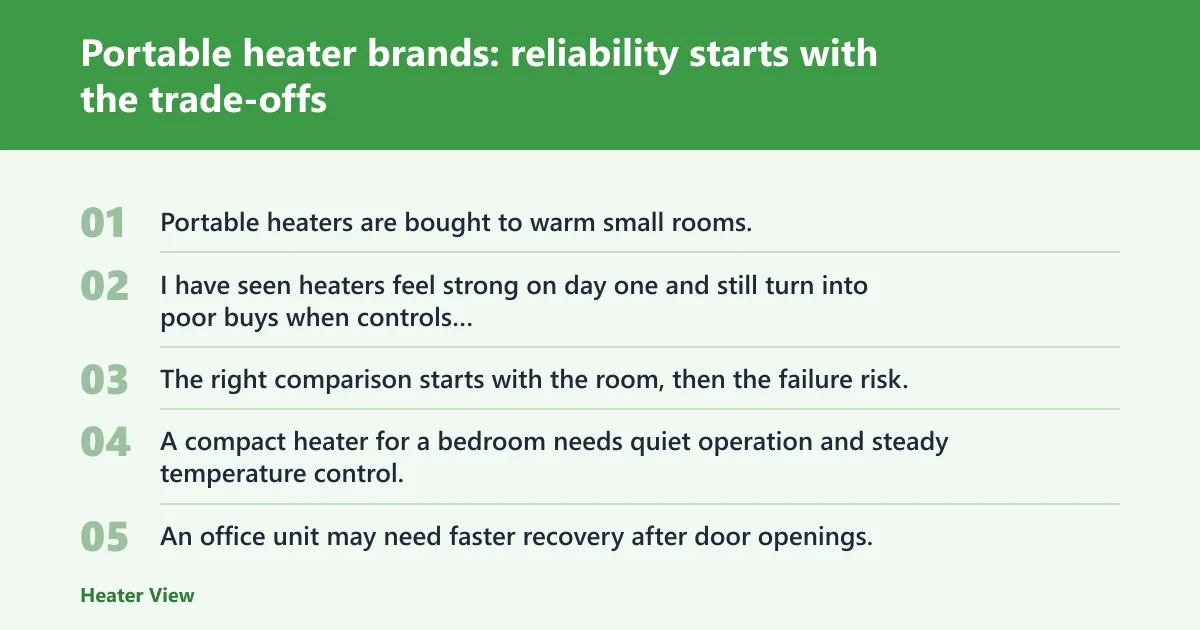
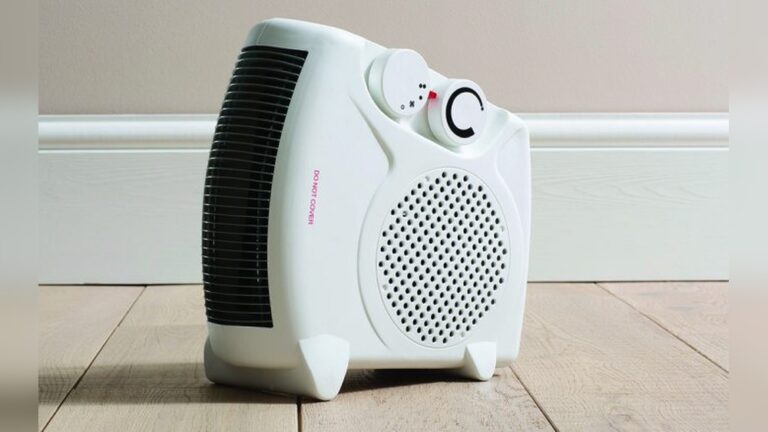
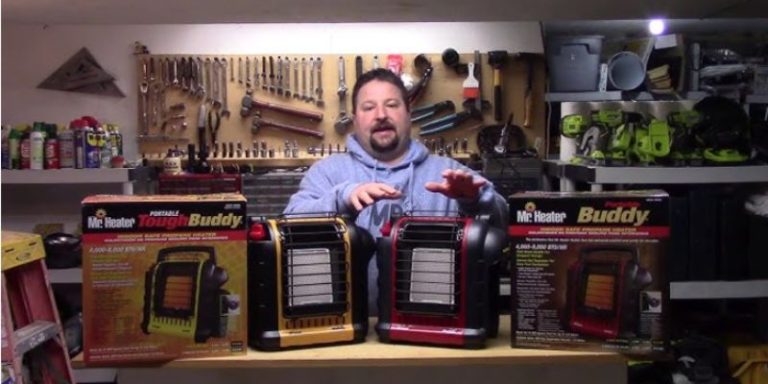
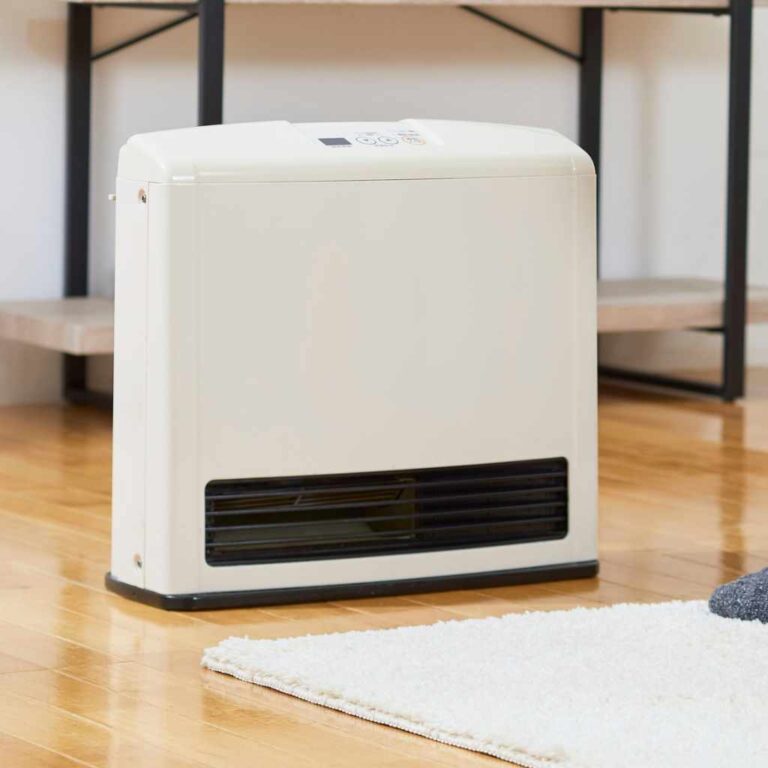
Portable heaters are bought to warm small rooms, but brand reliability is not the same as fast heat. I have seen heaters feel strong on day one and still turn into poor buys when controls drift, switches wear out, or safety shutoffs act up after months of use.
The right comparison starts with the room, then the failure risk. A compact heater for a bedroom needs quiet operation and steady temperature control. An office unit may need faster recovery after door openings. Backup use in an emergency raises the bar again, because the heater has to run safely when attention is split.
What buyers usually mean by dependable daily use
Dependable daily use means the heater reaches comfort quickly, holds that warmth without constant knob turning, and keeps working without frequent nuisance trips or fan noise changes. It also means the safety hardware behaves the same way every time the heater is moved, tilted, or left on too long.
Why short-term heat output and long-term failure risk are different
A heater can warm a small room fast and still be a bad long-term buy. Heating speed says little about switch wear, thermostat drift, support quality, or whether complaints pile up about dead units after a season or two. Reliability depends on repeated use, not just the first hour.
📊 Consumer Reports says heat pump water heaters use about 60 percent less energy than standard electric water heaters. Source: Consumerreports.
Comparison table: the brand signals that matter most
When I compare portable heater brands, the useful signals are safety hardware, temperature control, review consistency, room-fit honesty, noise, and support. A high star rating does not cancel out repeated complaints about overheating, weak thermostats, or poor warranty response.
| Signal | What to check | Why it predicts reliability | How to judge it |
|---|---|---|---|
| Safety features | Tip-over protection, automatic shutoff, overheat protection, cool-touch exterior | Shows whether the brand builds in accident and thermal-failure protection | Prefer clear, repeated listing across the brand’s portable heater line |
| Temperature control | Auto temperature control, thermostat stability, steady output | Stable control reduces manual adjustments and comfort swings | Look for reviews that mention consistent warmth, not just fast heat |
| Review consistency | Review count, star rating, complaint themes, cross-platform match | Repeated failure patterns are often visible before formal recall data appears | Compare Amazon, Walmart, BBB, and retailer comments for the same model |
| Room coverage | Square-foot rating and real room size | Underpowered heaters run harder and disappoint above rated area | Match the heater to the actual room, not the largest marketing number |
| Noise, support, warranty | Whisper-quiet claims, warranty terms, parts access, support response | Good support and quiet operation matter after the sale | Check whether the brand answers problems or just sells replacements |
Which portable heater brands are most reliable?
The most reliable portable heater brands are the ones that show steady temperature control, clear safety hardware, and fewer complaint patterns over time. That usually means the brand is honest about room size, uses dependable shutoff systems, and backs the product with warranty and support terms people can use.
Brands with steady temperature control
Brands that do well here usually offer auto mode or thermostat control that keeps warmth even. The point is not fancy menus. The point is whether the heater holds a room near the set level instead of cycling wildly or needing constant adjustment.
Brands with stronger safety hardware
Look for brands that routinely include tip-over protection, overheat protection, and automatic shutoff across multiple models. A ceramic heater is worth close attention when it combines fast heating with a cool-touch exterior and quiet fan behavior, because those traits often matter in bedrooms.
Brands that show fewer complaint patterns over time
Repeat complaints matter more than isolated one-star reviews. If buyers keep mentioning failed switches, weak auto mode, or heaters that stop working after one season, that is a brand-level signal. A good brand usually has problems that are varied, not repetitive and predictable.
How do I compare reliability between portable heater brands?
Compare reliability by scoring safety first, then temperature stability, then review consistency, then support and warranty. That order matters because a heater that feels comfortable but lacks dependable shutoff behavior is a worse buy than a slightly louder unit with better thermal protection and clearer service backing.
Score safety features first
Tip-over protection should cut power automatically if the heater is knocked over. Overheat protection should stop the unit before internal temperatures become unsafe. Automatic shutoff matters because it limits accident risk when a heater is left running too long or airflow gets blocked.
Check temperature stability and auto mode behavior
Auto temperature control helps when a heater is used for long stretches, because it reduces manual changes and keeps comfort more even. It is less important for short bursts of heat, where the main need is quick warm-up rather than precision.
Weight review consistency across sites
Use review count and cross-platform consistency, not star rating alone. A model with thousands of reviews and the same complaint theme on multiple sites deserves more attention than a newer model with a shiny average and very little history. For one featured ceramic heater, Amazon feedback cited 1,596 reviews with a 4.6/5 rating, Walmart feedback cited 1,122 reviews with a 4.7 rating, and BBB feedback cited 1,345 reviews with a 4.5 rating.
Look for support and warranty proof
Warranty length is only useful if the support path works. Check whether the brand offers parts, replacement steps, or a real contact route. Weak support often shows up first when buyers report broken fans, dead controls, or cracked housings and get only generic replies.
Proof asset: portable heater brand reliability scorecard
Use this scorecard to compare brands without guessing. It separates short-term performance from long-term failure risk, which is where many shopping guides go thin.
| Criterion | Weight | Score guide | Notes to fill in |
|---|---|---|---|
| Safety features | 40 | 0-10 based on tip-over protection, automatic shutoff, overheat protection, cool-touch exterior | List which protections are standard across the brand’s portable heaters |
| Temperature stability | 25 | 0-10 based on auto mode, thermostat accuracy, steady warmth, low manual adjustment | Note complaints about cycling, drifting heat, or overshoot |
| Review failure patterns | 20 | 0-10 based on review volume, star spread, repeated complaint themes, cross-platform match | Watch for dead-on-arrival, switch failures, or repeated safety mentions |
| Warranty and parts support | 15 | 0-10 based on warranty clarity, response quality, replacement process, parts access | Record whether support solves problems or stalls them |
Fill-in comparison table for five brands
| Brand | Safety /40 | Temp stability /25 | Review patterns /20 | Support /15 | Total /100 | Notes |
|---|---|---|---|---|---|---|
| Honeywell | Best when simple controls and familiar support matter | |||||
| Dreo | Best when auto mode and quiet bedroom use matter | |||||
| Lasko | Check noise and complaint repetition carefully | |||||
| Vornado | Check room-fit claims against actual space size | |||||
| De’Longhi | Often considered where steadier comfort is preferred |
How to score mixed signals without guessing
If one category looks strong but another looks weak, score the weak category harder. A heater with excellent warmth but repeated safety complaints does not get a pass. A heater with average speed but clean review patterns, useful shutoff behavior, and better support may be the safer brand bet.
What safety features matter most in a portable heater brand?
The most important safety features are tip-over protection, overheat protection, automatic shutoff, and a cool-touch exterior. These features matter because they reduce accident risk, limit thermal failure, and make indoor use less stressful, especially in bedrooms, offices, and other close-contact spaces.
Tip-over protection and automatic shutoff
Tip-over protection should cut power when the heater falls or is knocked sideways. That matters because a portable heater can be moved often, bumped by pets, or shifted near furniture. Automatic shutoff is the broader safety net when the heater is left running too long.
Overheat protection and thermal cutoffs
Overheat protection is one of the strongest signs that a brand has thought through failure prevention. It should stop the unit before internal heat becomes a hazard. If a brand never states this clearly, or hides it in tiny print, treat that as a warning sign.
Cool-touch exterior and indoor-use cautions
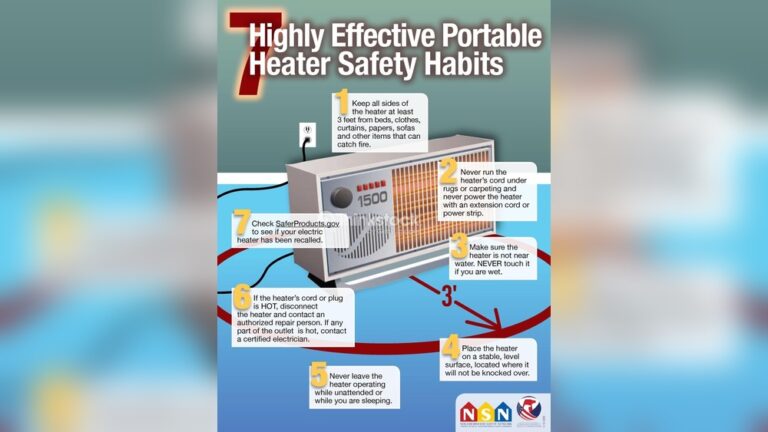
A cool-touch exterior helps in tight rooms where people, children, or pets may get close to the heater. Still, no heater should be treated as safe by default. Indoor-use cautions still matter, and fuel-burning heaters deserve extra attention because enclosed spaces can raise carbon monoxide risk, a concern discussed in the 2016 ice-fishing-shelter thesis on portable heater use.
Which heater brands have the best temperature control?
Brands with the best temperature control are the ones that hold warmth steady, respond cleanly to the thermostat, and make auto mode useful. The goal is consistent comfort with fewer manual changes. Good control also helps avoid waste from overheating a room and then letting it cool too far.
Auto temperature control and thermostat accuracy
Auto temperature control is most useful when a room gets occupied for long stretches, because it reduces tinkering. A ceramic heater with two heat levels plus Auto Mode can be easier to live with than a basic high-low unit, especially if the room changes temperature during the day.
How stable warmth affects comfort and use
Stable warmth matters more than headline wattage after the first few minutes. A heater that swings between too warm and too cool forces manual correction. That is a comfort problem, but it is also a reliability clue, because sloppy control often points to broader build inconsistency.
Signs a brand gets the control wrong
Look for repeated complaints about thermostat drift, room overshooting, or the heater shutting off too early. If users keep saying the auto mode is more annoyance than help, the brand may have decent hardware but weak control logic. That is a failure-risk clue worth weighting heavily.
Choose Honeywell if… / Choose Dreo if…
Choose Honeywell if you want simpler controls, a familiar support path, and a heater that is easy to compare against basic safety and room-fit checks. Choose Dreo if you value stronger auto mode behavior, quiet bedroom use, and a newer design that may place more emphasis on temperature steadiness.
Choose Honeywell if…
Choose Honeywell if the room is small to medium, the heater will be used in a bedroom or office, and you want fewer settings to manage. It also fits buyers who prioritize straightforward safety checks and want a brand that is easy to compare against older, familiar complaint patterns.
Choose Dreo if…
Choose Dreo if auto temperature control matters, if whisper-quiet operation is a priority, and if the heater will run for longer stretches where constant adjustment is annoying. It is also a sensible option when the buyer cares more about control behavior than legacy brand familiarity.
What should I check before buying a portable heater brand?
Check the safety hardware, the room coverage claim, the thermostat behavior, the noise level, and the support path before buying. Then compare review count, star average, and repeated complaint themes across multiple sites. That sequence catches more bad brands than staring at one glossy product page.
- Match the heater to the room size before looking at style.
- Confirm tip-over protection, overheat protection, and automatic shutoff.
- Check whether the heater offers auto mode or stable thermostat control.
- Read reviews for repeated failure themes, not just praise.
- Look for warranty length, parts access, and support response quality.
- Reject models with weak complaint consistency or vague safety language.
Room fit beats marketing output
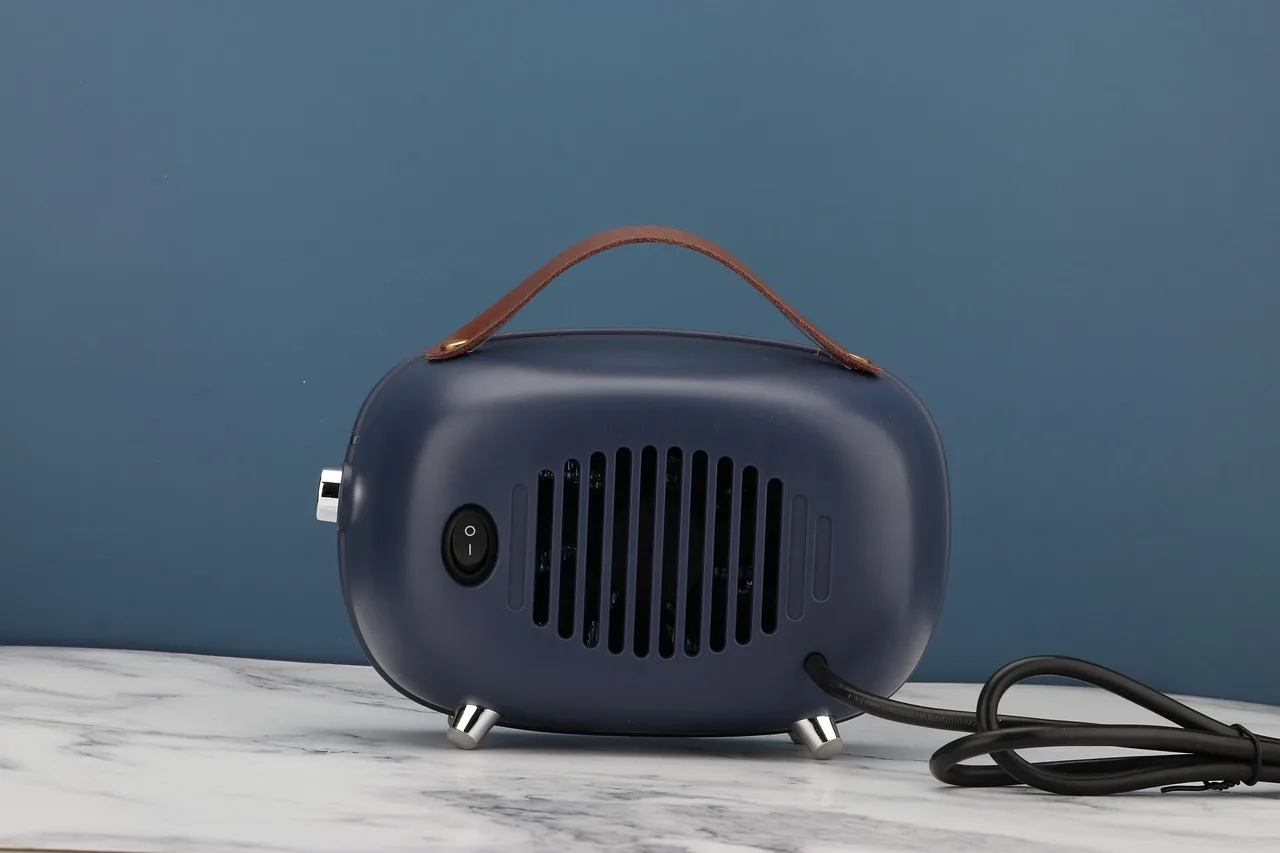
One featured ceramic heater is rated for spaces up to 250 square feet and uses 1200W ceramic heating. That is useful only if the actual room fits the claim. Above rated area, many heaters underperform, cycle harder, and leave buyers blaming the brand for a room-size mismatch.
Noise and portability still matter
Portable heater brands are often compared on heat first, but noise can be the deciding factor in bedrooms. The same featured unit is described as whisper-quiet operation, which matters more at night than in a garage or utility room. Portability also matters when the heater must move between rooms.
Which portable heaters are quiet and safe for bedrooms?
Quiet and safe bedroom heaters are usually ceramic models with whisper-quiet operation, cool-touch exterior, tip-over protection, overheat protection, and automatic shutoff. Bedroom use also depends on steady temperature control, because noisy cycling and temperature swings are harder to ignore while sleeping.
Ceramic heaters are worth a close look
Ceramic heaters are a strong bedroom category because they often heat quickly, include auto mode, stay cool to the touch, and run quietly enough for sleep spaces. A model with two heat levels plus Auto Mode is easier to adapt to bedtime use than a loud, fixed-output unit.
Bedroom safety still depends on room fit
Do not assume a bedroom heater is safe just because it is compact. The heater still needs the right protections and enough clearance from bedding, curtains, and furniture. If the room is larger than the rated area, the unit may run harder and become less comfortable to use.
How do I spot a portable heater that may fail early?
A heater may fail early if reviews mention repeated switch problems, weak temperature control, false shutoffs, noisy fans, cracked housings, or the same complaint pattern across multiple sites. Early failure risk is usually visible before breakdowns become widespread if the buyer checks for repetition instead of star rating alone.
Look for repeated complaint language
One bad review is noise. Ten reviews saying the same heater dies after a short period is a pattern. Repeated safety mentions, dead controls, or unstable output deserve extra weight because they point to design or manufacturing weakness rather than isolated user error.
Watch for weak support signals
If the brand hides warranty terms, offers vague replacement paths, or receives frequent complaints about unanswered service requests, that is a failure-risk clue. A heater brand should be judged as a product plus a support system. Weak support turns a small defect into a bad purchase.
How important are customer reviews when judging heater reliability?
Customer reviews matter a lot, but only when they are read as failure signals rather than popularity scores. Review count, star average, and cross-platform consistency are more useful than a single high rating. Strong brands usually show stable feedback and fewer repeat complaints over time.
Use review volume with context
For the featured ceramic heater, the review trail is substantial across platforms: Amazon feedback cited 1,596 reviews with a 4.6/5 rating, Walmart feedback cited 1,122 reviews with a 4.7 rating, and BBB feedback cited 1,345 reviews with a 4.5 rating. That kind of spread is useful because it is harder to fake consistency across sites.
Read the complaints, not just the praise
Positive comments about fast heat do not prove durability. The useful part is whether buyers also mention problems after weeks or months: stuck controls, inconsistent heat, or support delays. That is what separates a heater that performs well on day one from a brand that holds up.
Frequently asked questions
Which portable heater brands are most reliable?
The most reliable brands are the ones that combine good safety hardware, steady temperature control, consistent review patterns, and useful support. In practice, that means comparing more than brand fame. A lower-profile model can be a better buy than a famous one if the complaint pattern is cleaner.
How do I compare reliability between portable heater brands?
Use a weighted scorecard: safety first, then temperature control, then review consistency, then warranty and support. Compare models from each brand on the same room size and use case. That keeps a bedroom heater from being judged by the standards of a garage unit.
What safety features matter most in a portable heater brand?
Tip-over protection, overheat protection, automatic shutoff, and cool-touch exterior matter most. Those features reduce accident risk and thermal failure. If a brand hides them, lists them only vaguely, or omits them on some models, treat that as a reliability warning.
Which heater brands have the best temperature control?
Brands with good auto mode behavior and steady thermostats are usually the strongest here. The best control holds comfort steady without constant turning or cycling. Auto temperature control helps most in long-running bedroom or office use, where small swings become annoying.
How important are customer reviews when judging heater reliability?
Very important, but only when they are analyzed properly. Look at review count, star average, and whether the same complaints appear across sites. One strong rating means less than repeated reports of the same failure, especially when those reports mention safety or support problems.
What should I check before buying a portable heater brand?
Check the heater’s room coverage, safety shutoffs, temperature control, noise level, and warranty terms. Then read reviews for repeated failure patterns. If the brand cannot clearly explain support, replacement, or parts handling, that weakens the reliability case.
Which portable heaters are quiet and safe for bedrooms?
Quiet bedroom heaters are often ceramic units with whisper-quiet operation, cool-touch exterior, tip-over protection, overheat protection, and automatic shutoff. Those features help, but only if the heater is also sized correctly for the room and used with normal clearance from bedding and curtains.
How do I spot a portable heater that may fail early?
Look for repeated complaints about dead controls, weak thermostat behavior, noisy fans, and support that does not resolve problems. A heater with a few negative reviews is normal. A heater with the same negative story repeated across sites is the one to avoid.