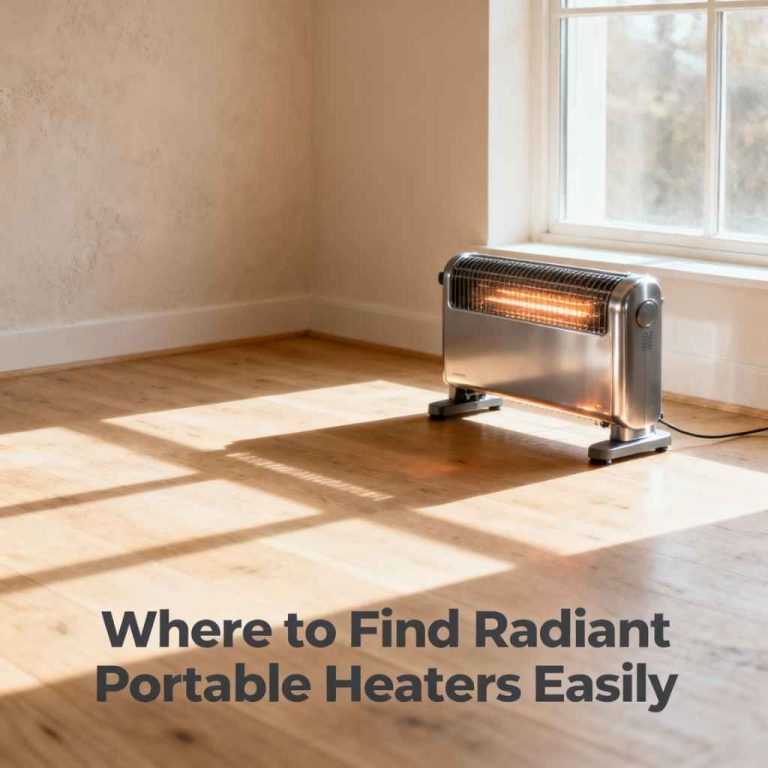
Portable heater operating costs by heater type: cost rankings
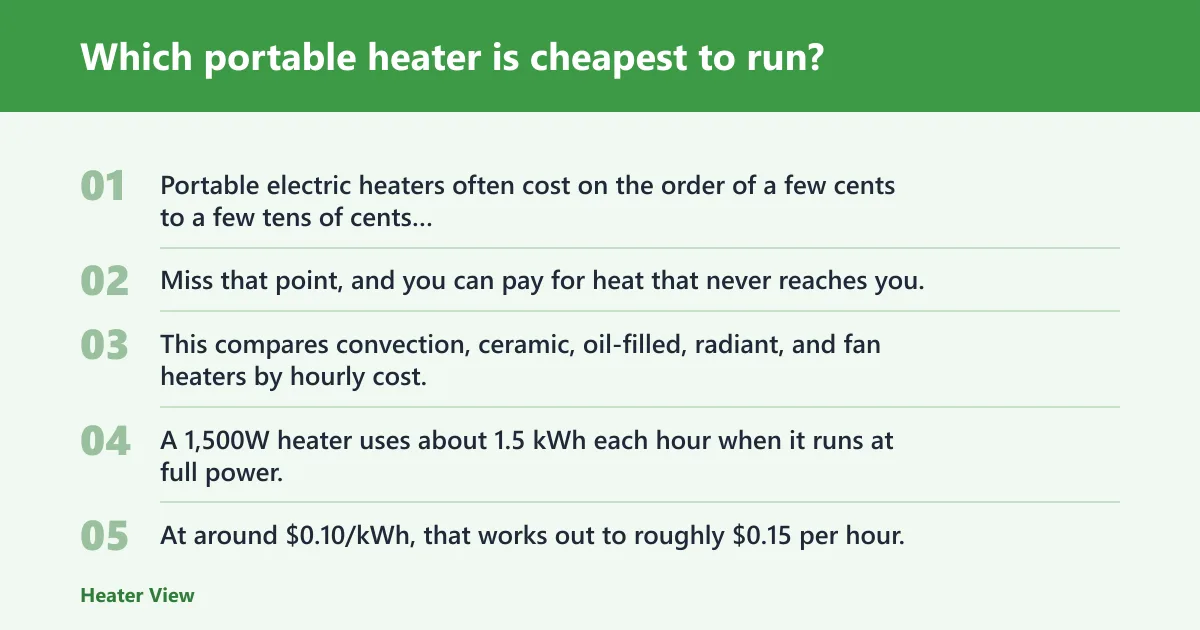
Portable electric heaters often cost on the order of a few cents to a few tens of cents per hour at 1,500 watts and a roughly $0.10–$0.20/kWh rate, so a practical choice is the heater that gets you comfortable faster and reduces the number of hours it has to run, not just the one with the lowest watt label. Miss that point, and you can pay for heat that never reaches you, especially in drafty rooms or oversized spaces. This compares convection, ceramic, oil-filled, radiant, and fan heaters by hourly cost, comfort-hour cost, and the best room and use pattern.
Which portable heater is cheapest to run?
Start with the 1,500W benchmark
A 1,500W heater uses about 1.5 kWh each hour when it runs at full power. Multiply that by your electricity rate. At around $0.10/kWh, that works out to roughly $0.15 per hour. At around $0.20/kWh, it works out to roughly $0.30 per hour. The common published range for all 1,500W electric heaters is about $0.20–$0.25 per hour, which sits in the middle of that band.
That hourly figure is only the starting point. A heater with a thermostat does not stay on full blast the whole time, and a heater that warms a person directly can feel cheaper than a unit trying to warm an entire room. I see that difference most clearly in small offices and bedrooms.
Why the cheapest heater depends on runtime, room size, and heat delivery style
A cheap-looking heater can get expensive when it runs for hours in a room it cannot hold at temperature. A pricier unit can save money if it heats only the occupied zone, cycles off often, or holds warmth after shutdown.
That is why sticker price and wattage do not tell the whole story. Operating cost is how long the heater must run to give usable comfort.
📊 Ceramic fan heater prices listed from $20 to $80. Source: Profindr.
How much does a 1,500W heater cost per hour?
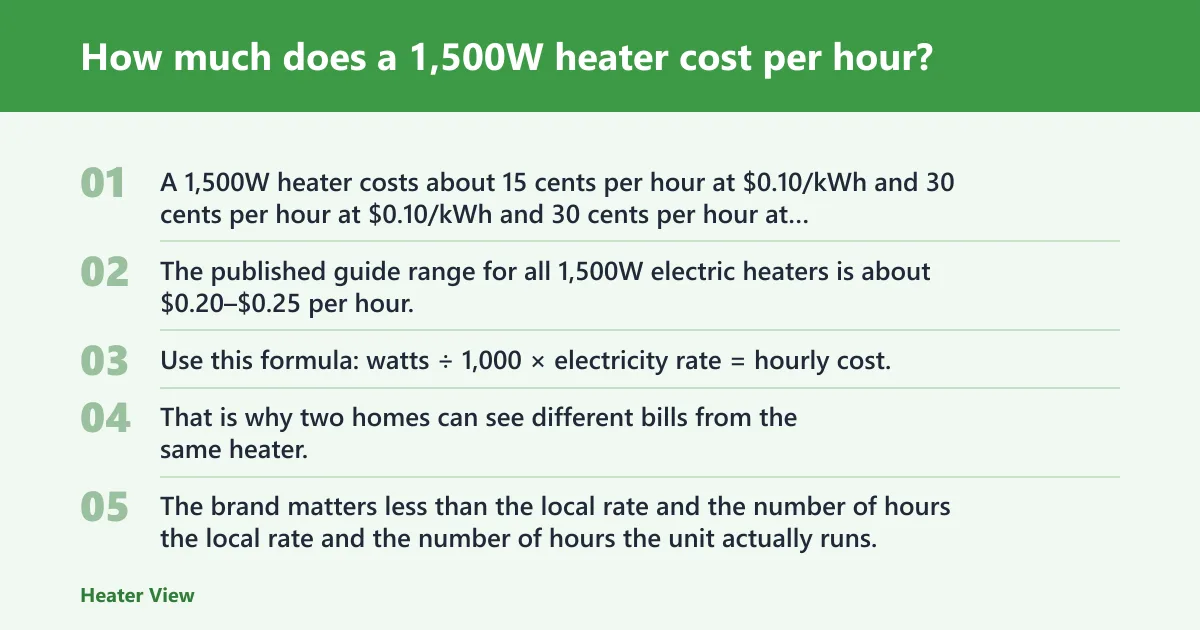
A 1,500W heater costs about 15 cents per hour at $0.10/kWh and 30 cents per hour at $0.20/kWh if it runs continuously. The published guide range for all 1,500W electric heaters is about $0.20–$0.25 per hour, which matches a midrange electricity bill.
The math readers can check
Use this formula: watts ÷ 1,000 × electricity rate = hourly cost. So 1,500 ÷ 1,000 = 1.5 kWh per hour. Multiply 1.5 by your rate. At $0.16/kWh, that comes to $0.24 per hour.
That is why two homes can see different bills from the same heater. The brand matters less than the local rate and the number of hours the unit actually runs.
Why thermostat cycling lowers real cost
Thermostat-equipped heaters may use 30–50% less electricity than continuous full-power operation. That happens because the heater cycles on and off once the room or zone reaches the set temperature.
For long sessions, that cycling matters more than the name on the box. A heater that runs at full power for 4 hours costs more than one that reaches comfort, then idles part of the time. I have seen that in winter bedrooms more times than I can count.
Operating-cost comparison by heater type
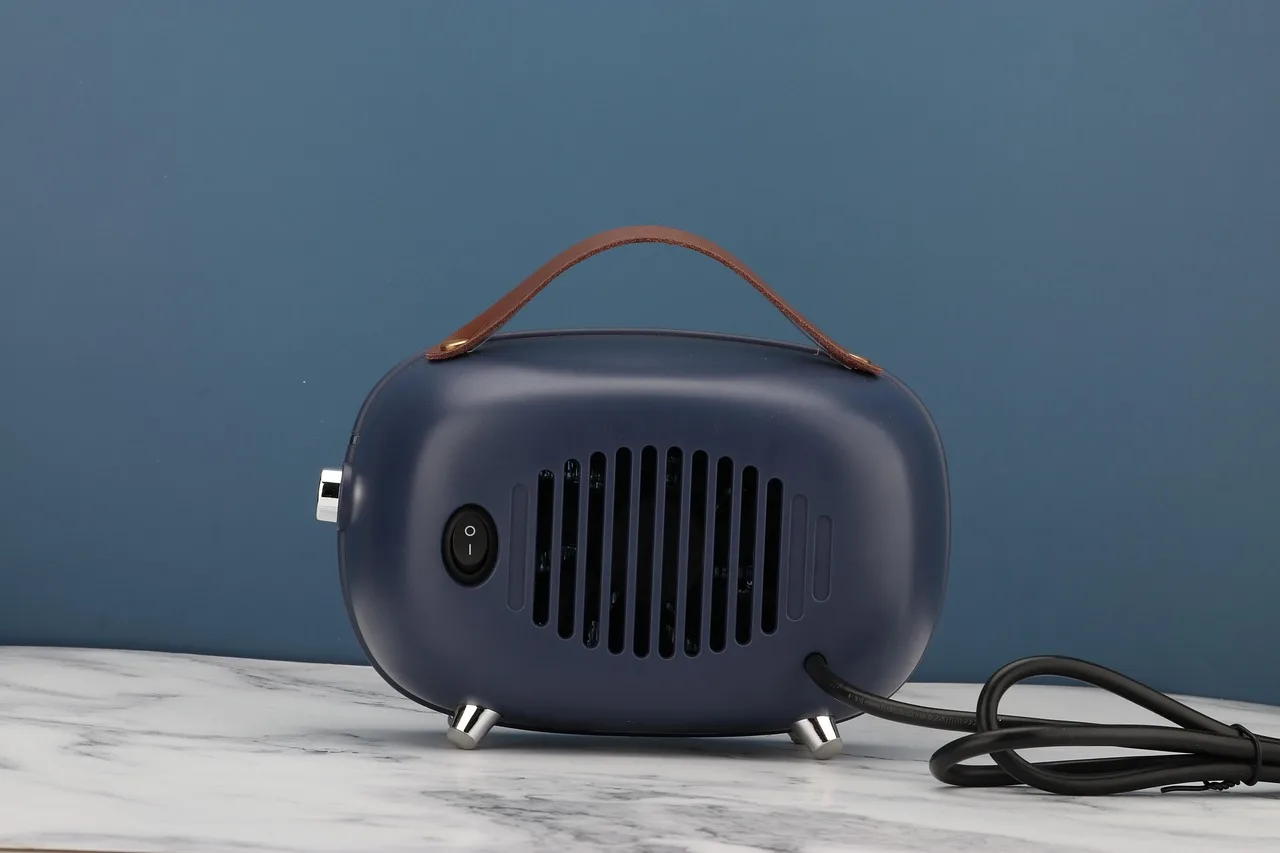
The table below separates purchase price from running cost. That distinction matters. A low purchase price does not mean low operating cost, and a higher-priced unit can be cheaper over repeated use if it heats the right area with less runtime.
| Heater type | Estimated cost per hour | Typical use duration | Best room scenario | Stops being cost-effective when |
|---|---|---|---|---|
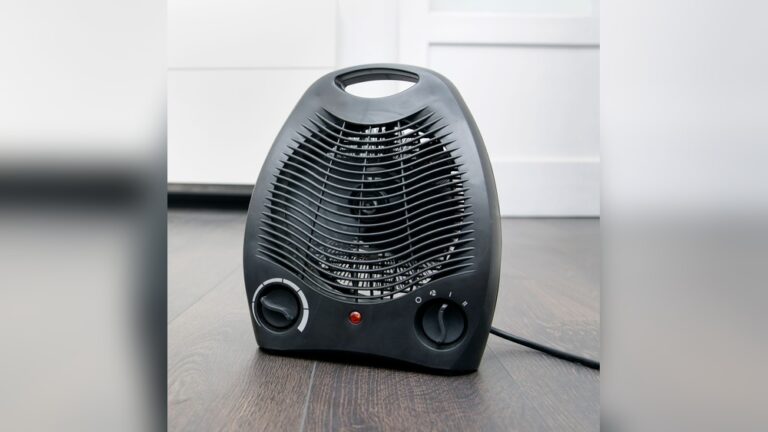
| Ceramic fan heater | About $0.20–$0.25 at 1,500W | 15 minutes to 3 hours | Small bedroom, bathroom, home office, quick warm-up | You need quiet heat all evening or you are trying to heat more than about 200 sq ft |
| Oil-filled radiator | About $0.20–$0.25 at 1,500W | 2 to 8 hours | Bedroom or office where silence and steady heat matter | You need instant warmth or fast recovery after the room has gone cold |
| Infrared or radiant heater | About $0.20–$0.25 at 1,500W, often less in practice for spot use | 15 minutes to 4 hours | Desk, workshop bench, garage, seated use within a 10–15 ft area | You are trying to heat a whole room for long sessions |
| Micathermic panel heater | About $0.20–$0.25 at 1,500W | 1 to 6 hours | Living spaces that need even, low-profile heat across up to 300 sq ft | The room is drafty, open-plan, or too large for its coverage |
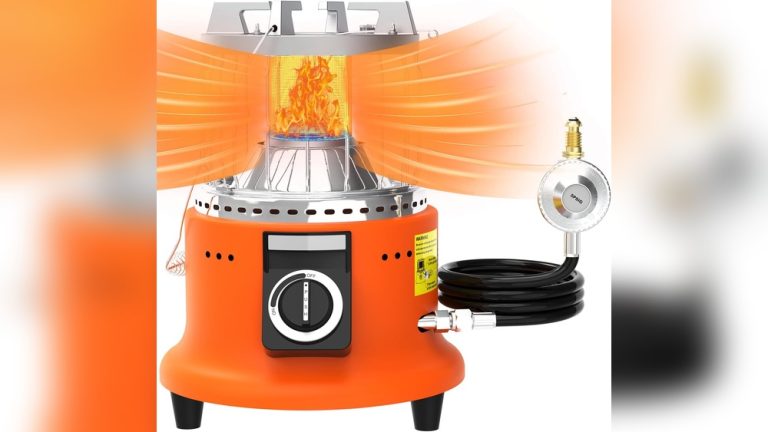
| Propane portable heater | Varies by fuel rate and output; can be cheap for outage use, costly for long indoor runs | Short emergency sessions to extended use with a large tank | Garage, cabin, outage backup, places without electricity | You need quiet, odor-free, indoor day-long heat in a sealed living space |
What the comparison table shows about comfort-hours
Cost per hour is only half the picture. Comfort-hour cost is the cost of getting a person warm enough to stay in the space. A radiant heater may cost the same per hour as a ceramic unit, yet feel cheaper because it heats the person first instead of the whole room.
That is why open-plan rooms can turn a low-hour-cost heater into a poor buy. If the heater cannot keep the space comfortable, the real cost rises through longer runtime and higher setpoints.
Are oil-filled heaters cheaper to run than ceramic heaters?
Oil-filled heaters are often cheaper in comfort-hour terms for longer sessions, but they are not cheaper in raw hourly power draw if both are 1,500W. Ceramic fan heaters and oil-filled radiators can cost about the same per hour at full power; the difference comes from how long each one must run and how the heat feels in the room.
When oil-filled radiators win
Oil-filled radiators use a sealed oil reservoir and hold heat after the element cycles off. That slow heat retention suits bedrooms and offices where the goal is steady background warmth and quiet operation.
If someone wants a room comfortable for several hours without fan noise, the oil-filled unit can be the better value. It may run less often once the room stabilizes.
When ceramic fan heaters win
Ceramic fan heaters use electric resistive heat and move warm air fast. That makes them useful for quick warm-up, cold bathrooms, and short sessions in rooms around 200 sq ft.
They are often the cheaper choice when the need is brief. Turn one on, warm the space, then turn it off after the short job is done.
Do infrared heaters cost less to operate?
Infrared heaters can cost less to operate when the goal is direct warmth for a person or work area, not the whole room. They send heat to people and objects inside a 10–15 ft zone, so the usable comfort-hour cost can be lower in a desk, workshop, or garage setup.
Why direct heat changes the bill
Radiant heat works best when the occupant stays in one spot. The heater does not need to warm all the air around the room before the person feels warm.
That can cut runtime. It also reduces the urge to raise the thermostat or leave the unit on all afternoon.
Where infrared gets expensive
Infrared is a poor fit for long, whole-room heating. If the room is large, open, or used by several people moving around, the 10–15 ft target zone becomes a limit.
At that point, the heater runs longer with less comfort return. A convection-style unit or oil-filled radiator may deliver better value for extended sessions.
Are propane heaters cheaper than electric heaters?
Propane heaters are not automatically cheaper than electric heaters. They use 1 lb or 20 lb propane tanks and produce 4,000–18,000 BTU, so the running cost depends on tank size, output level, and how long the heater runs. They are useful when electricity is unavailable, not when the only goal is the lowest hourly cost.
When propane makes sense
Propane portable heaters fit outage use, cabins, garages, and other places without power. They can deliver strong heat without electricity, which is their main advantage.
For indoor living spaces, though, they bring fuel handling and ventilation concerns that electric heaters avoid. Cost should not be the only filter.
When propane is the wrong choice
For a bedroom or office, propane usually loses on convenience and indoor air safety. It also creates a carbon monoxide risk if used improperly. Portable heater use in ice fishing shelters has been tied to carbon monoxide exposure concerns, which is why fuel-burning heat needs strict ventilation and caution.
What size room can a portable heater heat cost-effectively?
Most 1,500W heaters effectively warm 150–300 sq ft, but cost-effective use depends on insulation, ceiling height, and how long the room stays occupied. A heater that covers the right square footage on paper can still waste money in a drafty room or open-plan area.
Match the heater to the room and the job
Ceramic fan heaters are common in the 1500W portable format and often suit about 200 sq ft. Micathermic panel heaters are described as covering up to 300 sq ft, which puts them in a better spot for broader, steady use.
Radiant and infrared heaters are better when the “room” is really one chair, one desk, or one bench. The size question is not only about floor area. It is about where the warmth needs to land.
Failure cases that waste money
An oversized room can swallow heat fast. Poor insulation, gaps under doors, and high ceilings all push runtime up. In those cases, a small heater may run continuously and still leave the space uncomfortable.
That is when the hourly cost stops mattering and the total session cost starts climbing.
How can I reduce my portable heater operating costs?
The fastest way to cut operating cost is to shorten runtime. Use thermostat control, lower the setpoint, and heat only the occupied zone. A heater that runs 30–50% less often can save real money without changing the room layout.
Use controls that reduce runtime
- Choose a thermostat-equipped model so the heater cycles instead of running flat out.
- Set the temperature lower than you would for central heat.
- Use a timer for bedrooms, offices, and pre-warm periods.
- Close doors and block drafts so the heater is not feeding a leaky room.
- Turn off the unit once the occupied zone is warm enough.
Pick safety features before comparing price
Look for UL or ETL certification, tip-over shutoff, and overheat protection. Those features do not make a heater cheaper to run, but they matter before any cost comparison because a heater that is unsafe or poorly protected is the wrong buy.
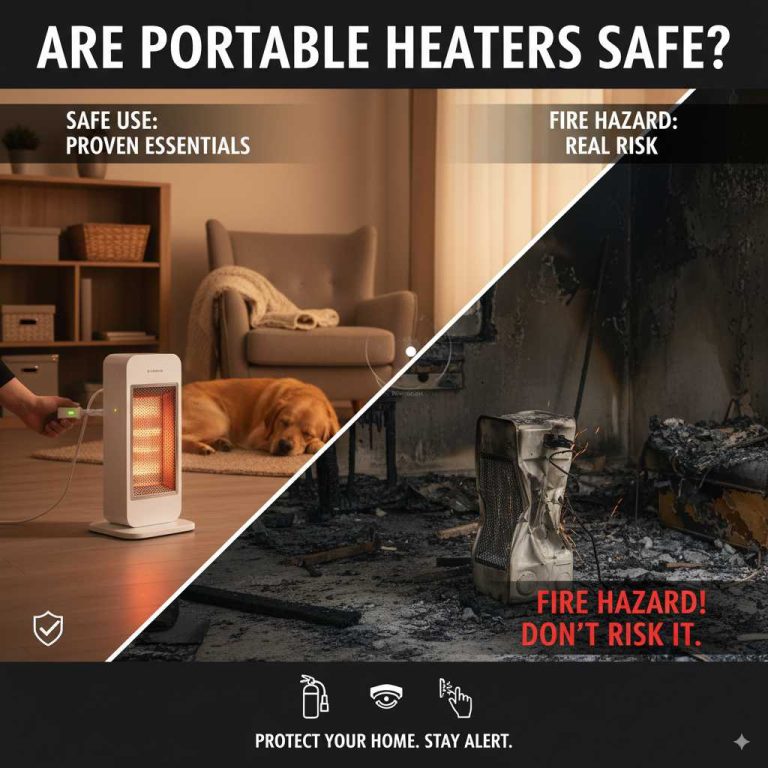
Space heaters are linked to 25,000+ home fires annually in the US, so low operating cost should never outrank safety.
How much electricity does a portable heater use?
A common portable electric heater uses about 1.5 kWh for every hour it runs at full power if it is a 1,500W unit. That is the baseline for most cost comparisons. Actual usage falls when the thermostat cycles the unit off, and it rises when a cold room forces longer runtime.
Frequently asked questions
Which portable heater is cheapest to run?
The cheapest heater is the one that delivers comfort with the fewest runtime hours. For short, direct use, infrared or radiant heaters often feel cheapest because they warm people fast. For longer sessions, an oil-filled radiator can be better if it cycles less and holds heat after shutoff.
How much does a 1500W heater cost per hour?
A 1,500W heater typically costs about $0.20–$0.25 per hour under the published benchmark, though your actual bill depends on the electricity rate and thermostat cycling. At a $0.10/kWh rate, the math is closer to $0.15 per hour. At $0.20/kWh, it is about $0.30 per hour.
Are oil-filled heaters cheaper to run than ceramic heaters?
Not always in raw hourly use. Both are often 1,500W units, so the full-power cost is similar. Oil-filled heaters can be cheaper over long sessions if they hold heat and cycle less. Ceramic heaters can be cheaper for short warm-up jobs because they heat fast and can be turned off sooner.
Do infrared heaters cost less to operate?
They can, when the goal is spot heating. Infrared units send heat to people and objects within a 10–15 ft area, so they often waste less energy on empty air. They become costly when asked to warm a whole room for hours, because the heater keeps running while the comfort gain fades.
Are propane heaters cheaper than electric heaters?
They are cheaper only in some situations, mainly where electricity is unavailable or very limited. Propane portable heaters use 1 lb or 20 lb tanks and can output 4,000–18,000 BTU, but the true cost depends on tank size and burn time. For ordinary indoor rooms, electric heat is usually simpler to control.
What size room can a portable heater heat cost-effectively?
Most 1,500W heaters effectively warm 150–300 sq ft, but the real limit depends on insulation, room shape, and how long the room is occupied. A heater can be a good value in a closed bedroom or office and a bad value in an open-plan room with drafts and high ceilings.
How can I reduce my portable heater operating costs?
Use a thermostat, a timer, and the lowest comfortable setpoint. Heat only the room you are using, shut doors, and keep the runtime short. A heater that cycles off often is usually cheaper than one left on continuously, even if both have the same watt rating.