When to Schedule Water Heater Maintenance Service for Safety
Schedule water heater maintenance once a year, but consider doing it about every 6 months if you have hard water, an older tank, or warning signs like rumbling, rusty water, or slower hot water. Skipping service can shorten tank life, raise energy use, and turn a small repair into a leak or replacement. This guide shows when to book service by heater type, age, water quality, and symptoms.
When should you schedule water heater maintenance service?
Book service on a routine schedule, then move it sooner when symptoms, age, or water quality point to sediment, scale, corrosion, or a failing safety part. For many homes, that means annual service for a standard tank, earlier attention for hard water, and immediate help if the temperature and pressure relief valve seems faulty.
Use this trigger matrix to decide on service timing
Think in four timing buckets: now, within 30 days, this season, or routine annual. The right bucket depends on heater type, water quality, age, and symptoms. A unit can be on schedule and still need faster service if it starts leaking, making noise, or delivering less hot water.
| Heater type | Water quality | Age or condition | Symptoms | Recommended window | DIY-safe checks | Technician-only tasks |
|---|---|---|---|---|---|---|
| Conventional tank | Normal water | Under 5 years, service current | No warning signs | Routine annual | Look for leaks, rust, noise, and T&P discharge pipe drips | Drain and flush, test T&P valve, inspect anode rod if due |
| Conventional tank | Hard water | 5-10 years | Popping, rumbling, slower recovery | This season | Check hot-water delivery and signs of sediment at the drain | Flush tank, inspect anode rod, test T&P valve |
| Conventional tank | Any | Older than 10 years or service date unknown | Rust, cloudy water, leaks, repeated relief-valve discharge | Now | Shut off power or gas only if safe, then inspect for visible leakage | Full inspection, corrosion check, part replacement, leak diagnosis |
| Tankless | Normal water | Any age | Reduced flow, error codes, mineral scale symptoms | Routine annual | Clean inlet filter screen if accessible | Descale, inspect heat exchanger, confirm burner or electrical operation |
| Tankless | Hard water | Any age | Scale, temperature swings, poor output | Within 30 days | Check filter screen and look for reduced flow | Descale sooner than annual if mineral buildup is present |
| Heat pump hybrid | Normal water | Service current | No warning signs | Routine annual | Clean air filter, verify two feet of clear space | Tank flush, refrigerant and electrical checks if needed |
| Heat pump hybrid | Any | Older unit or clogged filter | Long heat-up time, noise, reduced efficiency | This season | Clean or replace filter, clear surrounding space | Inspect components, flush tank, check controls |
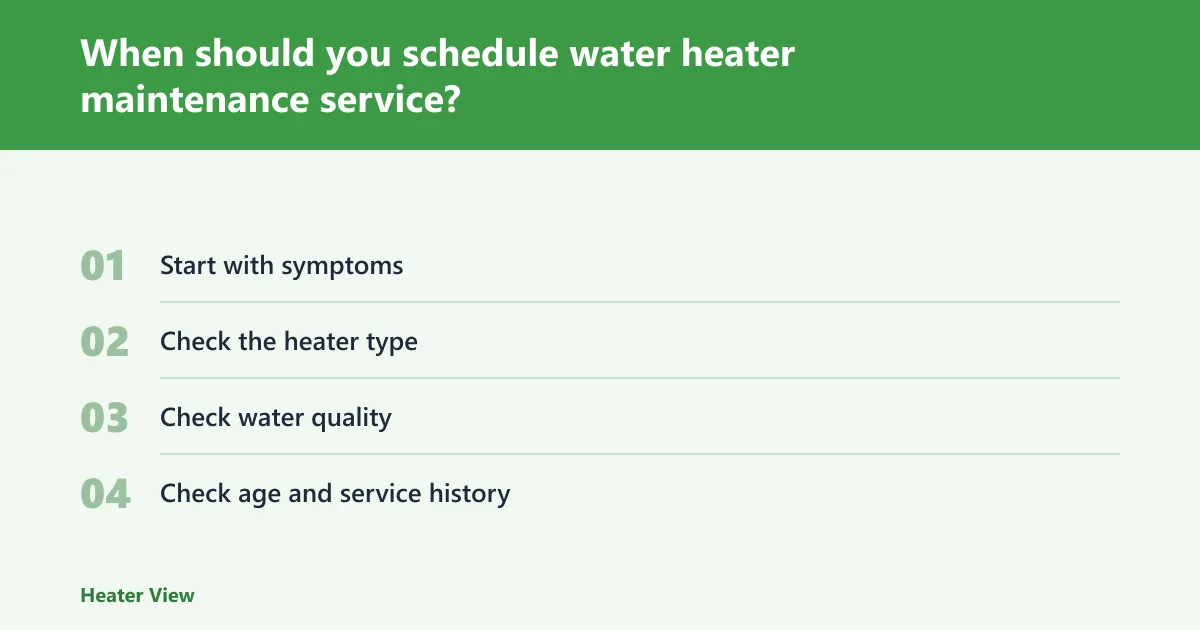
- Start with symptoms. Leaks, rust, strange noises, reduced hot water, or discolored water move the job into the now or within 30 days bucket.
- Check the heater type. Tank, tankless, and heat pump hybrid units follow different maintenance intervals.
- Check water quality. Hard water shortens service intervals because scale and sediment build faster.
- Check age and service history. If the last visit is unclear, choose professional inspection sooner.
📊 Heat pump hybrid water heater air filters should be cleaned or replaced every 1-3 months. Source: Water Heater Maintenance: The Real Service Schedule for Homeowners.
What maintenance timing works for each water heater type?
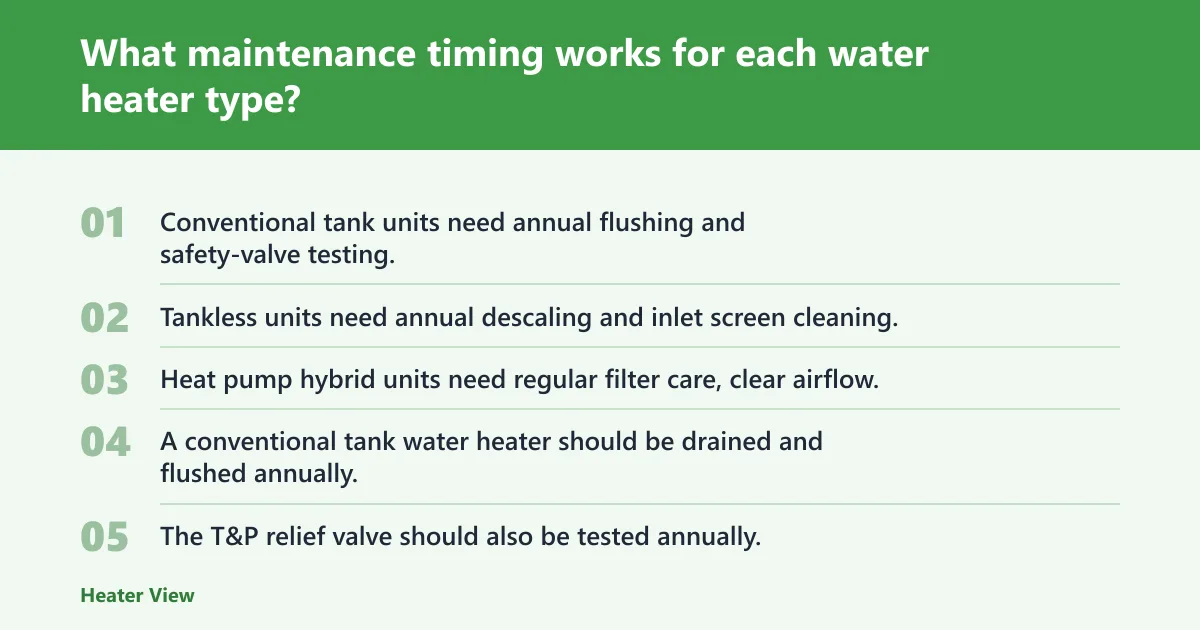
Each heater type needs a different schedule. Conventional tank units need annual flushing and safety-valve testing. Tankless units need annual descaling and inlet screen cleaning, often sooner in hard water homes. Heat pump hybrid units need regular filter care, clear airflow, and less frequent tank flushing than a standard tank.
Conventional tank water heaters
A conventional tank water heater should be drained and flushed annually. The T&P relief valve should also be tested annually. The anode rod, which helps protect the tank from corrosion, should be inspected or replaced every few years, sooner if corrosion looks advanced or the rod is significantly worn.
Sediment is the main problem here. It settles at the bottom, cuts efficiency, can harden over time, and speeds corrosion. ABM says annual flushing is the most important maintenance step, and it notes that most homes operate efficiently and safely at 120 degrees Fahrenheit.
Tankless water heaters
Tankless water heaters should be descaled annually, and their inlet filter screens should be cleaned annually as well. ABM says descaling is often recommended every one to two years depending on water quality and usage, which is why hard water homes need shorter intervals. Scale on the heat exchanger can reduce flow and trigger performance problems.
Picture a tankless unit in a home with hard water and heavy evening use. If hot water starts cycling or shower temperature swings, move service up instead of waiting for the next annual date. A dirty inlet screen can also choke flow before a major failure appears.
Heat pump hybrid water heaters
Heat pump hybrid water heaters need air filter cleaning or replacement every 1-3 months, plus two feet of clear space around the unit. Their tanks still need flushing every 2-3 years. Those intervals matter because the air side affects efficiency, while the tank side still collects sediment.
Keep the area around the unit open so it can move air freely. If the filter is clogged, the unit may run longer and heat less effectively. That is a good reason to move service from routine to this season.
What warning signs mean you should book service now?
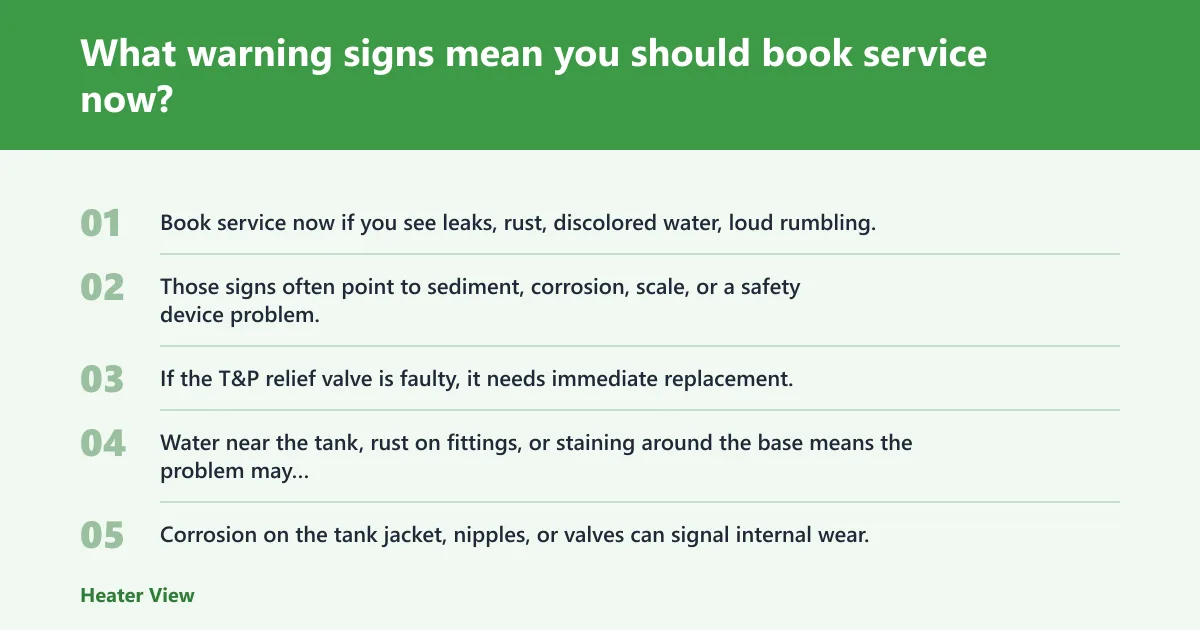
Book service now if you see leaks, rust, discolored water, loud rumbling, or a drop in hot-water output. Those signs often point to sediment, corrosion, scale, or a safety device problem. If the T&P relief valve is faulty, it needs immediate replacement, not a delay until the next routine visit.
Leaks, rust, and corrosion
Water near the tank, rust on fittings, or staining around the base means the problem may already be active. Corrosion on the tank jacket, nipples, or valves can signal internal wear. If the last service date is unclear, a professional plumbing service is the safer next step.
Strange noises, popping, or rumbling
Popping, cracking, or rumbling can suggest sediment buildup. That sediment can harden and create hot spots, which makes the tank work harder. A noisy tank is not only annoying; it is a sign that flushing should move up on the calendar.
Reduced hot water or slower recovery
If showers go cold faster or the tank takes longer to recover, scale and sediment are common causes. In tankless units, a clogged filter screen or scale on the heat exchanger can do the same thing. In heat pump hybrids, airflow or filter issues can also slow heating.
Discolored water or a faulty T&P valve
Rust-colored or cloudy water can point to corrosion or sediment disturbance. The temperature and pressure relief valve is a critical safety device, and its test lever should function correctly. A bad T&P valve must be replaced immediately.
How hard water and age change the maintenance schedule
Hard water shortens maintenance intervals because it accelerates scale and sediment. Older units also need closer attention because corrosion risk rises with age and service history becomes less predictable. ABM says tanks between five and ten years old should be monitored more closely, and that is a sensible threshold for moving maintenance up.
Why hard water shortens flush and descaling intervals
Hard water leaves mineral deposits behind. Those deposits collect faster in tanks and on tankless heat exchangers, which means more frequent flushing or descaling. In a hard-water home, annual service is often the minimum, not the ideal. If scale builds quickly, shorten the interval further.
Say your 50-gallon tank starts making a low popping sound after a year in a hard-water area. That is a clear sign to schedule service now, not wait for the next annual reminder. The same logic applies to tankless units that need descaling sooner than the usual cycle.
What older units need checked more often
Older tanks should be checked for anode wear, rust, and weak valves more often because the margin for error is smaller. An anode rod provides sacrificial corrosion protection, so once it is more than 50% corroded, replacement is due. If the unit is old and service records are thin, choose professional inspection.
When corrosion risk makes professional service a better choice
Choose a technician when there are gas, electrical, or corrosion concerns. DIY checks are fine for visual inspection, filter cleaning, or confirming whether the floor is dry. A pro should handle gas controls, electrical faults, leak diagnosis, valve replacement, and any corrosion that appears to involve the tank itself.
What happens during a professional water heater maintenance visit?
A professional visit should include inspection, safety checks, cleaning, and part evaluation, not just a quick drain. The technician should verify the tank’s condition, check valves and connections, and match the service to the heater type. That matters most when the age, last service date, or symptom history is unclear.
Inspection and safety checks a technician should complete
A proper maintenance visit should check for leaks, corrosion, improper venting on gas units, wiring issues on electric units, and the function of the T&P valve. The technician should also confirm temperature settings, inspect visible piping, and look for signs that sediment or scale is affecting performance.
Cleaning, flushing, and part checks by heater type
For a tank unit, the visit should include a drain and flush, T&P valve testing, and anode rod inspection when due. For tankless units, the scope should include descaling and inlet filter cleaning. For heat pump hybrids, filter service and tank flushing should be part of the plan.
When to choose professional service instead of DIY
Use DIY for simple, safe checks: spotting leaks, checking the area around the unit, cleaning a heat pump filter, or confirming access to the inlet screen on a tankless model. Choose professional plumbing service for any gas, electrical, corrosion, valve, or unclear-history issue. That is the difference between routine care and risk.
How much does professional water heater maintenance cost versus DIY?
DIY can be low-cost if you are only doing safe visual checks or filter cleaning, while professional maintenance costs more because it includes inspection, flushing, and part testing. The tradeoff is simple: DIY is cheaper for basic upkeep, but a technician is the better choice when safety parts, corrosion, or unclear service history are involved.
For budgeting, think in task bundles instead of a single price. A DIY bundle may include filter cleaning and a quick visual inspection. A professional bundle may include a tank flush, T&P testing, anode inspection, descaling, and a full safety review. If you are choosing only one, spend it on the riskier issue first.
Frequently asked questions
When should I schedule water heater maintenance service?
Schedule maintenance once a year for most water heaters, then move it sooner if the unit is older, the water is hard, or symptoms appear. Rumbling, rust, leaks, reduced hot water, or cloudy discharge all justify faster service because they often point to sediment, scale, corrosion, or a valve issue.
How often should a water heater be serviced?
Conventional tank water heaters should be serviced annually. Tankless water heaters should be descaled annually, with the inlet screen cleaned on the same schedule. Heat pump hybrid units need air filter attention every 1-3 months and tank flushing every 2-3 years, with faster service in hard water homes.
What are the signs my water heater needs maintenance now?
Leaks, rust, popping or rumbling noises, discolored water, and slower hot-water recovery are the clearest signs. A faulty T&P valve is also urgent because it is a critical safety device. If any of these show up, move the job from routine maintenance to immediate scheduling.
Should I schedule service yearly or only when there’s a problem?
Yearly service is the baseline, not the ceiling. Waiting for a problem usually means sediment, scale, or corrosion has already done more damage. Routine maintenance catches those issues earlier, while symptoms tell you to accelerate the appointment rather than skip the annual visit.
Can hard water mean I need water heater service sooner?
Yes. Hard water speeds up scale and sediment buildup, so tanks, tankless units, and heat pump hybrids all need closer attention. In hard-water homes, annual service may not be enough if performance drops, noises start, or scale shows up quickly in the drain, filter, or heat exchanger.
What is checked during a water heater maintenance visit?
A proper visit should include inspection for leaks and corrosion, testing the T&P relief valve, flushing or descaling by heater type, and checking wear parts such as the anode rod. For tankless and heat pump hybrid units, the technician should also inspect filters, clearances, and unit-specific components.