How to Maintain a Water Heater in Humid Climates Safely
Maintain a water heater in humid climates by draining a few gallons from the tank once a year to clear settled grit, checking the anode rod every 3–5 years, insulating cold pipes so they do not sweat, and replacing rusted, leaking, or swollen fittings as soon as they appear. Humid air speeds corrosion, shortens tank life, and can turn a small drip into water damage or a failed heater. This guide covers tank and tankless care for garages, closets, basements, and coastal homes, plus when to call a plumber.
How do you maintain a water heater in humid climates?
What you’ll need
- Flashlight
- Bucket
- Towels or absorbent rags
- Work gloves
- Safety glasses
- Adjustable wrench
- Garden hose for flushing
- Small mirror or phone camera for tight corners
- Replacement pipe insulation for cold lines
- Dehumidifier or fan, if the installation space stays damp
- Nonmetallic brush for light surface cleaning
Why humidity changes the maintenance priorities
Humidity shifts the job from heat management to corrosion control. Moist air condenses on cooler tank surfaces, settles in seams and fittings, and hangs under jackets, on base pans, and around valves. In coastal homes, salt in the air speeds rust on exposed steel and fasteners.
Garages and closets usually fail for different reasons. A garage may hold warm, wet air and dust that keeps moisture against metal. A closet may trap steam from showers, laundry, or a nearby attic hatch. Basements often add cold surfaces, which increases condensation. Those conditions call for airflow, dry surfaces, and close inspection of connection points.
What parts corrode first in damp spaces
The painted steel jacket, tank top, base, and fittings usually show trouble first. The T&P valve, drain valve, and pipe connections can also corrode where water sits or drips. On tankless units, the cabinet edges, intake and exhaust areas, condensate lines, and heat exchanger connections need attention.
What parts of a water heater need the most attention in humid weather?
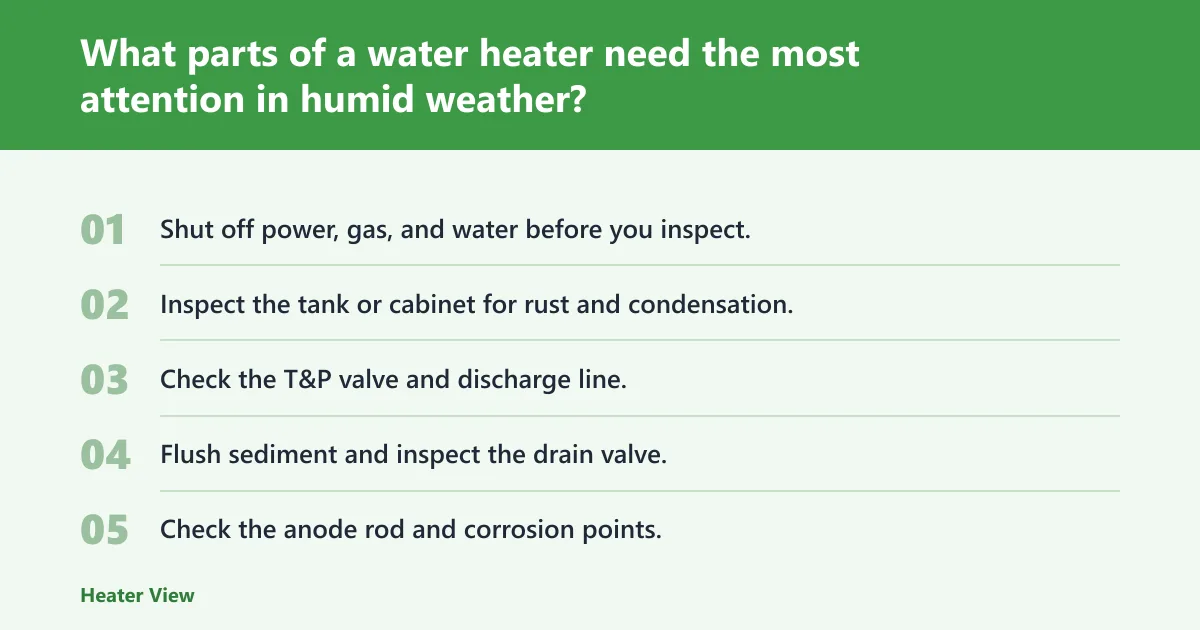
The most important parts are the tank exterior, the T&P valve and discharge pipe, the drain valve, the anode rod, the pan and drain line, and any exposed fittings. In humid weather, those areas tell you whether the unit is drying normally or trapping moisture. On tankless units, add the heat exchanger, condensate drain, and venting.
- Shut off power, gas, and water before you inspect.
- Inspect the tank or cabinet for rust and condensation.
- Check the T&P valve and discharge line.
- Flush sediment and inspect the drain valve.
- Check the anode rod and corrosion points.
- Manage the pan, drain line, airflow, and moisture.
- Adjust maintenance for tankless units and coastal homes.
1. Shut off power, gas, and water before you inspect
Turn off the breaker for electric units, set gas controls to off for gas models, and close the cold-water supply valve. Safe isolation matters because humid-climate checks often involve wet floors, tight spaces, and metal parts that may already be corroded. Wait for hot surfaces to cool.
2. Inspect the tank or cabinet for rust and condensation
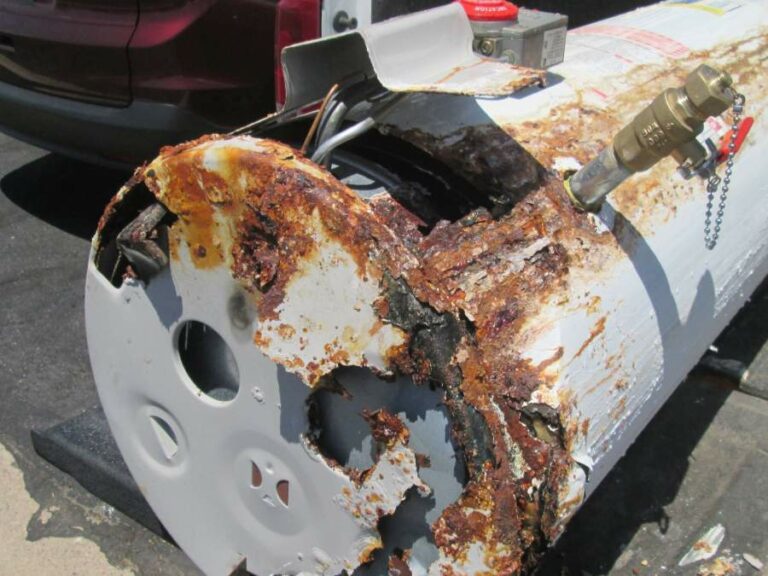
Look at the painted steel jacket, the top, and the base. Surface rust near seams, fasteners, or the bottom edge often starts where moisture collects. Keep clear of damp walls and floors; a tank set too close to a sweating wall or standing water will corrode faster.
Picture a tank in a closet with a damp baseboard. If the lower jacket shows orange streaks and the floor stays wet after showers, the issue is not cosmetic. Moisture control belongs in the repair plan.
3. Check the T&P valve and discharge line
Test the T&P valve at the interval listed by the manufacturer, often at least once a year. The discharge pipe should point downward, stay open, and end where you can see release. Rust, white mineral crust, or a valve that dribbles after the test can signal trouble.
4. Flush sediment and inspect the drain valve
Drain a few gallons from the tank about once a year in many homes, and more often if the water is hard. Humidity does not create sediment, but damp conditions can hide leaks around the drain valve and make metal parts corrode faster. Popping sounds, slow recovery, or cloudy discharge point to buildup inside the tank.
Drain valves vary in quality. Plastic valves and stiff, low-grade fittings can leak or break during flushing. If the valve sticks, seeps, or will not close cleanly, plan a replacement rather than forcing it.
5. Check the anode rod and corrosion points
The anode rod is sacrificial corrosion protection. It corrodes so the tank steel does not have to. Many manufacturers and service guides suggest checking it every few years, sooner in hard water or highly corrosive conditions. Magnesium rods usually protect well in softer water; aluminum rods can last longer in some aggressive water conditions.
Replace the rod when it is heavily pitted, coated with hard mineral scale, or reduced to a thin wire. If the tank shows rust at the hot-water nipple or top seam, the rod may already be spent.
How often should you flush a water heater in a humid climate?
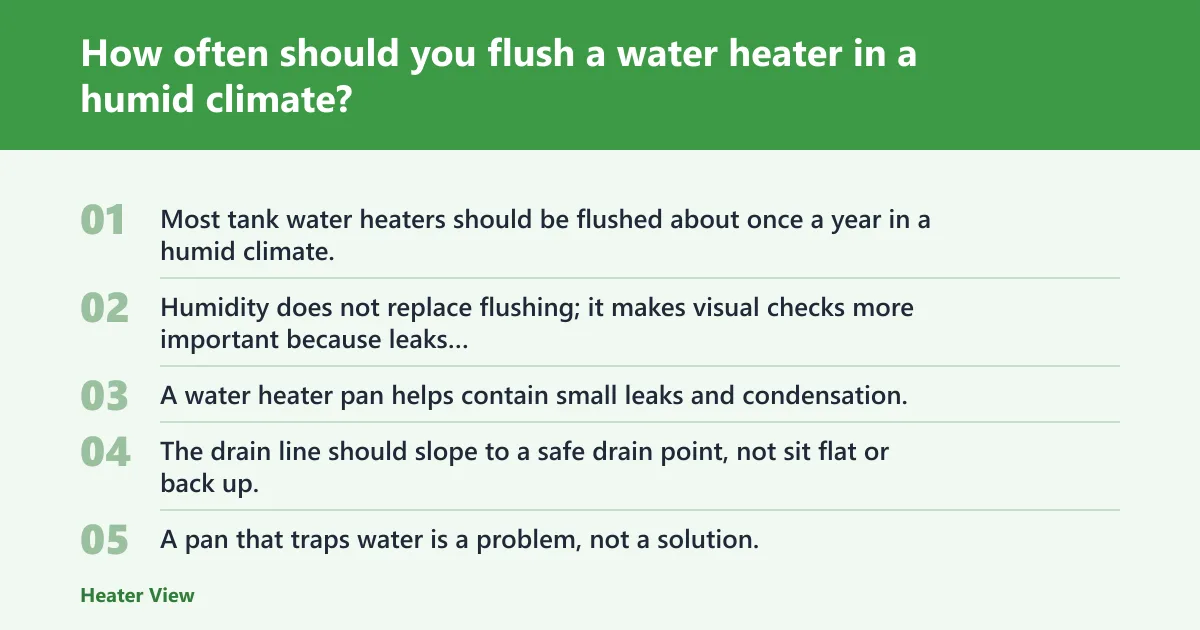
Most tank water heaters should be flushed about once a year in a humid climate, and more often if you have hard water, frequent sediment, or a tank in a damp garage or basement. Humidity does not replace flushing; it makes visual checks more important because leaks and rust spread faster around sedimented parts.
6. Manage the pan, drain line, airflow, and moisture
A water heater pan helps contain small leaks and condensation. The drain line should slope to a safe drain point, not sit flat or back up. A pan that traps water is a problem, not a solution, because standing water can rust the base and nearby framing.
Should I use a dehumidifier near my water heater? Yes, if the unit sits in a closed closet, basement, or garage that stays damp for long stretches. Aim for dry air around the appliance, good cross-ventilation where code allows, and no mold smell on walls or nearby insulation.
7. Adjust maintenance for tankless units and coastal homes
Tankless water heaters need descaling, vent checks, and cabinet inspection. Follow the manufacturer’s descaling interval; in hard-water or humid coastal areas, service is often needed more often. Check the heat exchanger for scale, the condensate drain for blockage, and the air intake and exhaust for corrosion, lint, or salt buildup.
Coastal homes need extra attention around fasteners, vents, and exposed edges. Salt air can stain or pit metal faster than inland humidity alone. In a garage, basement, or closet, look for cabinet corrosion, rust at screw heads, and dampness around the unit after rainy weather.
How can I stop condensation on my water heater?
To stop condensation, insulate the cold-water inlet pipe, improve airflow around the unit, and reduce room humidity with ventilation or a dehumidifier. Condensation usually forms when moist air hits a cooler tank surface, so the fix is drying the space and reducing the temperature gap on nearby pipes.
Insulation blankets: useful or risky?
Tank insulation blankets can help on some older tank models, but they are not a cure for damp rooms. In humid spaces, a blanket may trap moisture against the jacket if the area already stays damp. Use only if the manufacturer allows it, and keep clear of burners, controls, and service openings on gas units.
What signs show my water heater is corroding from humidity?
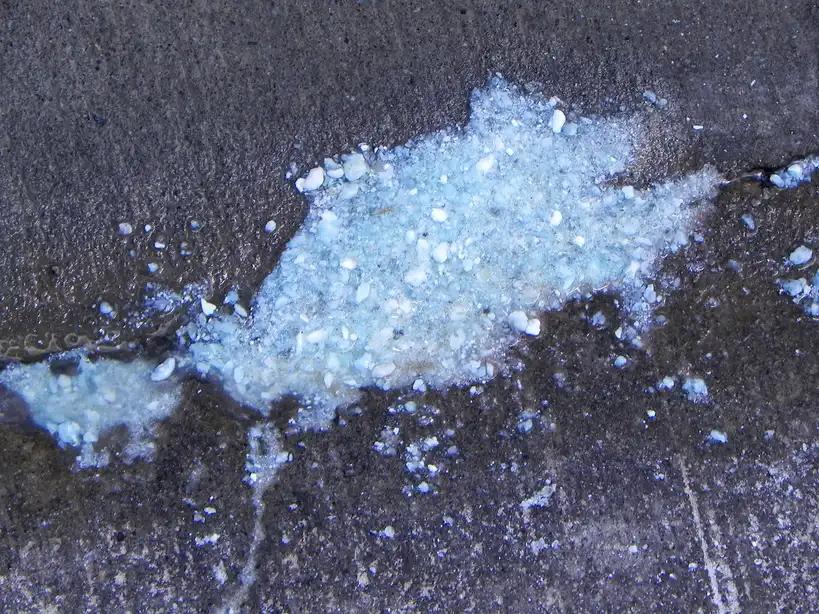
Watch for rust stains, white mineral crust, green or blue staining on copper fittings, moisture around connections, and a sour or metallic smell near the unit. Humidity-related corrosion usually starts at seams, the base, the top fittings, and valve threads, then spreads if the space stays damp.
| Location | Visible symptoms | Recommended action | DIY or plumber |
|---|---|---|---|
| Garage | Rust at base, damp concrete, rusted fasteners | Add airflow, raise the unit off standing water risk, inspect pan and drain line | DIY for airflow and drying; plumber for active leaks |
| Closet | Musty smell, condensation on jacket, wet wall behind tank | Check clearance, add ventilation or dehumidifier, inspect insulation and nearby plumbing | DIY if only condensation; plumber if fittings drip |
| Basement | White crust on valves, popping noises, rust at base ring | Flush sediment, test T&P valve, check floor drain and pan slope | DIY for flushing; plumber for valve discharge or tank rust-through |
| Coastal home | Green-blue fitting corrosion, pitted screws, surface rust on cabinet | Inspect more often, clean salt residue, check venting and exposed metal | DIY for cleaning; plumber for vent or heat exchanger damage |
| Tankless cabinet | Condensate smell, scale, blocked intake, rust around seams | Descale, clear condensate drain, inspect venting and cabinet edges | DIY for filter cleaning; plumber for vent or exchanger faults |
Suppose a tankless unit in a closet starts showing blue-green staining at the water lines after a rainy month. That usually points to moisture at copper fittings, not just cosmetic discoloration. If the stain returns after drying, the connection needs a closer look.
Is tankless water heater maintenance different in humid climates?
Yes. Tankless units still need descaling, but humid climates add condensate, venting, and cabinet corrosion checks. The heat exchanger can scale from hard water, while the cabinet and intake or exhaust parts can corrode if the space stays wet or salty. Keep condensate drains open and vents clean.
What should I check around my water heater after a rainy season?
After a rainy season, check the floor around the unit, the pan and drain line, wall surfaces nearby, and any fittings that may have stayed damp. Look for new rust, new mineral crust, musty odors, swollen pipe insulation, and any change in burner or vent appearance.
Common mistakes
Using an insulation blanket where it may trap moisture or violate clearance rules is a frequent error. Ignore small rust stains, white crust, or green-blue fitting corrosion, and those marks often turn into leaks later. Skipping airflow or dehumidification in a closed closet or garage leaves the metal wet longer than it should be.
Waiting too long to call a plumber is the other mistake. If the T&P valve drips after testing, if the drain valve leaks, or if the tank base shows active rust with moisture, do not keep resetting the schedule. That is a repair problem, not a cleaning problem.
When should I call a plumber for water heater rust or leaks?
Call a plumber if rust is forming at seams, the T&P valve leaks, the drain valve will not seal, or the tank base shows repeated moisture after drying. Surface rust on a jacket can be cleaned and monitored, but rust near fittings, the base, or the discharge line can mean the unit is failing.
Use this escalation ladder: dry the area first; tighten only accessible fittings if allowed; replace failed drain or discharge parts; then schedule service if moisture returns. If a tankless unit shows vent damage, condensate backup, or cabinet corrosion, stop at the inspection stage and get a pro involved.
Frequently asked questions
How do you maintain a water heater in humid climates?
Drain a few gallons from a tank yearly, inspect the jacket, valves, and fittings for rust, and keep the area dry with airflow or a dehumidifier if needed. In humid rooms, the goal is to stop condensation from sitting on metal parts. For tankless units, add vent and condensate checks to the routine.
Does humidity make a water heater rust faster?
Yes. Humid air leaves moisture on steel surfaces, fittings, and seams, which speeds corrosion. The effect is stronger when the unit sits near damp walls, concrete floors, or salt air. Rust usually starts small, then spreads where water can stay trapped after showers, storms, or leaks.
What parts of a water heater need the most attention in humid weather?
Focus on the tank top and base, the painted steel jacket, the T&P valve, the drain valve, the anode rod, and the pan and drain line. For tankless units, check the cabinet, heat exchanger, condensate drain, and intake or exhaust paths. Those are the parts humidity reaches first.
How often should you flush a water heater in a humid climate?
Plan on once a year for most tanks, then shorten the interval if your water is hard or the unit sits in a damp location. Popping noises, cloudy discharge, or slower hot water recovery are signs that sediment has built up sooner than expected and needs attention.
Should I use a dehumidifier near my water heater?
Use one if the heater sits in a closed closet, basement, or garage that stays damp for long periods. Keep the unit sized for the room and empty or drain it regularly. The aim is dry air around the heater, not just less visible condensation on one side.
When should I call a plumber for water heater rust or leaks?
Call a plumber if rust appears at seams, a valve drips after testing, water collects in the pan, or the tank base stays wet after you dry it. Also call for tankless vent corrosion, condensate backup, or any leak that returns after you tighten visible fittings once.