Best Water Heater for Energy Savings
For most homeowners, a heat pump water heater is the best water heater for energy savings if you have 240V power and enough space; otherwise, a high-efficiency gas tank or tankless unit may cost less over its life once upgrades are counted. Choosing by efficiency alone can lead to expensive electrical, venting, or gas-line work that wipes out the savings. This guide compares lifetime cost, installation limits, and hot-water demand so you can pick the cheapest fit for your home.
Best water heater for energy savings: tank, tankless, or heat pump
Heating water accounts for roughly 18 percent of household energy use, so the unit you choose can move your utility bill in a real way. The lowest sticker price is not always the lowest lifetime cost. Installation work, fuel type, maintenance, and how much hot water you use can matter more than the UEF on the box.
| Type | Typical operating cost driver | Installation constraints | Maintenance burden | Likely rebate fit | Best household scenario |
|---|---|---|---|---|---|
| Heat pump water heater | Electric use is cut by air-source heat pump operation; heat pump models can be two to four times more energy-efficient than conventional electric water heaters | Electric-only; needs about 1,000 cubic feet of air space or a ducted/louvered equivalent; needs a drain or condensate pump | Moderate; keep the air path clear and manage condensate | Often yes; some utilities and states offer incentives, and Con Edison offers $1,000 for Energy Star-certified upgrades | Electric homes with room for the unit and a long ownership window |
| Tankless water heater | Gas tankless models are more efficient than gas storage tank heaters; electric versions avoid standby losses | Gas or electric; may need electrical service upgrades; best when simultaneous demand is lower or spread out | Higher; descaling and flushing every one to two years | Sometimes, depending on program and fuel type | Homes with lower simultaneous demand or limited space for a tank |
| Storage tank water heater | Gas storage tank heaters generally cost about half as much to run as electric water heaters, but local rates still decide the real result | 30 to 80 gallon capacities; gas, propane, electric, or oil fuel options | Lower than tankless, but the unit is less efficient than heat pump models | Sometimes for replacement, especially in electric upgrade programs | Budget-sensitive replacements and simple swaps |
Which type tends to have the lowest operating cost?
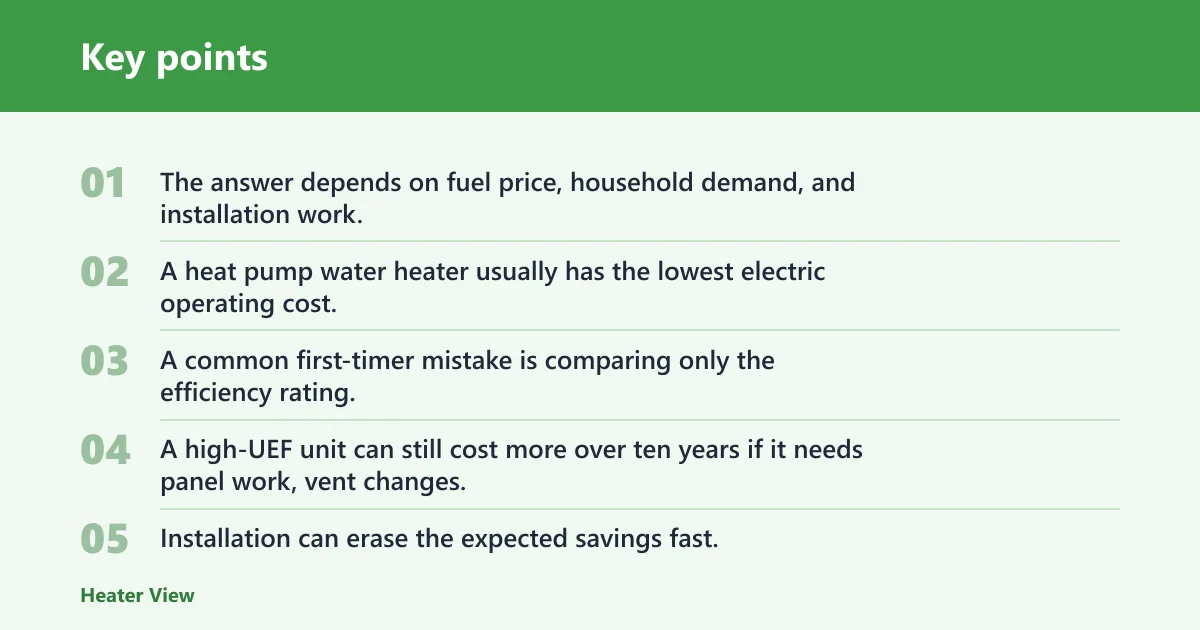
The answer depends on fuel price, household demand, and installation work. A heat pump water heater usually has the lowest electric operating cost, while a gas tankless or gas storage tank can be cheaper to run than electric resistance in many markets. Local utility rates decide the real winner.
A common first-timer mistake is comparing only the efficiency rating. A high-UEF unit can still cost more over ten years if it needs panel work, vent changes, or extra plumbing that a basic tank replacement would not need.
Where installation cost changes the answer
Installation can erase the expected savings fast. Replacing a gas tank with a heat pump unit may require electrical capacity that is not already there. Replacing a tank with tankless may require venting changes for gas models or a service upgrade for electric models. Those costs belong in the decision, not after it.
What matters more than the efficiency rating?
UEF matters, but it does not settle the bill by itself. Lifetime cost depends on fuel price, hot-water demand, installation complexity, and maintenance. A model with a higher UEF can still be the wrong choice if it needs a larger electrical service, special venting, or frequent upkeep that a simpler unit avoids.
UEF versus total lifetime cost
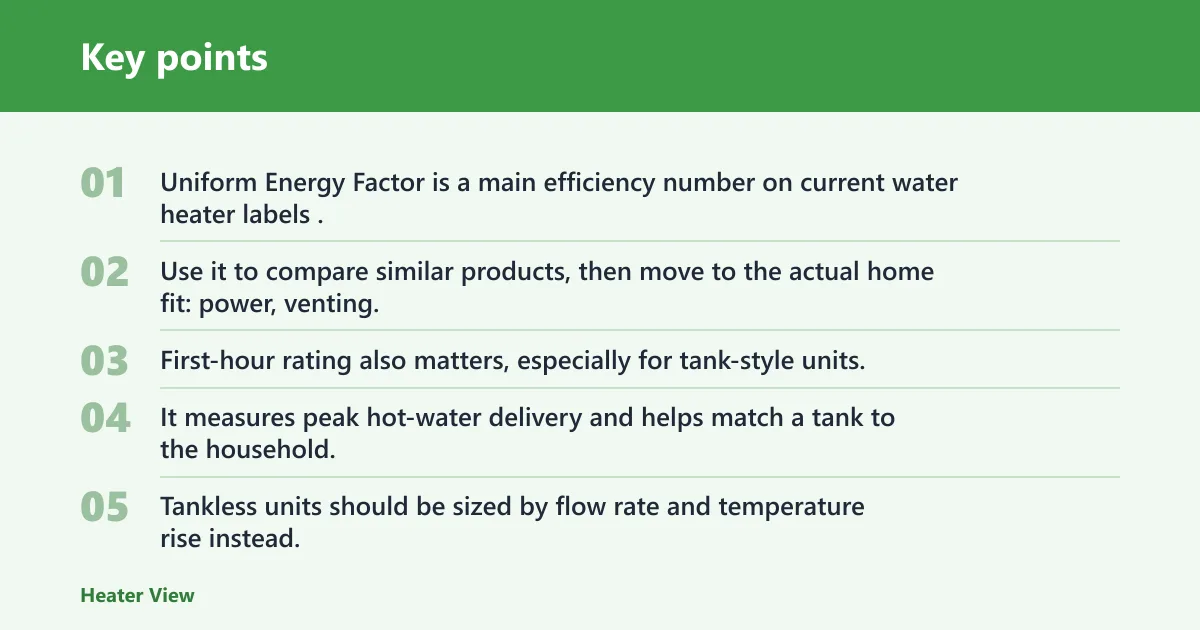
Uniform Energy Factor is a main efficiency number on current water heater labels. A higher number means greater efficiency. Use it to compare similar products, then move to the actual home fit: power, venting, space, and the number of people and fixtures that draw hot water at once.
First-hour rating also matters, especially for tank-style units. It measures peak hot-water delivery and helps match a tank to the household. Tankless units should be sized by flow rate and temperature rise instead. Using first-hour rating for tankless is the wrong metric.
Maintenance and service access
Maintenance changes lifetime savings. Tankless water heaters may need descaling and flushing every one to two years. Heat pump units need room to breathe, plus a drain path or condensate pump. Storage tanks are simpler, but they are still less efficient than heat pump models.
Suppose a 2-bath home has an older electric tank in a utility room with no drain and no spare space. A heat pump replacement may sound ideal on paper, yet a condensate pump and air-space work could turn a good deal into a marginal one. In that case, a high-efficiency tank may be the cheaper real-world swap.
Heat pump water heater: when the savings are real
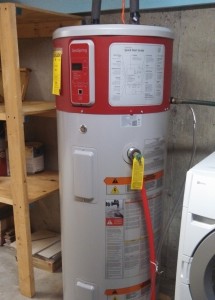
Heat pump water heaters are the highest-efficiency common residential type. They use air heat, run on electricity only, and may be significantly more energy-efficient than conventional electric water heaters. They can also qualify for rebates in some utilities and states, which can shorten payback. (Consumerreports)
Air space and condensate handling
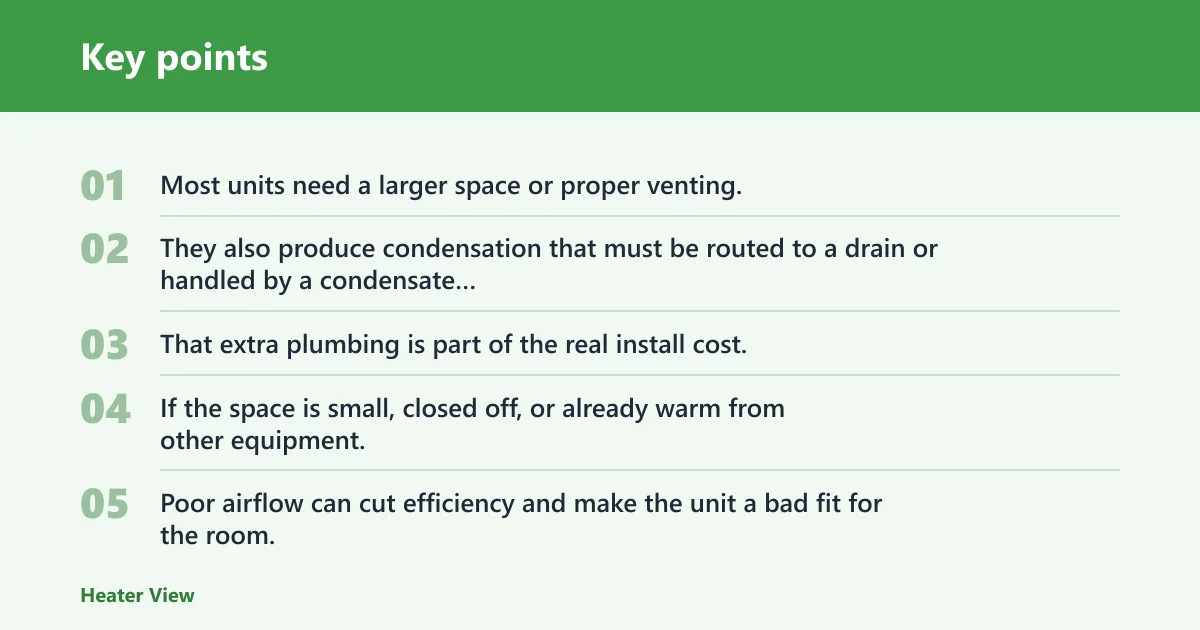
Most units need a larger space or proper venting, and they generally need about 1,000 cubic feet of air space to operate efficiently. They also produce condensation that must be routed to a drain or handled by a condensate pump. That extra plumbing is part of the real install cost.
If the space is small, closed off, or already warm from other equipment, the setup may still work with ducting or louvers. But that is a design question, not a given. Poor airflow can cut efficiency and make the unit a bad fit for the room.
Best-fit homes and poor-fit homes
Heat pump units tend to make the most sense in electric homes with room for the cabinet, a drain nearby, and a long enough stay in the home to recover the higher upfront cost. They are weaker fits for tight closets, sealed utility alcoves, or locations where condensate routing would be awkward.
Say your home has a 66-gallon electric tank in an open basement and a 240V circuit already in place. A heat pump replacement may be the cleanest savings move. If that same home had no drain and a cramped utility closet, the payback case would look weaker.
Tankless water heater: when on-demand heat helps
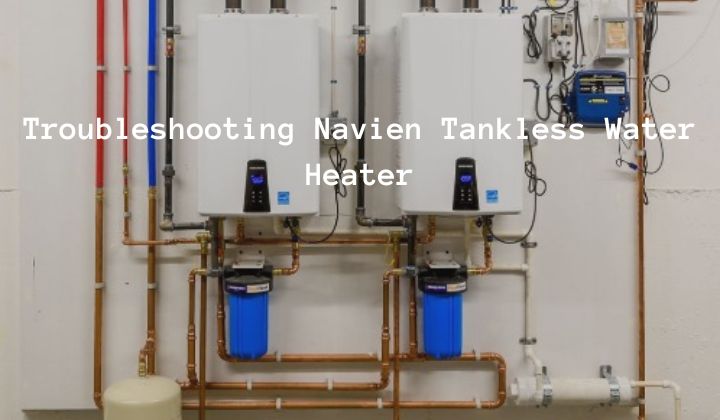
Tankless units heat water as needed, which avoids storage losses. Gas tankless models are more efficient than gas storage tank heaters. Electric tankless units exist too, but they can draw a lot of power and may trigger service upgrades. They tend to work best when simultaneous demand is modest or staggered.
Flow rate, simultaneous use, and sizing
Tankless sizing should be based on flow rate and temperature rise, not tank size or first-hour rating. A home with one shower and one dishwasher running at the same time may fit a tankless system well. A home with several showers, laundry, and sinks running together may need a large unit or may be better served by a tank.
Electrical upgrades and descaling costs
Electric tankless models can require electrical service upgrades, and that can make a low-energy-use idea more costly. Gas tankless units usually avoid that electrical burden, but they still need proper gas and venting setup. Both types bring more maintenance than a basic tank.
Maintenance also affects savings. Descaling and flushing every one to two years is common advice for tankless units, especially where hard water is an issue. That service cost can be small compared with energy savings, or it can eat into them if access is poor.
Storage tank water heater: the low-cost baseline
Storage tank water heaters remain the common replacement option because they are simple and cheaper to buy. They come in 30 to 80 gallon capacities and can run on gas, propane, electric, or oil. They are usually less efficient than heat pump models, but the install path is often straightforward.
First-hour rating and household size
For a tank, first-hour rating matters more than the tank label alone. It tells you how much hot water the unit can supply during peak demand. A family that takes back-to-back showers and runs laundry on the same morning needs more first-hour capacity than a couple with lighter demand.
Tank size and first-hour rating are related, but they are not the same thing. A larger tank does not automatically solve a high-use household if recovery is slow or the fixture pattern is demanding.
When a standard tank still makes sense
A standard tank can still be the best choice when you need a fast, low-cost replacement and the existing fuel setup is already a good fit. It also makes sense when the home has limited space, limited electrical capacity, or a short ownership timeline that makes a longer payback hard to justify.
What should you check before you buy?
The best savings choice starts with the house, not the product page. Check electrical capacity, fuel conversion needs, space, venting, condensate routing, and available rebates before you decide. Those factors can move the cheapest option by hundreds or thousands of dollars.
- Check whether the home already has 240V power or whether a panel, circuit, or service upgrade is likely.
- Confirm whether a gas-to-electric conversion would add electrical work that changes the payback.
- Measure the space for the new unit and confirm air volume, access, and service clearance.
- Look for a drain or condensate pump path if you are considering a heat pump unit.
- For gas tankless, verify venting and gas supply; for electric tankless, verify service capacity.
- Check rebate and utility incentive rules before you buy, since eligibility can change the economics.
Rebates and utility incentives
Rebates can change the answer. Some utilities and states offer heat pump incentives, and Con Edison offers $1,000 for Energy Star-certified heat pump water heater upgrades. That kind of support can offset part of the higher purchase price and shorten the payback period.
Do not assume every model qualifies. Incentives can depend on certification, installer paperwork, and local program rules. A unit that looks expensive on the shelf may become the best value after a rebate, while another model with a lower sticker price may fall out of contention if it misses the program terms.
Choose heat pump if… / Choose tankless if… / Choose storage tank if…
Use this section as a final filter. It is about fit, not brand loyalty.
Choose heat pump if…
Choose heat pump if your home has 240V power, enough air space, a drain or condensate pump option, and a long enough stay to recover the higher upfront cost. It is also the strongest pick when rebates are available and your goal is the lowest electric operating cost.
Choose tankless if…
Choose tankless if you want a compact unit, your simultaneous hot-water demand is modest or staggered, and the gas or electrical setup is already close to ready. It is a better fit when you value lower standby loss and can handle the maintenance and any service upgrade.
Choose storage tank if…
Choose storage tank if the priority is low upfront cost, easy replacement, and a simple fit for the current space and fuel. It is often the practical answer when the home needs hot water now and the site cannot absorb extra electrical, venting, or condensate work.
Frequently asked questions
What is the most energy efficient water heater?
A heat pump water heater is the most energy efficient common residential option. It uses air heat and can be two to four times more energy-efficient than conventional electric water heaters. That said, the most efficient unit is not always the cheapest one to own once installation and maintenance are included.
Are there energy efficient water heaters?
Yes. Heat pump, tankless, and high-efficiency storage tank models all beat older equipment in many homes. The right pick depends on fuel type, space, and demand. A high-UEF model helps, but only if it fits the house without major upgrade work.
How can I save energy with an electric water heater?
Use a heat pump water heater if the space and electrical setup allow it. If not, pick the smallest model that still meets first-hour demand, keep the temperature set as low as comfort allows, and limit hot-water waste from long runs and leaks. Rebates can improve the return.
Do hybrid water heaters save money?
Often, yes. Hybrid heat pump units can cut electricity use enough to pay back the higher purchase price, especially in homes with electric resistance tanks and available rebates. Savings depend on local rates, installation cost, and whether the unit has the space and drainage it needs.
Which water heater type has the lowest operating cost?
There is no single winner everywhere. Heat pump units usually have the lowest electric operating cost. Gas tankless can beat gas storage tanks on efficiency, and gas storage tanks often cost less to run than electric tanks in many markets. Local fuel prices decide the final result.
Can I switch from gas to electric water heating?
Yes, but the electrical side may need work. A gas-to-electric swap can require a new circuit, panel changes, or a service upgrade, and that cost can shrink or erase the expected savings. Check the space for the unit, the condensate path, and the rebate rules before you commit.