Water Heater Maintenance Questions to Ask a Technician
Ask the technician which parts were checked, what failed, what can wait, and what must be fixed now. If the tank shows leaks, corrosion, venting problems, or a bad relief valve, treat it as a same-day repair. Ignored maintenance can mean higher bills, weak hot water, leaks, or tank failure that damages flooring and walls. This guide gives you a homeowner question script you can use during a water heater maintenance visit.
Why these questions matter
Water heater maintenance can slow avoidable wear and catch small leaks early. A monthly visual check is recommended from a safe position, but a service visit should go further than a quick glance. You want clear answers on what the technician inspected, what changed, and whether the system can keep running safely.
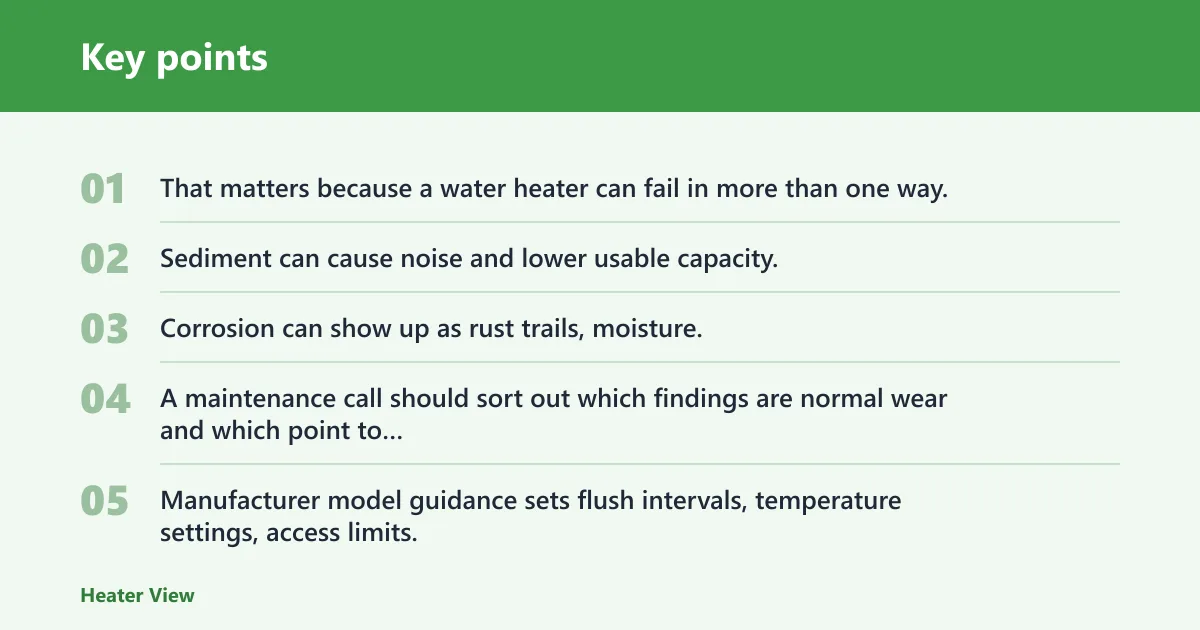
That matters because a water heater can fail in more than one way. Sediment can cause noise and lower usable capacity. Corrosion can show up as rust trails, moisture, or mineral deposits around the tank and connections. A maintenance call should sort out which findings are normal wear and which point to repair now.
Keep the manual nearby if you have it. Manufacturer model guidance sets flush intervals, temperature settings, access limits, and replacement parts. A generic calendar is only a starting point.
Water heater maintenance worksheet
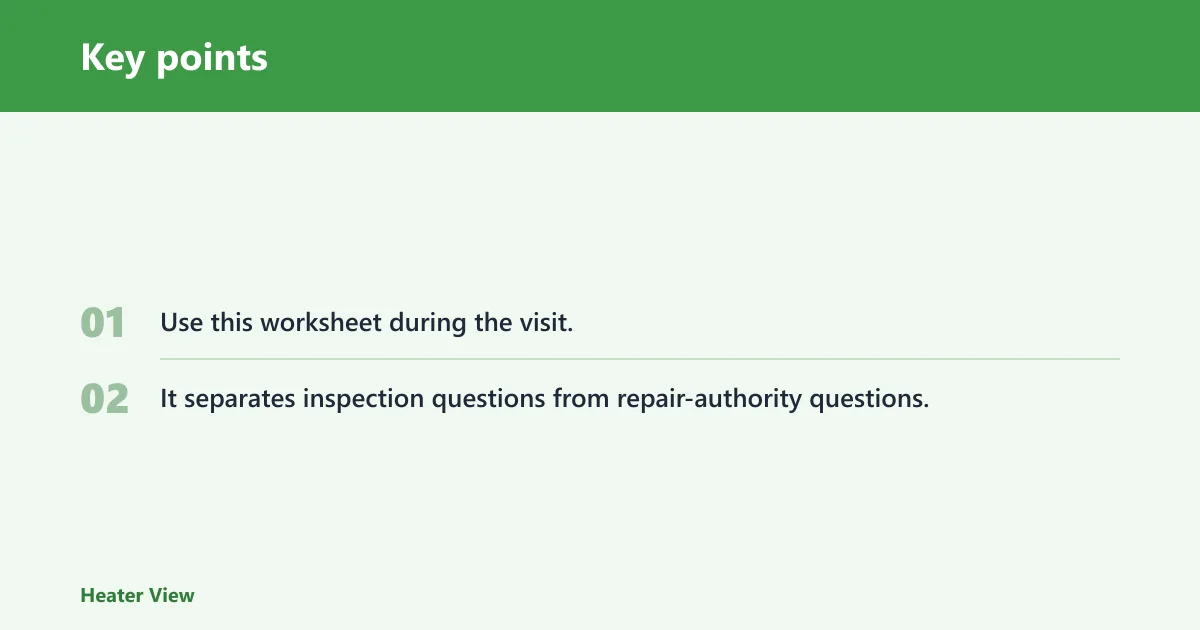
Use this worksheet during the visit. It separates inspection questions from repair-authority questions, so you can record what was checked and what the technician wants to do next.
| Ask | What a good answer includes | Red flags |
|---|---|---|
| What parts of the water heater did you inspect? | Tank or heat exchanger, connections, drain pan, drain line, shutoffs, and safety devices, plus nearby plumbing and access. | Only a quick look at the front of the tank; no answer about nearby plumbing or safety devices. |
| Did you find any leaks, rust, or corrosion? | Clear statement of where moisture, rust trails, or mineral deposits were found, or confirmation that none were seen from safe access points. | Vague talk like “looks fine” without location, source, or whether the tank, valves, or fittings were checked. |
| What did you see in the drain pan and drain line? | Whether the pan is dry, whether the drain line is clear, and whether either shows signs of a current or past leak. | Blocked drain line, standing water, or no comment on whether the pan drains properly. |
| What signs of sediment did you find? | Noise, reduced usable capacity, slower recovery, cloudy discharge during flushing, or mineral buildup at the bottom of the tank. | Dismisses loud popping or rumbling as normal without explanation. |
| Is flushing appropriate for this model now? | A reason tied to tank age, buildup level, water conditions, and whether a routine flush is likely to help. | Promises a flush for every tank, or says heavy buildup will clear completely without caveats. |
| What is the anode rod condition? | Whether it was inspected, how worn it looks, and whether replacement is practical on this model. | “It lasts forever,” or “replace it” without explaining the wear pattern or access issues. |
| What does the relief valve look like? | Whether the temperature-and-pressure relief valve is dry, whether the discharge pipe is clear, and whether it shows active discharge. | Any capped, blocked, or reduced discharge pipe; active dripping without a pressure or temperature explanation. |
| What temperature setting did you verify? | The current setting, whether the delivered temperature was measured, and whether the setting fits the home’s needs and scald risk. | “It is set right” with no measurement or no explanation of higher-setting risk. |
| Did you check shutoffs and utilities before work? | Water shutoff, gas shutoff, or electrical shutoff as applicable, plus safe access before any maintenance begins. | Work started before the technician identified the correct shutoff or confirmed safe access. |
| Do any repairs need to happen now, or can they wait? | A plain yes-or-no on immediate repair, what can be monitored, and what manufacturer guidance or part availability affects the plan. | Pressure to approve everything at once without separating urgent items from deferred items. |
What should the technician inspect first?
The first pass should be a visual check for moisture, rust trails, mineral deposits, and access issues. After that, the technician should confirm the tank, drain pan, drain line, shutoffs, nearby plumbing, venting, and any safety devices tied to the model. That sequence helps separate small wear from active failure.
Leak, rust, and corrosion checks
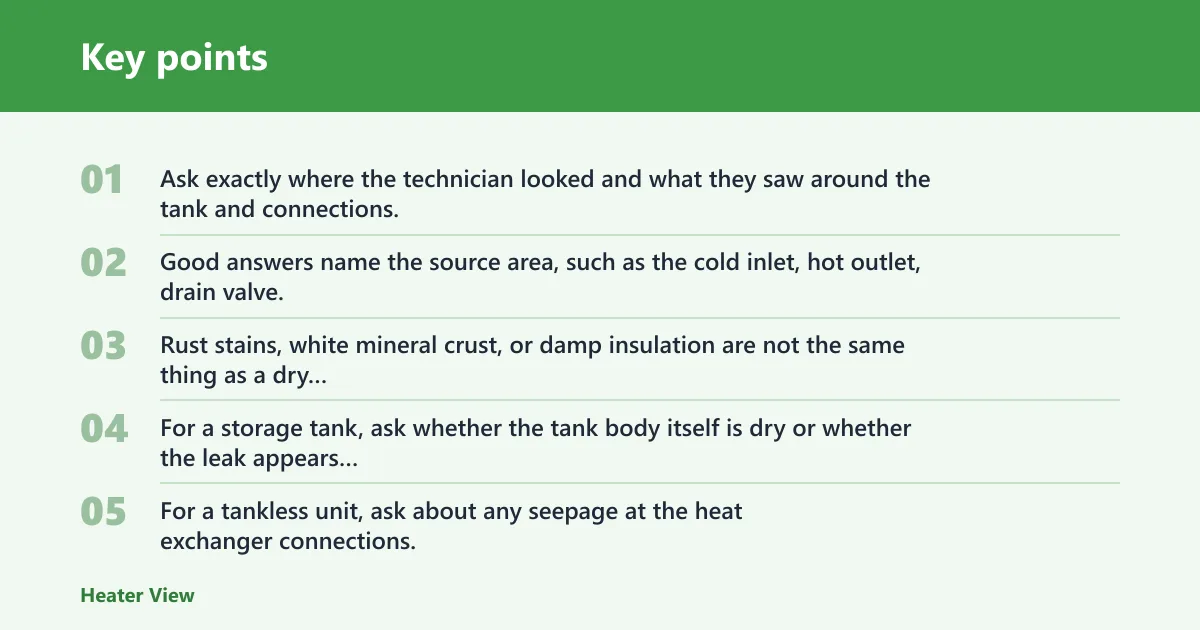
Ask exactly where the technician looked and what they saw around the tank and connections. Good answers name the source area, such as the cold inlet, hot outlet, drain valve, or base of the tank. Rust stains, white mineral crust, or damp insulation are not the same thing as a dry surface.
For a storage tank, ask whether the tank body itself is dry or whether the leak appears to come from fittings that might still be repairable. For a tankless unit, ask about any seepage at the heat exchanger connections, condensate path, or service valves. The answer should match the unit type.
Tank, venting, drain pan, and drain line
Gas units generally need a venting review. Electric units generally do not need flue checks, but they still need tank, wiring, and safety-device checks. Tankless systems often need closer attention to venting or condensate drainage, depending on design. Ask the technician to name the specific item inspected instead of saying “the vent was fine.”
Picture a 50-gallon tank in a closet with a drain pan under it. A dry pan is useful only if the drain line also works. If the line is capped, blocked, or pitched badly, a small leak can stay hidden until damage appears on the floor or adjacent wall.
Shutoffs and safe access
Ask whether the water shutoff, gas shutoff, or electrical shutoff was identified before any service started. Safe access matters because a technician should be able to stop water, fuel, or power quickly if a fitting fails during maintenance. If access is blocked, that should be recorded as part of the visit.
Nearby plumbing matters too. Maintenance includes more than the tank itself, and technicians may evaluate flexible connectors, unions, gas piping, venting, and electrical supply. That broader check can reveal problems that make a “minor” issue into a real repair.
What should I ask about sediment?
Ask what sediment was observed, where it collected, and whether it is affecting noise, usable capacity, or heat transfer. A good answer should say whether flushing makes sense for this model now or whether heavy buildup makes a routine flush less useful. The technician should connect the findings to the next step.
Signs of buildup
Sediment is mineral and particle buildup at the bottom of a tank. Ask whether it is causing popping, rumbling, or a delay in heating. Those sounds matter because sediment can cause noise and lower usable capacity. The answer should also address whether the unit has enough remaining capacity for the household’s demand.
Suppose a 40-gallon tank starts popping loudly during recovery and the hot water runs short faster than before. That combination points to buildup worth discussing, not just a noisy appliance. Ask whether the heating surface is being insulated by sediment and whether that changes the service plan.
Flush now or defer
Ask whether the tank should be flushed now, flushed later, or left alone until a repair visit. A neglected tank with heavy buildup may not respond to a routine flush the way a newer tank does. If the drain valve is old, stuck, or leaking, the technician should explain that before opening it.
Flush interval depends on water conditions. Harder water usually means more mineral buildup, but the technician should tie that to your system rather than guess from a calendar. Ask what evidence led to the recommendation, not just the recommendation itself.
When noise points to a deeper problem
Ask whether the sound is only sediment or a sign of another issue, such as overheating, scale on the element, or a burner problem on a gas unit. Noise alone does not identify the fault. The technician should say whether the noise changed after flushing or whether the source is still active.
What should I ask about the anode rod?
Ask what condition the anode rod is in, whether inspection is practical on this model, and whether replacement would help now. The anode rod is a sacrificial part that helps protect the steel tank from corrosion. Wear rate varies with water chemistry, temperature, demand, and tank design.
What the rod does
Ask the technician to explain whether the rod still has enough material left to do its job. A rod that is badly depleted does not protect the tank as well. That matters more in tanks with aggressive water conditions or higher usage, where deterioration can happen faster.
Do not let an anode rod discussion blur into a tank-leak discussion. The rod helps slow corrosion, but it is not a fix for a leaking tank. If the tank shell is leaking, replacement is usually the real issue.
Whether inspection is practical
Some models make anode access easy. Others do not. Ask whether the rod can be removed without damage, whether a combination rod or powered tool is needed, and whether the technician could inspect it without unnecessary disassembly. If access is poor, that should be stated plainly.
When replacement makes sense
Ask what wear level would justify replacement now rather than later. A good answer should mention the rod’s remaining core, overall shape, and whether the tank already has corrosion signs. If the tank is near end of life or has heavy scale, the technician may recommend limited spending instead of rod replacement.
What should I ask about safety devices?
Ask about the temperature-and-pressure relief valve, the thermostat or temperature setting, and whether the delivered temperature was measured. Higher temperature settings can increase scald risk and energy use. The answer should also say whether the discharge pipe is clear and whether any active discharge needs immediate evaluation.
Temperature-and-pressure relief valve
The temperature-and-pressure relief valve is a safety device, not a routine faucet. Ask whether it was tested, whether it drips, and whether the discharge pipe is clear and unobstructed. The discharge pipe should not be capped or blocked. If it is, the system may not be able to relieve excess pressure safely.
Active discharge matters. A few drops may still point to pressure or temperature issues, not just a worn valve. Ask the technician whether the discharge is normal expansion relief, a faulty valve, or evidence of a deeper system problem. A direct answer is better than reassurance without explanation.
Thermostat or temperature setting
Ask what the setting is and whether the delivered temperature at a faucet was measured. Do not rely only on the dial position. The real output can differ from the setting, and a higher setting can raise scald risk while increasing energy use. The technician should compare the reading to the home’s needs.
For a family with mixed needs, the right answer is system-specific, not a generic number. Ask which manufacturer guidance applies and whether any mixing valve or tempering device affects the delivered temperature. That gives you a better record than “set to normal.”
What should I ask about repairs versus replacement?
Ask the technician to separate what needs immediate repair from what can wait. Then ask how the tank age, model, and manufacturer guidance affect that decision. A repair recommendation should explain whether the fault is isolated, whether the tank has broader corrosion or buildup, and whether the system is still safe to run.
Signs that need action now
Active leaks, a failing relief valve, blocked venting, unsafe electrical conditions, or gas piping concerns usually need prompt attention. Corrosion around the tank base, a wet drain pan, or recurring discharge from the relief valve should not be brushed off. If the technician cannot explain the source, stop and get clarity before authorizing work.
A common first-timer mistake is hearing “it still works” and assuming that means the repair can wait. It can’t, if the tank is leaking or the relief valve is active. Working equipment is not the same thing as safe equipment.
What can wait?
Some issues can be monitored if the tank is dry, the venting is sound, and the safety devices are working. That may include light surface corrosion on fittings, a rod that is wearing but still serviceable, or sediment that is present but not causing major noise or capacity loss. Ask the technician to say why waiting is acceptable.
Model, age, and manufacturer guidance
Ask whether the model uses parts that are still available and whether the manual supports the recommended maintenance or repair path. Manufacturer guidance matters for drain-valve care, temperature settings, and replacement parts. If the tank is old enough that a major repair only buys limited time, ask for that judgment directly.
- Write down the model number, fuel type, and tank size if the label is visible.
- Record the technician’s findings for leaks, rust, sediment, anode condition, relief valve status, and temperature setting.
- Mark each item as repair now, monitor, or replace soon.
- Note any manufacturer guidance mentioned during the visit.
- Keep the date, the technician’s recommendations, and any parts that were deferred.
Frequently asked questions
What questions should I ask a water heater technician during maintenance?
Ask what parts were inspected, what failed, what can wait, and what must be fixed now. Then ask about leaks, rust, sediment, the anode rod, the relief valve, temperature setting, shutoffs, venting, and any nearby plumbing. Those questions turn a service visit into a clear record.
How often should a water heater be serviced?
A generic calendar is only a starting point. A monthly visual check is recommended from a safe position, and service timing should reflect the model, water conditions, and manufacturer guidance. Sediment buildup, demand, and tank design can change how often maintenance makes sense.
What parts should a technician inspect on a water heater?
The technician should inspect the tank or heat exchanger, connections, drain pan, drain line, shutoffs, safety devices, venting on gas units, and electrical supply on electric units. Nearby plumbing also matters, not just the tank itself. Ask them to list each item they actually checked.
Should my technician flush the water heater every year?
Not always. Flush interval depends on water conditions, tank age, and how much sediment is present. A neglected tank with heavy buildup may not respond to a routine flush the way a newer tank does. Ask whether flushing is appropriate for this model now, not just by date.
How do I know if my water heater needs an anode rod replacement?
Ask whether the rod was inspected, how worn it looks, and whether access made inspection practical. The rod helps protect the steel tank from corrosion, but wear depends on water chemistry, temperature, demand, and tank design. It is not a fix for a leaking tank.
When is a water heater problem serious enough to need repair right away?
Repair right away if you see active leaks, corrosion that is clearly progressing, a dripping or discharging relief valve, blocked venting, or unsafe electrical or gas conditions. If the technician cannot explain the source of the problem, treat that as urgent until proven otherwise.