Water Heater Maintenance for Condo Owners: Checklist
Condo owners should inspect an in-unit water heater regularly, flush it about once a year if the valve works and access is allowed, and replace worn parts before failure. A neglected tank can leak into your unit and the floor below, leading to repairs, damaged flooring, and fights over payment. This guide covers condo responsibility lines, access limits, shutoff steps, leak alarms, and a simple maintenance schedule.
What condo owners need to know first
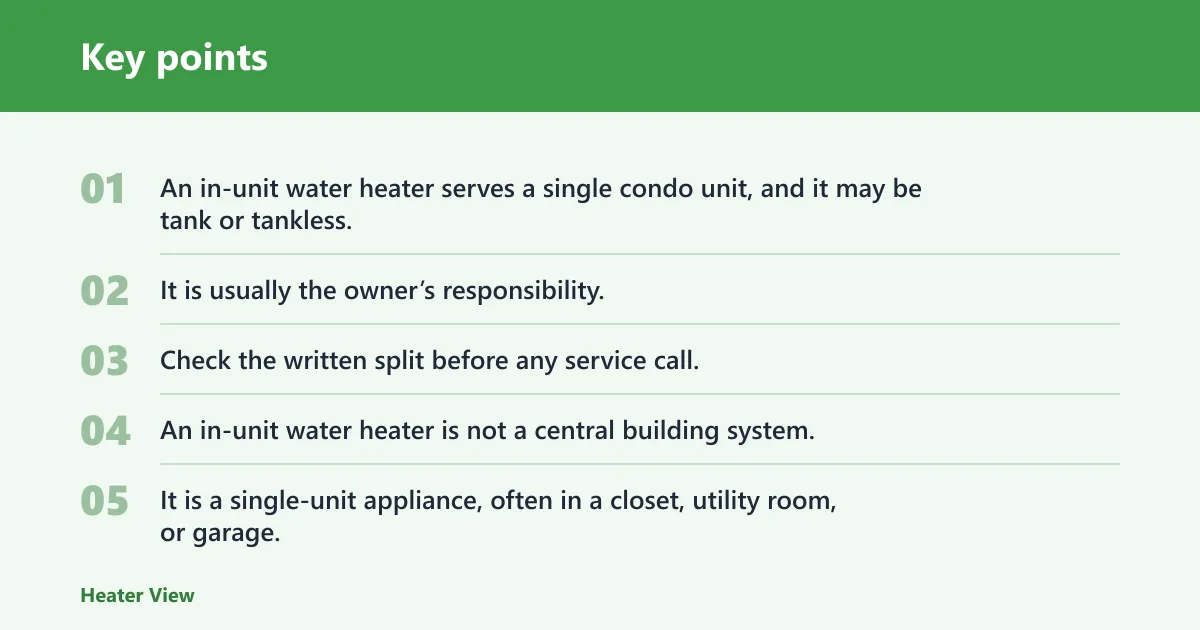
An in-unit water heater serves a single condo unit, and it may be tank or tankless. It is usually the owner’s responsibility, but condo CC&Rs and building rules can shift duties for vents, flues, penetrations, drain pans, or leak controls. Check the written split before any service call.
What an in-unit water heater is
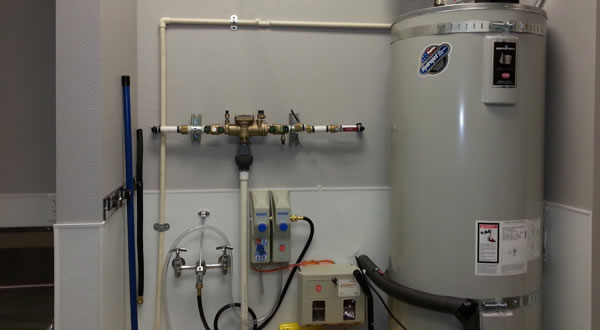
An in-unit water heater is not a central building system. It is a single-unit appliance, often in a closet, utility room, or garage, and it may be electric or gas. That location changes access, noise, and leak risk, because a small failure can spread to floors, cabinets, and neighboring units fast.
Why condos change the maintenance picture
Condos add shared walls, shared framing, and often shared building penetrations. A leak that starts in one unit can move into another before it is seen. Access may also be limited by locked closets, lease terms, or association rules, so maintenance has to fit the building’s process, not just the appliance.
How CC&Rs affect responsibility
CC&Rs usually determine who pays, who approves access, and whether certain parts count as unit items or common elements. They may require a drain pan, leak sensor, or specific discharge routing. If you do not have that document handy, get it before scheduling service or replacing parts.
Who handles each maintenance task?
Most in-unit work is often the owner’s responsibility, but some items may fall to the HOA or a plumber because they involve common elements, code-sensitive parts, or gas venting. Use the responsibility split in your CC&Rs first, then confirm with the association before changing anything that crosses a wall, ceiling, or roof line.
Condo water heater maintenance responsibility matrix
| Task | Usually responsible | Emergency shutoff step | Red-flag findings | Save this record |
|---|---|---|---|---|
| Monthly leak check, visual corrosion check, access check | Owner | Shut off cold water if leaking | Rust stains, active dripping, blocked access | Photos, date, notes |
| Flush sediment from tank heater | Owner or plumber, depending on access and skill | Shut off water; for electric, turn off breaker; for gas, set control to off or pilot | Cloudy discharge, heavy grit, valve will not close | Service receipt, date, any water-quality notes |
| Inspect anode rod | Plumber | Shut off water and heater before service | Heavy wear, corrosion at tank top | Service report, part condition, replacement note |
| T&P valve and discharge pipe check | Plumber; HOA if discharge route is a common element | Shut off water; shut off power or gas if advised | Valve drips, stuck valve, pipe ends in unsafe place | Inspection record, photos, repair invoice |
| Drain pan and drain routing | Owner for in-unit hardware; HOA if building rule controls the route | Shut off water if active leak appears | Pan holds standing water, no drain path, cracked pan | Photos, HOA rule, permit or install record |
| Expansion tank | Plumber | Shut off water and heater before service | Waterlogged tank, pressure surges, repeated T&P discharge | Pressure notes, invoice, warranty paper |
| Gas vent or flue where it passes through the building shell | HOA or common-element contractor; plumber for appliance-side work | For gas odor or unsafe exhaust, stop use and call for help | Loose vent, soot, corrosion, smell of exhaust | Association approval, contractor report |
| Leak detector or automatic shutoff valve | Owner, unless CC&Rs require HOA standard equipment | Follow device instructions; stop supply automatically if present | Sensor low battery, inactive alarm, no coverage under tank | Install date, model, battery or test log |
Tasks that are usually owner duties
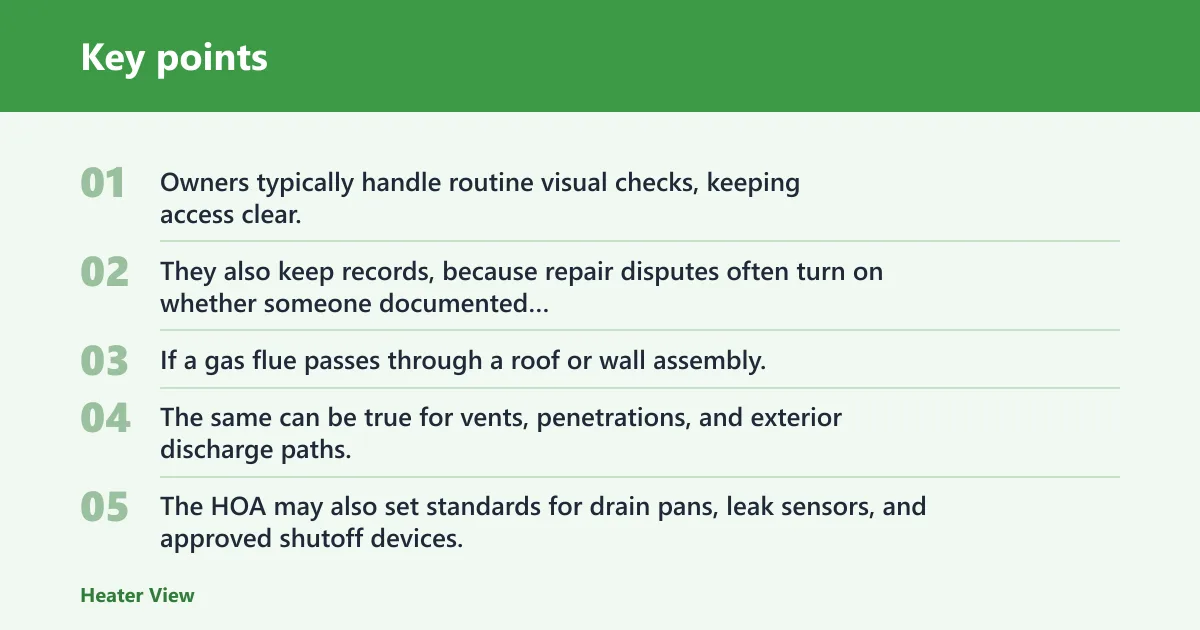
Owners typically handle routine visual checks, keeping access clear, reporting leaks fast, and arranging service for the appliance inside the unit. They also keep records, because repair disputes often turn on whether someone documented a problem before water escaped beyond the closet floor.
Tasks that may involve the HOA or a common element
If a gas flue passes through a roof or wall assembly, that portion may be a common element. The same can be true for vents, penetrations, and exterior discharge paths. The HOA may also set standards for drain pans, leak sensors, and approved shutoff devices.
What should you check during routine maintenance?
Routine condo maintenance should focus on leaks, corrosion, loose fittings, noise, sediment, and access, because those problems lead to water damage faster than a slow loss in efficiency. A monthly visual check and periodic professional service catch more than normal wear in a tight condo utility space.
Leaks, corrosion, and loose fittings
Look for moisture at the base, rust on the tank jacket, green or white mineral marks on fittings, and damp insulation or drywall near the closet. Any water line drip deserves attention, since even a small leak can soak adjacent walls before the stain becomes obvious.
Sediment, noise, and water quality signs
Tank heaters are especially prone to sediment buildup, and hard water makes the problem worse. Popping or rumbling noise, cloudy discharge during flushing, and reduced hot-water output are common warning signs. Sediment can reduce efficiency and increase stress on tank parts.
Access, clearances, and shutoff access
Do not stack storage in front of the heater. You need clear access to the cold-water shutoff, power disconnect, or gas control, plus the T&P valve and drain pan. If the panel is blocked, an emergency takes longer and the damage footprint grows.
Which parts matter most in a condo water heater?
The parts that matter most are the ones tied to pressure, discharge, and leak containment. In a condo, those parts matter more because failure can move into a neighboring unit or common area before anyone sees the source. The safety chain starts with the T&P valve and ends with a safe drain path.
T&P valve and discharge pipe
The temperature and pressure relief valve opens if the tank gets too hot or pressurized. Its discharge pipe must go somewhere safe. If that pipe is capped, bent, corroded, or emptying into a risky spot, the system is not doing its job and a plumber should inspect it.
Drain pan and leak detector or automatic shutoff valve
A drain pan can catch small leaks under a tank, and some associations require one. A leak detector or automatic shutoff valve adds another layer by warning you or stopping supply early. These devices are especially useful when the heater sits above finished flooring or shared ceilings.
Expansion tank, anode rod, and vent or flue
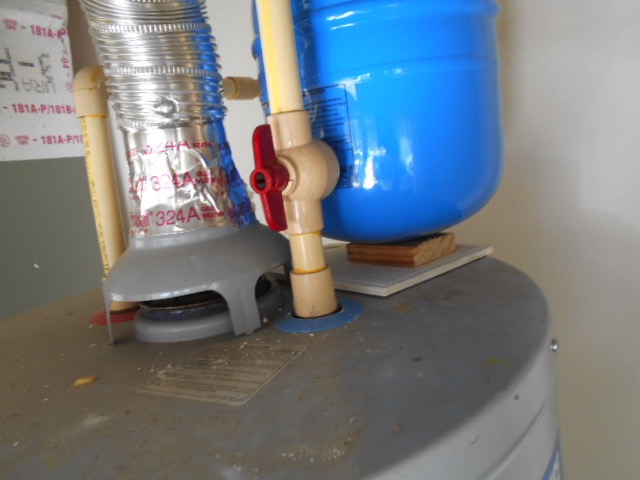
An expansion tank absorbs pressure changes and is often required by local code in some setups. The anode rod helps limit tank corrosion and is usually inspected during service. For gas heaters only, the vent or flue must move exhaust safely outside, and roof-related portions may be common elements.
How do you handle a leak or safety problem now?
If a condo water heater leaks, the first response is to stop the water source, then stop power or gas, then alert the right people. The order matters because water spreads quickly and can damage nearby units, while a hot or pressurized tank can create a safety hazard if left active.
First 5 minutes
Shut off the cold water supply first. For electric heaters, turn off power at the breaker. For gas heaters, set the control to off or pilot. If water is near outlets, flooring, or a ceiling below, keep people away from the area.
First 30 minutes
Move stored items out of the way, place towels or a bucket only if it is safe, and take photos of the leak source, the pan, and any damage path. Notify the HOA if the leak may affect a common element, a neighboring unit, or a shared vent or penetration.
Same-day follow-up with HOA, plumber, and insurer
Call a plumber if the shutoff does not stop the leak, the T&P valve keeps discharging, or you hear boiling, popping, or hissing from the tank. Contact your insurer if water reached flooring, drywall, cabinets, or another unit. Save the CC&Rs, repair notes, and all photos.
Simple leak-response order
- Shut off cold water supply.
- Turn off breaker for electric or set gas control to off or pilot.
- Check whether water is entering the drain pan or spreading beyond it.
- Notify the HOA if common elements or another unit may be affected.
- Call a plumber and document the scene.
- Contact insurance the same day if there is any visible damage.
What does condo-specific preventive care look like?
Preventive care in a condo is about reducing damage paths, not only improving heater efficiency. That means the right service depends on heater type, unit location, access limits, and building rules. The best upgrades often involve sensors, pans, and shutoff devices rather than a long list of generic tune-up items.
Tank versus tankless maintenance priorities
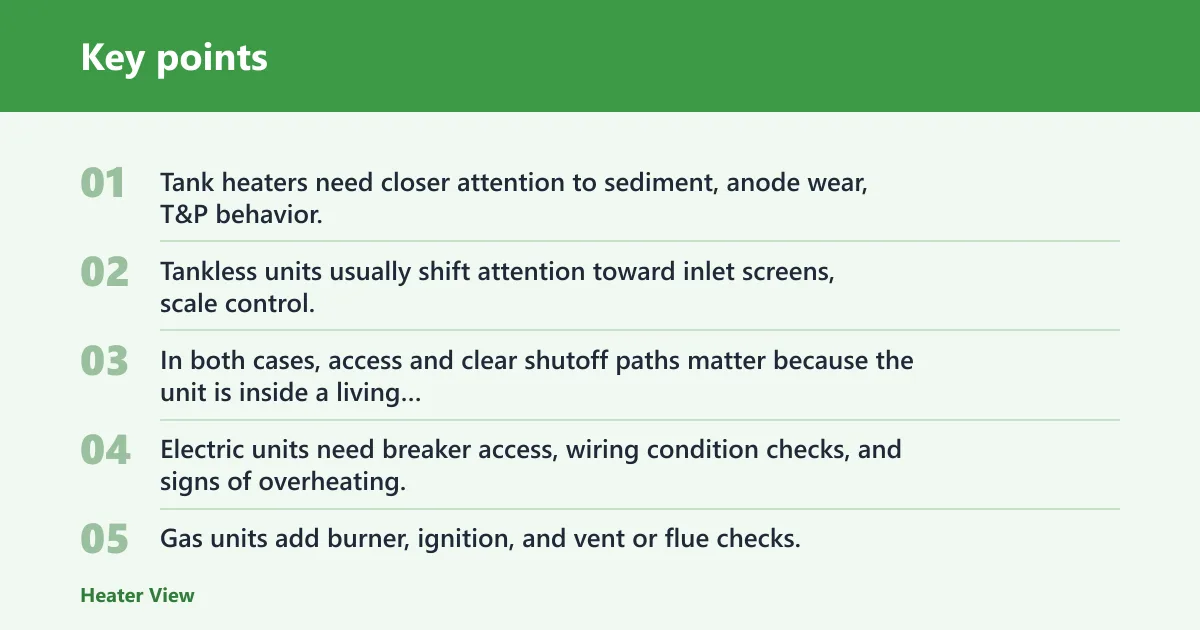
Tank heaters need closer attention to sediment, anode wear, T&P behavior, and pan drainage. Tankless units usually shift attention toward inlet screens, scale control, and manufacturer service requirements. In both cases, access and clear shutoff paths matter because the unit is inside a living structure, not a detached mechanical room.
Electric versus gas checks
Electric units need breaker access, wiring condition checks, and signs of overheating. Gas units add burner, ignition, and vent or flue checks. Do not treat them the same. A gas heater in a tight closet also needs safe exhaust routing, and some vent sections may sit under HOA control.
Sensors, pans, and shutoff devices that reduce damage
For condo owners, leak detectors and automatic shutoff valves can be worth more than a cosmetic repair after a flood. A drain pan should direct water to a safe location if the building design allows it. If a rule requires one, treat that as part of the maintenance plan, not an optional add-on.
Say your 40-gallon electric tank sits in a laundry closet above engineered flooring. A slow inlet fitting leak may drip into a pan for hours before anyone notices. A leak sensor on the pan floor can flag the problem early, which is far cheaper than replacing cabinets and underlayment.
Condo water heater maintenance and replacement costs
Routine service is usually far cheaper than emergency repair or replacement, but condo owners should also factor in likely damage to finishes, neighboring units, and association claims. A tank heater commonly expected to last roughly a decade may be better replaced than repeatedly patched, especially after rust, repeated leaks, or a failing valve.
Routine service versus emergency repair
Routine service usually covers inspection, flushing if allowed, valve checks, and basic parts review. Emergency repair rises fast when water has reached flooring, drywall, or another unit. In a condo, the hidden cost is often the damage path, not the appliance part alone.
When age and repeat repairs point to replacement
If a tank heater is near the age range where many are expected to fail, and you are already seeing corrosion, sediment noise, or recurring T&P discharge, replacement may be the safer option. Repeated repairs on a worn tank can cost more than a controlled swap with updated leak protection.
What records to keep for warranty and insurance
Keep the CC&Rs, any HOA maintenance rules, service invoices, serial number photos, warranty papers, inspection notes, leak photos, and proof of sensor or shutoff-device installation. If the HOA asks for contractor approval or specific parts, keep that too. Documentation matters when responsibility is disputed.
Frequently asked questions
How do I maintain a water heater in a condo?
Start with monthly visual checks for leaks, rust, and access issues, then schedule periodic professional service for tank flushing, valve checks, and worn-part inspection. In a condo, you also need to confirm CC&Rs, keep the shutoff clear, and add leak detection if the building allows it.
Does a condo water heater need maintenance?
Yes. An in-unit water heater still needs regular maintenance, and condo conditions make neglect more expensive because leaks can spread beyond your unit. The most useful work is routine inspection, sediment control for tank heaters, and fast replacement of parts that show wear.
How often should you service a water heater in a condo?
A practical approach is monthly visual checks and periodic professional service based on heater type, water quality, age, and local rules. Many tank heaters benefit from at least annual attention if access is allowed and the drain valve works, but the CC&Rs or manufacturer may call for more.
Who is responsible for a condo water heater leak?
Responsibility depends on the CC&Rs, the source of the leak, and whether the problem is inside the unit or tied to a common element. The owner is often responsible for an individual in-unit heater, while the HOA may handle common-element vents, flues, or penetrations.
What parts are checked during condo water heater service?
A plumber usually checks the tank or tankless unit body, fittings, T&P valve, discharge pipe, drain pan, expansion tank, anode rod on tank systems, and gas venting on gas units. Service should also confirm that the cold-water shutoff, breaker, or gas control is easy to reach.
Should I shut off power and water before water heater maintenance?
Yes. Shut off the cold water supply first, then cut power at the breaker for electric units or set the gas control to off or pilot for gas units before maintenance. That reduces the chance of scalding, electrical shock, or a running burner during service.