Best Water Heater for High-Demand Households
For a high-demand household, choose the water heater by your worst 30-minute hot-water load, size it for the simultaneous fixtures you run, then verify recovery rate and fuel cost. Undersizing means cold showers, slow tub refills, and a unit that never catches up. This guide compares tank, tankless, heat pump, and hybrid options by peak demand, recovery speed, operating cost, and installation fit.
Choose by peak demand, not category
Hot-water comfort in a large home is usually decided in the same short window every day. Two showers, a dishwasher cycle, and a laundry fill can overwhelm a unit that looks fine on paper. Start with simultaneous use, then check recovery and operating cost.
What the household’s worst 30 minutes looks like
Focus on the busiest overlap, not the full day. A home with back-to-back showers and a sink running can drain a tank faster than a smaller home with more total daily gallons but less overlap. That is why the best water heater for high-demand households is the one that matches the peak pattern, not just total capacity.
How simultaneous use changes the right size
Tank models are judged by first-hour rating, which is the DOE measure for hot water delivered in one hour. Tankless models are judged by GPM, because their output depends on flow and temperature rise. Those are different sizing tools. Use the one that matches the heater type.
Why recovery speed matters as much as capacity
A larger tank can still disappoint if recovery is slow. In a big household, a unit must refill usable hot water fast enough to handle the next demand spike. That is why gas often fits heavy-use homes well, and why a heat pump unit can be a poor fit if you need fast back-to-back delivery in a tight space.
📊 Stiebel Eltron Electric Tankless Water Heater is listed at 5 GPM. Source: Best Water Heaters (2026).
Water heater comparison table
This table gives the quick comparison most buyers need first. It keeps the decision tied to peak demand, efficiency, and fit, because those are the trade-offs that matter most in a larger home.
| Type | How it handles high demand | Key sizing metric | Efficiency signal | Fit and utility notes |
|---|---|---|---|---|
| Gas tank water heater | Strong recovery and solid one-hour delivery | First-hour rating | UEF varies by model | Needs venting and gas access; often best for stacked morning use |
| 240-volt electric tank water heater | Simple replacement for many homes, but recovery depends on element size | First-hour rating | UEF varies by model | Common in 40- or 50-gallon formats; breaker and wiring must match |
| Tankless water heater | Continuous output if flow and temperature rise stay within limits | GPM | Often higher than tanks | Needs gas line or electrical capacity; flow drops as temperature rise climbs |
| Heat pump water heater | Lower operating cost, but slower recovery than gas | Tank size plus UEF | Usually 2-3x more efficient than conventional electric | Needs enough space for surrounding air and drainage |
Two listed tankless examples show the range buyers see: one electric model is listed at 5 GPM, and one gas model is listed at 6.5 GPM. Those numbers only help when you pair them with incoming water temperature and the number of fixtures you want running at once.
How much hot water do you need?
For a high-demand household, size the heater against the simultaneous fixtures you expect to run, not against average daily use. A shower, a dishwasher, and a laundry fill can push a system past its comfort zone if the unit was chosen only by bedroom count. That is where first-hour rating and GPM matter most.
1-2 bathrooms and staggered showers
Homes with one or two bathrooms can often do well with a properly sized tank, especially if showers are usually staggered. A 240-volt electric tank water heater is often the simplest replacement path if the breaker and wiring already match. A gas tank model can be better if you want quicker refill between uses.
3+ bathrooms and back-to-back use
Three or more bathrooms raise the chance that showers overlap. In that case, the best choice is usually a gas tank with strong recovery or a tankless unit sized for the required temperature rise. If the home has a weak utility supply or limited venting, a large tank may still beat an undersized tankless unit.
Soaking tubs, laundry, and dishes at once
A soaking tub changes the math fast. Tub fill plus a shower plus a dishwasher can outrun a modest tank. A common mistake is choosing a large tank but overlooking how quickly it can reheat for back-to-back showers and laundry. That can lead to a hot bath that starts fine and ends lukewarm before the tub is full.
Suppose a household runs two showers while a washer fills and the dishwasher starts. If the heater cannot keep the outgoing flow hot at that exact overlap, the problem shows up immediately as cooler showers or a tub that takes too long to finish. Peak demand exposes weak sizing.
Minimum first-hour rating or GPM targets
Use these as starting points, not universal rules. For tank heaters, a household with 1-2 bathrooms and staggered use should look for a first-hour rating that comfortably covers the morning overlap. For 3+ bathrooms or tub-heavy homes, aim higher. For tankless, match the simultaneous fixture load in GPM and adjust for temperature rise, because usable flow falls as the required heat rise goes up.
- 1-2 bathrooms: tank model with a first-hour rating that covers one shower plus a second short draw, or a tankless unit sized for one shower at a time.
- 3+ bathrooms: gas tank or gas tankless with enough output for overlapping showers.
- Soaking tub priority: favor strong first-hour output, or a tankless unit sized well above the tub fill flow.
- Back-to-back showers: favor fast recovery, especially in gas or heat pump systems with enough capacity.
Which heater type fits a big household?
The right type depends on whether your main problem is recovery, utility cost, or physical fit. Gas usually wins on recovery. Heat pump units usually win on electric operating cost. Tankless can work well when the utility supply and temperature rise allow enough flow for simultaneous fixtures.
Gas water heaters for strong recovery
Gas water heaters fit high-demand homes because they refill hot water quickly. They also tend to deliver strong first-hour performance, which helps when mornings are stacked with showers. Natural gas and propane versions both exist, but the right one depends on what the home can already supply.
240-volt electric tank water heaters for simple replacement
A 240-volt electric tank water heater is often the least disruptive replacement when the home already has the right breaker and wiring. Many 240-volt electric tank water heaters are commonly sold in roughly 40- to 50-gallon sizes. The trade-off is recovery speed. If the household regularly stacks loads, a standard electric tank may struggle more than a gas unit.
Tankless water heaters for continuous output
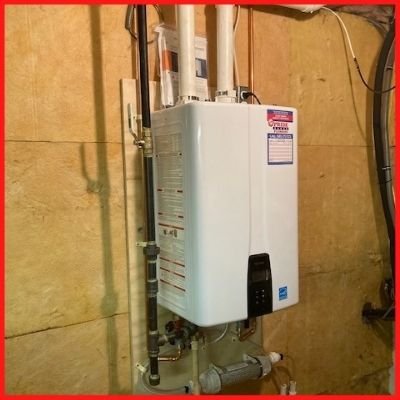
Tankless water heaters, also called on-demand or instant water heaters, heat water as it flows through the unit. That means continuous output, not stored volume. The limit is still real: at higher temperature rise, usable GPM drops. One electric model is listed at 5 GPM, and one gas model is listed at 6.5 GPM, which shows why flow math matters.
Heat pump water heaters for lower operating cost
Heat pump water heaters pull heat from surrounding air and are typically 2-3x more efficient than conventional electric water heaters. That can cut electricity use sharply in homes with enough space and the right setup. The trade-off is slower recovery than gas, so they suit big families best when the home can tolerate that pace.
Water heater sizing matrix
This decision matrix translates common household patterns into a practical starting point. It is meant to narrow the field fast, then you verify local utility availability, fit, and installer requirements before buying.
| Household scenario | Recommended heater type | Minimum target | Likely utility type | Main reason it wins |
|---|---|---|---|---|
| 1-2 bathrooms, staggered showers | 240-volt electric tank or gas tank | Tank: first-hour rating sized for one busy morning; tankless: around 5 GPM if only one major draw runs at a time | Electric or gas | Simple sizing and enough hot water without overspending on unused capacity |
| 3+ bathrooms, back-to-back showers | Gas tank or gas tankless | Tank: high first-hour rating; tankless: around 6.5 GPM or more, depending on temperature rise | Natural gas or propane | Fast recovery and better support for overlapping fixture use |
| Soaking tub priority | Gas tank or oversized tankless | Tank: high first-hour rating; tankless: enough flow to fill the tub while another fixture runs | Gas preferred | Continuous fill or large first-hour delivery helps avoid a lukewarm tub |
| Low energy-cost home with room for equipment | Heat pump water heater | Choose tank size for demand, then compare UEF | Electric | Lower operating cost than conventional electric in a space that can support it |
| High energy-cost home | Heat pump or efficient gas tank | Balance UEF against recovery speed and local rates | Electric or gas | Operating cost matters more when utility rates are high |
What efficiency and operating cost matter?
Efficiency matters most in homes that use a lot of hot water every day. UEF lets you compare models across categories, but it does not tell the whole story by itself. A lower-UEF unit that recovers quickly can still fit a high-demand home better than a slower, more efficient unit that cannot keep up.
How UEF compares models
UEF is the efficiency metric used to compare water heaters, and higher is better. One listed electric tank model has a UEF of 0.93, which is a useful reminder that efficient tanks exist, even before you move into heat pump territory. Compare UEF only after you have checked whether the unit can actually meet your peak demand.
Why gas often wins on recovery
Gas units often perform well in households that stack showers and tub fills because they recover hot water quickly. That matters more than raw capacity when the home needs hot water again before the first tank has fully refilled. Strong recovery is a comfort feature, not just a technical one.
When heat pump units cut electricity use
Heat pump water heaters are a strong choice when the household has enough room and wants lower electric operating cost. They use surrounding air, so placement matters. Put them where they can breathe and drain properly. In a cramped closet, that same efficiency advantage can become a space problem.
When tankless does and does not save money
Tankless units often use less energy than a traditional tank water heater, and that can help in homes with variable use patterns. But savings are not automatic. If the home needs a large amount of hot water at once, you may need a bigger gas service, a stronger electrical circuit, or a second unit, which changes the cost equation.
Choose gas tank water heater if… / Choose heat pump water heater if…
These two options solve different problems. Gas tank units are about speed and recovery. Heat pump units are about cutting electric operating cost when space and recovery pace are acceptable. Pick the one that matches the home’s hardest hour, not the one with the best brochure number.
Choose gas tank water heater if…
Choose gas tank water heater if your mornings involve overlapping showers, a tub fill, or frequent back-to-back use. Choose it if you want strong first-hour output and quick recovery. Choose it if the home already has gas access and proper venting. It is often the safer pick for large households that cannot afford cold-water interruptions.
Choose heat pump water heater if…
Choose heat pump water heater if you have enough open space, can handle the extra height and airflow needs, and want lower electric operating cost. Choose it if the home’s demand is high but not so stacked that recovery speed becomes the main problem. It fits best where utility bills matter more than instant refill speed.
Fit checks before you buy
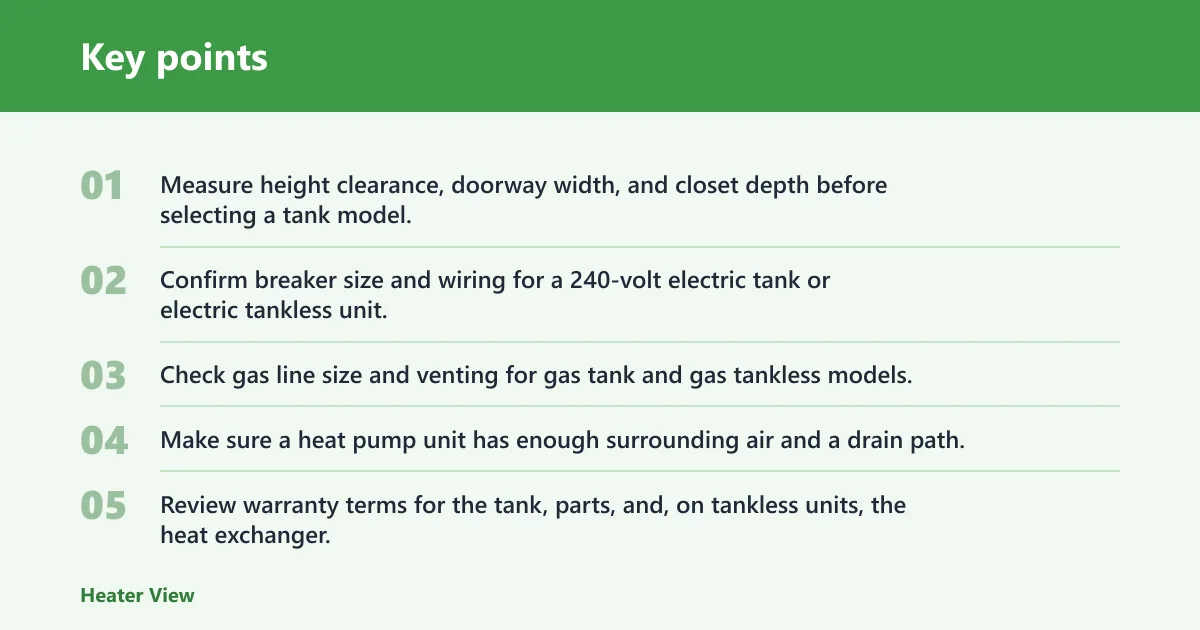
- Measure height clearance, doorway width, and closet depth before selecting a tank model.
- Confirm breaker size and wiring for a 240-volt electric tank or electric tankless unit.
- Check gas line size and venting for gas tank and gas tankless models.
- Make sure a heat pump unit has enough surrounding air and a drain path.
- Review warranty terms for the tank, parts, and, on tankless units, the heat exchanger.
Warranty terms matter more in high-use homes because wear shows up faster. Tank coverage tells you how the vessel is protected. Parts coverage affects repairs after controls or sensors fail. For tankless units, heat exchanger coverage is especially important because that is the part doing the continuous heating work.
Picture a 3-bathroom home where two showers start within minutes of each other and the water heater sits in a narrow closet. If the new unit is too tall for the clearance, or the venting path is wrong, the best-performing model on paper is the wrong buy in practice.
Frequently asked questions
What is the most economical water heater?
The most economical water heater depends on both utility rates and usage pattern. Heat pump water heaters usually win on electric operating cost when space allows. Gas tank units can be economical in high-demand homes when fast recovery avoids oversizing or backup equipment. The cheapest unit to buy is not always the cheapest to run.
What size water heater do I need for a high-demand household?
Size it to the household’s peak overlap. For tanks, use first-hour rating as the main guide. For tankless, use GPM at your required temperature rise. A home with 1-2 bathrooms may be fine with a midrange tank or a single tankless unit, while homes with 3 or more bathrooms often need stronger recovery or higher capacity.gher flow.
Is a tankless water heater enough for a family with multiple bathrooms?
Yes, if the unit is sized for simultaneous use and the temperature rise is realistic for your climate and plumbing layout. A tankless unit can fail a large household if shower flow, tub fills, and laundry overlap beyond its rated GPM. High-demand homes often need a larger gas model or a second unit.
Should I choose gas, electric, hybrid, or heat pump for high hot-water use?
Choose gas if recovery speed is the top need. Choose 240-volt electric if you want a simpler replacement and already have the right circuit. Choose heat pump if electric operating cost is the priority and the space can support it. Choose tankless when continuous output and fit make more sense than stored volume.
How many GPM do I need for showers, laundry, and dishes at once?
Start by adding the simultaneous fixture flows, then adjust for temperature rise. A single shower can use a large share of a tankless unit’s flow allowance, and adding laundry plus dishes can push the system over the edge. The higher the incoming-water temperature gap, the lower the usable GPM becomes.
Is a heat pump water heater good for a big family?
It can be, if the family’s usage is heavy but not tightly stacked and the home has enough space for the unit to pull in surrounding air. Heat pump water heaters are efficient, but they are usually slower to recover than gas. Big families with back-to-back showers may still prefer gas.
What features matter most in a water heater for a large household?
The main features are first-hour rating, GPM for tankless units, UEF, recovery speed, warranty terms, and fit. Also check doorway width, height clearance, venting, drain access, and breaker or gas requirements. In a large household, the right installation details matter almost as much as the heater itself.